
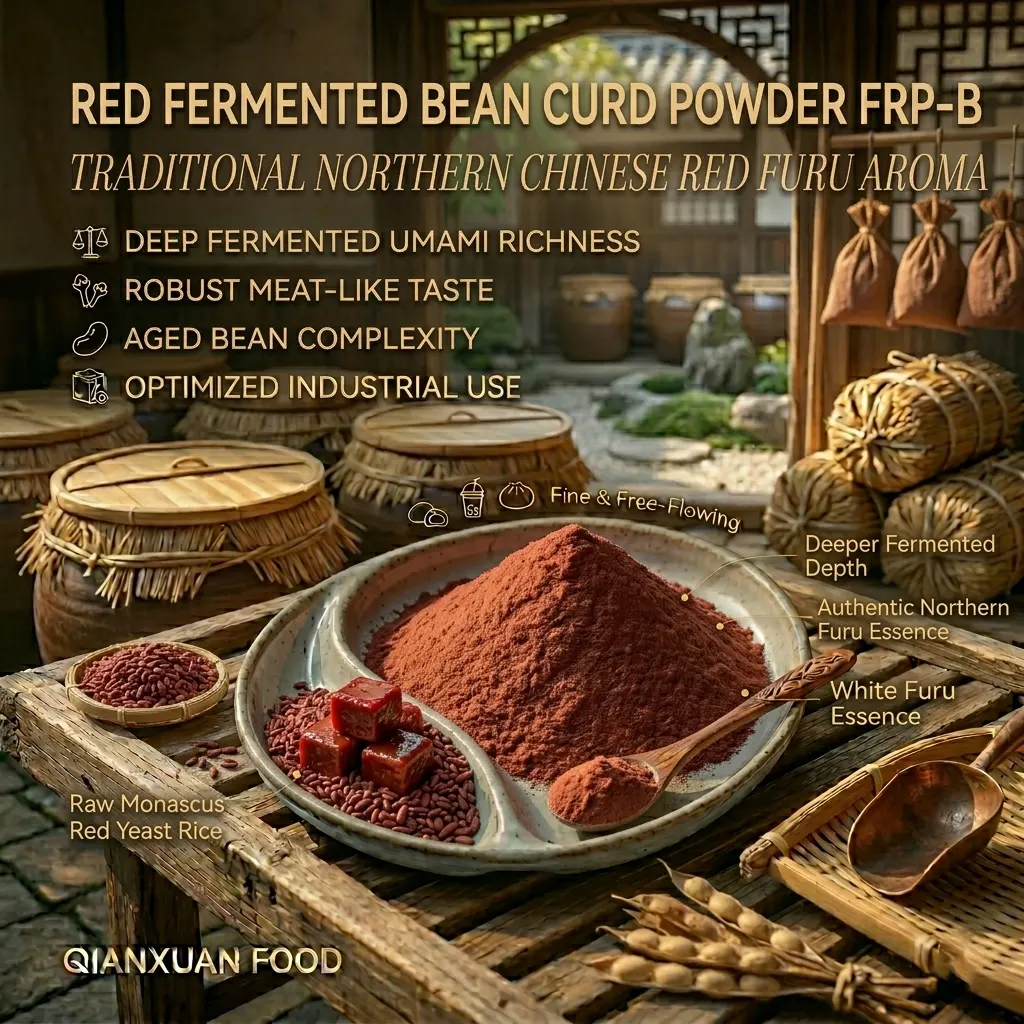
Red Fermented Bean Curd Powder FRP-B for Authentic Northern Chinese Fermented Umami Flavor
When people talk about traditional Chinese fermented flavors, spicy doubanjiang and soy sauce are usually the first ingredients that come to mind.
But in Northern China, another fermented ingredient has quietly shaped savory cooking for generations — red fermented bean curd.
Compared with ordinary white fermented tofu, red fermented bean curd carries a much deeper aroma profile. It is richer, slightly wine-like, more savory, and noticeably more layered after cooking. In many traditional dishes, especially braised meats, hot pot dipping sauces, barbecue marinades, and regional noodle toppings, red fermented bean curd acts almost like a hidden flavor engine behind the dish.
That traditional fermented complexity is exactly what inspired our Red Fermented Bean Curd Powder FRP-B.
Developed from traditional Northern Chinese red fermented bean curd and processed through blending, sterilization, and spray drying technology, FRP-B transforms classic fermented tofu flavor into a stable industrial powder suitable for modern food manufacturing systems.
Compared with smoother white fermented bean curd systems such as
Fermented Bean Curd Powder FRP-A,
FRP-B delivers stronger fermented depth, darker savory notes, and more recognizable regional Chinese flavor identity.
The Traditional Background of Red Fermented Bean Curd
Red fermented bean curd has long been associated with Northern Chinese home-style cooking and traditional savory sauces.
Historically, tofu cubes were fermented under controlled conditions with red yeast rice and seasoning systems, gradually developing their characteristic reddish appearance and complex umami aroma.
What makes red fermented bean curd unique is not simply saltiness.
Its flavor profile combines:
- Deep fermented soybean aroma
- Rich savory umami
- Subtle wine-like notes
- Mellow aged-bean character
- Lingering cooked-meat perception
- Slightly sweet fermented undertones
This layered flavor structure is one reason why red fermented bean curd works exceptionally well in meat applications, hot pot systems, barbecue sauces, and traditional Chinese savory foods.
Why Red Fermented Flavor Systems Are Growing Again
Interestingly, many modern food trends are now moving back toward regional authenticity and fermentation-based flavor development.
Consumers increasingly prefer foods that feel:
- Traditional
- Culinary-inspired
- Slow-cooked
- Fermentation-driven
- Naturally savory
That shift has created new demand for ingredients capable of reproducing authentic Chinese fermented flavor profiles in industrial food systems.
Red fermented bean curd is particularly valuable because it creates savory richness without relying entirely on artificial flavor enhancers.
For manufacturers, FRP-B helps build:
- More authentic braised-meat flavor perception
- Richer hot pot soup bases
- Traditional Chinese barbecue seasoning
- Deeper savory snack coatings
- More layered instant noodle seasonings
In many applications, even relatively low dosage levels can noticeably improve overall umami depth and “cooked flavor” perception.
How FRP-B Differs from FRP-A
Although both products belong to the fermented bean curd powder series, their positioning is intentionally different.
FRP-A focuses more on:
- Smooth white fermented tofu aroma
- Milder savory balance
- Creamier mouthfeel
- Lighter fermented character
FRP-B, by contrast, is designed around:
- Stronger fermented depth
- Traditional red bean curd identity
- Darker savory richness
- More robust regional Chinese flavor
- Better performance in meat-oriented applications
That difference makes FRP-B especially suitable for stronger savory systems requiring more recognizable fermented character after cooking.
Production Process and Industrial Advantages
Traditional red fermented bean curd is highly flavorful but difficult to manage in industrial manufacturing because of refrigeration requirements, moisture instability, and transportation limitations.
FRP-B solves these challenges through advanced powder processing technology.
The production process includes:
- Selection of fermented bean curd raw materials
- Controlled blending
- Homogenization
- Sterilization treatment
- Spray drying technology
This allows manufacturers to achieve stable fermented flavor performance while significantly improving handling efficiency.
Compared with paste-style fermented tofu systems, FRP-B offers:
- Longer shelf life
- Easier transportation
- Improved dry blending capability
- Lower storage complexity
- Better industrial dosage control
- Higher production efficiency
- More consistent batch performance
For large-scale seasoning factories and prepared food manufacturers, these operational advantages are extremely important.
Main Application Areas
Hot Pot Bases
FRP-B performs especially well in spicy hot pot and savory soup base systems where deep fermented richness is needed to create stronger body and mouthfeel.
Chinese Barbecue and Marinade Systems
The reddish fermented aroma works naturally with roasted meat applications, barbecue sauces, and traditional Chinese-style marinades.
Instant Noodle Seasonings
Manufacturers can use FRP-B to create more authentic regional noodle flavor systems with deeper savory complexity.
Savory Snack Coatings
Fermented savory snacks continue growing in popularity. FRP-B helps create stronger “cooked-food” flavor perception in chips, crackers, coated nuts, and puffed snacks.
Prepared and Frozen Foods
Suitable for braised products, frozen meals, savory fillings, and meat-style prepared food systems.
Recommended Dosage
Typical application dosage ranges between 0.3%–5% depending on flavor intensity requirements and product category.
Actual dosage may vary according to:
- Salt level
- Oil system
- Heating process
- Regional flavor preference
- Application type
Related Fermented Flavor Products
Manufacturers often combine FRP-B with other fermented and savory ingredients to build more layered regional seasoning systems.
- Fermented Bean Curd Powder FRP-A
- Pixian Doubanjiang Powder SP-C
- Pixian Doubanjiang Powder SP-CA
- Yongchuan Douchi Powder LSP-A
- Yongchuan Douchi Powder LSP-B
- Japanese Miso Powder MS-A
- Garlic Chili Sauce Powder SP-D
- Bean Paste Powder SP-A
- Bean Paste Powder SP-B
- Sweet Bean Paste Powder SFFP-A
- Sweet Bean Paste Powder SFFP-C
Explore more ingredient categories:
- Fermented Paste Powders
- Soy Sauce Powders
- Vinegar Powders
- Hydrolyzed Vegetable Protein (HVP)
- Compound Seasoning Powders
- Natural Plant Extracts
Learn More About Fermented Paste Powders
Fermented paste powders are widely used in snack seasonings, instant noodles, sauces, dry soup blends, and savory food formulations. Learn more about their production methods, flavor profiles, and industrial applications in our complete fermented paste powder guide.
Quality Management and Industrial Supply Support
At Qianxuan Food, we understand that industrial savory systems require far more than strong flavor alone. Consistency, manufacturing stability, export support, and formulation compatibility are equally important.
Our production systems focus on:
- Controlled raw material sourcing
- Stable manufacturing processes
- Batch consistency management
- OEM customization support
- Export-oriented production capability
- Application-focused formulation assistance
We work with seasoning factories, instant food manufacturers, hot pot brands, catering suppliers, and international food developers across multiple global markets.
Why Manufacturers Choose Qianxuan Food
Many industrial fermented flavors become overly artificial after large-scale processing. Either the fermentation character disappears entirely, or the aroma becomes excessively sharp and unbalanced.
Our development philosophy is different.
We focus on preserving the recognizable identity of traditional fermented foods while improving industrial usability and production efficiency.
That includes helping manufacturers achieve:
- Better savory layering
- More authentic regional flavor profiles
- Stable industrial processing performance
- Improved cost-performance balance
- Customized compound seasoning development
For brands building premium Chinese-style savory foods, maintaining authentic regional flavor identity is becoming increasingly important in today’s competitive food market.
Industry References and External Resources
- Food Ingredients First
- Food Business News
- Institute of Food Technologists (IFT)
- Food and Agriculture Organization (FAO)
Frequently Asked Questions
What is red fermented bean curd powder used for?
Red fermented bean curd powder is commonly used in hot pot seasoning, barbecue sauces, savory marinades, instant noodles, snack coatings, and traditional Chinese-style savory foods.
How is FRP-B different from FRP-A?
FRP-B provides stronger fermented aroma, darker savory richness, and more robust regional Chinese flavor identity, while FRP-A focuses on smoother and milder white fermented tofu characteristics.
Can FRP-B be used in meat seasoning systems?
Yes. FRP-B performs especially well in roasted meat, barbecue, braised food, and meat-style savory applications because of its deep fermented umami profile.
Is FRP-B suitable for industrial manufacturing?
Yes. The spray dried powder format improves storage stability, handling efficiency, and compatibility with automated seasoning production systems.
Does Qianxuan Food provide OEM and customized flavor support?
Yes. We support OEM manufacturing, customized savory formulations, and application-focused seasoning development for global food manufacturers.
Reviews
There are no reviews yet.