
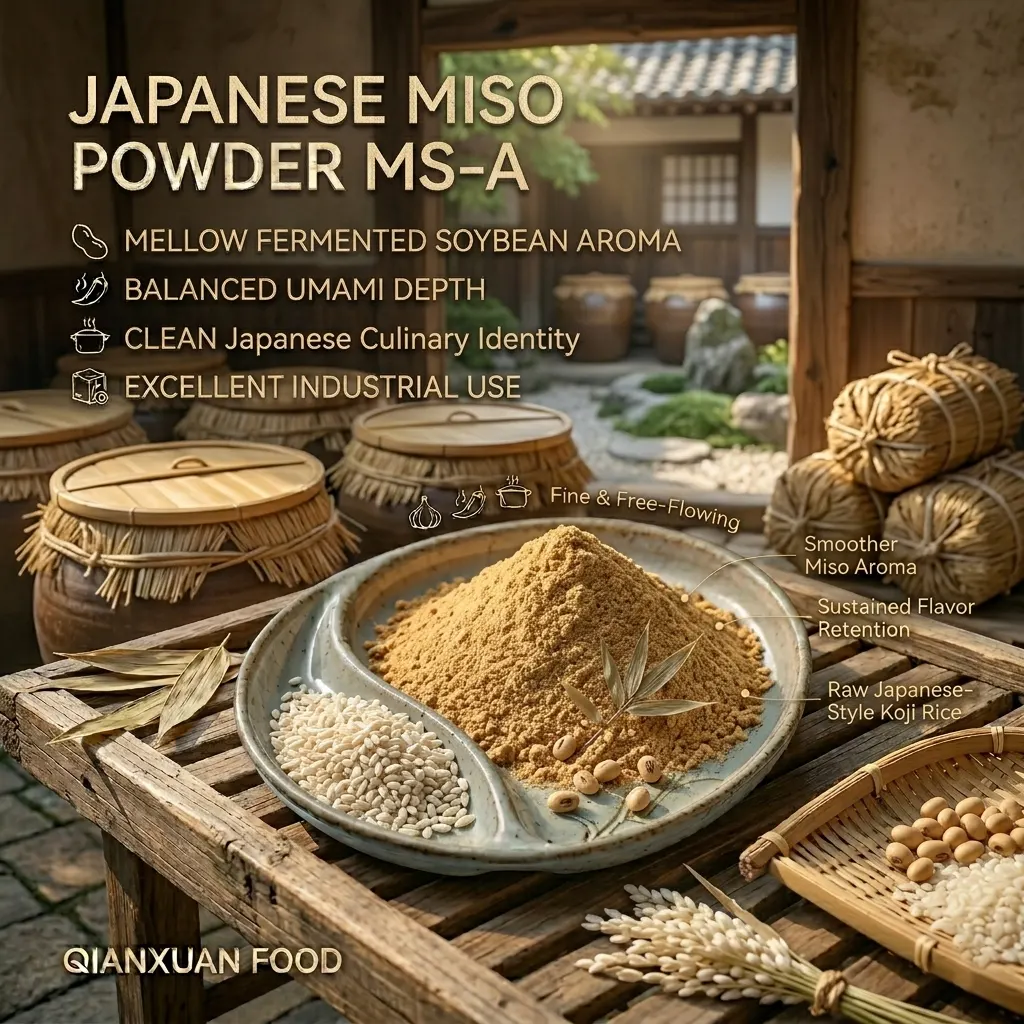
Japanese Miso Powder MS-A for Authentic Fermented Umami Applications
Some savory flavors announce themselves loudly.
Miso doesn’t.
Good miso works differently.
It builds slowly — soft at first, then deeper and warmer as the flavor opens across the palate.
There’s a certain roundness to it. A mellow fermented richness that feels comforting rather than aggressive.
That’s one reason why miso has remained such an important ingredient in Japanese cuisine for centuries.
And today, far beyond traditional soup applications, miso flavor is finding a new role in modern food manufacturing.
From plant-based meat to premium snacks, fusion sauces, instant noodles, frozen meals, and savory seasonings, manufacturers are increasingly using fermented soybean systems to create more natural umami depth and culinary authenticity.
Japanese Miso Powder MS-A was developed precisely for this shift.
It transforms traditional fermented miso flavor into a stable spray-dried powder while preserving the smooth savory character, subtle sweetness, and layered umami that make authentic miso so recognizable.
What Is Japanese Miso Powder MS-A?
Japanese Miso Powder MS-A is a fermented soybean seasoning powder produced through controlled fermentation, blending, sterilization, and spray drying technology.
Unlike sharper fermented ingredients that focus on intensity or pungency, MS-A is designed around balance and refinement.
The flavor profile emphasizes:
- Mellow fermented soybean aroma
- Rounded umami depth
- Soft natural sweetness
- Clean savory finish
- Warm fermented complexity
This softer and more elegant profile is one reason miso has become increasingly attractive in global savory product development.
It enhances flavor depth without overpowering the entire formulation.
The Culinary Heritage Behind Miso Flavor
Miso is deeply connected to Japanese food culture.
Traditionally made from soybeans, grains, salt, and koji fermentation, miso develops through a long maturation process that slowly builds amino acids, aroma compounds, and complex savory notes.
Different regions in Japan developed their own styles:
- Lighter sweet miso varieties
- Rich red miso systems
- Rice-based fermentation profiles
- Barley miso traditions
What all good miso styles share, however, is a layered umami character that feels smooth and naturally integrated rather than sharp or artificial.
That distinction matters more than ever today.
Modern consumers increasingly prefer savory systems that feel:
- Authentic
- Comforting
- Culinary-inspired
- Fermentation-based
- Less chemically aggressive
Miso fits perfectly into this direction.
Why Miso Powder Is Becoming More Important in Food Manufacturing
Traditional wet miso paste is flavorful, but from a manufacturing perspective it also creates operational limitations:
- High moisture content
- Storage instability
- Difficult dry blending
- Transportation inefficiency
- Shorter shelf-life management
Spray-dried miso powder solves many of these issues while preserving the core fermented flavor identity.
MS-A is produced through:
- Controlled soybean fermentation
- Flavor stabilization processing
- Ingredient blending systems
- Sterilization treatment
- Advanced spray drying technology
This creates a free-flowing powder with:
- Better industrial handling
- Improved batch consistency
- Dry seasoning compatibility
- Longer storage stability
- More flexible formulation applications
For seasoning manufacturers, these practical improvements are just as valuable as flavor performance itself.
The Flavor Characteristics of MS-A
Compared with stronger fermented bean systems such as
Yongchuan Douchi Powder LSP-A,
MS-A is noticeably softer, smoother, and more rounded.
Compared with spicy fermented systems like
Pixian Doubanjiang Powder SP-C,
miso powder focuses less on impact and more on harmony.
The sensory profile generally includes:
- Warm fermented soybean aroma
- Balanced savory richness
- Gentle sweetness
- Creamy umami perception
- Long but soft aftertaste
This profile makes MS-A highly versatile across both Asian and Western-style savory foods.
Recommended Food Applications
Instant Soup and Noodle Seasonings
Miso powder is widely used in soup sachets, ramen seasonings, and instant meal applications where smooth umami depth and comforting savory flavor are required.
Plant-Based Foods
One of the fastest-growing applications for miso powder today is plant-based meat and vegan savory systems.
Because fermentation naturally produces amino-acid richness, MS-A helps create more realistic cooked-food perception without relying solely on artificial flavor enhancers.
Savory Snacks
Miso-flavored chips, crackers, nuts, popcorn, and rice snacks have become increasingly popular globally, especially in premium snack positioning.
Sauce and Dressing Systems
MS-A performs well in powdered sauces, salad dressings, catering blends, and fusion seasoning systems requiring mellow savory depth.
Frozen and Prepared Foods
Suitable for ready meals, frozen entrees, microwave foods, and prepared savory fillings.
How MS-A Differs from Other Fermented Flavor Powders
- Garlic Chili Sauce Powder SP-D focuses on aromatic garlic-chili intensity, while MS-A emphasizes smooth fermented umami.
- Yongchuan Douchi Powder LSP-B provides stronger fermented black bean character, whereas MS-A delivers cleaner and more delicate savory balance.
- Pixian Doubanjiang Powder SP-CA contains chili-bean complexity, while MS-A remains softer and sweeter.
- Bean Paste Powder SP-B is more traditional Chinese savory-focused, while MS-A fits both Japanese and global fusion applications.
Related Product Links
- Bean Paste Powder SP-A
- Bean Paste Powder SP-B
- Pixian Doubanjiang Powder SP-C
- Pixian Doubanjiang Powder SP-CA
- Garlic Chili Sauce Powder SP-D
- Yongchuan Douchi Powder LSP-A
- Yongchuan Douchi Powder LSP-B
- Sweet Bean Paste Powder SFFP-A
- Sweet Bean Paste Powder SFFP-C
- Fermented Bean Curd Powder FRP-A
- Fermented Bean Curd Powder FRP-B
Explore More Ingredient Categories
- Fermented Paste Powders
- Soy Sauce Powders
- Vinegar Powders
- Hydrolyzed Vegetable Protein (HVP)
- Compound Seasoning Powders
- Natural Plant Extracts
Learn More About Fermented Paste Powders
Fermented paste powders are widely used in snack seasonings, instant noodles, sauces, dry soup blends, and savory food formulations. Learn more about their production methods, flavor profiles, and industrial applications in our complete fermented paste powder guide.
Global Trends: Why Fermented Umami Ingredients Are Growing
Fermentation is no longer viewed as a niche culinary concept.
Across global food development, fermented savory ingredients are increasingly associated with:
- Natural umami
- Clean-label positioning
- Culinary authenticity
- Premium flavor systems
- Plant-based innovation
Miso, in particular, has gained attention because it delivers complexity without harshness.
That softer umami profile works extremely well in modern international products.
Useful industry references:
- FoodNavigator Asia
- Institute of Food Science & Technology
- McCormick Science Institute
- JETRO Japan External Trade Organization
Storage and Shelf Life
- Store in cool and dry conditions
- Recommended temperature below 25°C
- Humidity below 60%
- Seal after opening
- Shelf life: 12 months under recommended storage conditions
About Qianxuan Food
Qianxuan Food specializes in fermented savory ingredient systems for global food manufacturers and seasoning companies.
Our product portfolio includes:
- Fermented paste powders
- Miso and soybean fermentation systems
- Soy sauce powders
- Fermented vinegar powders
- Hydrolyzed vegetable protein
- Customized compound seasonings
We support OEM seasoning development, export-oriented ingredient supply, and application-focused flavor solutions for snack, noodle, catering, prepared food, and plant-based manufacturers worldwide.
Frequently Asked Questions
What is Japanese Miso Powder MS-A mainly used for?
MS-A is widely used in soups, instant noodles, savory snacks, plant-based foods, sauces, frozen meals, and compound seasoning systems.
What does MS-A taste like?
It has mellow fermented soybean aroma, balanced umami richness, subtle sweetness, and a soft savory finish characteristic of traditional Japanese miso.
How is miso powder different from douchi powder?
Miso powder is generally smoother, sweeter, and more balanced, while douchi powders deliver stronger fermented black bean intensity and deeper savory punch.
Can MS-A be used in plant-based foods?
Yes. Miso powder is increasingly used in vegan and plant-based applications to improve natural umami depth and cooked-food perception.
Is MS-A suitable for dry seasoning manufacturing?
Yes. The spray-dried powder format offers excellent dry blending compatibility and industrial production stability.
Do you support OEM customization?
Yes. We support customized savory formulations and OEM seasoning development for global food manufacturers.
Reviews
There are no reviews yet.