
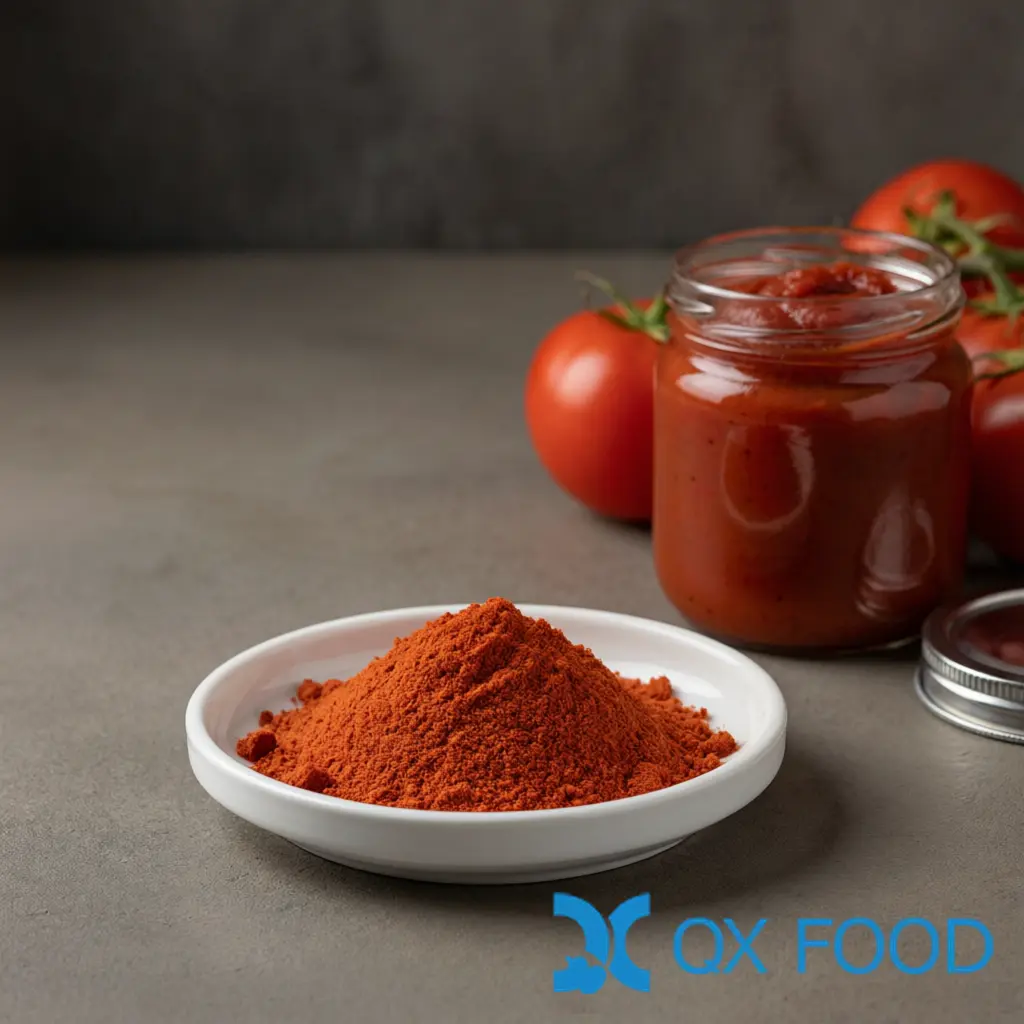
Tomato powder vs tomato paste is one of the most common sourcing questions in food formulation, and the tomato powder vs tomato paste choice depends on the system. Conversion between the two is a grade-matching and mass-balance problem, not a universal rehydration ratio.
This guide compares tomato powder vs tomato paste across conversion, composition, flavor, cost and application fit, with the tomato powder vs tomato paste decision framework for industrial production.
Tomato Powder and Tomato Paste Are Different Ingredient Forms
Tomato paste is a concentrated wet tomato product made by removing water from tomato juice or puree. Tomato powder is a dry form produced by drying tomato material and, depending on the grade, may or may not be a pure tomato ingredient. The two forms differ in water content, processing history and handling, and those differences drive the conversion logic.
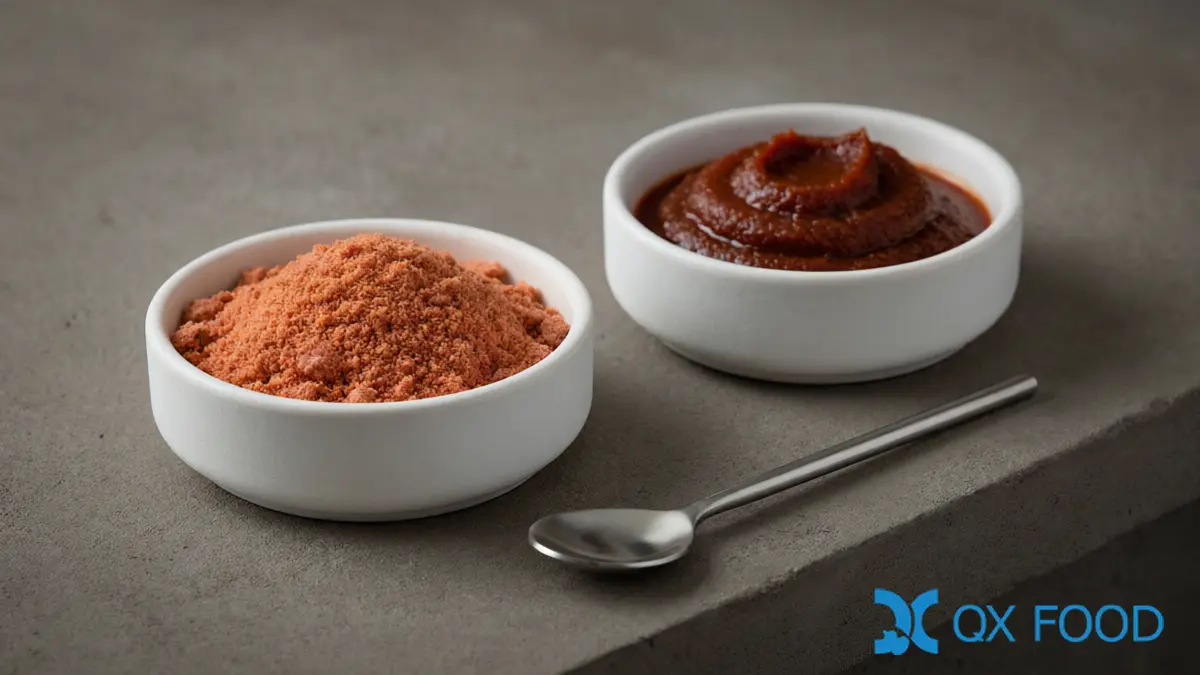
There Is No Universal Powder-to-Paste Ratio
Tomato paste and tomato powder cannot be converted reliably with one universal ratio. A useful starting calculation compares the actual paste specification with the composition of the selected powder, including tomato-derived solids and any carrier or added ingredients.
Brix may help define the soluble-solids target of the paste reference, but the converted formula still needs to be checked for water balance, viscosity, acidity, color and sensory performance.
If the powder is a formulated tomato seasoning rather than a pure tomato powder, a direct paste-equivalence calculation is usually not meaningful, because added sugars, acids, carriers and flavor materials also contribute to the finished product.
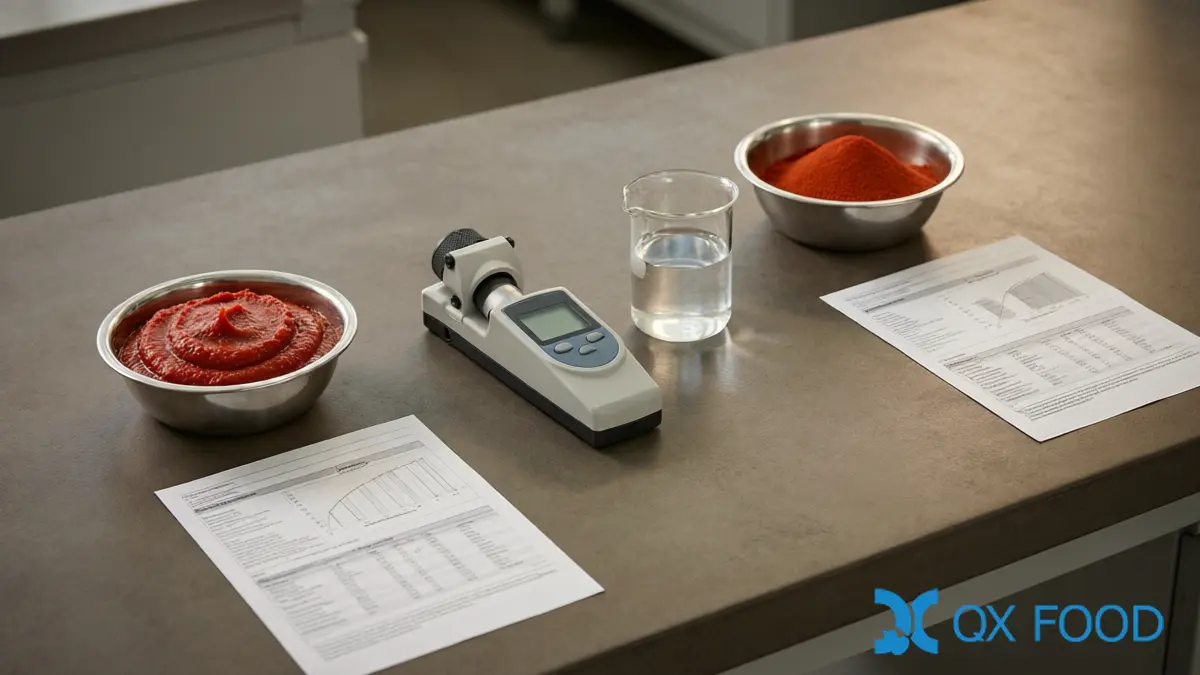
Start With the Actual Paste Specification
Industrial tomato paste is sold at different concentration grades. A 28-30 deg Brix paste is a common commercial reference, but the actual paste specification should be used for conversion. Under the Codex standard for processed tomato concentrates, tomato paste is defined by a minimum of 24 percent natural tomato soluble solids, while lower-concentration products fall into the puree range (Codex standard for processed tomato concentrates).
Record the reference paste’s soluble solids or Brix, ingredient composition, salt, acidity, viscosity or consistency, and color before building the powder-based equivalent.
Pure Tomato Powder Is Different From Tomato Seasoning Powder
A formulated tomato seasoning powder is not interchangeable with a pure tomato powder in a paste-conversion calculation. Added sugars, acids, carriers, flavors or anti-caking agents change both the solids balance and the sensory result. For example, a ketchup-style seasoning powder may combine tomato powder with maltodextrin, glucose, citric acid, tomato flavor, sweetener and an anti-caking agent, which makes it a finished flavor system rather than a tomato-solids ingredient.
A pure tomato powder provides the most direct basis for tomato-solids replacement calculations. A powder containing carriers or other added ingredients may still be evaluated if its composition and tomato-derived solids are known, but those added solids must be separated from the tomato-solids balance. Formulated seasoning powders should normally be treated as application-specific flavor systems rather than direct paste equivalents.
Brix Is Useful, but It Is Not Full Equivalence
Brix describes soluble solids, which is useful when the paste is specified by natural tomato soluble solids. But Brix alone does not establish formulation equivalence: insoluble tomato solids, carrier solids, sugars, acids, salt, particle structure, viscosity and processing history all sit between the Brix number and the finished product. Two systems at the same Brix can still differ in viscosity, flavor, color and tomato-solids composition.
Rebuild Water, Viscosity, Acidity and Color
A paste-replacement trial should follow five steps rather than a fixed ratio:
- Define the paste reference: record actual soluble solids or Brix, ingredient composition, salt, acidity, viscosity and color.
- Define the powder composition: confirm whether it is a pure tomato powder or a formulated seasoning, and identify carriers or added ingredients.
- Run the solids and water balance: use the selected specifications rather than a generic rehydration ratio.
- Rebuild functional properties: check viscosity and body, acidity, salt, color and process behavior.
- Validate in the finished product: compare against the paste reference after the actual process and shelf-life conditions.
Drying and Concentration Both Change Flavor
Drying and concentration both change tomato aroma and taste, and different drying technologies produce different sensory results; for example, comparative studies have found that spray-dried tomato can develop more cooked or tinned tomato character while fresh-green volatiles decrease (impact of drying technologies on tomato flavor). Neither form has one universal sensory profile, so conversion should use the actual powder and paste grades as references.
| Variable | Tomato powder | Tomato paste |
|---|---|---|
| Flavor | Grade- and process-specific | Grade- and process-specific |
| Solids | High, but composition must be checked | Defined by the selected paste concentration |
| Water | Low-moisture dry form | Concentrated wet form |
| Addition | Dry feeding or reconstitution possible | Wet dosing |
| Finished sensory | Must be compared in application | Reference product must be defined |
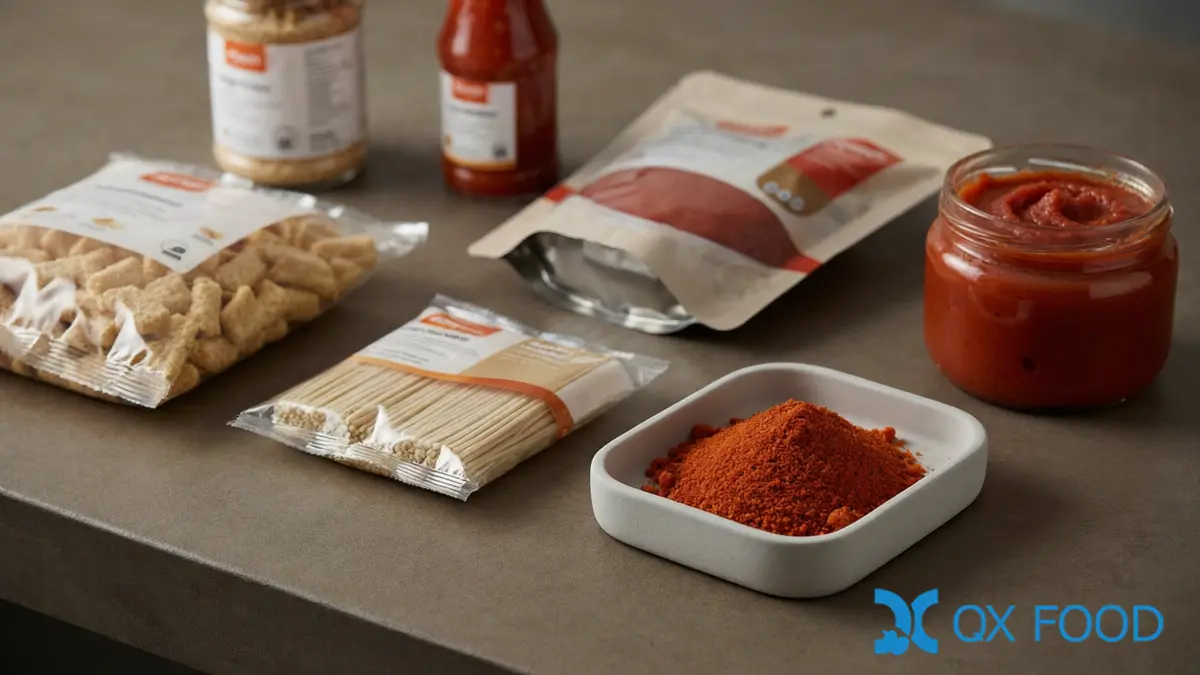
Dry Systems Usually Favor Powder; Wet Systems Can Use Either
A conventional finished dry blend usually favors a dry tomato ingredient, because adding paste introduces a liquid phase. If wet tomato material is to be used in a dry system, the process has to accommodate it through drying, coating, encapsulation or another processing step.
Wet systems are not automatically locked to paste either: a powder can be reconstituted into a sauce when the solids and water balance is rebuilt. The matrix below shows common starting directions, not fixed boundaries:
| Application | Common starting direction | What must be confirmed |
|---|---|---|
| Snack seasonings and coatings | Tomato powder | Blend uniformity and coating-line behavior |
| Instant noodle seasonings | Tomato powder | Sachet compatibility and reconstitution |
| Dry mixes and sachets | Tomato powder | Water-free formula and point-of-use rehydration |
| Retort sauces and wet sachets | Tomato paste or puree | Process fit and finished-product cost |
| Soup bases | Either, depending on format | Wet or dry process and finished product |
| Dry marinades and rubs | Tomato powder | Dry-blend compatibility |
Compare Cost at Equivalent Finished-Product Performance
Neither form is inherently cheaper at finished-product level. Powder usually contains substantially less water than tomato paste, but the usable concentration advantage depends on the actual powder composition and the paste solids specification. Storage requirements also depend on packaging and process rather than form: unopened aseptic tomato paste can be stored under specified ambient conditions, while opened paste generally requires tighter time and temperature control. Powder creates a different storage problem, mainly moisture uptake and caking, rather than automatically having a universal shelf-life advantage.
The comparison should include required dose, actual solids, packaging, freight, storage, handling and any formulation changes, measured at equivalent finished-product performance.
What Specifications to Compare Before a Trial
For the paste reference: natural tomato soluble solids or Brix, total solids where relevant, viscosity or consistency, acidity and pH, salt or added ingredients, and color.
For the powder candidate, the first question is ingredient composition: pure tomato powder or formulated seasoning, and any carrier or added ingredients. Then compare tomato solids or carrier status, moisture, acidity and pH, color, dispersion or reconstitution behavior, and particle properties where relevant.
How QXFOOD Approaches Paste-Replacement Trials
For paste-replacement work, QXFOOD can first identify whether a pure tomato-powder grade or a formulated tomato-seasoning grade is appropriate. Product-specific specifications and batch documentation should then be reviewed for the selected grade, and the required conversion parameters confirmed before trials. The tomato range and its application logic are covered in the tomato powder applications guide and the lycopene food color guide.
Tomato Powder and Paste Questions
Is there a standard tomato-powder-to-paste conversion ratio?
No. The ratio depends on the paste concentration and the composition of the selected powder. Start from the actual solids and water balance, then validate viscosity, acidity, color and sensory performance in the finished product.
Is tomato powder cheaper than tomato paste?
Neither form is inherently cheaper at finished-product level. Compare required dose, actual solids, packaging, freight, storage, handling and any formulation changes at equivalent finished-product performance.
Does tomato powder taste like tomato paste?
Not necessarily. Drying and concentration both change tomato sensory properties, and different grades can behave differently. Compare the actual candidates in the target product rather than assuming one fixed flavor profile per form.
Can tomato powder replace tomato paste in wet sauce systems?
Yes, with recalibration. Rebuild the solids and water balance against the actual paste specification, then adjust viscosity, acidity and color, and validate the finished product against the paste-based reference.