
In maltodextrin spray drying, the carrier is often added because sugar-rich and acid-rich materials can become sticky as water is removed. But choosing a carrier is not as simple as selecting a DE number from a table.
DE value, carrier level, feed composition, solids concentration, moisture and drying conditions all interact. A maltodextrin that works well in one fruit or fermented base may behave differently in another.
The practical goal is to find a carrier system that gives acceptable drying performance and storage stability without adding more carrier than the finished product needs.
What Maltodextrin Actually Changes During Spray Drying
Maltodextrin is a partially hydrolyzed starch, available in a range of dextrose equivalent (DE) grades. Added to the liquid feed before atomization, maltodextrin increases the proportion of higher-molecular-weight solids and reduces the relative contribution of low-molecular-weight sugars and organic acids to the solids mixture. High-sugar or acid-rich feeds such as fruit juices, honey, tomato concentrates and some vinegar concentrates can be difficult to spray dry: without sufficient drying aid or suitable process conditions, these feeds can show severe wall deposition and poor powder recovery (wall deposition in spray drying).
Maltodextrin can raise the glass transition temperature (Tg) of the solids mixture while also increasing feed solids. Raising Tg directly helps reduce stickiness, while higher feed solids can reduce the amount of water that must be removed and alter particle formation during drying. Low-molecular-weight sugars and organic acids have low Tg values, which is why sugar-rich systems are difficult to dry; adding a higher-Tg polymer shifts the mixture toward the glassy state (spray-drying optimization based on the glass transition concept).
DE Is a Material Property, Not an Application Code
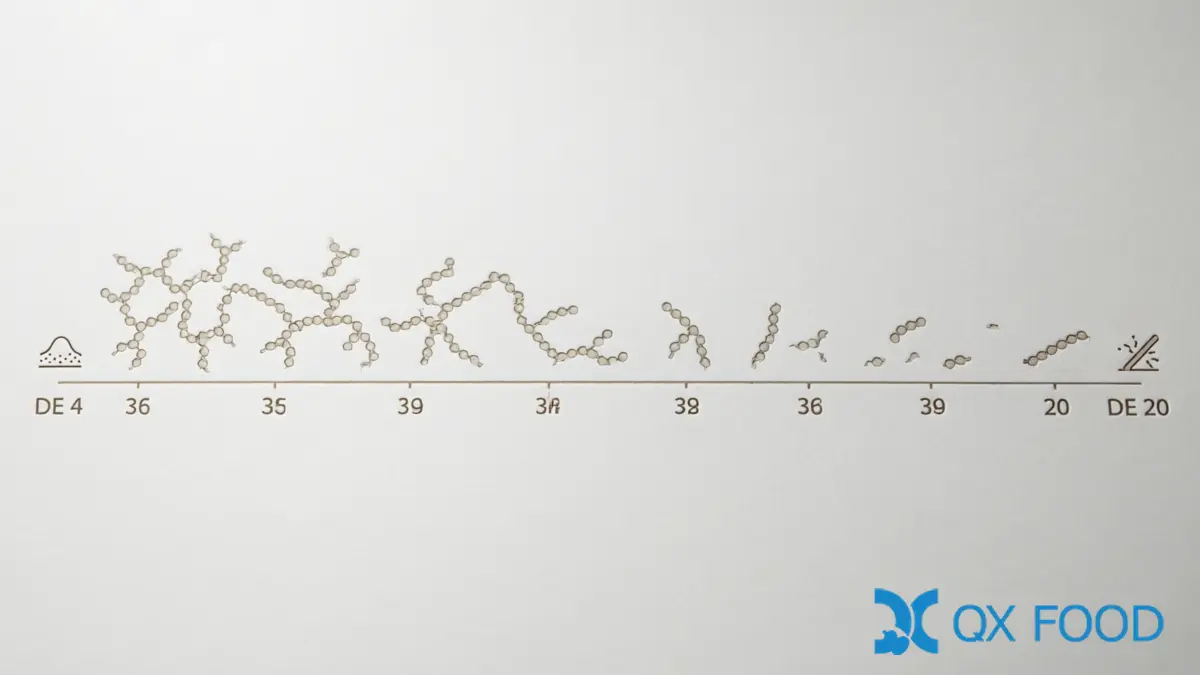
DE describes the extent of starch hydrolysis. Food-grade maltodextrins are generally characterized by DE values below 20, with commercial grades available across different ranges. DE describes the maltodextrin itself; it does not prescribe which product it should be used in.
The same DE range can perform differently in different food systems, because the feed matrix modifies the effect. In a coconut yogurt spray-drying study, maltodextrin DE 19 gave the highest powder yield, the lowest water activity and a higher solubility index than lower-DE grades, even though low-DE maltodextrins are often expected to perform better in sticky systems (carrier effects in spray-dried coconut yogurt). The authors attributed the result to faster kinetic shell formation with the higher-DE material. Treating a DE range as a fixed recipe would have missed this.
What Changes as DE Increases?
Some commonly observed trends are useful as a starting point before testing:
| As DE increases | Typical tendency | Why it matters |
|---|---|---|
| Average chain length | Decreases | Changes viscosity and molecular mobility |
| Sweetness | Increases | Can affect the sensory profile |
| Hygroscopicity | Often increases | Storage and caking may become more sensitive |
| Water solubility | Generally increases | Can affect feed handling and reconstitution |
| Dry maltodextrin Tg | Generally decreases | Relevant to sticky, high-sugar systems |
| Feed behavior | Product-dependent | Must be tested in the actual matrix |
In practice, feed behavior is the reason these trends should not be treated as fixed rules. Real food matrices can reverse simple DE expectations, so DE should be used as a starting point rather than a final answer.
Before Comparing Carrier Ratios, Ask: “20% of What?”
A carrier percentage is meaningless unless the calculation basis is stated. “20% maltodextrin” may refer to 20% of the feed, 20% of total dry solids, or a carrier-to-original-solids ratio. Those are not the same formulation.
Published work illustrates the point: a sour cherry juice study added 20, 30 and 40% carrier on a mass-per-volume basis (sour cherry juice spray-drying optimization), while other studies express carrier as a ratio to juice solids or as a percentage of the feed. For supplier comparisons, record both the carrier amount and the basis used to calculate it. Otherwise two powders described as “20% maltodextrin” may not be directly comparable.
Carrier Level Is a Process Window, Not a Standard Percentage
There is no universal carrier percentage. Too little carrier can compromise drying and storage performance, while excessive carrier can dilute the original food solids and change feed behavior.
With too little carrier, wall deposition, poor recovery and storage instability become more likely. As carrier increases, Tg and powder stability often improve; higher maltodextrin concentrations have been shown to raise Tg and reduce hygroscopicity in fruit systems (bayberry juice spray-drying optimization). But past a certain point, more carrier mainly dilutes the original food solids and flavor intensity, and it can change the feed viscosity and atomization behavior.
The target is therefore not the highest possible carrier level. It is the lowest practical level that meets the drying, handling and shelf-stability requirements of that specific formulation.
Tg Helps Explain Stickiness, But It Is Not the Whole Process
In maltodextrin spray drying, glass transition temperature is useful because sugar-rich amorphous powders become more mobile and sticky as temperature and moisture move the material away from the glassy state. Maltodextrin can raise the effective Tg of the solids mixture, and water acts as a strong plasticizer: humidity, packaging, water activity and powder composition all influence whether a powder stays in the glassy state.
But Tg alone does not determine dryer performance. Feed solids, droplet size, moisture, inlet and outlet conditions and surface composition also matter, and models based only on Tg or sticky-point behavior do not explain every droplet outcome during spray drying (glass transition approach to droplet surface stickiness). Carrier selection therefore still needs process validation in the actual system.
Use the Failure Pattern to Decide What to Check
When a spray-dried powder misbehaves, the symptom usually points to a specific set of variables. Starting from the observed failure is faster than running generic tests.
| What you observe | What may need checking |
|---|---|
| Heavy dryer-wall deposition | Feed composition, solids, carrier level, drying conditions |
| Powder cakes during storage | Moisture, water activity, Tg margin, packaging, carrier system |
| Powder becomes too weak in flavor | Carrier loading, original solids, dosage |
| Poor dispersion | Particle structure, DE, formulation, agglomeration |
| Batch-to-batch flow changes | Moisture, particle-size distribution, bulk density |
Use a defined internal or supplier-approved test method for each parameter, and do not compare results generated under different humidity, temperature or dispersion conditions as though they were equivalent.
When Maltodextrin Is Not Enough
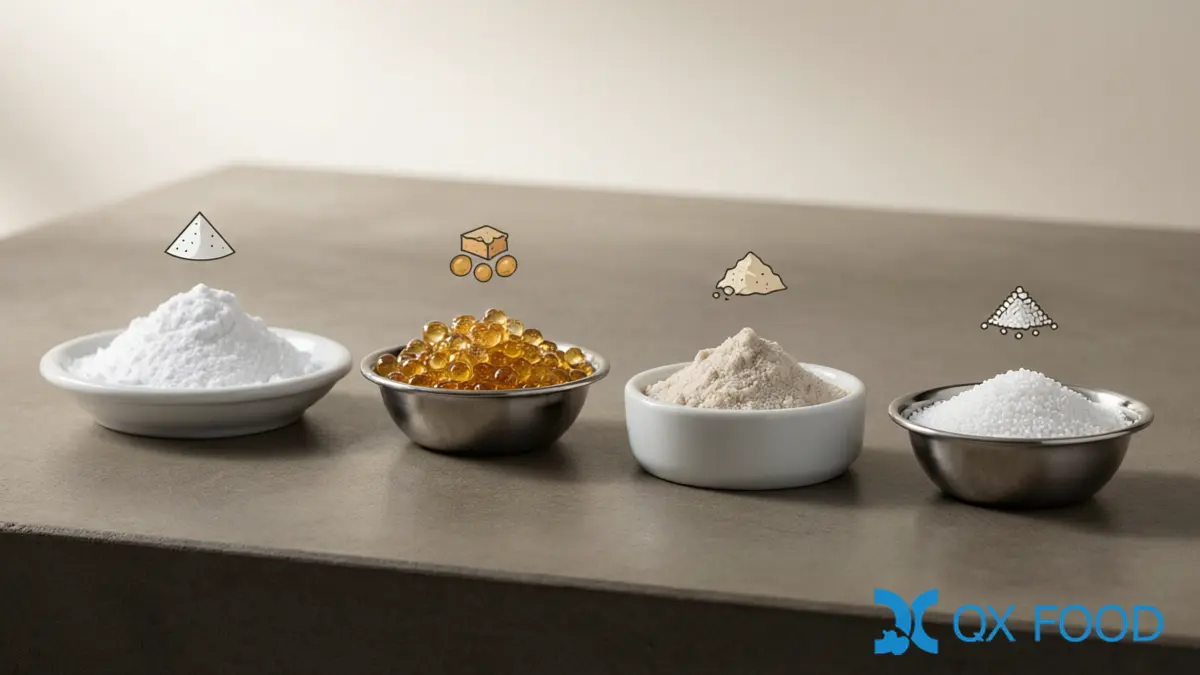
Maltodextrin is common because it is relatively low in cost, bland or only slightly sweet, highly water-soluble, low in viscosity at fairly high solids, and available in a range of DE grades. But other wall materials are regularly used, alone or in blends, when the system needs more than bulk drying performance (wall materials for spray-dried tea and herbal powders).
Oil or volatile-aroma systems may need better interfacial and emulsification performance, which is where gum arabic and modified starches are widely used; gum arabic’s value comes mainly from its interfacial activity and film-forming ability, alongside real cost and supply considerations (gum arabic modification routes for encapsulation). Encapsulation-efficiency targets may favor mixed wall systems over a single maltodextrin. Fiber or nutrition positioning may bring inulin or resistant dextrins into the discussion, but formulation and process suitability still have to be tested. Different feed rheology may favor modified starch or protein-based systems.
Wall materials should be selected according to what the feed needs and what each material contributes, then confirmed in trials on the actual product.
What Buyers Should Compare Between Two Spray-Dried Powders
When two quotes for a spray-dried powder differ in price, carrier level is one of the first formulation variables worth checking. A lower-priced powder may contain a higher proportion of carrier, although raw-material solids, process yield, specifications and commercial terms can also affect the quote. That does not automatically make the powder worse, but it means price per kilogram alone cannot explain formulation value.
Compare these points together: the carrier basis and level, original food solids, moisture and water activity, bulk density, reconstitution behavior and the dosage needed to hit the same finished-product target. A higher carrier level changes the balance between original food solids, powder handling and required dosage. A lower carrier level can deliver more original solids per gram, but drying and storage performance still need to meet the agreed specification. The comparison only works when the carrier declaration is on the table.
How QXFOOD Handles Carrier Requirements
QXFOOD produces spray-dried powders from liquid and concentrated food systems, including soy sauce powder, vinegar powder, hydrolyzed corn protein, tomato seasoning powder and mango powder. For maltodextrin spray drying programs, carrier selection is treated as part of the formulation work for each product: the feed composition, target solids, drying behavior and finished-powder requirements are assessed together rather than taken from a fixed table.
Carrier information, including DE class where relevant, can be provided in the applicable product specification for evaluation. Buyers comparing powders are welcome to request the specification, sample and, where useful, the carrier declaration together with the COA, so the comparison is made on the same basis. Where a customer has a specific feed to dry, the carrier system should be evaluated against that feed rather than assumed from another product’s setup.
Questions That Come Up During Formulation
Does lower DE always reduce sticking?
No. Low-DE maltodextrins generally have higher dry Tg values, and the tendency is often in that direction, but the food matrix and process conditions can change the result. In some systems a higher-DE carrier has delivered better yield and stability.
How much maltodextrin should I use?
There is no universal percentage. Define the calculation basis first, then determine the lowest carrier level that meets drying, handling and shelf-stability targets on the actual feed.
Does more maltodextrin always improve powder stability?
Not necessarily. More carrier can improve drying and storage stability, but it also dilutes the original food solids and flavor intensity, and very high levels can change feed behavior. Stability and dilution have to be balanced against each other.
Can spray drying work without maltodextrin?
Yes, depending on the feed and the desired functionality. Other carbohydrates, gums, starches or proteins may be used alone or in blends, and some products need very little carrier at all. The right system is defined by the feed, not by convention.