
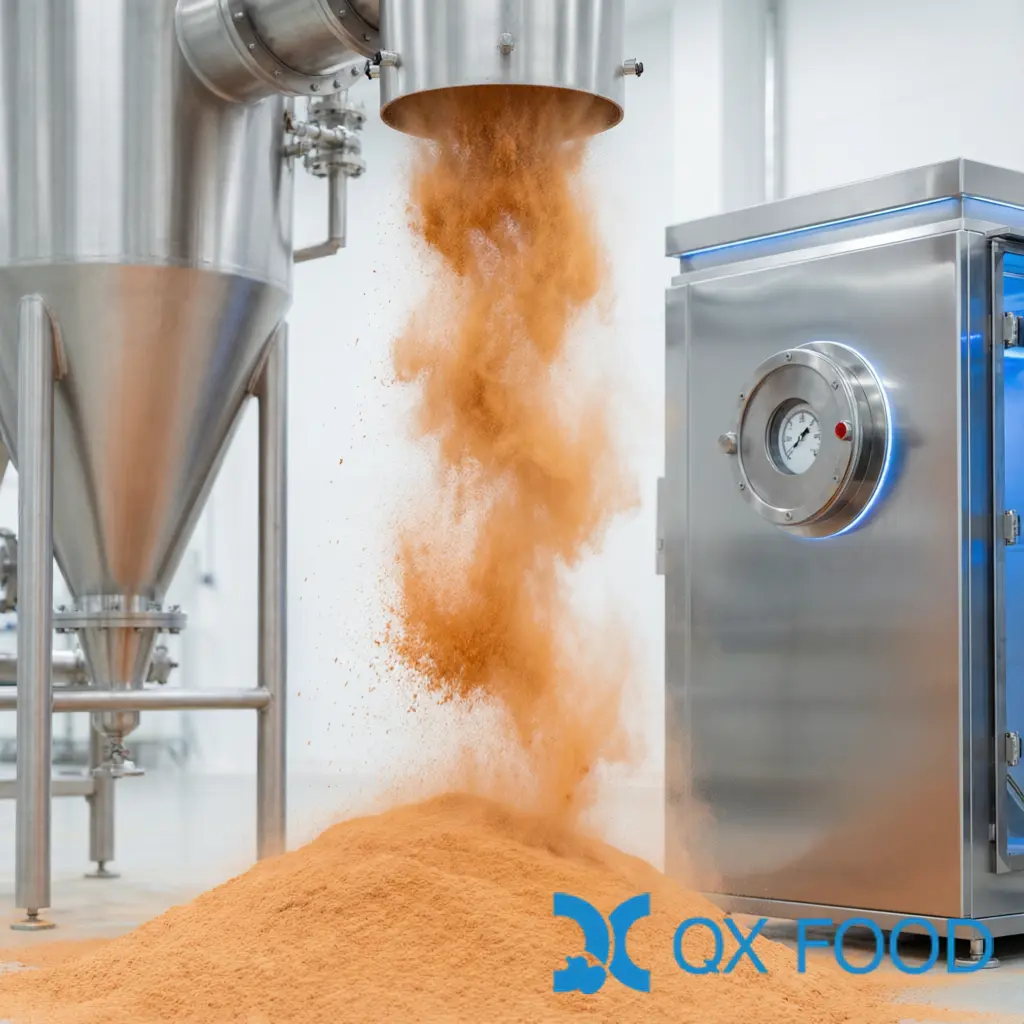
Spray drying and freeze drying can start with the same raw material and produce powders with very different structures, costs and sensory characteristics. Process reputation alone is not enough to make the choice.
Freeze drying is usually more expensive, but sometimes the extra cost protects exactly what gives the ingredient its value. Spray drying is easier to scale economically, but formulation aids and process conditions can also change the finished powder.
The useful comparison is not simply cost per kilogram. It is cost versus the product attributes your formulation actually needs to preserve.
Decision rule: Use spray drying when scalable powder production, formulation flexibility and unit economics matter most. Consider freeze drying when preserving heat-sensitive compounds, fresh-like sensory characteristics or physical structure justifies the added processing cost. Reconstitution still needs to be tested product by product.
What Are You Paying to Preserve?
The first question is not which process is better. It is which attribute carries the commercial value of the ingredient: fresh aroma, natural color, heat-sensitive compounds, whole-food structure, or simply a stable industrial powder for blending and formulation.
If the ingredient’s commercial value comes from a delicate fresh aroma, thermally sensitive compound or intact porous structure, freeze drying deserves serious consideration. If the main requirement is a stable industrial powder for blending, seasoning or further formulation, spray drying may offer a more practical route (freeze drying for food powder production reviews applications where freeze drying can justify its higher processing cost).
Reconstitution Is More Complicated Than “Which Dissolves Faster?”
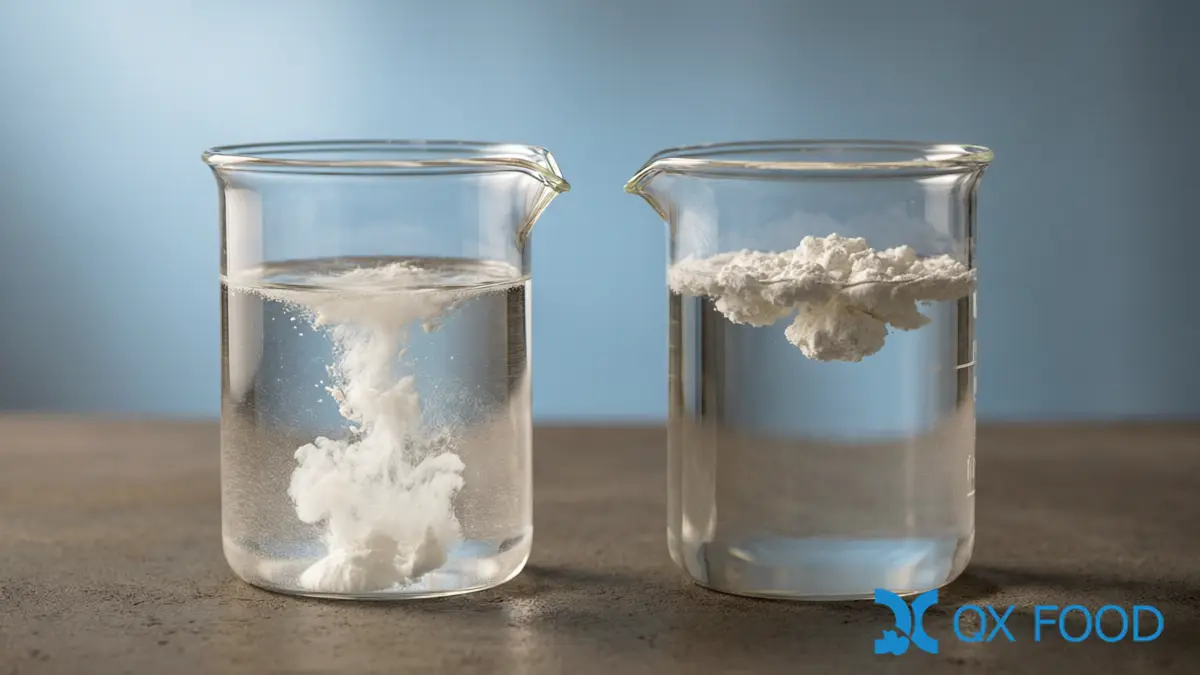
Drying method affects particle structure, but it does not determine reconstitution by itself. Freeze-dried products often retain an open, porous structure that can rehydrate quickly. Spray-dried powders can also perform very well in liquid systems, particularly when particle size, carrier system and agglomeration are designed for the application (rehydration of instant powders reviews how composition, microstructure and processing interact).
For a buyer, “solubility” is therefore too broad a specification. It is more useful to separate wetting, dispersion and true dissolution, then test the powder under the actual water temperature, shear and dosage used in production.
Compare Cost per Functional Dose, Not Cost per Kilogram
A freeze-dried powder can cost substantially more per kilogram but may be used at a different dosage or preserve a sensory attribute that allows premium positioning. Conversely, a lower-priced spray-dried powder may contain a carrier and therefore require a different usage rate.
Compare the two powders at equivalent finished-product performance, not simply at equivalent ingredient weight. Delivered cost per finished batch = ingredient cost at the required usage rate + allocated freight + storage + any process adjustment needed to achieve equivalent performance.
Freeze drying is generally more expensive because freezing, vacuum operation and sublimation make the process energy- and time-intensive. The actual cost gap varies widely with product, batch size, equipment utilization, cycle time and yield (powdered foods: structure, processing and challenges).

Carrier Content Can Change the Comparison
Some spray-dried formulations—particularly sugar-rich or sticky fruit and flavor systems—use maltodextrin, starch derivatives or other carriers to improve drying behavior and powder stability. Other spray-dried products may require little or no comparable carrier, depending on the feed.
The carrier level therefore belongs in the commercial comparison. Two powders with the same price per kilogram may deliver different amounts of the original food solids or flavor system.
Powder Structure Changes Logistics Too
Freeze-dried materials are often highly porous and low in bulk density. Spray-dried powders are generally more compact, but their density varies with formulation and drying conditions.
For buyers shipping large volumes, bulk density affects bag size, pallet utilization and warehouse space. The impact on freight becomes more important when annual volume is high.
Bulk-density differences can also require different filling-machine settings, especially in volumetric or auger-based systems. Use the actual product specification rather than assuming density from the drying method, and include logistics in the comparison when the density difference is commercially meaningful.
Two Powders With the Same Name Can Still Be Different Products
“Mango powder,” “soy sauce powder” or “tomato powder” does not describe enough for an industrial buyer. A spray-dried version and a freeze-dried version may differ in original solids, carrier content, density, particle structure, aroma intensity and usage rate.
This is why changing drying method should be treated as a formulation change—not simply as changing suppliers. Our mango powder page, for example, publishes the spray-dried format with its processing line and specification, and the same comparison framework can be used when equivalent products are available in different drying formats.
When Freeze Drying Is Worth Paying For
Freeze drying is worth considering when heat-sensitive compounds, fresh aroma, natural color or physical structure are central to the finished product’s value. The additional processing cost should be justified by measurable sensory or functional retention in the finished application. Where shelf-life retention matters, evaluate the relevant attributes during storage rather than only immediately after drying.
When Spray Drying Is the More Practical Choice
Spray drying is well suited to high-throughput industrial production. Where feed viscosity and atomization allow, higher feed-solids levels can reduce the amount of water that must be evaporated. Once feed and process conditions are established, the process can also be run repeatedly at production scale.
| Your priority | Route worth evaluating | What still needs testing |
|---|---|---|
| High-volume powder production | Spray drying | Yield, carrier, sensory fit |
| Preservation of delicate aroma | Freeze drying | Sensory gain vs cost |
| Heat-sensitive bioactives | Freeze drying | Retention over shelf life |
| Dry blending / industrial formulation | Spray drying | Flow, dispersibility, dosage |
| Retaining visible food structure | Freeze drying | Texture after rehydration |
| Lowest delivered formulation cost | Start by evaluating spray drying | Compare at equal functional dose |
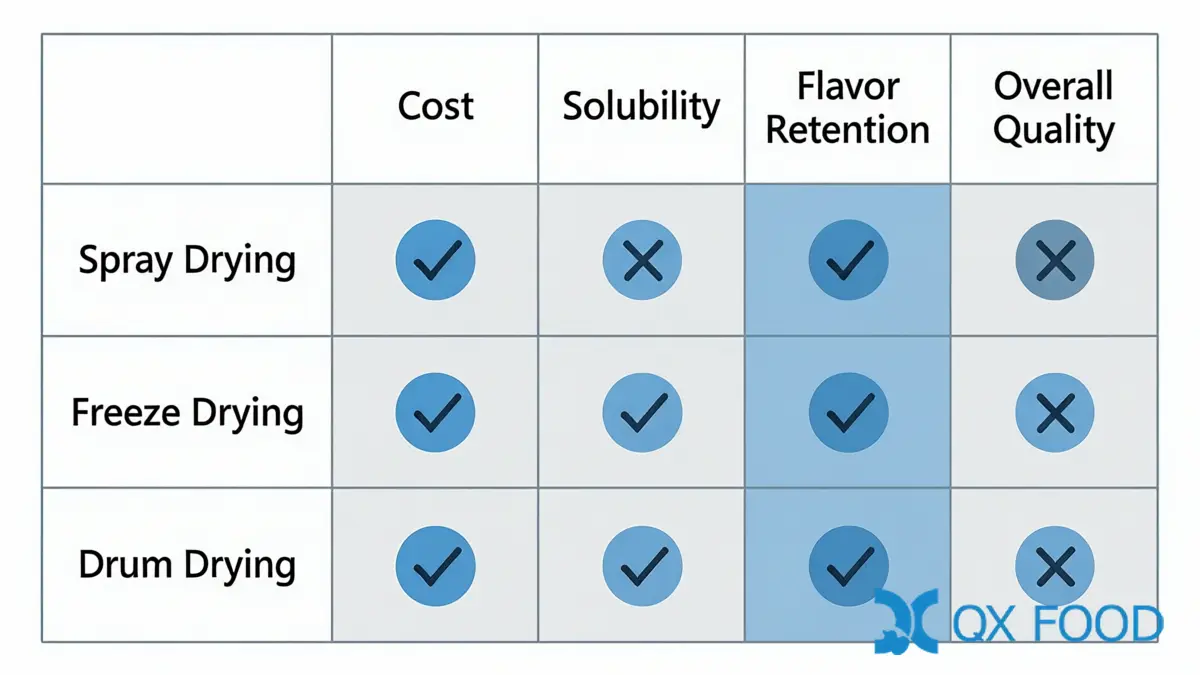
Run the Comparison in the Finished Product
A format decision should be validated in the product it will actually go into:
- Sensory: side-by-side finished-product test under your target conditions.
- Reconstitution: actual water temperature, shear and dosage used in production.
- Usage rate: the dose needed to hit the equivalent flavor, color or function target.
- Delivered cost: ingredient price plus freight, storage and dosage effects.
Where Spray Drying Fits at QXFOOD
Spray drying is part of QXFOOD’s production platform for liquid and concentrated food systems that need to be converted into stable powders for industrial use. Examples on our site include soy sauce powder, vinegar powder, hydrolyzed corn protein, tomato seasoning powder and mango powder. The spray drying process guide covers the production flow in detail.
For these products, buyers should evaluate the actual specification—raw-material solids, carrier system where applicable, moisture, bulk density, sensory profile and reconstitution behavior—rather than assuming performance from the drying method alone. Where a customer requires a freeze-dried format, the requirement should be evaluated separately rather than treated as an interchangeable version of the spray-dried product.
Common Selection Questions
Is freeze drying always better quality?
No. “Quality” depends on what attribute matters. Freeze drying can better preserve some heat-sensitive compounds and structures, while spray drying may be better suited to scalable industrial powder production.
Is spray drying always cheaper?
Generally lower-cost at industrial scale, but the gap varies with product, scale and yield. Compare actual supplier quotes and usage rates at equal finished-product performance rather than assuming from the process name.
Which one rehydrates faster?
There is no universal answer. Rehydration depends on particle structure, porosity, composition, carrier system and the water temperature and shear used. Test the specific powder under your actual reconstitution conditions.
Do spray-dried powders always contain maltodextrin?
No. Carrier use depends on the feed and the target powder properties. Sugar-rich or sticky systems often need a carrier, while other feeds may require little or none—check the specification rather than assuming.