
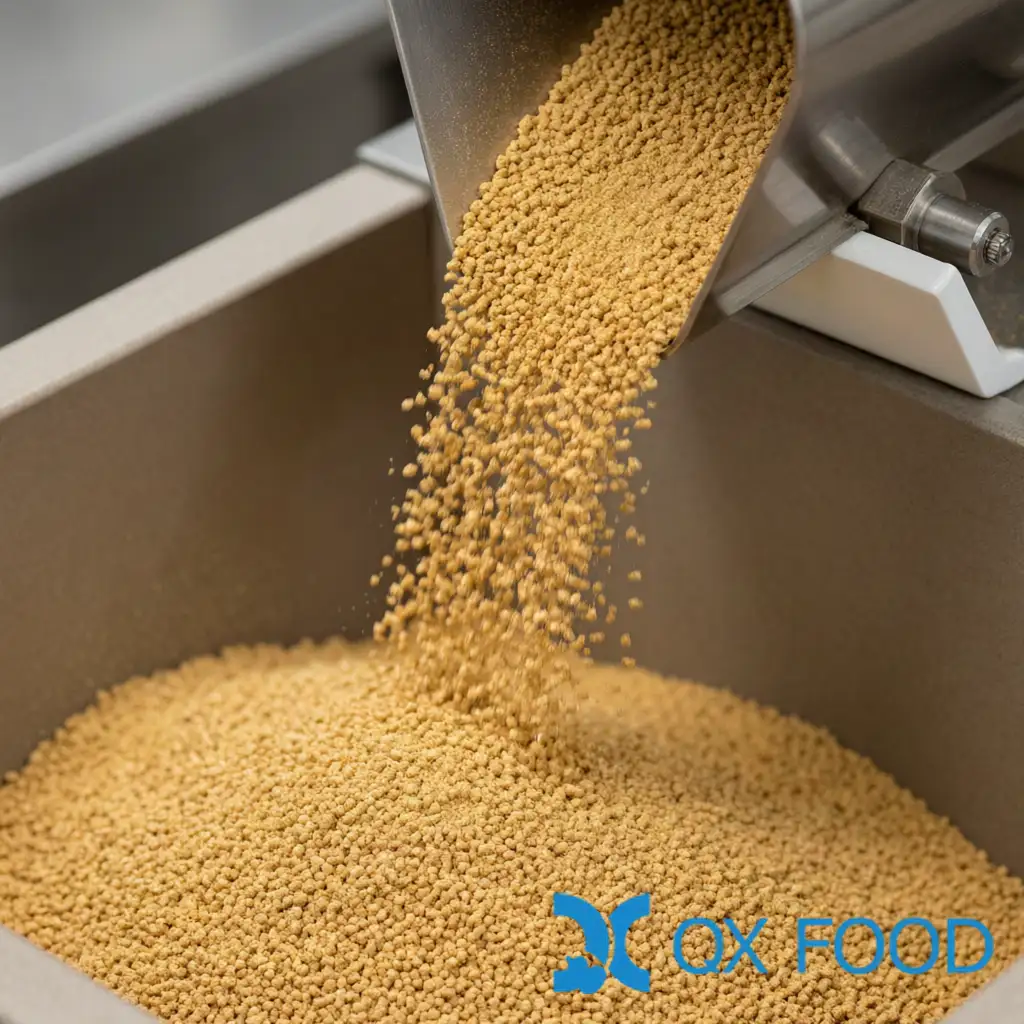
A seasoning does not need to be granulated simply because granules look easier to handle. Granulation becomes useful when a powder creates a specific production problem—excessive dust, poor hopper flow, inconsistent volumetric dosing, segregation, or difficult wetting during reconstitution.
But changing powder into granules also changes particle size, density, porosity and surface behavior. A format that performs well in an instant soup may perform poorly on a snack-coating line.
Short answer: Granulation is worth evaluating when seasoning powder creates dust, poor flow, segregation, dosing instability or wetting problems. It is not automatically better for snack coatings, sauces or other applications where fine particle coverage is important.
Start With the Production Problem
Granulation is one option among several for fixing a powder-handling issue. The table below maps common production symptoms to possible causes and to whether a format change is worth evaluating.
| Production issue | What may be happening | Can granulation help? |
|---|---|---|
| Powder becomes airborne during feeding | High proportion of fines / low particle mass | Can reduce fines-related dust |
| Powder bridges in hopper | Cohesive particles or unsuitable flow properties | May improve flow if fines are the cause |
| Volumetric dosing drifts | Bulk density / flow varies between fills | Worth testing |
| Blend separates during handling | Components differ greatly in size or density | Granulation may reduce segregation |
| Powder floats or forms lumps in water | Poor wettability / rapid surface hydration | Porous agglomeration may help |
| Seasoning does not adhere well to snacks | Particles may already be too coarse | Granulation may make it worse |
| Visible seasoning texture is required | Powder is visually too fine | Granules may help |
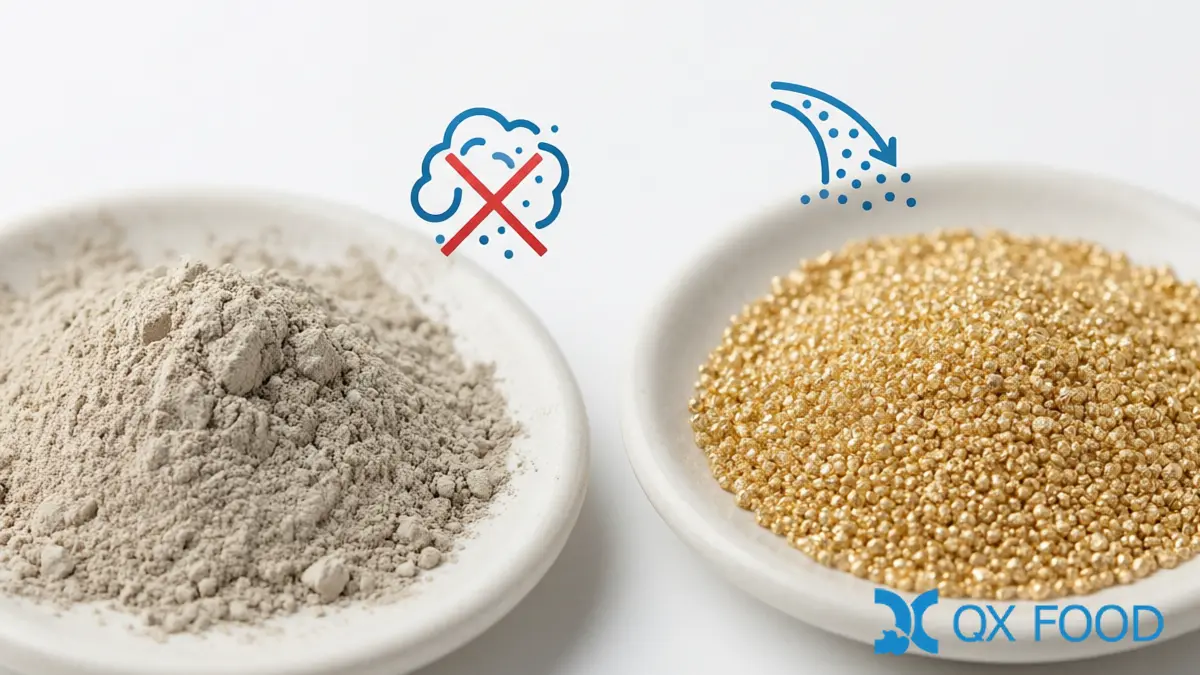
What Granulation Actually Changes
Granulation changes several physical properties at the same time, and the result depends on the application.
| Property | What granulation can change | Why the buyer should care |
|---|---|---|
| Particle size distribution | Reduces the proportion of very fine particles | Dust and feeding behavior |
| Bulk density | Can increase or decrease depending on structure | Volumetric dosing and pack fill |
| Porosity | Often higher in wet-agglomerated products | Wetting and reconstitution |
| Mechanical strength | Depends on binder and process | Fines generated during transport |
| Flow behavior | Can improve when cohesive fines are reduced | Hoppers, augers and fillers |
| Wettability | May improve with porous agglomerates | Instant soups and drink systems |
| Segregation tendency | May be reduced when components are bound together | Blend uniformity |
When Granulation Is the Wrong Fix
Granulation is not automatically an upgrade. For snack coatings, a larger particle can reduce surface coverage or adhesion. A blend intended to disperse invisibly into a sauce may need a finer particle rather than a larger granule. And if poor flow is caused mainly by moisture pickup or caking during storage, changing particle size without fixing packaging or moisture control may not solve the problem.
Before changing format, identify whether the failure comes from particle size, moisture, formulation, packaging or the customer’s dosing equipment.
Common Granulation Routes
The route depends on what the formulation can tolerate and what the finished granule needs to do. Moisture-sensitive blends, for example, may rule out processes that rely heavily on wetting and drying.
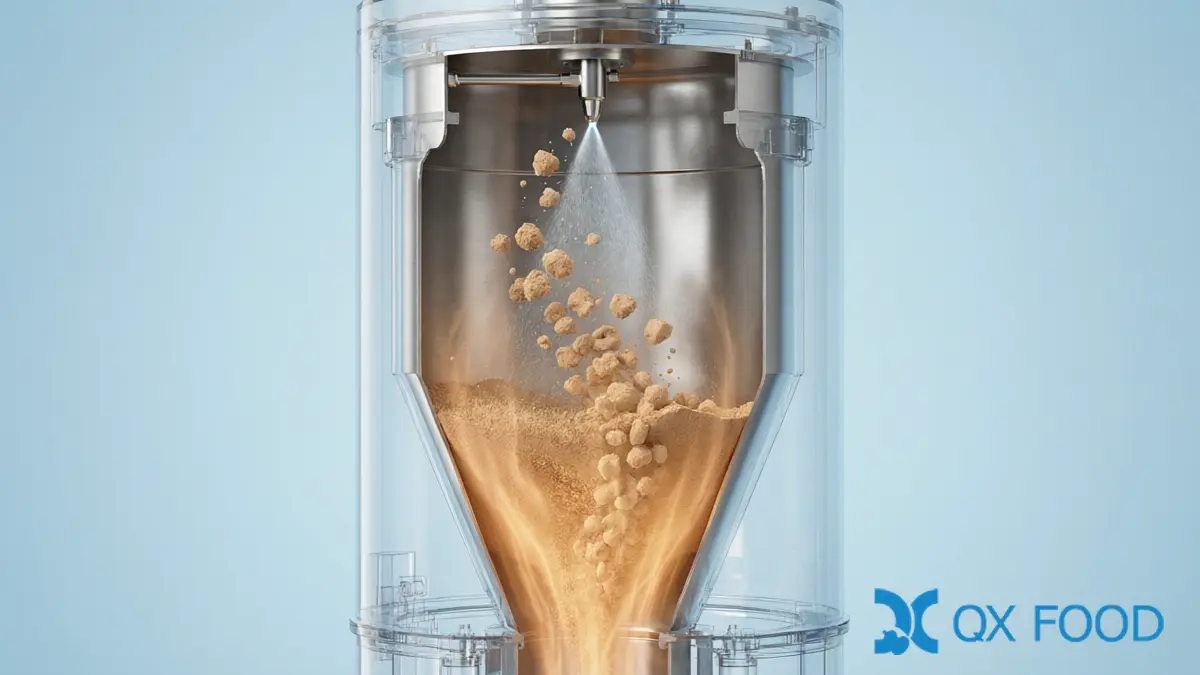
Fluid-Bed Agglomeration
Fine particles are fluidized in an air stream while water or a binder solution is sprayed onto the particle surface. Repeated wetting, collision and drying build larger agglomerates.
The resulting particle structure can be relatively porous, which is useful when rapid wetting and dispersion are important. Sticky or carbohydrate-rich blends need more careful control because heat and added moisture can change how they agglomerate.
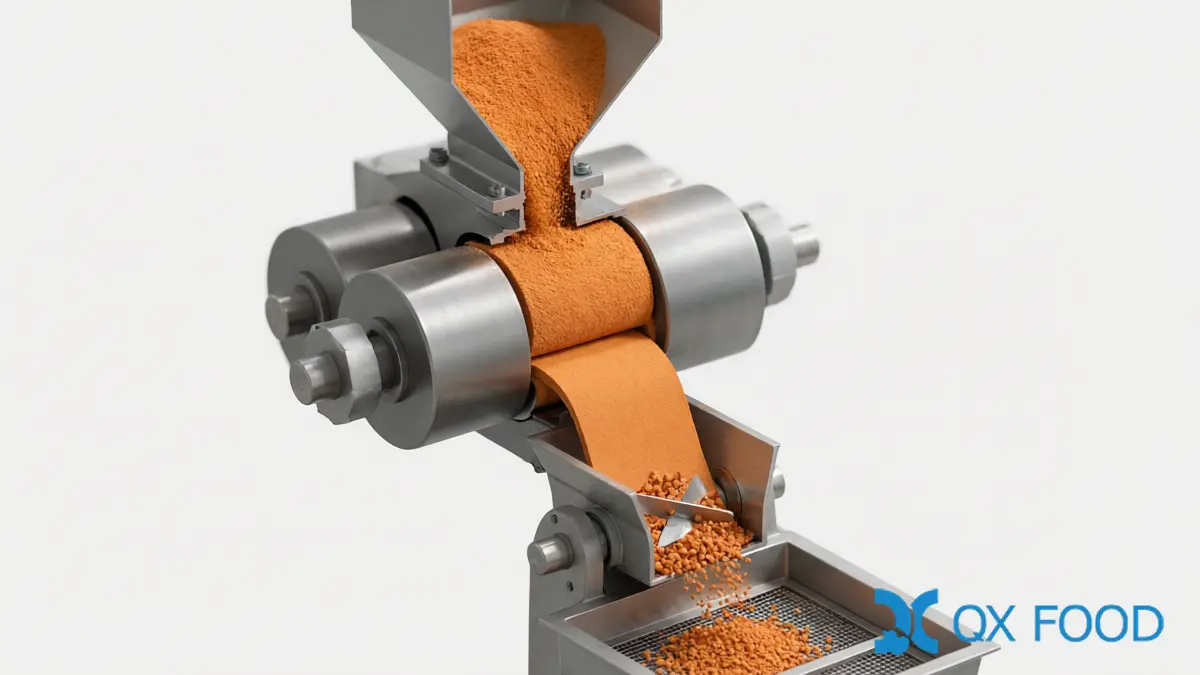
Pressure Agglomeration / Roller Compaction
Pressure agglomeration forms larger particles mechanically without adding a liquid binder. This can be useful for moisture-sensitive formulations. The trade-off is a denser particle structure, so reconstitution should be checked in the final application (dry granulation references describe the same roller-compaction principle).
Whether it suits a seasoning blend depends on compressibility, formulation and the required reconstitution behavior.
Wet Granulation and Extrusion
In wet granulation, liquid is introduced to create temporary particle bonds before drying. Extrusion can then be used when a more defined particle shape or dense granule structure is required.
Wet processing gives more freedom to shape the particle, but it also exposes the blend to added moisture and a drying step. That matters for flavors or ingredients that do not tolerate either condition well.
Wetting Is Not the Same as Dissolving
Instant powders are often described as “dissolving,” but reconstitution is a sequence of stages: wetting, immersion, dispersion and, for soluble components, dissolution. Salt and MSG are highly soluble, while much of the plant material in ground spices remains as suspended or dispersed solids rather than fully dissolving.
This distinction matters when choosing a format. A porous agglomerate may wet and disperse quickly even when part of the particle is insoluble. Judging a granule only by “dissolution time” in hot water can miss what actually happens in the customer’s process (food-powder agglomeration studies use wetting and hydration rather than simple dissolution as functionality criteria).
There Is No Universal “Best” Granule Size
Particle size should be specified from the application backward. A buyer using volumetric dosing may prioritize flow and bulk-density consistency, while an instant-soup manufacturer may care more about wetting and dispersion. A sprinkle seasoning may instead need visible particles and controlled fines.
The target specification should therefore be a range supported by application testing—not a generic number copied from another seasoning.
Three Products, Three Different Answers
Instant soup. The priorities are wetting, dispersion, low fines and consistent reconstitution. Porous agglomeration is often worth evaluating because the open structure lets water penetrate the particle quickly.
Snack coating. The priorities are adhesion, surface coverage, visible specks and interaction with the oiled substrate. Over-granulation can reduce coverage per kilogram and leave the seasoning sitting on the surface instead of adhering to it.
Table seasoning / sprinkle mix. The priorities are free flow through the shaker or dosing head, visual appearance and resistance to segregation. A controlled granule size band may matter more here than in any other application.
How to Evaluate a Granulated Seasoning
Practical evaluation goes beyond sieve analysis and bulk density. Depending on the application, these parameters are worth confirming:
- Particle-size distribution: target fraction, fines and oversize—not just a single nominal size.
- Bulk and tapped density: relevant to pack fill and volumetric dosing consistency.
- Flowability: where measured, indicators such as Carr Index or Hausner Ratio; otherwise a practical hopper or auger trial.
- Attrition after handling: whether granules generate new fines during transport and packing.
- Wetting and dispersion: more informative than “dissolution” for instant applications.
- Moisture / water activity: affects caking risk and storage stability.
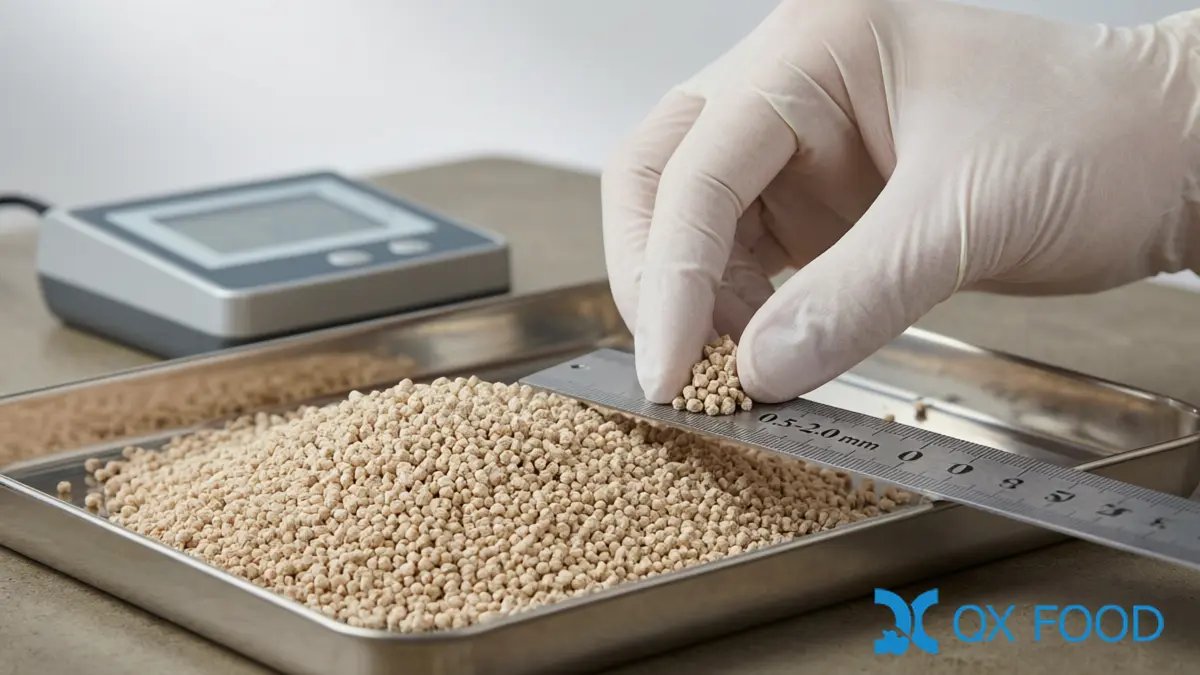
What We Need Before Evaluating a Granulated Seasoning
QXFOOD produces granular seasoned salts—for example parsley-garlic, sea-salt black pepper, sesame and baking-salt blends—through low-temperature blending and granulation under ISO9001, ISO22000 and HACCP systems with HALAL certification. The seasoning granules range covers the current published formats.
A granulation request should start with the application, not just a particle-size number. For feasibility evaluation, we would normally need:
- target food application
- current seasoning formula or reference sample
- required particle-size range
- customer dosing or packing equipment
- whether the product is reconstituted in water
- moisture-sensitive ingredients
- expected packaging and storage conditions
A formula outline or reference sample can be submitted during the evaluation.
Questions Buyers Usually Ask
Are seasoning granules always better than powder?
No. Granulation helps with specific problems such as dust, flow, segregation and wetting, but it can hurt adhesion or coverage in snack coatings and adds a processing step. The right format depends on the application and the production line.
Do seasoning granules dissolve faster than powder?
Not necessarily. Reconstitution involves wetting, dispersion and dissolution. Porous agglomerates may wet and disperse more easily, but actual behavior should be tested against the product composition and granule structure in the intended application.
What particle size should seasoning granules be?
There is no universal number. The target range should be set by the application, dosing equipment, reconstitution requirements and visual target, and confirmed by application testing rather than copied from another seasoning.
Can an existing seasoning powder be converted to granules?
Many formulations can be evaluated for conversion, but moisture sensitivity, binder compatibility, flavor stability and the target structure must be assessed first.