
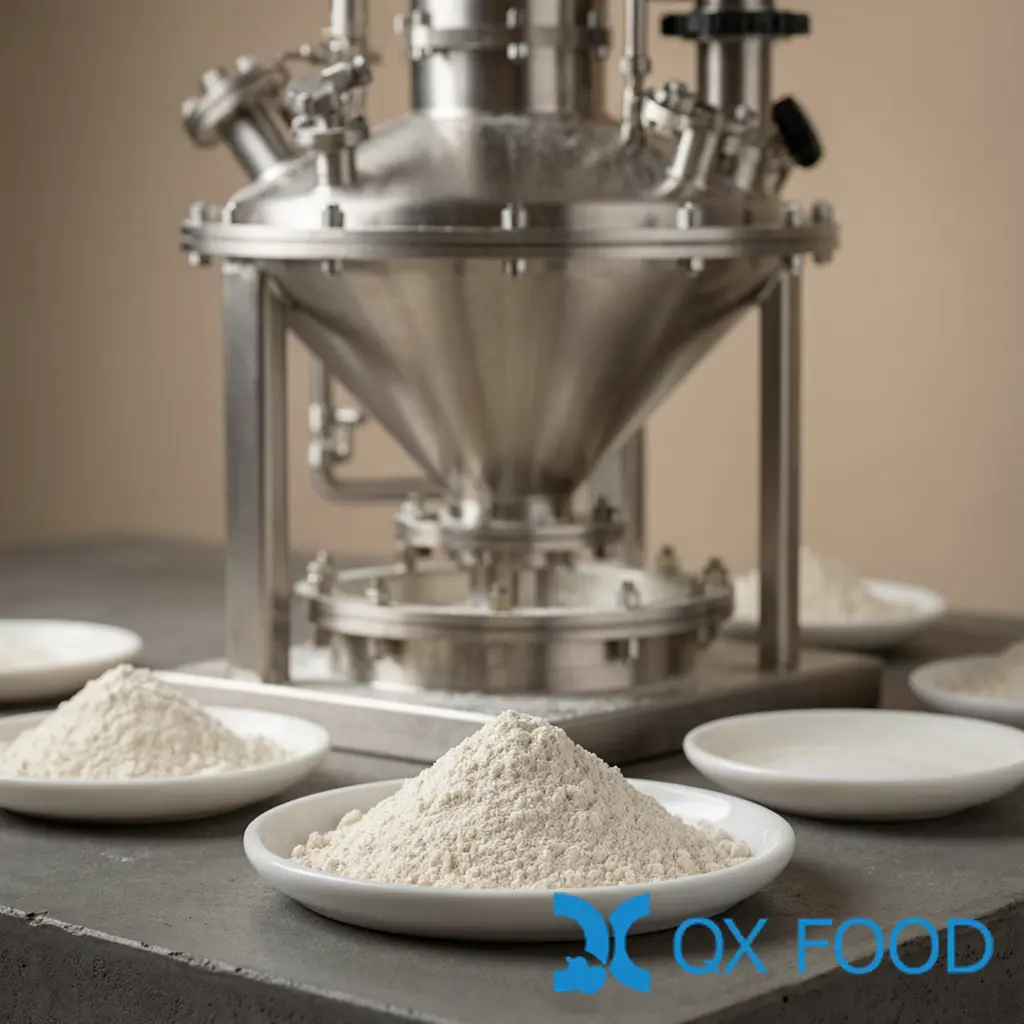
The spray drying process for food powders turns a liquid feed into a powder, but the finished powder is not set by any single dial on the dryer. Inlet temperature, outlet condition, feed solids, atomization, airflow and downstream treatment all act on each other.
Changing one variable usually moves several powder properties at once: moisture, particle morphology, flow, rehydration and yield respond together. A spray-drying process is therefore understood as a coupled system, not as a list of independent settings.
The useful question for a buyer or process engineer is not “what temperature is used” but how the process variables interact to produce the powder specification required.
From Liquid Feed to Powder: What Actually Happens
A spray-drying line can be described in five physical stages: feed preparation, atomization, drying and particle formation, powder separation with fines recovery, and post-drying or cooling where the dryer design includes it. Multi-stage systems may add a fluid bed for final moisture and cooling, which means the drying task is shared beyond the main chamber (milk and whey powder processing).
Downstream steps such as screening or metal detection belong to the plant flow around the dryer and are positioned according to the facility’s hazard-control plan, not as fixed stages of the drying process itself.

Inlet Air Temperature Is Not Product Temperature
Hot inlet air provides the driving force for evaporation, but the droplet does not instantly reach the inlet-air temperature. Rapid evaporation cools the wet particle, so product temperature follows the coupled heat- and mass-transfer conditions rather than the inlet setting alone. In dairy powder systems, drying air may run well above 150 degrees Celsius while droplets approach the wet-bulb temperature during the early drying phase, typically in the region of 50 degrees Celsius, before the particle heats up as drying progresses (drying principles in powder production).
This is also why a high inlet-air number cannot by itself tell you whether a flavor has been thermally damaged. Thermal load depends on the temperature history of the particle, which is set by droplet size, solids, airflow and residence conditions together.
Outlet Temperature Is an Indicator, Not a Moisture Knob
Outlet temperature is closely related to drying load and residual moisture, which makes it a useful signal for process control. But the same outlet temperature does not guarantee the same powder moisture when feed solids, feed rate, inlet conditions, ambient humidity or downstream drying change. Powder moisture is an outcome of the whole drying system, and in multi-stage dryers a fluid bed can continue removing moisture after the chamber (powder moisture and drying configuration).
Treating outlet temperature as a stand-alone moisture setting is therefore misleading. It is monitored and used to adjust the line, but the moisture spec is verified on the powder, not inferred from one temperature.
Process Variables Act as a System
The variables in the spray drying process for food powders interact, so no single number can be quoted as a universal setting for every food powder. Each variable changes something, and what changes the answer depends on the product:
| Process variable | What it changes | What changes the answer |
|---|---|---|
| Feed solids and viscosity | Water load, atomization behavior, particle formation | Composition, pumpability, carrier system |
| Atomization | Initial droplet-size distribution | Nozzle or wheel design, pressure or speed, viscosity |
| Inlet air condition | Evaporation driving force | Heat sensitivity, dryer design, airflow |
| Outlet condition | Drying load and residual-moisture relationship | Feed rate, solids, ambient humidity, downstream drying |
| Airflow and residence environment | Drying history and particle movement | Chamber design, droplet size |
| Fines return and fluid bed | Agglomeration, final moisture, cooling | Dryer configuration and target powder properties |
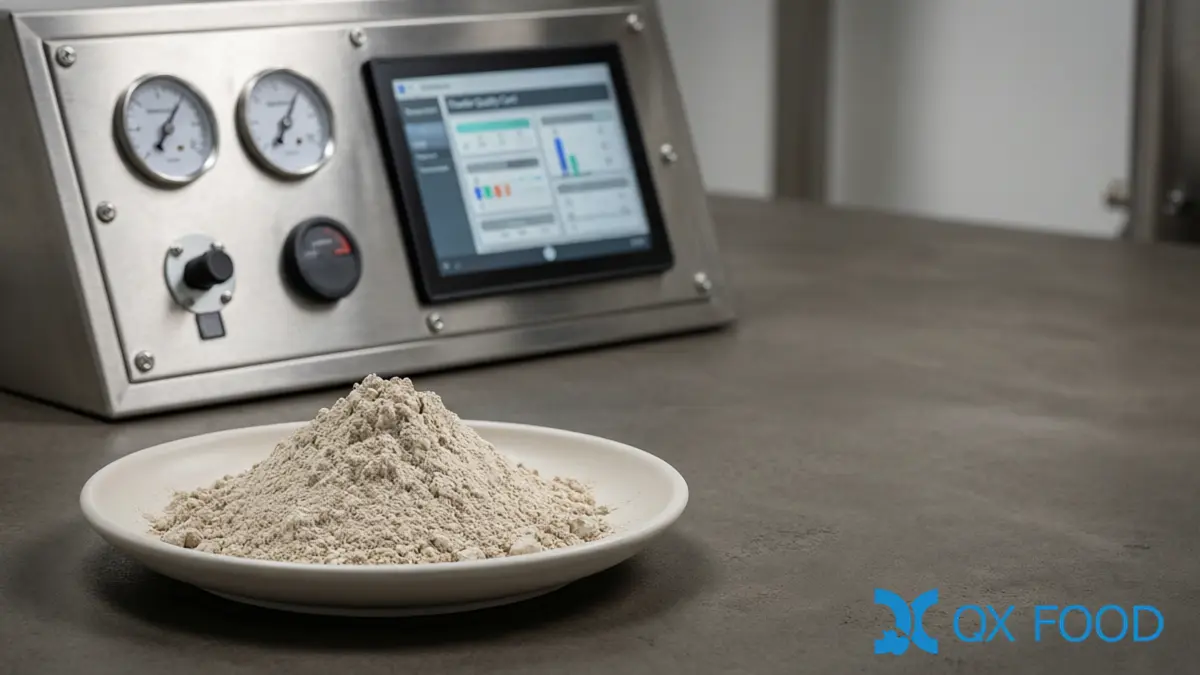
Atomization Starts Particle Formation, It Does Not Finish It
Atomization establishes the initial droplet-size distribution, which is a major influence on the final particle size. Rotary, pressure-nozzle and two-fluid atomizers create droplets through different mechanisms, and selection depends on feed properties, the required droplet and particle distribution, capacity and dryer design rather than on a single best-for rule.
But the finished particle is not set by the atomizer alone. Feed solids, drying rate, shrinkage, shell formation and agglomeration all shape the final structure, and particle morphology develops through the drying step from the single droplet to the pilot and production scale (particle structure development during spray drying).
Feed Solids Improve Water Economy Until Atomization Becomes the Constraint
Increasing feed solids can reduce the amount of water that must be evaporated, which improves energy economy and throughput, and concentrating the feed before drying is standard practice where the product allows it.
The practical limit is set by viscosity, atomization and the target particle structure. Higher solids raise viscosity, which changes droplet formation and can alter the particle, so the useful solids level is found by testing, not by a fixed percentage.
Finer Powder Is Not Automatically More Instant
Smaller primary particles are not automatically easier to reconstitute. Wettability, dispersibility and true solubility are different properties. During reconstitution, the powder first has to wet and disperse; where the components are soluble, dissolution follows. Some food powders are intended to disperse rather than fully dissolve, and each step can fail independently.
Agglomerated powders can wet faster even though their apparent particle size is larger, because the open structure lets water enter between particles more easily (agglomeration and rehydration properties of spray-dried powders). Particle size, morphology and rehydration are outcomes of interacting feed and process conditions, not of fineness alone.

Particle Structure Is Created During Drying
Particles can form as hollow, dense, porous or agglomerated structures depending on feed composition, drying rate and process design, and that structure influences flow, bulk density, rehydration and how the powder behaves in the finished food (particle morphology from droplet to pilot scale).
For buyers, this means the specification should describe what the powder needs to do in the application, and the process that achieves it should be validated per product. A carrier system that supports drying behavior and structure is part of that process; carrier selection is covered in our maltodextrin carrier guide.
Final Moisture and Water Activity Are Different Specifications
Target moisture depends on product composition and specification, and it varies across food powders. Moisture content and water activity are not the same measure: water activity describes the water available for chemical and microbial change, and low-water-activity foods are not sterile, since pathogens can survive in dried products and hygiene during drying and storage still matters (microbiological quality of dried foods).
Water activity, glass transition behavior, packaging and storage conditions must be considered separately when assessing caking and stability, and the acceptable values are set by the product specification rather than by a universal moisture figure.
When Powder Performance Moves, Trace the Process Variable
When a spray-dried powder drifts from specification, the observed symptom usually points to a set of interacting variables rather than a single cause:
| Powder observation | Variables worth checking |
|---|---|
| Moisture moves lot to lot | Feed rate, solids, outlet condition, ambient humidity, downstream drying |
| Too many fines | Atomization, feed viscosity, droplet distribution, fines handling |
| Wall deposition | Composition and glass transition, carrier system, moisture, dryer conditions |
| Poor wettability | Particle structure, agglomeration, surface composition |
| Bulk-density changes | Solids, atomization, particle morphology, agglomeration |
Where Spray Drying Fits at QXFOOD
Spray drying is used across several QXFOOD product families, including selected brewed, fermented, protein-hydrolysate and fruit powders, with each product’s feed, carrier system and drying conditions developed against its specification. Representative lines include the soy sauce powder series, vinegar powder series and fermented paste powder series.
Depending on the product, release specifications may include moisture, particle-size distribution, bulk density, reconstitution and sensory characteristics, with applicable tests linked to the released lot. Samples can be evaluated in the buyer’s own application before commitment. For the route-selection question between drying methods, see our spray-dried versus freeze-dried guide.

Process Questions Food Manufacturers Ask
Is inlet-air temperature the same as product temperature?
No. Rapid evaporation keeps the wet droplet well below the inlet-air temperature during the moisture-removal stage. As drying progresses and less water remains available for evaporative cooling, particle temperature can rise.
Does outlet temperature alone determine powder moisture?
No. Outlet temperature is closely related to residual moisture and is useful for control, but feed solids, feed rate, inlet conditions, ambient humidity and downstream drying all affect the final moisture.
Does finer spray-dried powder dissolve faster?
Not necessarily. Wetting, dispersion and dissolution are different properties, and agglomerated powders can wet faster even though their apparent particle size is larger. Rehydration should be tested in the intended application.
Why are feed solids important?
Feed solids affect the water load, viscosity, atomization, throughput and particle formation. Higher solids improve water economy up to the point where viscosity and atomization become the constraint.