What Is Pure Black Pepper Powder BPP-K45?
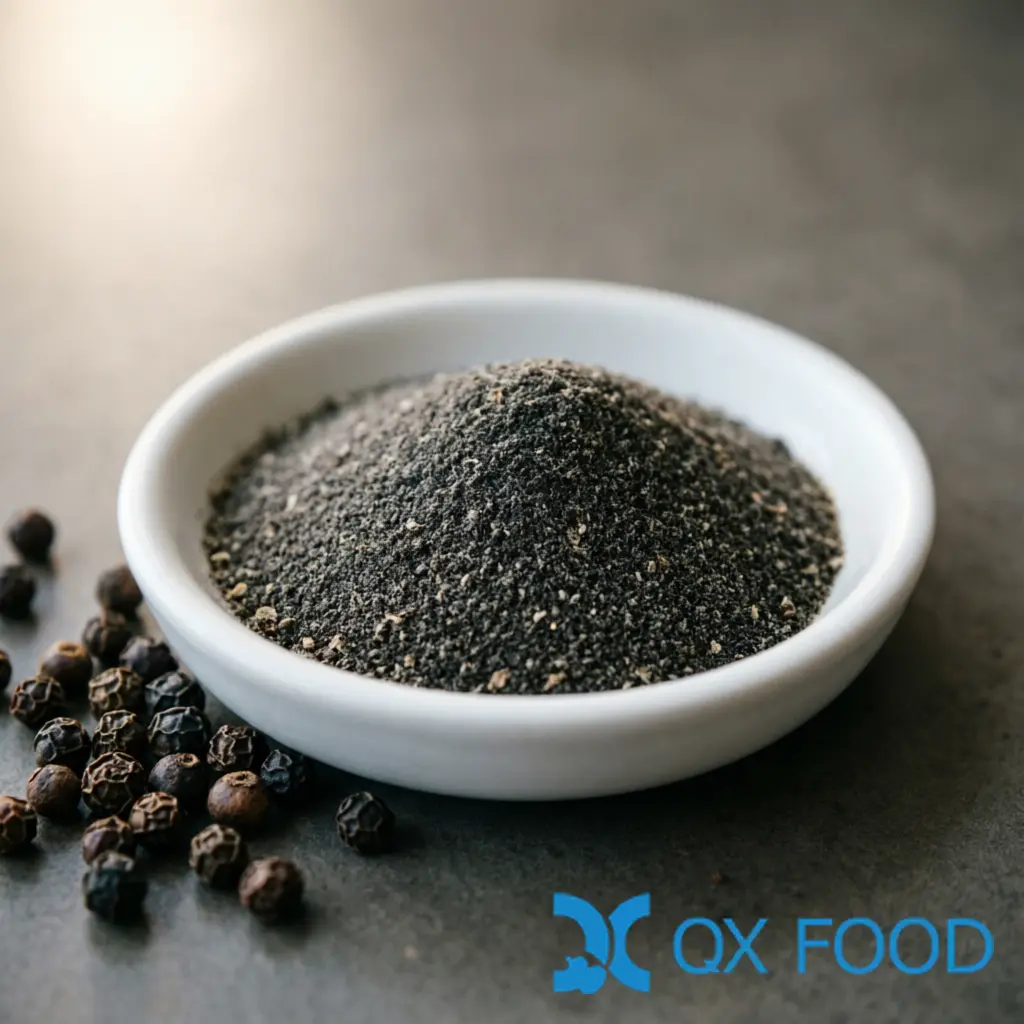
Pure black pepper powder BPP-K45 is made from unripe green pepper berries that are harvested, dried until the outer skin shrinks and darkens into the familiar black wrinkled surface, then cleaned, steam-blanched, dried again and ground to a fine powder. Nothing else goes in — no carrier agents, no anti-caking silica, no fillers. If your specification sheet needs to say “100% black pepper” without qualification, this is the grade that delivers that.
The difference between black pepper powder and white pepper powder starts with the outer pericarp. Black pepper retains it; white pepper removes it by soaking or mechanical decortication. Keeping the pericarp changes everything about this pure black pepper powder: it has a sharper, more complex aroma with piney top notes, a citrus brightness that grounds the heat, and a lingering warmth that white pepper does not produce. For food manufacturers working with pure black pepper powder in dry seasoning blends, that complexity is the reason you choose black over white — it fills more aromatic space at the same dosage.
The moisture spec on pure black pepper powder BPP-K45 runs at 4.03 g/100g against an 8.0 g/100g ceiling. That headroom matters in industrial blending: a drier ground black pepper flows more consistently through dosing equipment, stays free-flowing in multi-component dry mixes, and holds its volatile oil character longer in storage. The aerobic plate count sits at 90 CFU/g against a 10,000 ceiling — relevant if you are blending pure black pepper powder into a ready-to-eat product where microbial load across all ingredients adds up.
Specification Data — Standard Grade
| Parameter | Unit | Standard | Measured | Method |
|---|---|---|---|---|
| Moisture | g/100g | ≤8.00 | 4.03 | GB 5009.3 |
| Aerobic Plate Count | CFU/g | ≤10,000 | 90 | GB 4789.2 |
| Coliforms | MPN/g | ≤0.3 | <0.3 | GB 4789.3 |
| Total Nitrogen | g/100g | Standard requirements | 1.13 | GB 5009.5 |
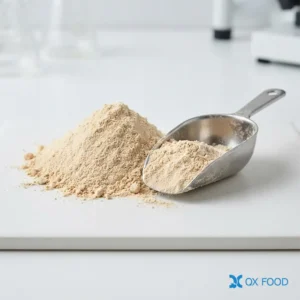
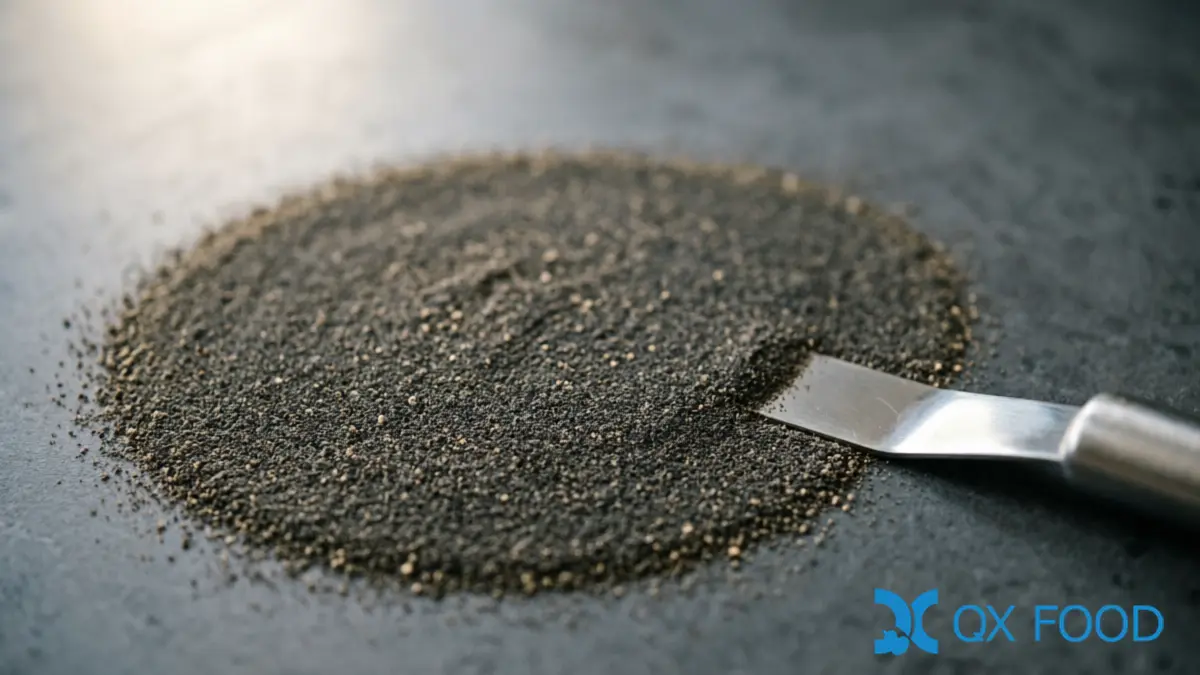
| Appearance | — | Fine powder, uniform color | Dark grey-black with visible lighter speckles | Q/HKSP 0002S |
| Odor & Taste | — | Characteristic pungent, aromatic | Compliant | Q/HKSP 0002S |
| Impurities | — | No foreign debris visible | No foreign debris visible | Q/HKSP 0002S |
The nitrogen value (1.13 g/100g) comes from the pepper’s natural protein and piperine alkaloid content — it is not supplemented. For a pure black pepper powder with no additives, the nitrogen reading acts as a rough indicator of the pepper’s intrinsic density: low-moisture, high-oil peppercorns produce a powder with more substance per gram than over-dried, lightweight stock. Piperine, the alkaloid responsible for black pepper’s pungency, typically runs 5–9% in good-quality whole peppercorns; the grinding process does not change that number, but it does determine how quickly the piperine disperses into a food matrix once the powder makes contact with moisture or fat.
Black Pepper vs White Pepper: Why the Pericarp Matters
If your formulation currently uses white pepper powder and you are evaluating whether pure black pepper powder could replace or complement it, the decision turns on three practical questions:
First, appearance. Pure black pepper powder leaves visible dark speckles in a light-colored sauce, soup or sausage emulsion. If your product’s visual spec cannot accept speckling, white pepper is the correct choice. If speckling is acceptable or even desirable — many dry-rub barbecue seasonings, steak coatings and artisanal sausage products deliberately show black pepper specks as a quality signal — then black pepper powder adds visual value.
Second, aroma complexity. Pure black pepper powder carries the volatile oils concentrated in the outer pericarp: pinene (pine-like), limonene (citrus), and caryophyllene (woody-spicy). White pepper, having lost the pericarp, leans more toward the musty, earthy side of the pepper profile. In a spice-forward application like a dry-rub steak seasoning, the difference between black pepper powder and white pepper powder is immediately noticeable. In a background application where pepper is one of fifteen ingredients in a compound seasoning blend, the difference may not register.
Third, heat profile. The piperine content is similar between black and white pepper from the same lot of berries. But pure black pepper powder’s heat feels sharper and more immediate on the palate because the volatile aromatics amplify the perception of pungency. White pepper’s heat is slower-building and more sustained — a difference that matters if your product’s heat curve has been calibrated to a specific sensory profile.
How Pure Black Pepper Powder Performs in Food Manufacturing
Meat Processing and Dry-Rub Seasoning
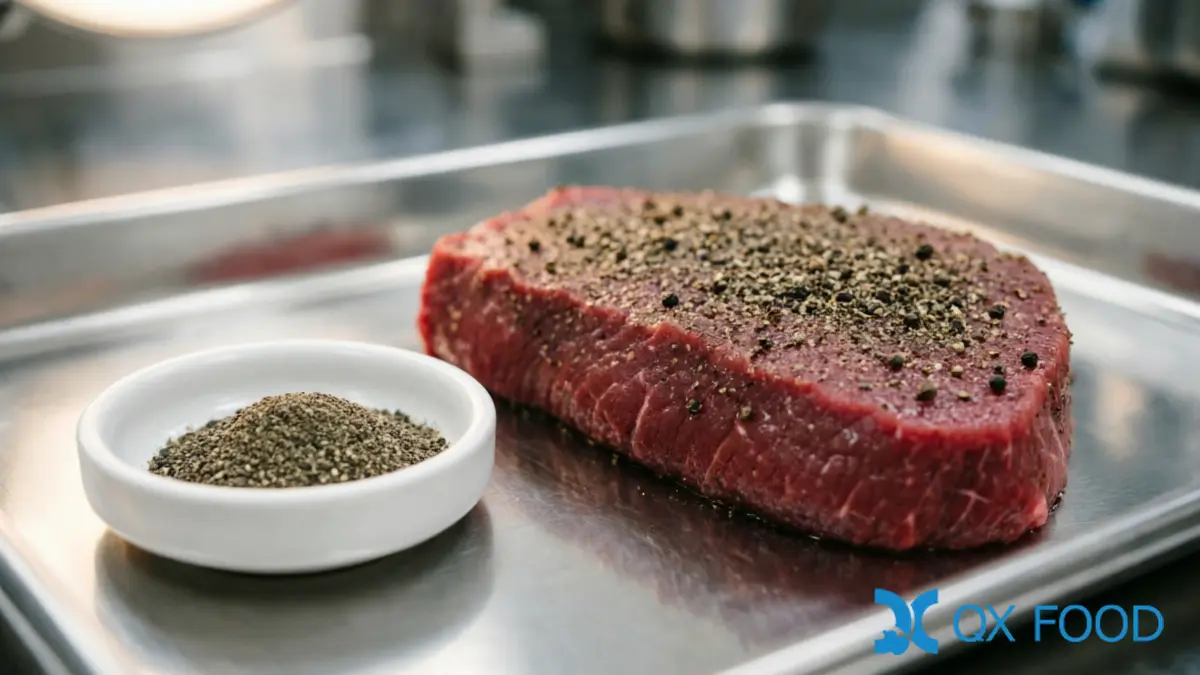
Pure black pepper powder is one of the few spices that works in both the pre-cook marinade and the post-cook finishing stages of meat processing. In a wet marinade for steak or grilled chicken, the ground black pepper disperses through the liquid phase and deposits piperine and volatile oils onto the meat surface. In a dry rub for barbecue or roast applications, the fine particle size of pure black pepper powder ensures even adhesion without creating hot spots — which is what happens when a coarse-grind black pepper seasoning clumps on the meat surface and delivers an uneven burn. Sausage manufacturers use ground black pepper at 0.2–0.5% of the meat block for a standard breakfast or Italian sausage; the speckled appearance that black pepper powder creates in the sausage cross-section is part of the product’s expected visual identity.
Sauce, Soup Base and Gravy Manufacturing
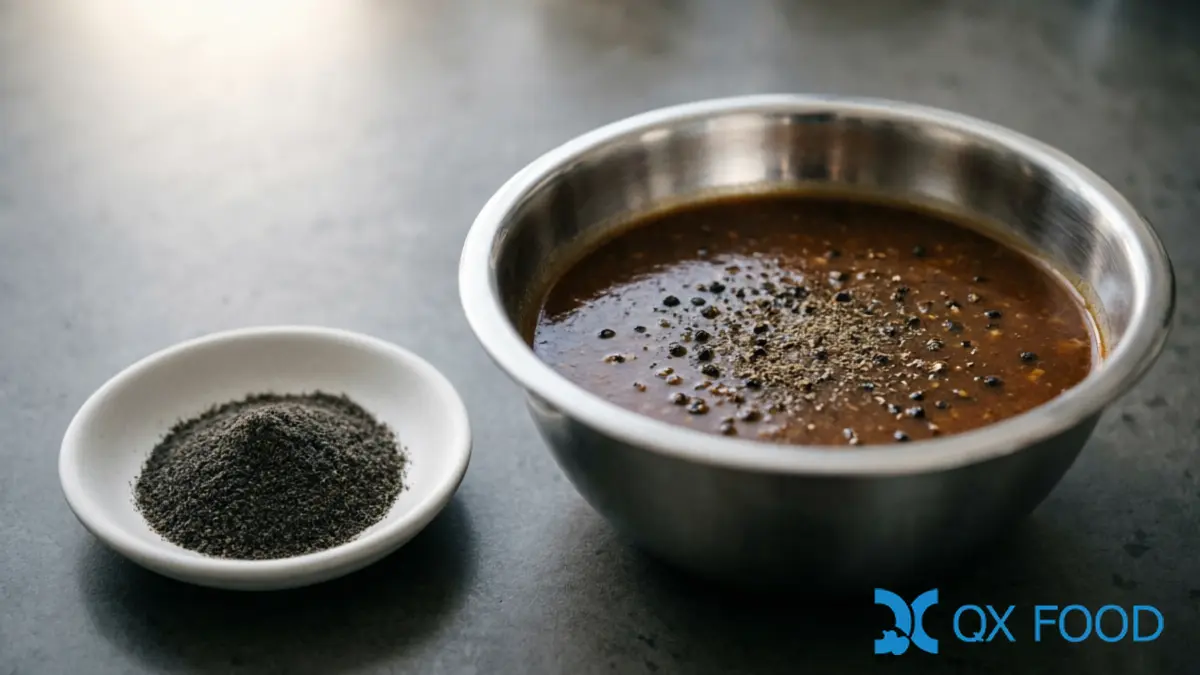
In liquid-based food systems — sauces, gravies, canned soups, ready-meal sauce sachets — pure black pepper powder hydrates and disperses within seconds of contact with warm liquid. Unlike whole peppercorns or cracked pepper, which need simmering time to extract, a fine black pepper powder releases its volatile oils into the sauce matrix almost immediately. This behavior is useful in retort-packed ready meals where the cook step happens inside the sealed pack: the black pepper powder dissolves into the surrounding liquid during the sterilization cycle and distributes evenly without requiring a separate pre-dispersion step.
Snack Seasoning and Coating Systems
In dry snack coating systems — potato chips, extruded snacks, coated nuts — pure black pepper powder participates in the same oil-based adhesion mechanism as any other powdered spice. The key variable is particle size: a powder that is too coarse will not stick to the oil film on the snack surface and will separate during packaging. Black pepper powder ground to a fine, uniform particle size avoids this separation problem and delivers a consistent black pepper seasoning intensity across the batch. Snack manufacturers who use black pepper powder in combination with salt, garlic powder and onion powder for a classic salt-and-pepper profile typically dose black pepper at 0.3–1.0% of the seasoning blend weight.
Table Seasoning and Consumer-Facing Blends
Pure black pepper powder is one half of the universal salt-and-pepper table condiment. For B2B buyers who supply the foodservice and retail channels, this grade provides a clean-label, single-origin black pepper spice that meets the ingredient-list expectations of both commercial kitchens and retail consumers. The absence of additives is the selling point here: a restaurant that grinds whole peppercorns tableside and a consumer reading a “pure black pepper” label are both rejecting products that add flow agents or fillers to the grind.
Particle Size, Packaging and Shelf Stability
Pure black pepper powder is a natural single-ingredient product. The flavor profile — piney top notes, citrus brightness, woody-spicy base — comes from the raw peppercorn itself, not from a post-grinding flavor addition. What can be adjusted for your production needs is the physical form: the standard grade is a fine powder that passes through routine industrial sieving, but buyers can discuss coarser particle size specifications, customized mesh requirements and packaging formats with the factory.
The standard packaging options cover the usual purchase volumes: sample-size aluminum foil bags for evaluation, mid-volume cartons for pilot runs and initial production, and bulk drums or sacks for full container loads. Custom packaging — private-label bags, branded cartons, specific bag sizes, multi-layer barrier packaging for extended shelf life — is part of the OEM conversation.
Storage requirements for pure black pepper powder are straightforward: sealed container, cool dry environment, no direct sunlight, no exposure to strong odors. The natural volatile oils in ground black pepper are sensitive to oxygen and light over extended storage. Under proper conditions — sealed bag, below 25°C, humidity below 60% — the shelf life is 18 months from production date. If your production facility operates in a high-humidity environment, consider vacuum-sealed or nitrogen-flushed packaging for longer storage intervals.
Quality Systems and Documentation
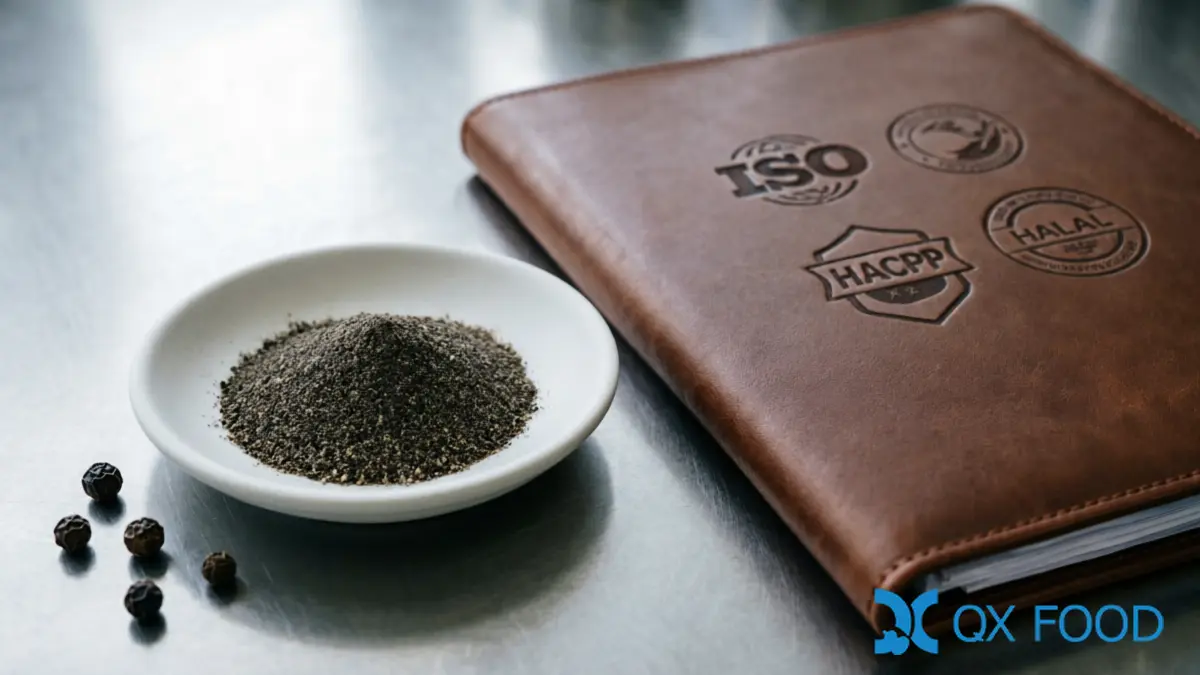
The production facility for pure black pepper powder BPP-K45 operates under an integrated quality management system:
- ISO 9001:2015 — quality management system
- ISO 22000:2018 — food safety management system
- HACCP — hazard analysis and critical control points
- HALAL — certified by an accredited halal certification body
Each shipment of pure black pepper powder is accompanied by a batch-specific certificate of analysis covering moisture, aerobic plate count, coliforms and sensory parameters. Additional testing — heavy metals, pesticide residues, piperine content by HPLC, microbiological panels beyond the standard COA — can be arranged on request. The QA team confirms availability and lead time for any extra testing before the order proceeds.
Black pepper powder traded internationally falls under Codex Alimentarius guidelines for spices and dried aromatic herbs. For import clearance documentation, the standard export package includes the commercial invoice, packing list, batch COA, certificate of origin, and copies of active certifications. Any country-specific requirements — a health certificate, free-sale certificate, or specific lab report required by your national food safety authority — should be communicated early in the inquiry process.
Related reading: Black pepper’s functional roles in sausage and processed meat seasoning.
Frequently Asked Questions
What is the difference between black pepper powder and white pepper powder in a food manufacturing context?
Black pepper powder retains the outer pericarp of the peppercorn, which carries the volatile oils responsible for the piney, citrusy and floral top notes, and gives the powder a visible dark speckled appearance. White pepper powder has the pericarp removed, producing a lighter color and a more earthy, sustained heat profile. In manufacturing, the choice between pure black pepper powder and white pepper powder depends on three things: whether the product’s visual specification allows dark specks, whether the aromatic profile needs to be complex and immediate (black pepper) or background and sustained (white pepper), and whether the target market has a cultural preference for one over the other.
What is the piperine content of pure black pepper powder BPP-K45 and can you provide a test report?
The standard production grade of pure black pepper powder is made from quality peppercorns that carry piperine in the typical 5–9% range on a dry-weight basis. Piperine content is not part of the routine factory COA, but it can be tested by HPLC on request — if piperine specification is important to your formulation, mention it when you send the inquiry so the QA team confirms current batch data and turnaround time for the test before sampling begins. The total nitrogen reading on the standard COA (1.13 g/100g) provides a rough proxy for the powder’s density and intrinsic alkaloid load, but it does not substitute for a direct piperine assay.
Does pure black pepper powder contain any additives, anti-caking agents or fillers?
No. Pure black pepper powder BPP-K45 is 100% ground black pepper — no silicon dioxide, no maltodextrin, no rice flour, no carrier agents of any kind. If your ingredient label needs to read “black pepper” and nothing else, this grade supports that. The moisture content (4.03 g/100g) is low enough that the powder stays free-flowing in standard dry-blend operations without the help of flow agents.
How should I store pure black pepper powder to maintain volatile oil character during extended storage?
Pure black pepper powder should be stored in a sealed container in a cool, dry environment below 25°C with humidity below 60%. Direct sunlight and exposure to strong odors should be avoided — the volatile oils in ground black pepper are sensitive to both light and ambient aromas. Under these conditions, the shelf life is 18 months. For longer storage intervals or high-humidity production environments, vacuum-sealed or nitrogen-flushed barrier packaging can be discussed at the order stage.
Can I get pure black pepper powder in a coarser grind for dry-rub applications?
Yes. The standard grade is a fine powder, but coarser particle size specifications — closer to a restaurant-style coarse grind that provides visible texture in dry rubs and steak coatings — can be discussed. This is a physical specification change (sieving mesh adjustment), not a formulation change, and it can normally be confirmed without extended sample rounds. Mention the target particle size or reference a sample when you inquire.
Is this pure black pepper powder suitable for Halal-certified production?
Yes. The manufacturing facility holds active Halal certification. Pure black pepper powder is a single-ingredient plant product — black pepper berries, cleaned and ground — and the production process involves no animal-derived materials or ethanol at any step. The Halal certificate is renewed on schedule and the current copy is included in the standard documentation package.
What is the minimum order quantity and how does the sampling process work?
The standard MOQ for pure black pepper powder is 1 metric ton. For first-time evaluation, a sample is provided from current production stock with a batch COA so your R&D team can test the powder in your application. If the standard particle size or packaging needs adjustment, those details are confirmed at the sample or pilot stage before commercial production begins. The sequence — standard sample, pilot run (if customized), commercial order — is the normal way most buyers work with this ingredient.
Explore Our Natural Spice Powder Range
Pure black pepper powder BPP-K45 sits in the Natural Plant Powders family alongside other single-origin spice powders. If you are sourcing multiple spices for a seasoning blend or production line, the following grades are the ones buyers most often evaluate together:
Cinnamon Powder CP-K38 — pure ground cassia bark for baking, beverage and meat processing applications.
Turmeric Powder TP-K37 — curcumin 4.5 g/100g, used as a natural food color and seasoning base.
Garlic Powder GP-B06 — pure ground garlic, a foundational savory spice for snack seasonings and meat processing.
Onion Powder OP-B03 — spray-dried onion powder for dry seasoning blends and soup bases.
Ginger Powder DGP-W01 — pure ground dried ginger for bakery, beverage and savory seasoning applications.
For a broader view of this category, the Natural Plant Powders category page lists the full range across spice, vegetable and botanical powder lines.