
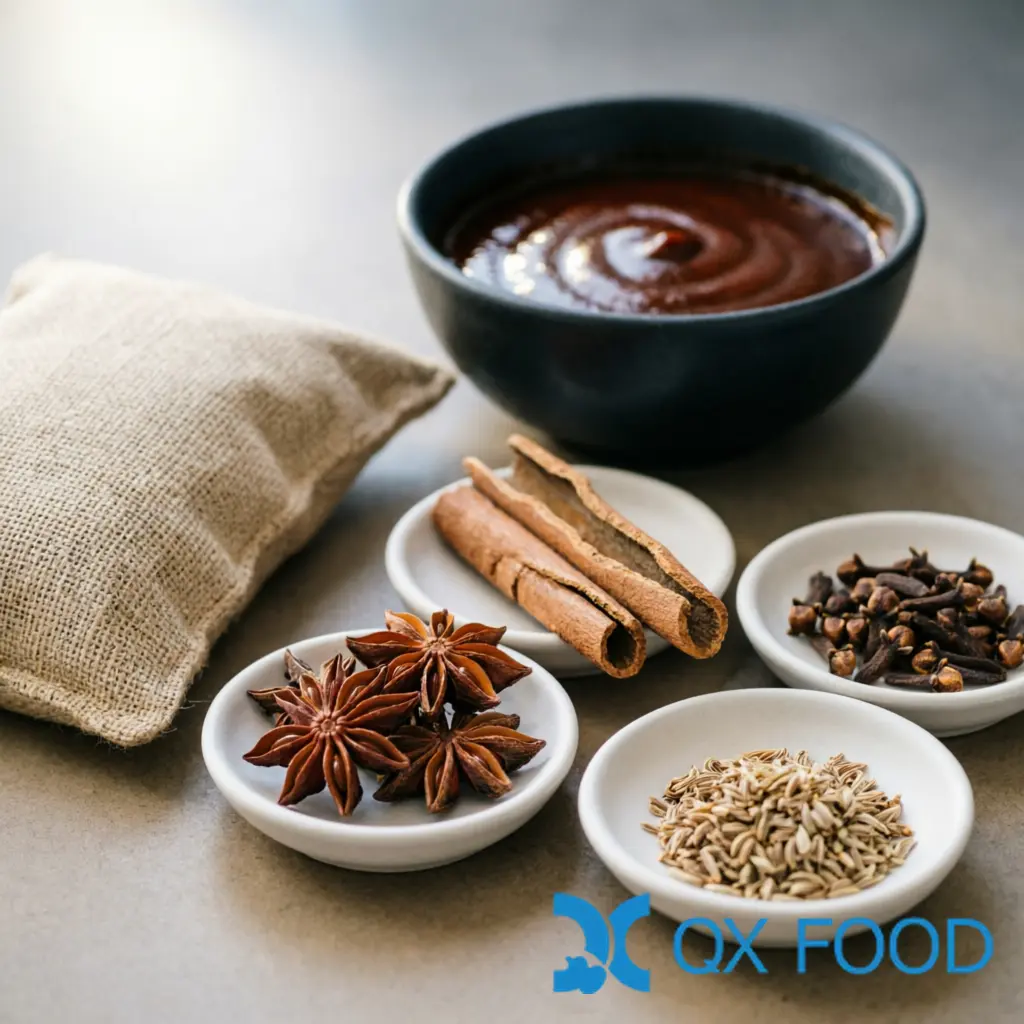
Braised Meat Spice Packs: Industrial Flavor Consistency for Ready-Meal Production
Braised meat spice packs are the flavor engine of a ready-meal and processed-meat category served by a spices and seasonings market worth USD 21.14 billion in 2025, projected to reach USD 32.88 billion by 2034 at a 5.16% CAGR (Fortune Business Insights, 2025). For braised beef plants, ready-meal producers and central kitchens, the spice pack decides whether batch 400 tastes like batch 001 — and industrial flavor consistency is a sourcing and formulation discipline, not luck. This guide covers the architecture of braised meat spice packs, the role of each component, and how to build a pack that survives production scale.
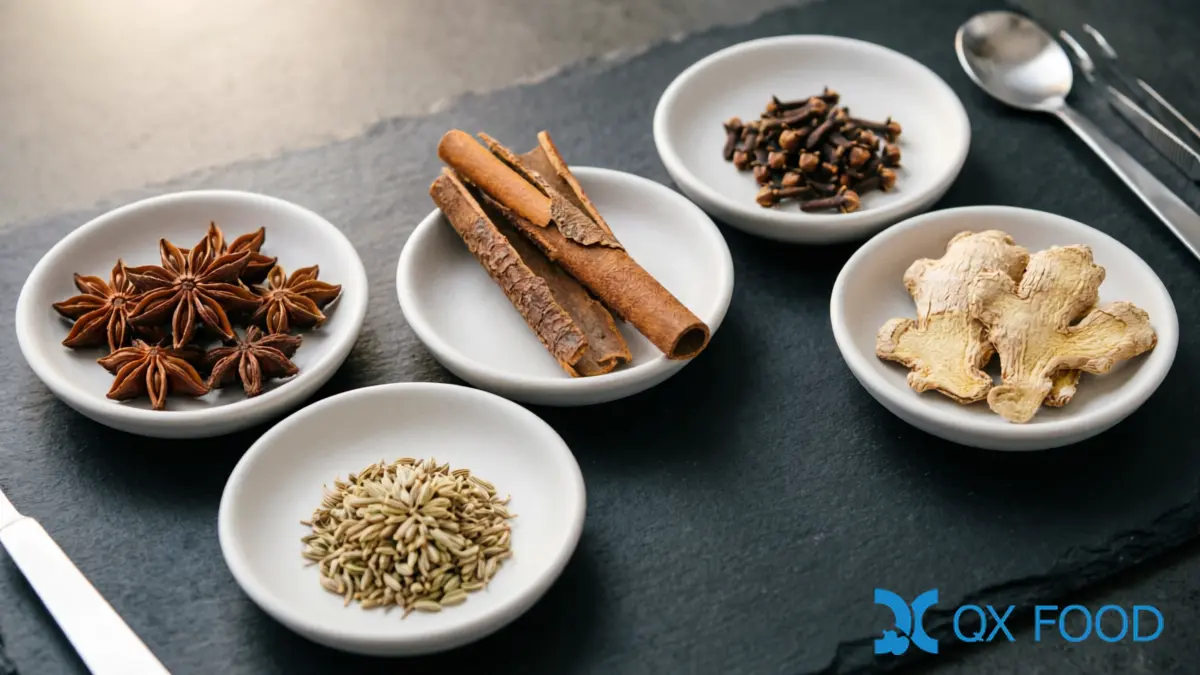
The Architecture of a Braised Meat Spice Pack
A classic Chinese braising spice pack combines a recognizable core with product-specific layers. The core appears in nearly every regional braise — from red-braised pork to five-spice beef — and consists of:
- Star anise — the licorice-sweet anchor of the braise; whole pods for soup-bag formats, ground for paste and injection systems.
- Cassia bark — the warm, sweet-bark depth that defines the “braised” character; sticks for visible formats, powder for blends.
- Cloves — a small-dose aromatic that rounds the blend and suppresses greasy mouthfeel.
- Fennel seed — the cooling anise-adjacent note that balances the heavy, rich profile.
- Sichuan peppercorn — the numbing (ma) note in mala-style braises.
- Dried ginger — the pungent warmth that complements the sweet spices and aids deodorizing.
Whole star anise STA-23, cassia powder CP-B04, clove powder CLO-D11, fennel powder FP-B01 and dried ginger DGR-27 form the QXFOOD core set for braised meat spice packs, each with documented volatile oil content and mesh specification.
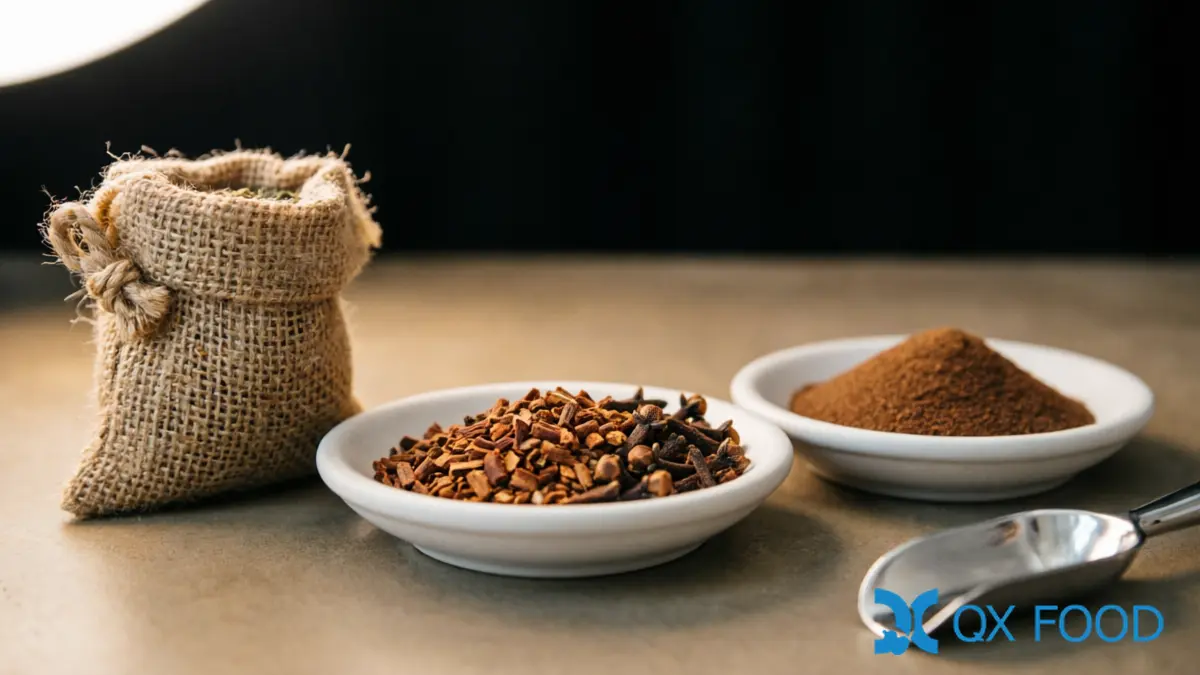
Whole, Coarse or Ground: Format Follows Process
The spice pack format must match the production step — this decision drives every other specification:
| Format | Best Fit | Why |
|---|---|---|
| Whole spice bag | Traditional braising, soup-bag products, central kitchen stock | Slow flavor release, visual authenticity, easy removal before packing |
| Coarse cut | Ready-meal braised meat with visible ingredients | Flavor extraction with controlled texture |
| Ground blend | Emulsion, injection and glaze systems | Precise dosing, even distribution, fast flavor release |
For ground braised meat spice blends, mesh consistency is a contract item. Clove powder CLO-D11 at 80 mesh and pure white pepper powder WPP-K44 at 80-120 mesh are typical braising-blend grades; a blend that dusts on the line or clumps in storage costs more than the mesh premium.
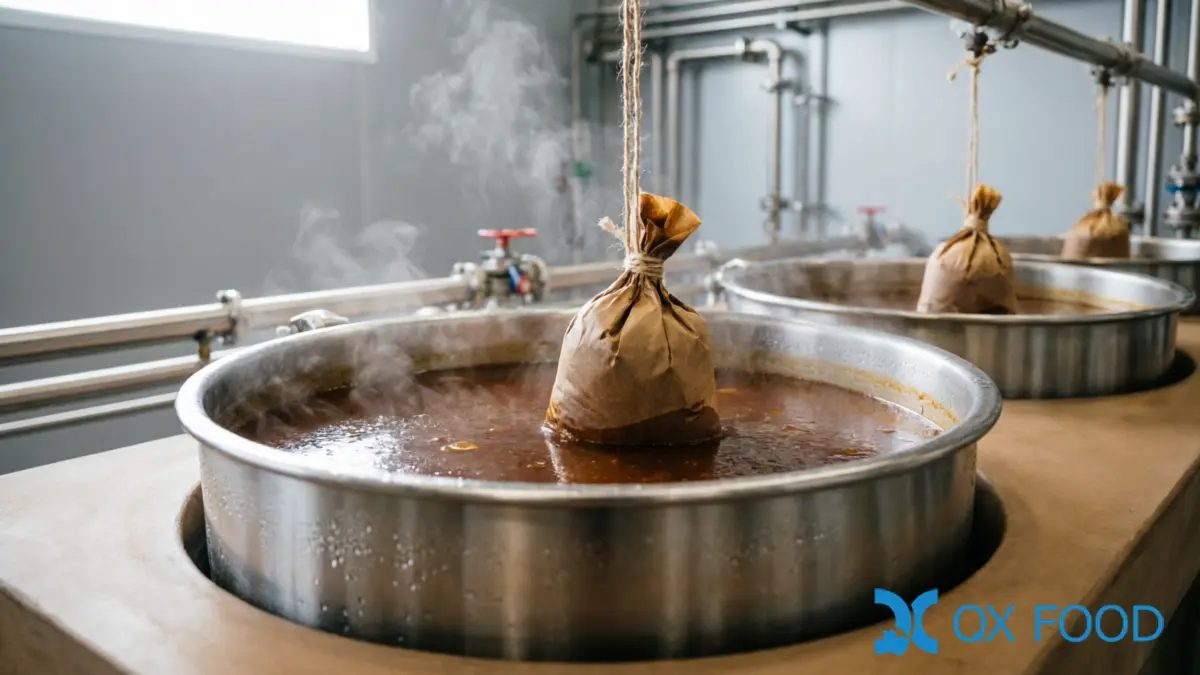
Flavor Consistency Across Batches: The Reuse and Aging Problem
Traditional braising has a hidden variable that industrial production must control: the master stock is reused and aged, and its flavor changes with every cycle. Industrial braised meat lines handle this in two ways:
- Controlled stock management — standardize the spice pack weight, replacement schedule and simmer time so the stock reaches a repeatable equilibrium.
- Fresh-pack formulation — for single-batch products, formulate the spice pack to deliver the full profile in one cycle, eliminating stock aging as a variable.
Either path depends on component-level consistency: if the star anise lot varies in trans-anethole content or the cassia lot drifts in volatile oil, the equilibrium moves and the product drifts. This is why volatile oil verification on every lot is the core discipline of braised meat spice pack sourcing.
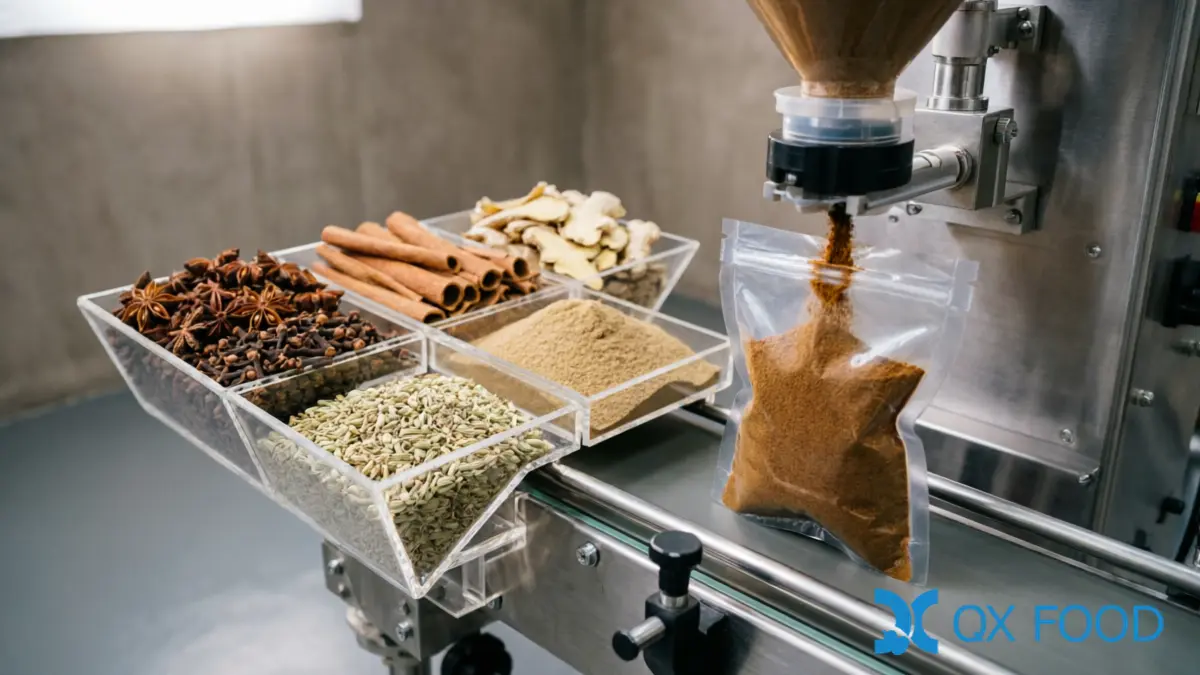
Pack Design for Production: Weight, Extraction and Removal
Industrial braised meat spice packs are engineered, not assembled. Three design parameters separate production-grade packs from retail spice bags:
- Fixed weight per pack — each pack carries a defined spice weight so the extraction ratio is repeatable; typically 10-30 g per 10 kg of meat depending on the target intensity.
- Extraction surface — whole pods extract slowly; coarse cuts and ground blends extract faster. Match the cut to the simmer window: short-cycle products need finer cuts, long braises can use whole spice.
- Removal design — packs must be removable without bursting or leaking fines into the product; heat-sealed woven bags with controlled pore size are the industrial standard.
The research on prepackaged braised meat processing confirms that processing technique — including spice delivery — critically determines the quality of the final product (MDPI Foods, 2025). For a peer-reviewed overview, see the prepackaged braised meat process and quality study.
Regional Profiles: One Core, Many Signatures
The braised meat spice pack core stays constant while the signature layer changes by region and product:
- Sichuan red braise — core plus heavy Sichuan peppercorn, dried chili and bean paste; heat and ma dominate.
- Five-spice beef — core plus more fennel and a touch of licorice root; balanced sweet-aromatic.
- Cantonese soy braise — core plus more cassia and star anise, less pepper; sweet, dark, glossy.
- Luzhou-style — core plus cardamom and bay leaf; layered aromatics.
For ready-meal producers serving multiple markets, the practical approach is one verified core supply chain plus a small signature-spice library — garlic GP-W04, black pepper BPP-K45 and star anise STA-23 all carry the COA data needed to freeze a regional formula.
Sourcing Braised Meat Spice Packs: The Five-Point Check
When qualifying a braised meat spice pack supplier, run the same five checkpoints used for any spice procurement, applied to the pack as a system:
- Component COAs — volatile oil, moisture, mesh and microbiology per spice, not just a blended certificate.
- Blend spec — declared weight per component, blending tolerance, and a locked reference sample.
- Pack integrity — pore size, seam strength, fines leakage test.
- Traceability — lot-level origin for each component, not just the finished pack.
- Stability data — volatile oil retention of the finished pack at 3 and 6 months.
QXFOOD supplies the component library — star anise STA-23, cassia CP-B04, clove CLO-D11, fennel FP-B01, ginger DGR-27, garlic GP-W04 and black pepper BPP-K45 — with per-lot COAs, ISO9001, ISO22000, HACCP and HALAL certification, and 1 kg samples for pack-design trials.
For the full category view, visit the Raw Spices & Herbs category page.
Request braised meat spice samples through the contact form on this page and our application team will support pack design against your production process.
Braised profiles belong to the broader processed-meat family: compare the sausage and processed meat seasoning guide, or step up the heat with the hot pot spice architecture guide.
For the full grade and adulteration checklist on the anchor spice, our star anise procurement guide walks through volatile oil specs and species verification.
Frequently Asked Questions
What spices are in a braised meat spice pack?
The core is star anise, cassia, cloves, fennel and ginger, with Sichuan peppercorn for mala styles. Regional signatures add licorice root, cardamom, bay leaf or dried chili. Whole formats suit soup-bag braising; ground blends suit injection and glaze systems.
Whole spice or ground blend for industrial braising?
Whole spice bags suit traditional long braises and central kitchen stock; ground blends suit short-cycle, emulsion and injection processes where precise dosing matters. Many lines run both — whole packs for the visible product, ground for the base seasoning.
How do I keep braised meat flavor consistent across batches?
Standardize pack weight, simmer time and replacement schedule, and verify volatile oil on every component lot. Stock-based braising needs controlled aging; fresh-pack formulation removes stock aging as a variable entirely.
What mesh should braised meat spice blends use?
80 mesh for cloves and pepper in ground blends is typical; injection-grade systems need finer material. Match the cut to the simmer window — short-cycle products need finer cuts for faster extraction, long braises can use whole spice.
How much spice per pack for industrial braising?
Typically 10-30 g of spice per 10 kg of meat, depending on target intensity and cycle length. The pack weight should be fixed per formula so the extraction ratio is repeatable across batches.
What should a braised meat spice COA include?
Per-component volatile oil, moisture, mesh and microbiology, plus pack-level weight tolerance and stability data. Lot-level traceability for each component matters more than a single blended certificate.
How long does a braised meat spice pack keep its flavor?
Whole-spice packs retain volatile oil for 12-18 months under cool, sealed storage; ground blends decay faster and should be rotated within 6-9 months. Verify with volatile oil testing at 3 and 6 months rather than calendar dates.