
Vinegar Powder in Food Manufacturing: Applications and Formulation Guide
Vinegar powder is the dry form of vinegar — spray-dried, free-flowing and stable — that lets manufacturers put authentic acidic character into products where liquid vinegar cannot go. The global vinegar powder market is valued at USD 1,595.7 million in 2025 and is projected to reach USD 3,500 million by 2035, driven by snack coatings, dry seasoning blends and clean label preservation. For food manufacturers, vinegar powder solves a recurring problem: how to deliver tartness, fermented acidity and flavor balance in powders, sachets and dry mixes. This guide covers the types, the application logic, the formulation rules and the sourcing parameters for vinegar powder in industrial food production.
Why Vinegar Powder Instead of Liquid Vinegar
The vinegar powder vs liquid vinegar decision is an engineering choice as much as a flavor choice. Liquid vinegar brings water, logistics weight, packaging complexity and shelf-life constraints; vinegar powder brings concentration, stability and dry-system compatibility. The advantages that matter in production:
- Dry systems — seasoning powders, spice blends, sachets and dry marinade mixes need vinegar powder because liquid would clump, activate reactions or destabilize the blend.
- Stable acidity — the acid is carried on a carrier (maltodextrin or dextrose); titratable acidity stays consistent across storage and transport.
- Clean label fit — vinegar powder carries “vinegar powder” or “distilled vinegar” on the label, aligning with clean label positioning.
- Weight and logistics — 25 kg bags of powder replace drum quantities of liquid, cutting freight and warehouse footprint.
- Heat behavior — powder tolerates dry blending and coating processes without the evaporation losses of liquid acid.
In the seasoning market, the powder segment alone was valued at USD 18.1 billion in 2024 and is growing at 5.5% CAGR — vinegar powder is one of the functional acids riding that growth (Global Market Insights, 2025).
Vinegar Powder Types and Their Applications
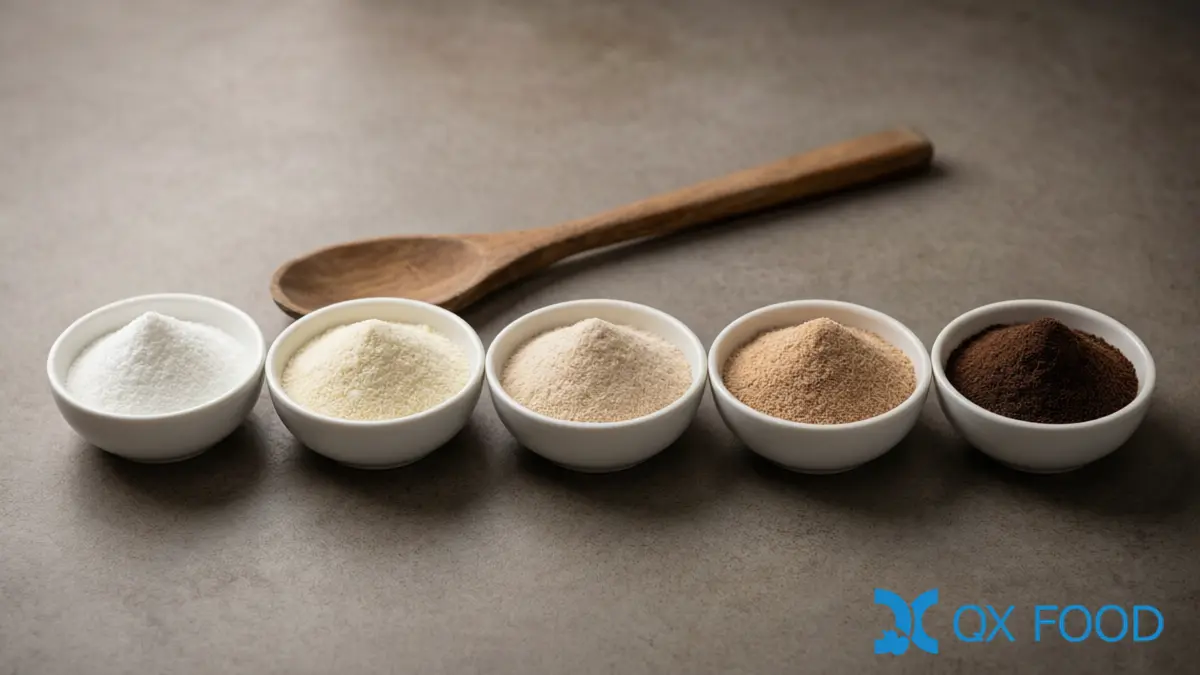
Not all vinegar powder is the same — the source vinegar defines the flavor character, and the carrier defines the behavior:
| Type | Flavor Character | Primary Applications |
|---|---|---|
| White distilled vinegar powder | Clean, sharp, neutral tartness | Salt and vinegar snack coatings, pickled-flavor seasonings, acidity adjustment in dry blends |
| Brewed vinegar powder (mature/rice/white) | Fermented depth, rounded sourness | Instant noodle seasonings, sauce sachets, Asian cuisine profiles |
| Malt vinegar powder | Malty, robust tang | Chips and savory snacks, fish and chip seasonings, burger condiment blends |
| Apple cider vinegar powder | Fruity, mild tang | Functional foods, health-oriented snacks, salad dressing dry mixes |
| Balsamic vinegar powder | Sweet-sour, complex | Premium snack coatings, dipping blends, vinaigrette sachets |
The malt vinegar powder market alone is valued at USD 249.4 million in 2025, growing at 5.8% CAGR through 2034, with snacks and savory products as the lead application (Growth Market Reports, 2025). QXFOOD’s brewed vinegar powder series covers mature vinegar, fragrant vinegar, white vinegar and red vinegar powders for instant seasoning and snack systems.
Snack Coatings: The Salt and Vinegar System
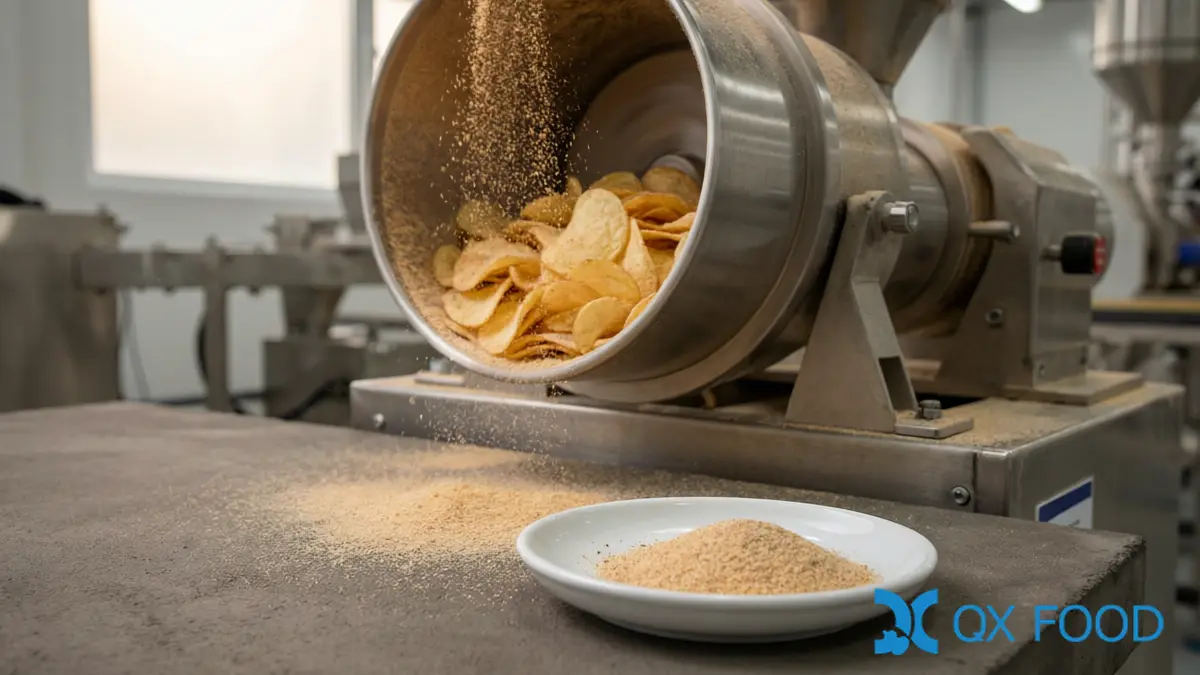
Salt and vinegar is the most recognizable vinegar powder application in snacks — and the most demanding to formulate. The coating system must deliver the sour punch, hold it through the coating process and stay stable in the bag:
- Acid level — typical titratable acidity of 5-15% in vinegar powder; the target sourness drives the dosage and must be balanced against salt and the base flavor.
- Coating adhesion — vinegar powder blends with oil-based coatings differently than sugar-based ones; particle size and oil absorption matter.
- Moisture management — hygroscopic blends need flow agents; vinegar powder can cake in high-humidity lines if the carrier and anticaking treatment are not matched.
- Heat stability — acid is stable in coating tumblers, but formulations with caramelized sugars need the acid added post-toast.
For the adhesion mechanics and coating line parameters in snack production, see our snack seasoning application guide — vinegar powder fits the same tumble-coating framework with acidity as the lead note.
Dry Marinades and Pickle Seasonings
Vinegar powder is the functional acid in dry marinade mixes and pickle-flavor seasonings, where liquid vinegar is impossible and citric acid alone tastes flat:
- Dry marinades — rehydrated on the meat surface, vinegar powder releases acetic acid to tenderize and flavor; buffered versions control the pH swing.
- Pickle-flavor seasonings — dill pickle, bread and butter pickle and spicy pickle profiles all build on a vinegar powder base with dill, garlic and spice accents.
- Salad dressing sachets — vinegar powder plus oil powder and herbs reconstruct a vinaigrette when the consumer adds water.
- Clean label preservation — dry vinegar contributes to the preservative system in dry-cured and pickled-style products without liquid handling; the vinegar-based preservation systems market is expanding at 5.6% CAGR from USD 328 million in 2025 (Global Market Insights, 2025).
The dried onion and garlic powders that complete these systems are covered in QXFOOD’s dehydrated garlic powder and onion powder — the classic pickle-seasoning base trio is vinegar powder, dill, garlic and onion.
Instant Foods and Sauce Sachets
Instant noodle seasoning and sauce sachet systems use vinegar powder for the sour and fermented notes that liquid vinegar cannot survive in:
- Instant noodle seasonings — brewed vinegar powder adds the fermented sourness characteristic of hot and sour profiles; it blends with chili, garlic and soy sauce powder.
- Sauce sachets — dry sauce mixes need complete water-free systems; vinegar powder replaces liquid acid one-for-one in the dry recipe.
- Hot and sour soup bases — vinegar powder plus white pepper is the classic pairing; the acid arrives with the hot water rehydration.
QXFOOD’s vinegar powder range includes aged vinegar powder VNP-H08 and rice vinegar powder VNP-H07 developed specifically for instant seasoning systems, complementing the soy sauce powder for sauce packets in dry noodle applications.
Formulation Rules and Sourcing Parameters
Formulating with vinegar powder follows five rules, and buying it follows five parameters:
- Acidity first — always spec titratable acidity (as acetic acid) and dose by acid contribution, not by powder weight.
- Carrier awareness — maltodextrin-based powders are sweeter and more hygroscopic; dextrose carriers brown differently in heat.
- Flow and caking — demand anticaking treatment and flow tests for high-humidity lines.
- pH control — buffered vinegar powder for applications where a pH swing would destabilize protein or starch systems.
- Label match — verify the declared ingredient name matches your label claim (vinegar powder vs distilled vinegar vs brewed vinegar).
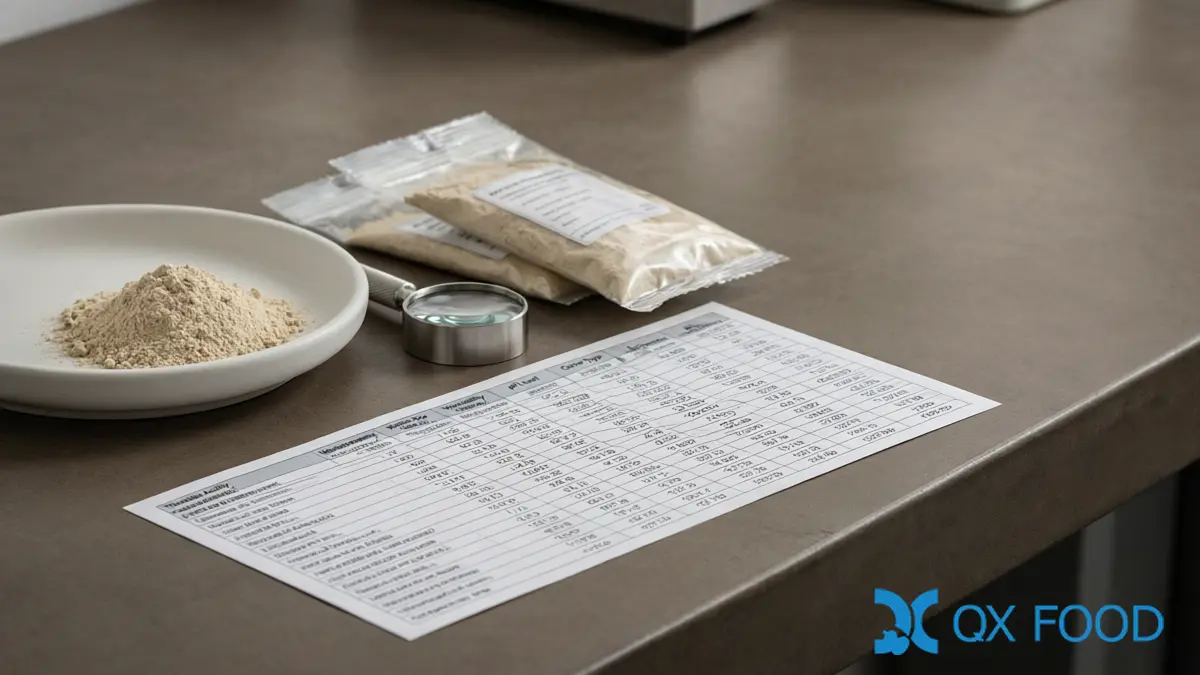
Sourcing parameters on the COA: titratable acidity (%), moisture, bulk density, particle size, carrier type, flowability, microbiology, and the vinegar source. QXFOOD ships the full brewed vinegar powder series with per-lot COAs covering these parameters.
Request vinegar powder samples for your snack coating or seasoning trials through the contact form on this page, and our application team will support the formulation.
Frequently Asked Questions
What is vinegar powder used for in food manufacturing?
Vinegar powder is used for dry systems where liquid vinegar cannot go: salt and vinegar snack coatings, dry marinades, pickle-flavor seasonings, instant noodle seasonings, sauce sachets and dry salad dressing mixes. It delivers stable acidity and fermented flavor in powder form.
Is vinegar powder the same as citric acid?
No. Vinegar powder delivers acetic acid with the fermented character of vinegar; citric acid is a straight, sharp acid with no fermented notes. They can be blended, but they are not interchangeable in flavor terms.
How is vinegar powder made?
Liquid vinegar is spray-dried onto a carrier (typically maltodextrin or dextrose) to create a free-flowing powder. The acid is carried rather than encapsulated, so titratable acidity is the key specification.
Does vinegar powder dissolve in water?
Yes — vinegar powder disperses and dissolves when water is added, releasing the acetic acid and reconstructing liquid vinegar flavor. This makes it suitable for dry marinades and rehydrated sauces.
How much vinegar powder equals liquid vinegar?
It depends on the titratable acidity of the powder and the acid level of the liquid. As a rule of thumb, 1 kg of 10% acidity vinegar powder delivers roughly the acid of 2 kg of 5% liquid vinegar, but always dose by measured acidity, not by weight.
Does vinegar powder cause caking in seasoning blends?
It can — vinegar powder is hygroscopic. Proper anticaking treatment, moisture-proof packaging and flow agents in the blend prevent caking. Specifying flowability and humidity resistance on the COA is part of buying correctly.
Is vinegar powder clean label?
Yes — vinegar powder declares as vinegar powder or distilled vinegar plus the carrier, which are recognizable ingredients. It is widely used in clean label snack and seasoning systems as a functional acid.