
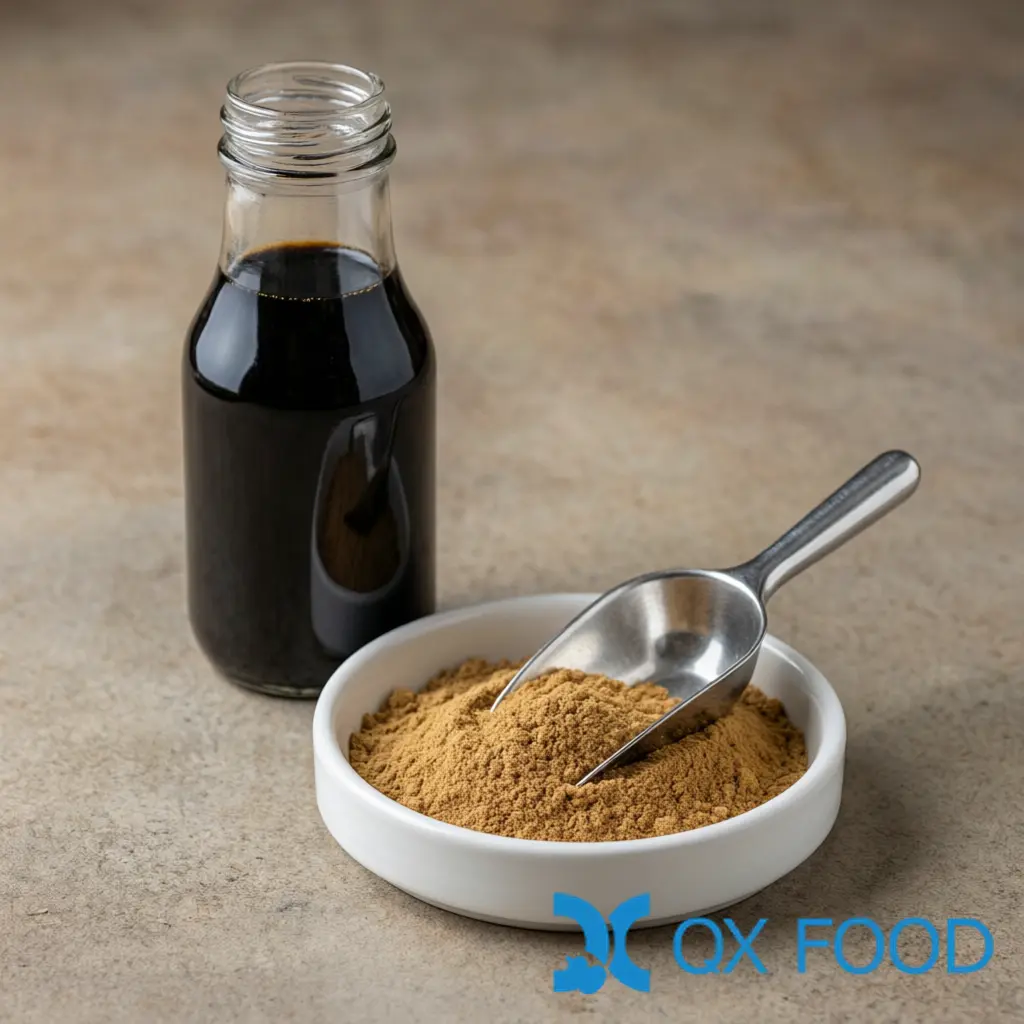
Liquid versus powder is primarily a process and handling decision, but form alone does not determine flavor performance. Different HVP grades can also differ in protein source, salt, nitrogen specification, color, sensory direction and finishing process. For formulators choosing HVP liquid vs powder, the useful comparison is therefore between actual grades at equivalent finished-product performance, not between a generic liquid and a generic powder.
Form Is a Process Variable, Not a Flavor Ranking
Form changes how the ingredient enters the process: a liquid can be metered into a wet system, while a powder is weighed or dry-fed. Neither form is inherently stronger or more flavorful. Sensory performance belongs to the selected grade and to the finished product, not to the word liquid or powder.
Liquid and Powder Are Finished Forms, Not One Identical Process Route
Some powder HVP grades are produced by drying a liquid hydrolysate, while other finished grades may include additional blending or standardization steps. Liquid and powder should therefore be treated as finished-product forms rather than as proof of one identical upstream process route. The HVP production process guide explains how process history, not the form label, carries the technical information.
What Actually Changes Between the Forms
| Variable | Liquid | Powder |
|---|---|---|
| Physical form | Pumpable liquid | Dry particulate |
| Water and solids | Grade-specific | Grade-specific |
| Addition method | Liquid dosing | Weighing or dry feeding |
| Wet-system use | Often direct | May require dissolution or dispersion |
| Dry-system use | Requires formulation or process accommodation | Usually more direct |
| Storage | Selected-grade specification | Selected-grade specification |
| Freight | Carries more water where solids are lower | Often less transported water |
Wet Process Does Not Automatically Mean Liquid
A wet sauce, soup base or marinade can use a powder grade where it disperses or dissolves adequately under the process conditions. Reconstitution behavior should be tested rather than assumed from form alone; for example, fat content has been shown to influence dissolution kinetics in food powders (effect of fat content on food powder dissolution). The practical questions are dissolution or dispersion behavior, dosing and finished sensory performance.
Common starting directions and what still needs confirmation:
| Application | Common starting direction | What must be confirmed |
|---|---|---|
| Wet sauces | Liquid or powder | Dissolution or dispersion, dosing, sensory performance |
| Injection brines | Liquid or fully compatible powder | Viscosity, sediment, needle passage, brine compatibility |
| Dry seasoning | Usually powder | Blend uniformity, flow, moisture interaction |
| Snack seasoning | Usually powder | Complete-blend and coating-line behavior |
| Soup base | Either, depending on format | Wet or dry process and finished product |
| Instant noodles | Powder for dry sachet; liquid possible in wet component | Seasoning format and preparation system |
Dry Process Usually Favors Powder, but It Is a Process Constraint
For a conventional finished dry seasoning blend, powder HVP is usually the more practical form because it avoids introducing a liquid phase. If a liquid savory ingredient is to be used, the manufacturer has to accommodate it through the formulation or an additional processing step rather than treating it as a direct dry-blend replacement.
Injection Compatibility Is Grade-Specific
For injection brines, liquid can simplify handling, but compatibility must still be confirmed grade by grade. A powder may also be suitable if it dissolves or disperses adequately in the actual brine and does not create sediment, viscosity or needle-passage problems. The HVP in processed meat guide covers the injection-brine questions in detail.
Storage and Shelf Life Come From the Selected Grade
Liquid and powder forms create different handling requirements, but shelf life and storage temperature should be taken from the selected product specification rather than inferred from form alone.
For liquid grades, evaluate container handling, pumping, sanitation and storage conditions. For powder grades, evaluate moisture exposure, flow, caking and resealing after opening, with the powder caking prevention guide covering the dry-system discipline. Microbiological stability should likewise be assessed from the actual product specification, formulation and validated storage conditions rather than from solids or form alone.
Compare Cost at Equivalent Finished-Product Performance
Per-kilogram price is not sufficient for comparing liquid and powder HVP. The comparison should account for the selected grade’s solids, salt and required dose, together with freight, storage, handling and any dissolution or pumping steps.
Most importantly, liquid and powder grades should be compared at equivalent finished-product sensory performance rather than by assuming that one kilogram of dry solids represents one kilogram of flavor value. Bulk density affects package volume, not the flavor concentration of a given weight, and dry solids include salt and any carrier or other standardized solids alongside the savory components.
Freight comparisons should use the actual solids specification, packaging and required finished-product dose for the selected grades: powder often reduces transported water, but the economic advantage still depends on the grade and application.
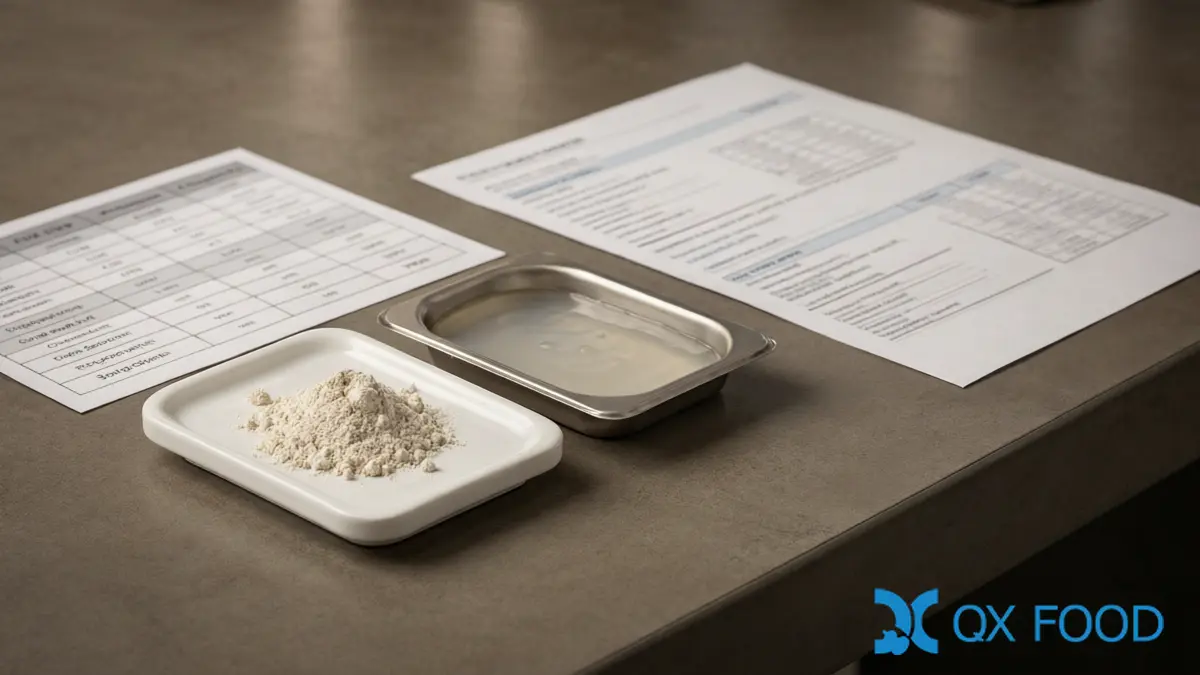
What to Compare Before Choosing
- Sensory direction: evaluated in the finished product, not inferred from form.
- Actual solids: the grade specification, not an assumed industry range.
- Salt contribution: toward the finished-product sodium target.
- Color: impact in the intended application.
- Dispersion and dissolution: under the actual process conditions.
- Dosing equipment: metered pumping vs weighing or dry feeding, and what the line can control accurately.
- Storage and shelf life: from the selected grade specification.
- Freight: actual solids, packaging and dose basis.
- Allergen and documentation: including destination-market contaminant requirements such as Regulation (EU) 2023/915 for EU programs (Commission Regulation (EU) 2023/915).
How QXFOOD Documents Liquid and Powder Grades
QXFOOD supplies liquid and powder HVP grades with product-specific specifications and batch documentation, including liquid grades such as soy YSA and enhanced-umami YBI, and powder grades such as FSA soy and FYA corn. Analytical parameters and applicable contaminant documentation should be confirmed for the selected grade and destination market, with the wider options in the HVP powder series, liquid series and full HVP category.
Questions Formulators Ask About Liquid and Powder HVP
Is liquid HVP stronger or more flavorful than powder HVP?
Not inherently. Form does not independently determine flavor strength. Compare the actual grades in the finished product.
Is liquid HVP always better for wet applications?
No. It may simplify liquid dosing, but a powder can also work where it disperses or dissolves adequately and fits the process.
Can powder HVP be used in injection brines?
Potentially. Confirm dissolution or dispersion, viscosity, sediment and needle passage in the actual brine.
How should liquid and powder HVP costs be compared?
Compare delivered cost at equivalent finished-product performance, including dose, solids, freight, storage and handling, not product price per kilogram alone.