
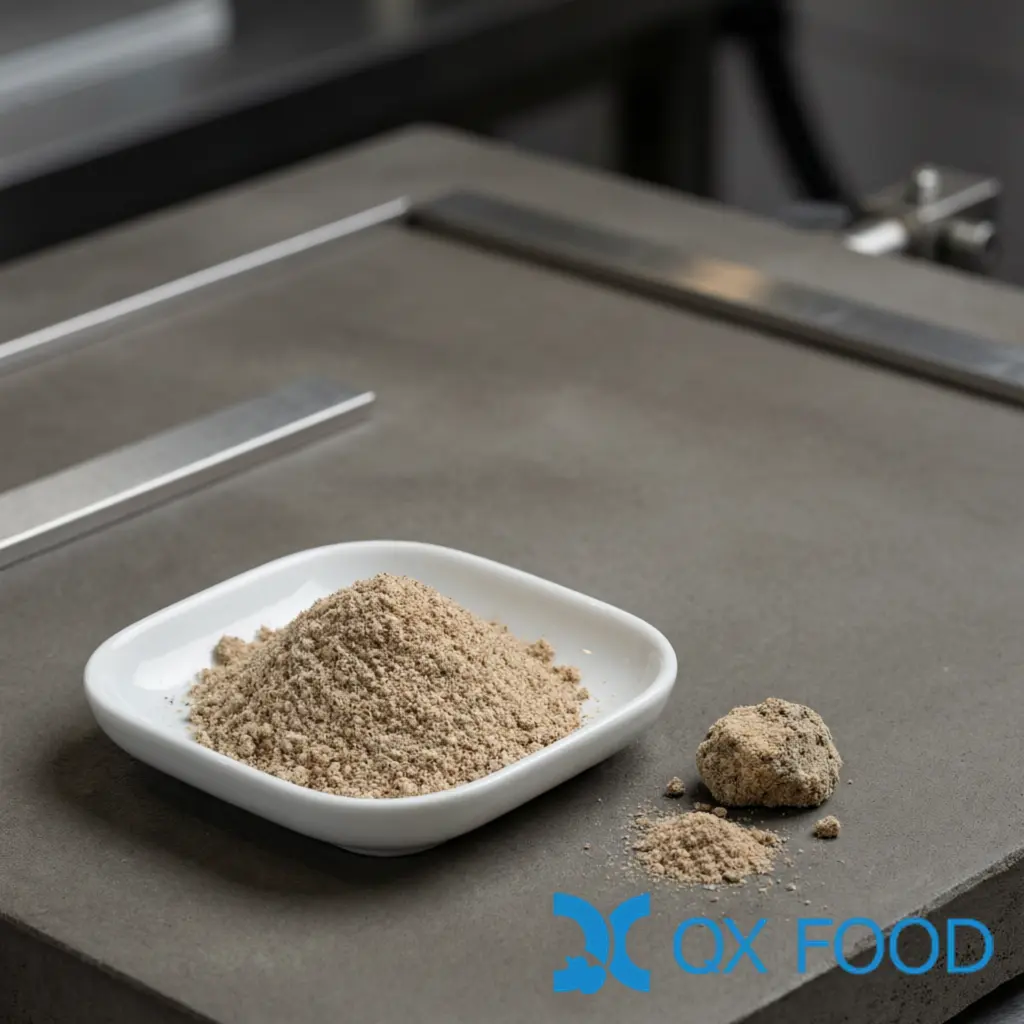
Powder caking is a system behavior, not a single moisture threshold. Caking risk depends on composition, physical state, water sorption, particle properties, temperature, pressure, packaging and time, so the same humidity reading can be harmless for one powder and destructive for another. A 25 kg bag that arrives free-flowing can still turn into a solid block when the system changes.
This guide explains how to work with powder caking in food ingredients: the mechanisms that can act, the properties that raise risk, the parameters that answer different questions, the controls that actually reduce caking, and the records a buyer should compare before and after a problem appears.
Powder Caking Is a System Behavior
Caking is the result of particles bonding into lumps or a solid mass, but there is no single cause to fix. Moisture, temperature, glass transition, particle geometry, mechanical load, packaging and time all interact. Two lots of nominally the same powder can behave differently if the amorphous fraction, particle size or storage history differs, and the same storage room can be safe for one product and damaging for another.
Different Powders Cake Through Different Mechanisms
Powder caking can arise through several mechanisms, including moisture-induced liquid or solid bridges, deliquescence and recrystallization in soluble crystalline ingredients, viscous flow above the glass transition in amorphous materials, and consolidation under mechanical load. Which mechanism dominates depends on the powder composition and storage conditions.
Crystalline and amorphous powders do not behave alike: a crystalline deliquescent ingredient such as salt or sugar can adsorb little moisture until a critical relative humidity is crossed, after which surface dissolution can be rapid, while an amorphous spray-dried carrier softens and sticks as water plasticizes it toward its glass transition. In multi-component seasoning systems, the critical humidity of the blend can also be lower than that of the individual ingredients: deliquescence research shows that when two or more deliquescent components are mixed, the relative humidity of the solid-solution transition is lowered. Deliquescence data from salt, sugar or organic acid alone should therefore not be applied directly to a complete seasoning blend; the mixture has to be evaluated as its own system. Research on water-sorption and caking of food powders describes these distinct mechanisms and cautions against assuming one universal behavior for all powders, and reviews note that no single prediction model is reliable across every powder type. Practical guidance for interpreting the mechanisms in plant terms is available from bulk-solids engineers.
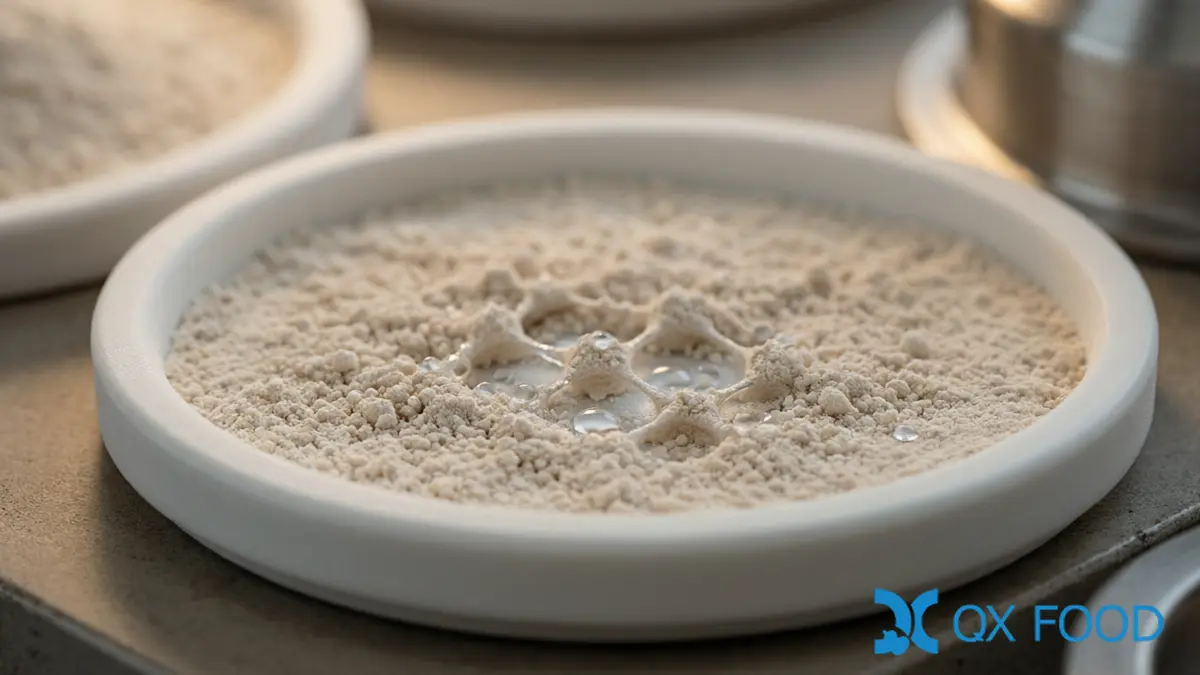
Composition and Physical State Determine the Risk
Risk is not a fixed property of an ingredient name. Maltodextrin grades differ in dextrose equivalent, moisture and glass-transition behavior, and the same carrier can behave differently when blended with organic acids or sugars. The drivers that matter are physical and compositional:
| Risk driver | Why it matters |
|---|---|
| High hygroscopicity / deliquescence | Promotes moisture uptake or surface dissolution |
| High amorphous fraction and low Tg | Increases stickiness when storage conditions approach or exceed Tg |
| High soluble sugar / organic-acid content | Can increase moisture sensitivity depending on matrix |
| Fine particles / high surface area | Can increase cohesion and contact area |
| Broad PSD / segregation | Changes packing and local contact conditions |
| High consolidation load | Promotes contact and cake strength |
| Poor moisture-barrier packaging | Allows the storage environment to reach the powder |
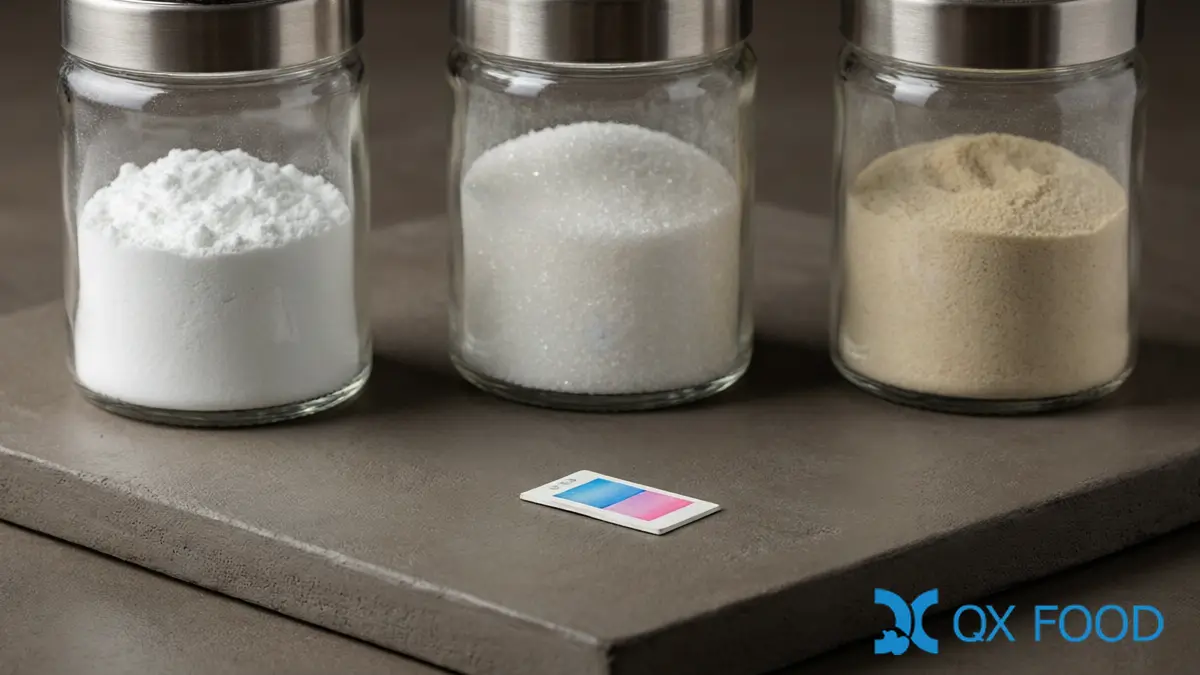
The same driver logic explains why two powders in the same category can differ: garlic powder with residual moisture and fines behaves differently from the same lot dried and classified differently, and a vinegar powder is only as predictable as its acid carrier, amorphous fraction and packaging allow.
Water Activity, Moisture and Tg Answer Different Questions
Water activity can provide information that moisture content alone does not, and studies on several hygroscopic model powders have found stronger correlations between aw and flowability than between absolute moisture and flowability. It should still be interpreted together with composition, physical state, temperature and particle behavior rather than treated as a universal caking index.
Each parameter answers a different question. Moisture content describes how much water is present on a weight basis. Water activity describes how available that water is for reactions and microbial growth. Glass-transition temperature describes where an amorphous matrix moves from a glassy to a rubbery state, which changes with water content and temperature together. For amorphous systems the relevant comparison is Tg against storage temperature; for crystalline and deliquescent systems the relevant reference is critical relative humidity and phase behavior. One number does not replace the others.
Particle Properties and Consolidation Also Matter
Particle size, fines content, shape and distribution change how particles pack and contact each other. Fine particles increase surface area and cohesion; a broad distribution with segregation creates zones of different local behavior; angular or irregular shapes interlock more than rounded ones. Consolidation adds the mechanical dimension: stacked bags and silo depth press particles together, and time under load converts loose contact into stronger cake. Particle-size information should match the method controlled for the selected grade, such as sieve or mesh data or instrumental PSD where applicable. D10/D50/D90 should not be assumed to be a universal COA requirement.
Anticaking Agents Are One Control Layer
Anticaking agents can improve flow or reduce caking in some powders, but they do not replace control of formulation, moisture exposure, packaging, temperature and mechanical load. Their effectiveness has to be validated in the actual host powder: research on deliquescent ingredients shows that the effect of an anticaking agent depends strongly on the host powder, the storage condition and the agent itself.
Silicon dioxide is a widely used anticaking agent, but the required level is formulation- and market-specific. In the United States, 21 CFR 172.480 allows silicon dioxide as an anticaking agent only in foods where an anticaking effect has been demonstrated, in an amount not exceeding that reasonably required for the intended effect and not more than 2 percent by weight of the food. That 2 percent is a regulatory ceiling for the US market, not a recommended universal dosage range. Food-derived powders or starch-based materials may be evaluated as formulation alternatives in some products, but their technical effectiveness and ingredient-declaration requirements must be checked for the actual formula and destination market.
Packaging and Storage Conditions Must Match the Powder
Storage humidity should be set from the moisture-sorption and caking behavior of the selected powder rather than from one universal RH limit. The relevant threshold can change with composition, temperature and packaging, so supplier storage conditions and product-specific stability data should be used where available.
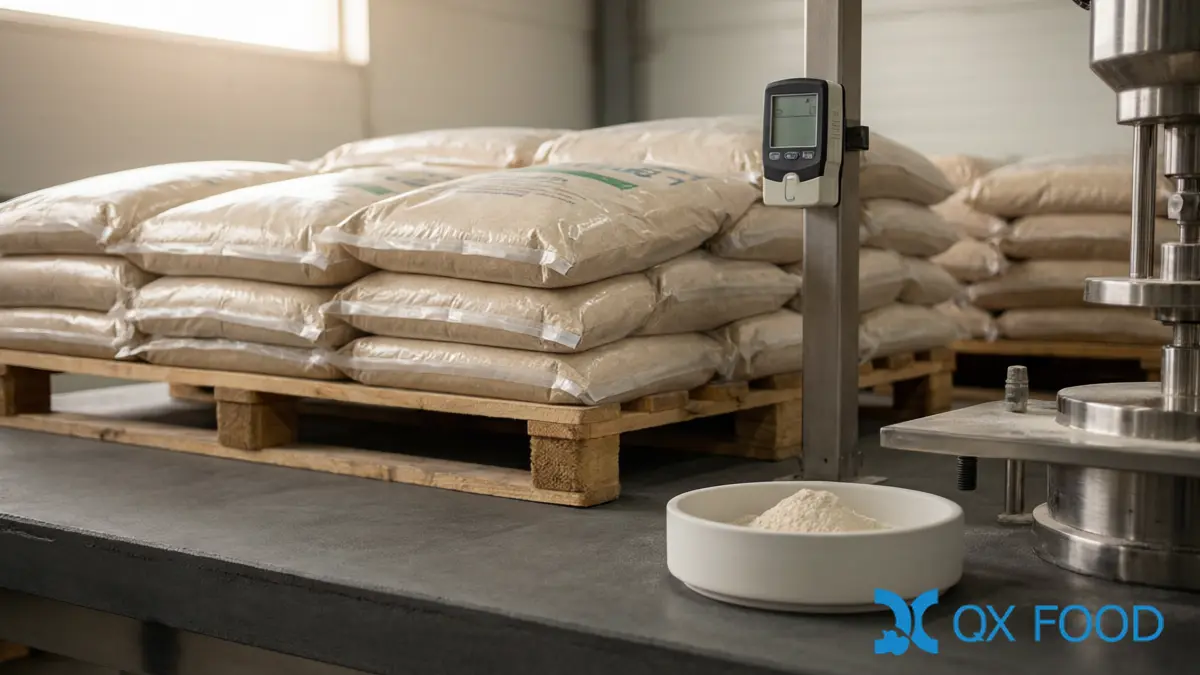
The rest of the storage system follows the same logic. Temperature stability matters where amorphous materials sit near their glass transition, so large swings and hot container legs deserve attention rather than one fixed rule. Stacking height and time under load should be limited according to the powder’s consolidation sensitivity. Moisture-barrier liners and sealed packaging keep the warehouse environment away from the powder, and stock rotation prevents the time factor from compounding. None of these is a substitute for the others, and none works from a single setpoint.
Specification, COA and Packaging Data Are Different Records
The relevant controls depend on the selected powder. A buyer may need limits or evidence for moisture, water activity, particle characteristics, flow behavior, anticaking treatment, packaging barrier and storage conditions, but these should not be turned into one universal specification template.
Keep the three record types separate. The specification defines the controlled targets for the grade, such as moisture or water-activity limits with methods. The batch COA reports what was actually measured for the batch, on the parameters the SKU controls. The packaging specification describes liner, barrier and sealing, and stability data describe how the product behaves under defined environmental conditions. A flowability value or packaging description does not belong on the COA just because caking is a concern; it belongs in the record that answers that question.
How to Investigate a Caked Lot
Caking does not automatically mean microbiological spoilage, but a caked lot should not be released solely because the lumps can be broken apart. Investigate package integrity, moisture exposure, applicable analytical results and the product’s quality specification before deciding whether the lot can be used or reworked.
Mechanical deagglomeration may break a cake, but it does not prove that the original particle distribution, blend uniformity, stability or food-safety status has been restored. Rework should follow an approved quality procedure and product-specific assessment, because a caked lot may reflect package failure, condensation, phase change, segregation or a process deviation that simple milling does not address.
How QXFOOD Documents Caking-Sensitive Powders
QXFOOD provides product-specific specifications and batch documentation for the selected powder grade. Moisture, water activity, particle or flow parameters should be confirmed according to the applicable SKU specification and actual batch COA rather than assumed across the entire product range. Packaging specifications should be reviewed separately.
The relevant product ranges for dry powder systems include the brewed soy sauce powder series, brewed vinegar powder series, HVP powder series and single-ingredient spice powders such as dehydrated garlic powder, black pepper powder and white pepper powder. Carrier selection logic for spray-dried systems is covered in our maltodextrin carrier guide, and incoming-lot checks in the ingredient procurement guide.
Frequently Asked Questions
What causes powder caking?
Particles bond through mechanisms that depend on the powder and its conditions: moisture-induced liquid or solid bridges, deliquescence and recrystallization in soluble crystalline ingredients, viscous flow above the glass transition in amorphous materials, and consolidation under mechanical load. Usually more than one factor is involved.
How do I prevent powder caking in storage?
Match the storage and packaging system to the selected powder: control humidity relative to its sorption and glass-transition behavior, avoid large temperature swings, limit stacking pressure and time under load, use moisture-barrier packaging, and use product-specific stability data where available. There is no one relative-humidity setpoint that protects every powder.
What is the best anticaking agent for food powder?
There is no universal best agent. Effectiveness depends on the host powder, the storage condition and the agent, so candidates should be validated in the actual product. Silicon dioxide is widely used; in the United States, 21 CFR 172.480 limits its anticaking use to no more than 2 percent by weight of the food and no more than reasonably required for the effect.
Which food powders cake the most?
Caking follows risk drivers rather than fixed ingredient rankings: deliquescent salts and acids, amorphous powders with low glass-transition temperature, fine-particle systems and products with poor moisture-barrier packaging are the types where risk concentrates. Grades within one ingredient category can differ substantially.
Is a caked lot spoiled?
Not necessarily, but do not release a caked lot solely because the lumps can be broken apart. Investigate package integrity, moisture exposure, applicable analytical results and the product quality specification before deciding whether the lot can be used or reworked.
Can caking be fixed after it happens?
Mechanical deagglomeration may break a cake, but it does not prove that the original particle distribution, blend uniformity, stability or food-safety status has been restored. Rework should follow an approved quality procedure and a product-specific assessment.
What should a COA say for a caking-sensitive powder?
The batch COA reports the parameters the selected SKU actually controls, such as moisture or other specified items with their methods. Water activity, particle-size information, flow data and anticaking treatment belong where the grade controls them, and packaging and stability information is documented separately. Do not use one universal COA template for every powder.