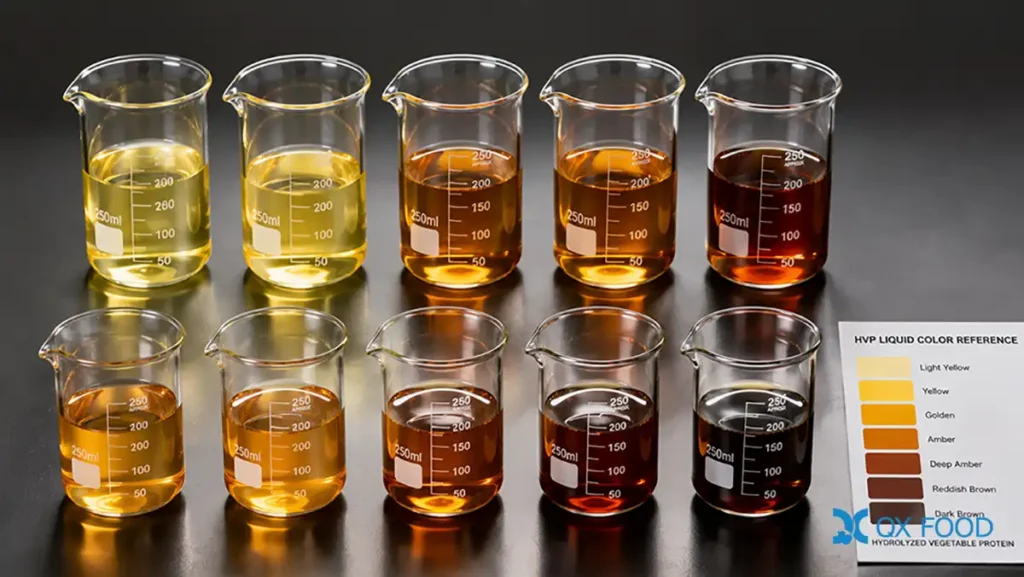
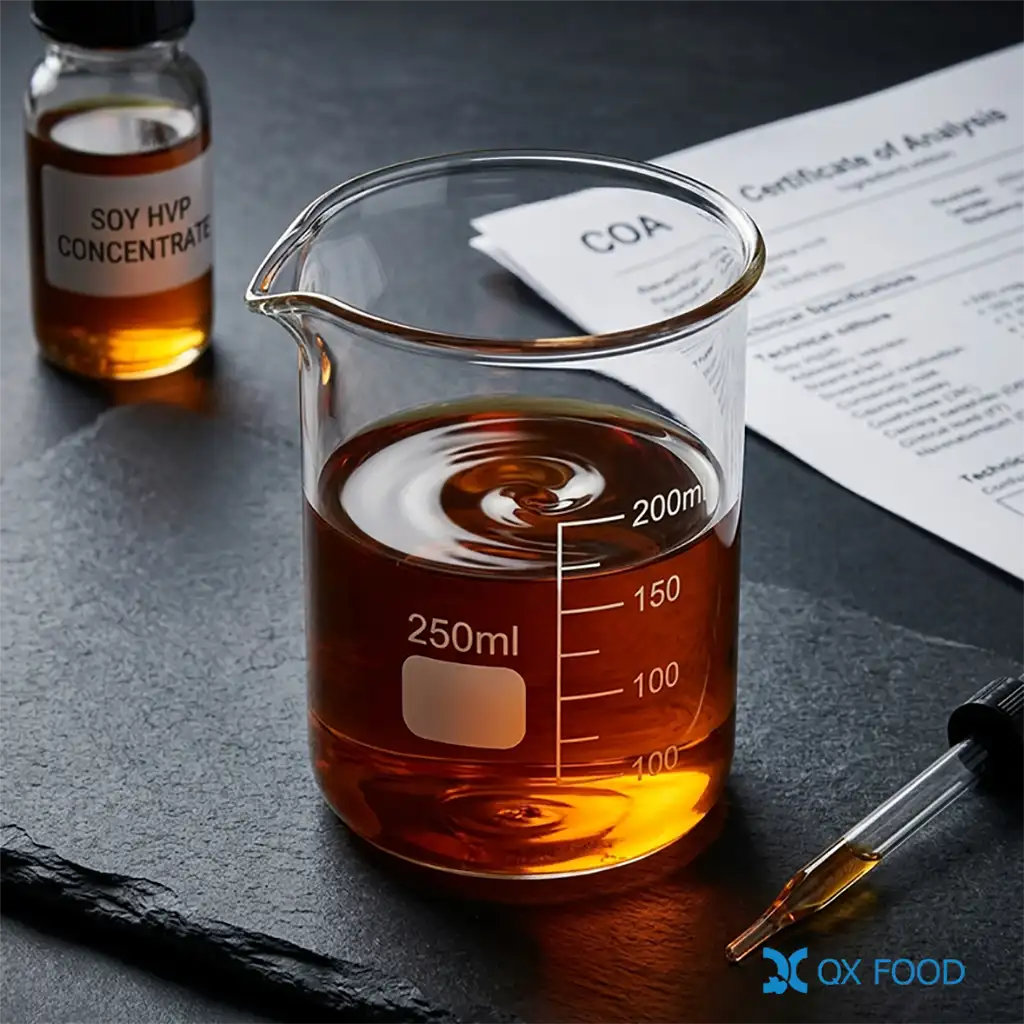
Enhanced umami soy HVP liquid HVP-YBI is an acid-hydrolyzed vegetable protein produced as a liquid concentrate from soy protein with total nitrogen ≥2.0 g/100g and amino nitrogen ≥1.5 g/100g. Unlike powder HVP that must be dissolved into formulations, this soy HVP liquid is already a pumpable concentrate — reducing processing steps in liquid seasoning systems, sauce manufacturing, and pickled vegetable production where direct liquid dosing leads to faster batch times and simpler production workflows. Its reddish-brown appearance, pleasant fresh-salty flavor, and low sodium chloride at ≤23.0 g/100g make it a natural fit for applications ranging from compound seasonings (5–20%) and pickled vegetables (10–40%) to Maillard reaction flavor bases (5–20%) and vinegar-based products (2–12%). Produced under Codex Alimentarius-aligned processes with 3-MCPD measured at ≤0.4 mg/kg, it is one of the cleanest acid-HVP liquids available for export.

Why Liquid HVP Changes the Production Equation
Manufacturers who have only used powder HVP may not realize how much an enhanced umami soy HVP liquid simplifies their production floor. Here is what changes:
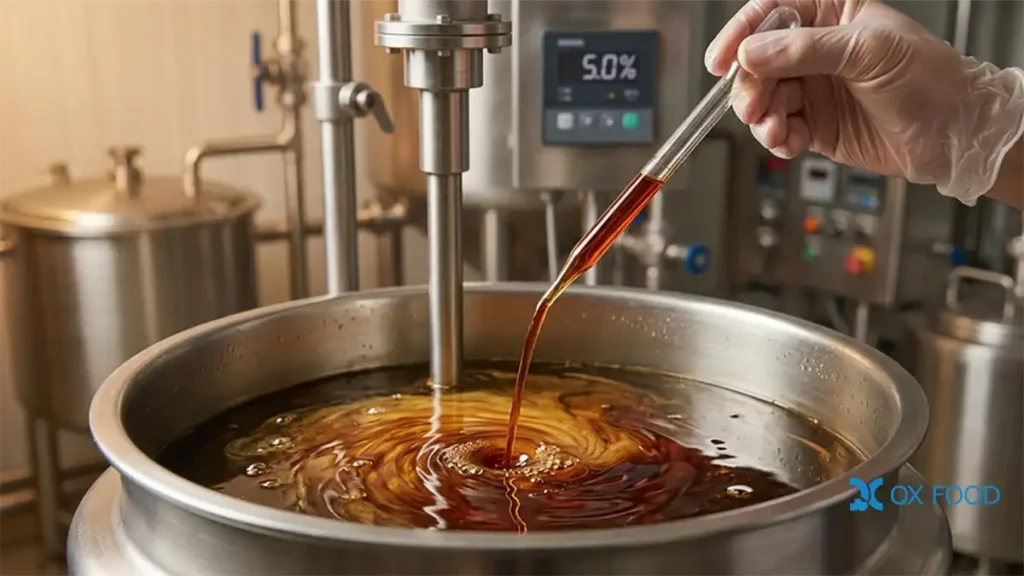
- No dissolution step. Powder HVP requires weighing, water addition, and mixing before incorporation into liquid systems. A liquid hydrolyzed vegetable protein at 37% solid content is already a concentrate — it can be metered directly into the mixing tank via pump, gravity feed, or manual dosing. For a factory running 20 batches a week, the eliminated dissolution step translates to measurable labor and equipment savings.
- Better distribution in liquid systems. Liquid HVP disperses through the vessel immediately — no waiting for powder lumps to break up, no incomplete dissolution leaving HVP sediment at the bottom. In liquid seasoning systems (soy sauce, oyster sauce, condiment bases), this means faster, more uniform flavor development per batch.
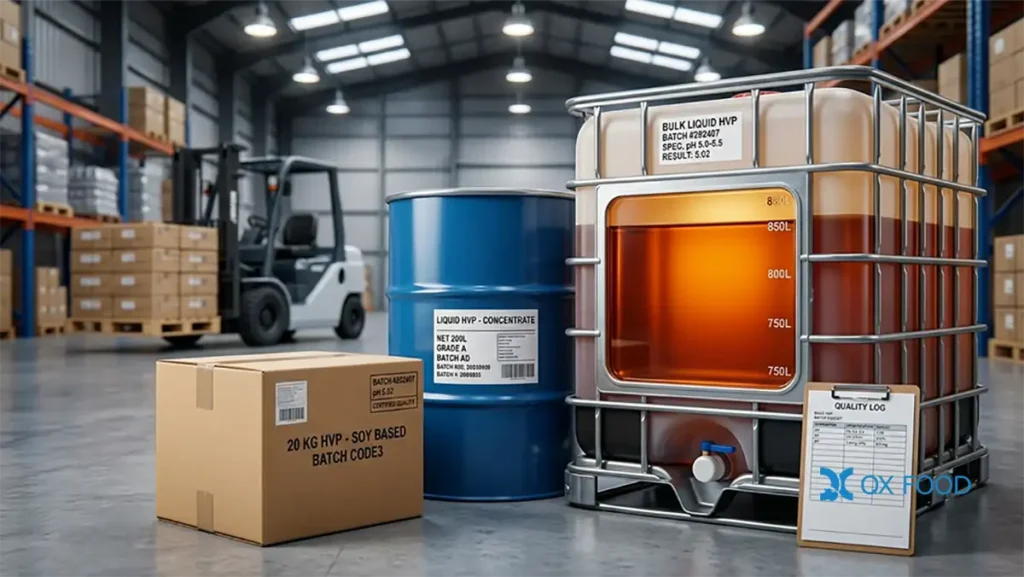
- Pumpable logistics. For manufacturers receiving HVP in IBC totes or drums with pumping infrastructure, liquid format eliminates powder handling — no dust, no humidity-caking risk, no dry-mix equipment required. This is increasingly relevant for factories in humid climates where powder caking in storage and handling is a persistent quality issue.
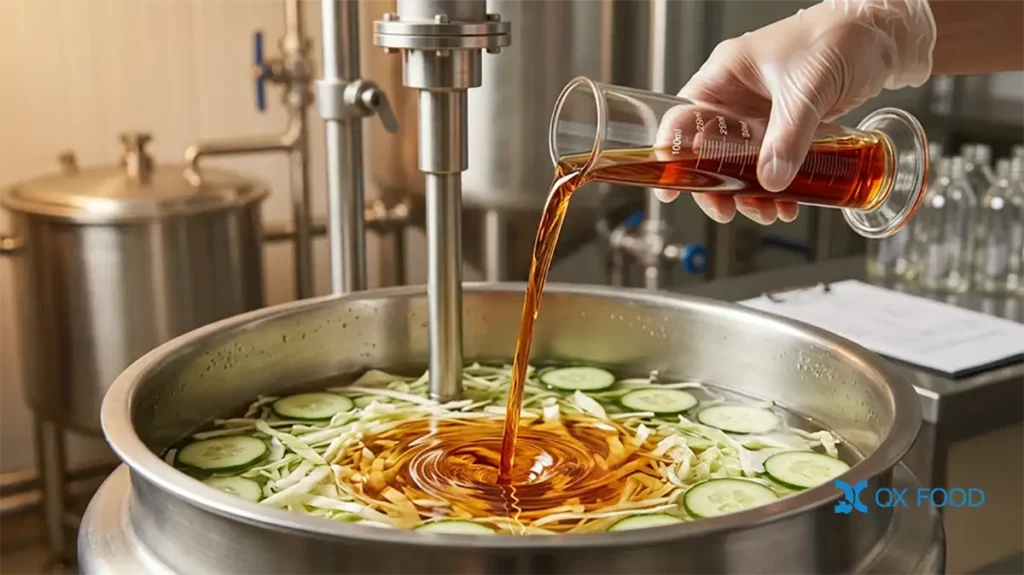
- Direct application in brines and pickling. The 10–40% inclusion rate for pickled vegetables is uniquely achievable with liquid format: the brine or pickling liquor is already a liquid system, and adding liquid HVP directly into it is simpler than pre-dissolving powder, especially in cold-pickling processes where powder solubility drops with temperature.
The trade-off is concentration: at 37% solid content, HVP-YBI delivers its nitrogen payload in a liquid matrix that is about two-thirds HVP solids and one-third water. For applications where the final product already contains water (sauces, soups, brines), this water contribution is negligible. For dry blending or powder-only applications, a powder HVP format would be more suitable.
What “Enhanced Umami” Means in a Liquid HVP
Standard HVP liquids provide a savory base; enhanced umami soy HVP liquid like HVP-YBI goes further. The product profile describes a “pleasant fresh-salty flavor” with a soybean hydrolyzed protein character — a profile that does two things simultaneously:
- Defined specification position. Total nitrogen ≥2.0 g/100g (measured ≥2.20) and amino nitrogen ≥1.5 g/100g (measured ≥1.65) define this grade’s specification position. The “enhanced” designation reflects product positioning; sensory results compared with standard HVP liquids should be confirmed in the target application.
- Rounds out salt and acid. The “pleasant fresh-salty” character does not mean “salty” — NaCl is ≤23.0 g/100g, meaning HVP-YBI is actually a low-salt HVP liquid by industry standards. Instead, “fresh-salty” describes a clean savory brightness that balances heavy or acidic notes in the finished product — particularly useful in pickled vegetable and vinegar-based formulations where acid forwardness needs savory counterbalance.
- Contributes ester-like brightness. The product’s light ester fragrance adds a subtle fruity-floral top note that lifts the overall flavor above the flat, one-dimensional savory character of basic HVP liquids. This is detectable in the finished food product and matters in premium applications where flavor complexity is a selling point.
The 3-MCPD level is measured at ≤0.4 mg/kg — well below the Codex standard and a meaningful differentiation from commodity acid-HVP liquids that operate closer to the regulatory limit of ≤1.0 mg/kg.
Technical Specifications: Enhanced Umami HVP Liquid
All values are from the synced product profile. HVP-YBI is produced under Q/WKSP 0002S standard, distinct from the Q/HKSP 0002S used by powder HVP SKUs.
| Parameter | Specification | What It Means for Formulators |
|---|---|---|
| Product SKU | HVP-YBI | Unique identifier for ordering |
| Physical State | Liquid (concentrate, 37% solids) | Pumpable, meterable, no dissolution required |
| Color | Reddish-brown | Contributes warm amber-brown color to finished products |
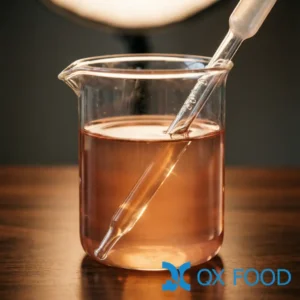
| Appearance | Clear reddish-brown or light yellow liquid | No sediment or turbidity — visually clean in clear broths and sauces |
| Solid Content | ≥36.0% (measured 37%) | Approximately two-thirds HVP solids; one-third water carrier |
| Total Nitrogen | ≥2.0 g/100g (measured ≥2.20) | Protein-derived amino acids for umami intensity and Maillard reactivity |
| Amino Nitrogen | ≥1.5 g/100g (measured ≥1.65) | Free amino acids available for direct umami perception |
| Sodium Chloride | ≤25.0 g/100g (measured ≤23.0) | Low-salt liquid HVP — much lower than typical powder HVP (40–50%) |
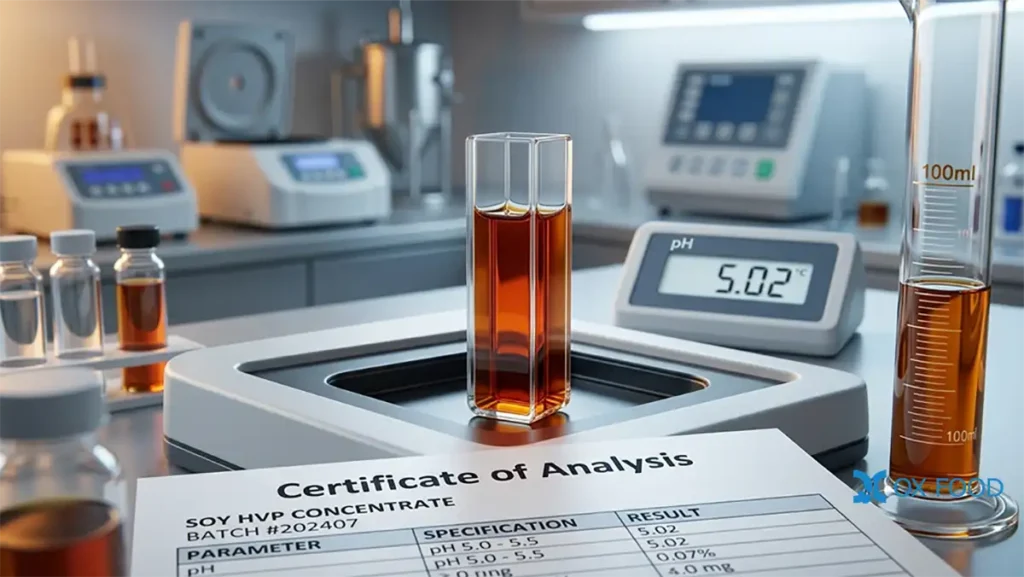
| pH (5% solution) | 5.02 | Mildly acidic; compatible with most food systems from vinegar to neutral broths |
| 3-MCPD | ≤1.0 mg/kg COA; measured ≤0.4 | Well under regulatory threshold — suitable for premium export markets |
| Protein Source | Soy Protein (Shandong) | Not for soy-free applications; contains soybean allergens |
| Process | Acid Hydrolysis | Controlled hydrolysis for consistent amino acid profile |
| Microbial | APC 200 CFU/g, Coliforms <0.3, Salmonella ND, Staph <10 | Clean microbial profile; suitable for ready-to-eat food applications |
| Suggested Usage | 5–40% depending on application | Higher than powder HVP (2–10%) due to liquid carrier dilution |
Comparing liquid vs powder: At NaCl ≤23.0 g/100g, HVP-YBI has approximately half the salt of a typical powder HVP. The amino nitrogen at ≥1.5 g/100g must be viewed through the 37% solids lens — accounting for the water carrier, the effective amino nitrogen on a dry basis is approximately 4.5 g/100g, competitive with mid-tier powder HVP SKUs. The 3-MCPD measured at ≤0.4 mg/kg is a genuine point of differentiation — many acid-HVP products operate closer to the 1.0 mg/kg ceiling, and the lower level simplifies export documentation and customer approval in markets with strict contaminant thresholds (EFSA, EU 1881/2006).
Application Scenarios Unique to Liquid HVP
While powder HVP serves dry blending and coating applications, enhanced umami soy HVP liquid dominates liquid and semi-liquid food systems where direct addition, faster incorporation, and brine compatibility matter. Usage rates vary by application — compound seasonings at 5–20%, pickled vegetables at 10–40%, Maillard reaction bases at 5–20%, general seasonings at 5–10%, and vinegar-based products at 2–12%. Each application below would be more difficult or slower with powder format.
① Compound Seasoning Systems (5–20%)
Liquid HVP integrates directly into compound seasoning pastes, liquid concentrates, and semi-solid seasoning bases without the dissolution bottleneck that powder HVP creates in these systems. For manufacturers producing seasoning pastes for the foodservice or industrial market, HVP-YBI can be metered by pump into the mixing vessel — no powder bag handling, no dust extraction, no moisture absorption from opened bags. The reddish-brown color contributes visual warmth to the finished seasoning paste, and the low salt (≤23.0 g/100g) leaves more headroom in the formulation for functional salt addition for preservation or taste balance. See the full HVP liquid range for alternative nitrogen levels.
② Pickled Vegetables & Brine Systems (10–40%)
This is a category where liquid HVP has a structural advantage over powder that no amount of pre-dissolving can fully compensate for. Pickled vegetable production is inherently a liquid processing environment: the brine, pickling liquor, or seasoning marinade is the primary vehicle for flavor transfer into the vegetable substrate. Adding a liquid hydrolyzed vegetable protein directly to this brine — at inclusion rates of 10–40% depending on target flavor intensity — means the HVP is immediately distributed, immediately available for diffusion into the vegetable tissue, and immediately contributing to flavor development without waiting for a powder to dissolve in what is often a cold or room-temperature pickling process where powder solubility is thermodynamically limited. This application is covered in the HVP solutions overview.
③ Vinegar-Based Products & Acidic Seasonings (2–12%)
The pH of 5.02 (5% solution) means HVP-YBI is already mildly acidic and integrates seamlessly into vinegar-based systems without pH shock or precipitation that can occur when a neutral-pH powder HVP hits an acidic liquid matrix. The pleasant fresh-salty character rounds out the sharp acetic edge of vinegar-based seasonings, dipping sauces, and pickling solutions — providing savory depth without adding sweetness or requiring flavor masking. This is a differentiated capability that powder HVP — with its higher salt content and neutral dissolution step — handles less gracefully. Compare with the corn-based HVP liquid for a non-soy alternative in this application.
④ Maillard Reaction Flavor Bases (5–20%)
In reaction flavor systems where HVP serves as the amino acid source for heat-driven Maillard browning, liquid HVP has a practical advantage: the amino acids are already in solution, meaning they are immediately available for reaction without a pre-dissolution step. The solid content of 37% means the fluid is concentrated enough to contribute meaningful amino nitrogen (≥1.65 g/100g measured) without introducing excessive water that would dilute the reaction system. For manufacturers running Maillard reaction flavor development on heated reactors, pumping liquid HVP into the vessel is faster, cleaner, and more reproducible than weighing and dissolving powder for each batch.
⑤ Soup Bases, Bouillon & Hot Pot Concentrates (5–20%)
In liquid soup bases and hot pot concentrates — products that are shipped as pastes, concentrates, or semi-liquid blocks — HVP-YBI’s reddish-brown color and enhanced umami profile contribute both visual warmth and savory depth. The low salt content means formulators can build the sodium level through separate salt addition for precise control, rather than accepting whatever salt comes with the HVP input. For powder bouillon applications, liquid HVP can be used as the moisture component in the agglomeration or granulation step. See the mixed protein HVP liquid for alternative profiles.
⑥ Soy Sauce, Oyster Sauce & Condiment Systems (5–20%)
Condiment manufacturing is perhaps the most intuitive fit for liquid HVP: sauce and condiment production is already a liquid system, with mixing tanks, pumps, and filling lines designed for fluid handling. Adding HVP-YBI directly into the blending tank — alongside fermented soy sauce, caramel color, starch thickeners, and preservatives — eliminates the pre-dissolution and filtration steps that powder HVP would require. The liquid savory base contributes umami intensity and rounds out sharp salt and fermented notes. Compare with high-nitrogen mixed protein liquid for formulations needing higher amino nitrogen.
Why B2B Manufacturers Choose Liquid HVP Over Powder
For procurement managers evaluating soy protein hydrolysate liquid against powder HVP, the decision often comes down to production workflow. Here is what tips the choice toward liquid:
- Faster batch times. Direct liquid dosing eliminates the 5–15 minute dissolution and verification step per batch. Across a multi-batch production day, this represents measurable labor savings and increased vessel utilization.
- Pump-based automation. Factories with automated dosing systems can meter HVP-YBI directly — no manual powder weighing, no dust, no operator exposure. This is particularly relevant for factories pursuing lean manufacturing or automated batch control.
- No dissolution quality issues. Powder that does not dissolve completely leaves undissolved HVP in the product — uneven flavor distribution, visible specks, potential filter clogging. Liquid HVP eliminates this entire category of quality deviation.
- Certification coverage. Produced under ISO 9001, HACCP, and Halal certified management systems. COA and specification sheets provided per shipment.
- Flexible packaging. Available in 100 g and 1 kg aluminum foil bags for trials, 10 kg and 20 kg cartons for production, and 25 kg fiber drums for bulk. Custom packaging configurations available upon request. Contact us for your specific logistics and packaging requirements. MOQ 1 MT. 1 kg samples available for qualified buyers.
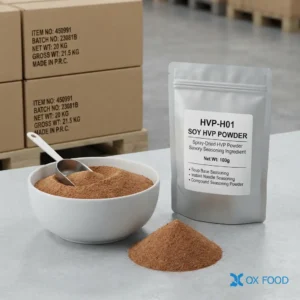
When powder format is the right choice: If your application is primarily dry blending (seasoning powders, snack coatings, dry soup mixes), powder HVP from the HVP powder range eliminates the need to spray-dry liquid HVP onto a carrier. For intermediate applications where you want the processing convenience of liquid but need dry output, custom formulation can be discussed.
Storage, Handling & Compliance
Storage (Liquid HVP specific)
- Store in sealed containers below 25°C and humidity below 60%
- Avoid direct sunlight — UV exposure can affect color and volatile aroma compounds over extended storage
- Liquid HVP is hygroscopic in concentrate form; keep containers sealed when not in use
- Agitate before use if stored for extended periods — gentle mixing restores homogeneity without affecting product quality
- Shelf life: 12 months under recommended conditions
Compliance
HVP-YBI is produced under ISO 9001, HACCP, and Halal certified quality and food safety management systems, aligned with FAO/WHO Codex Alimentarius standards. 3-MCPD measured at ≤0.4 mg/kg — well below the Codex guideline and EFSA recommendations for acid-hydrolyzed vegetable protein. Additional documentation including ISO 22000 may be available depending on destination market requirements. Halal documentation available for qualified buyers.
Allergen note: Made from soy protein. Contains soybean allergens. For soy-free liquid HVP, refer to corn-based alternatives.
Certification note: Core Certification field lists “IS09001” which is a recognized typo for ISO 9001. The product operates under ISO 9001 certified quality management.
Frequently Asked Questions
What is the difference between liquid HVP and powder HVP?
Liquid HVP is a 37% solid content concentrate — already in solution, pumpable, and dosable directly into liquid and semi-liquid food systems without dissolution. Powder HVP is spray-dried to ~95% solids, requiring water addition and mixing before use in liquid applications. Liquid is preferred for sauces, brines, condiments, and pickled products; powder is preferred for dry blending, coating, and sachet filling. Both deliver the same amino acid base for umami and Maillard reactivity. Compare powder and liquid HVP formats.
Why is liquid HVP recommended for pickled vegetables?
Pickling brine is already a liquid system — adding liquid HVP directly at 10–40% ensures immediate distribution and diffusion into the vegetable tissue, without waiting for powder to dissolve (which is slower in cold-pickling processes). The enhanced umami profile and pleasant fresh-salty character also round out the sharp acidic notes in the vinegar-based pickling environment. See the full liquid HVP options.
How does the salt level compare to powder HVP?
NaCl is ≤23.0 g/100g (measured ≤23.0) — roughly half the typical salt level of powder HVP (which ranges from 30–50 g/100g). This means formulators using HVP-YBI have more room to add functional salt for preservation, taste, or texture without exceeding the total sodium target. The lower salt is inherent to the liquid production process, not a post-treatment adjustment.
What is the solid content and why does it matter?
Solid content is 37% — meaning one kilogram of HVP-YBI contains approximately 370 grams of HVP solids and 630 grams of water. For applications where the final product already contains water (sauces, soups, brines), this dilution is negligible. The solid content also determines the effective amino nitrogen contribution — at 1.65 g/100g measured, the dry-basis amino nitrogen is approximately 4.5 g/100g, competitive with mid-tier powder HVP.
What is the 3-MCPD level?
Measured at ≤0.4 mg/kg — well below the Codex standard of ≤1.0 mg/kg for acid-hydrolyzed vegetable protein. This is a genuine quality advantage that simplifies export documentation for markets with strict contaminant monitoring under EFSA and EU 1881/2006 regulations. Batch-specific COA values are available on request. Learn about EFSA food safety standards.
Can liquid HVP be used in dry seasoning blends?
HVP-YBI is not designed for dry blending — its liquid format makes it unsuitable for direct addition to powder seasoning mixes without a spray-drying or carrier-adsorption step. For dry applications, use powder HVP from the HVP powder range. For intermediate applications where liquid processing convenience is needed but dry output is required, contact us for custom formulation support.
What certifications, packaging, and MOQ apply?
HVP-YBI is produced under ISO 9001, HACCP, and Halal certified systems. Available in IBC totes, drums, and custom packaging. MOQ 1 MT. 1 kg samples for qualified buyers. COA provided per shipment. Full HVP product range available.
Explore Related HVP Liquid & Powder Options
HVP-YBI is the enhanced umami liquid in the range. For other liquid formats, powder alternatives, or different protein sources:
- HVP-YSA Soy HVP Liquid — Standard-grade soy liquid HVP for general savory applications
- HVP-YSB Soy HVP Liquid — Higher nitrogen soy liquid for stronger umami
- HVP-YSD Economical Soy HVP Liquid — Cost-effective option for budget-conscious formulations
- HVP-YYA Corn HVP Liquid — Soy-free corn-based liquid HVP alternative
- HVP-YMA Mixed Protein HVP Liquid — Blended vegetable protein source for broader amino acid profile
- HVP-YMB High-Nitrogen Mixed Liquid — High-nitrogen blended liquid for elevated specification programs
- HVP-YBI Enhanced Umami Liquid — This product
- HVP-YDAL Soy HVP Liquid — Alternative soy liquid HVP grade
- HVP-FSA Soy HVP Powder — Standard powder HVP when dry format is required
- HVP-FYA Corn HVP Powder — Soy-free corn-based powder HVP
For broad product selection, see the HVP powder overview and complete HVP solutions guide. For format comparison between powder and liquid HVP, contact our technical team.
Request a Sample or Get a Quote
Ready to evaluate HVP-YBI enhanced umami soy HVP liquid for your formulation?
- Submit inquiry — Target application, required volume, and destination country
- Receive product specification sheet + COA — Within 1 business day
- Request sample — 1 kg trial samples for qualified buyers
- Confirm formulation fit — Technical team supports application testing and dosage calibration
- Place production order — Flexible packaging from trial sachets to bulk cartons; competitive FOB pricing
Contact us today to start your product evaluation process.