
Plant-protein off-notes do not all come from the same source. Beany and grassy aromas can come from volatile aldehydes and related lipid-oxidation products, while bitterness and astringency involve different non-volatile compounds and protein interactions.
For formulators using HVP in plant-based meat, the ingredient can add savory depth around those notes, but adding a stronger savory ingredient is not the same as removing the compounds that caused the off-flavor.
The useful formulation question is therefore which off-note is present, whether it needs to be reduced at the source or balanced sensorially, and what savory role HVP should play after cooking.
Plant-Protein Off-Notes Are Not One Problem
Plant-protein off-notes vary by source and processing history. Pea and other legume proteins may show beany, grassy, bitter or astringent characteristics, but the dominant problem should be identified in the actual protein ingredient rather than assumed from the crop name.
Beany and grassy aromas in pea protein, for example, are linked to volatile aldehydes such as hexanal and related lipid-oxidation products, while bitterness and astringency involve different compounds and protein interactions (beany flavor in pea protein). Processing history can create, release or reduce these notes, so the same crop can behave differently between suppliers and batches.
Masking an Off-Note Is Not the Same as Removing It
Reduction at the source is one route: protein processing, fermentation, oxidation control and raw-material treatment can change or remove some of the compounds responsible for off-notes (volatile analysis and mitigation of beany flavor in pea protein).
Sensory balancing is a different route: savory ingredients, roasted notes, spices, reaction flavors and fat systems can reduce the perceived importance of an off-note without removing the underlying compounds.
Masking changes perception; removal changes the off-note source. HVP is primarily useful on the sensory-balancing side of that distinction.
What HVP Can Contribute
HVP can provide part of the savory foundation of a plant-based meat product: amino-acid-rich savory depth, a brothy or processed character depending on the grade, and a salt contribution that must be counted in the formula.
The finished meat-like identity still depends on the wider flavor and fat system. Reaction flavors, sulfur notes, lipid-derived aroma, spices, smoke or grill character and the fat phase all participate, so HVP alone does not create a complete meat character.
What HVP Cannot Fix by Itself
Different sensory problems point to different solution layers:
| Sensory problem | Possible source | What HVP can contribute | What HVP cannot solve by itself |
|---|---|---|---|
| Beany or grassy aroma | Lipid-oxidation volatiles | Add savory context and reduce sensory prominence | Remove the volatile compounds |
| Bitterness | Peptides, phenolics or other non-volatiles | Add savory balance | Guarantee receptor-level bitterness blocking |
| Astringency | Protein or polyphenol interactions | Add flavor fullness | Fix the underlying mouthfeel mechanism |
| Weak meat identity | Missing savory and aroma architecture | Provide savory foundation | Create complete beef or chicken character alone |
Fix the Protein Before You Over-Flavour It
If the base protein carries a strong beany or oxidized aroma, increasing HVP and top-note flavor can eventually create a product that tastes both strongly seasoned and still recognizably beany.
Where possible, improve the protein base first, through raw-material selection, oxidation control, fermentation or another validated process, then use HVP to build the savory architecture around the improved base (protein quality in alternative-product development).
HVP and Yeast Extract Can Be Complementary
HVP and yeast extract can be complementary, depending on the target profile. HVP is plant-protein-derived, while yeast extract is produced from yeast. Both may be suitable for vegan formulations depending on the complete ingredient system and processing aids.
Whether the pair is useful in a specific product, and in what ratio, should be confirmed in the finished formulation rather than assumed as a fixed combination.
Choose the Grade From the Finished Product, Not the Meat Name
Candidate grades should be compared on sensory direction, color, salt contribution, nitrogen specification, allergen constraints and performance through processing and final cooking. A beef target does not automatically require soy HVP, and a chicken target does not automatically require a light or corn grade.
QXFOOD grades such as FSA, FSC and FYA can be evaluated as candidates rather than fixed answers. Corn-based candidates may be considered where avoiding soy-derived protein is required, subject to complete formulation and cross-contact verification.
Dose Is Set by the Finished Product, Not by Product Category
Two burgers can require very different HVP levels if their protein base, salt target, HVP grade and flavor system differ. Nitrogen figures help describe the grade; they do not predict meat-like intensity or the required dose by themselves.
The dose is set by sensory and label targets in the actual product, validated through processing and final cooking, rather than copied from a category table.
Validate Through Processing and Final Cooking
Bench tasting before processing does not predict the finished product. Extrusion, retorting, grilling, frying and reheating can change volatile formation and retention, savory balance and the perception of existing off-notes.
Candidate grades should therefore be evaluated through the actual manufacturing process and, where relevant, the final consumer or foodservice cooking step. Compare aroma, taste, salt balance and any claim-relevant attributes in the finished product rather than in the unprocessed formulation alone.
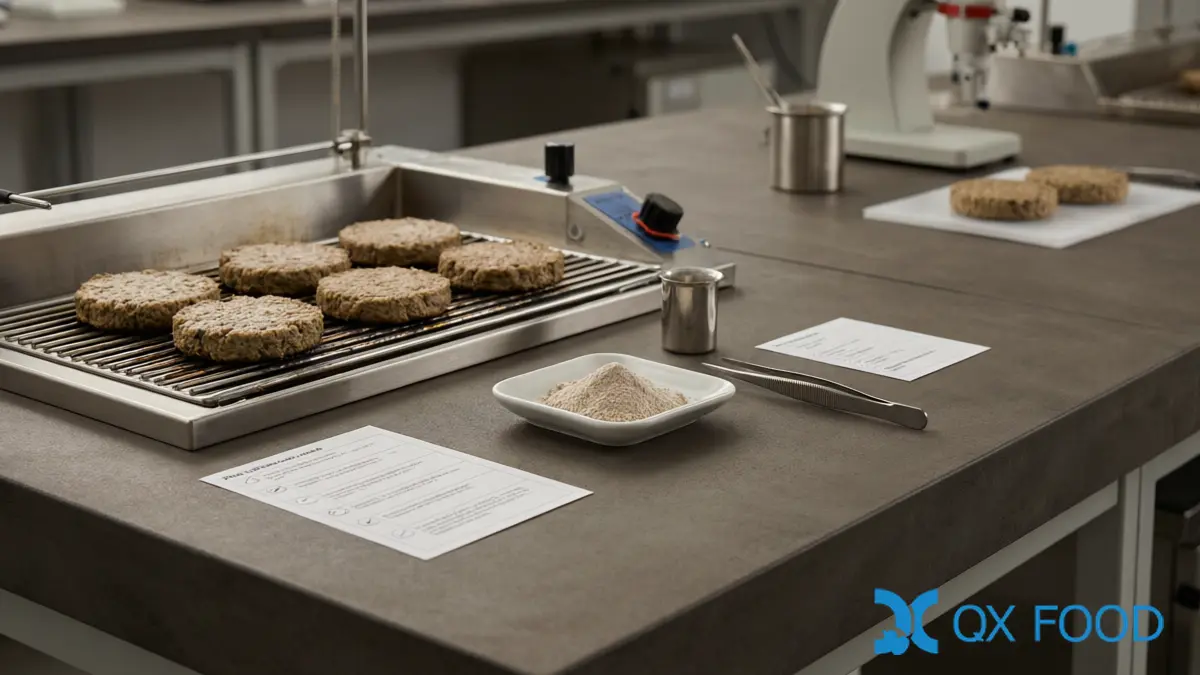
How QXFOOD Evaluates Candidate HVP Grades
QXFOOD evaluates candidate grades for plant-based meat targets on sensory direction in the finished product, salt and color contribution, nitrogen specification, allergen constraints and cook performance, with the full matrix in the HVP powder series and HVP liquid series. Samples can be evaluated in the buyer’s own formulation, and the wider savory architecture is covered in our plant-based meat flavor guide.
Questions Formulators Ask
Does HVP remove beany flavor from pea protein?
No. HVP can reduce the sensory prominence of beany notes by adding savory context, but it does not necessarily remove the underlying volatile compounds. Source reduction and sensory balancing are different routes.
Is soy HVP always better for plant-based beef?
No. Grade fit should be compared in the finished product after the relevant manufacturing and cooking steps, because sensory direction, salt, color and cook performance differ between grades regardless of protein source.
Does higher amino nitrogen mean stronger meat flavor?
No. Nitrogen figures describe the grade; they do not predict meat-like intensity by themselves. The finished flavor depends on the wider savory and aroma system and on cook validation.
Can HVP help reduce sodium in plant-based meat products?
Possibly, but the calculation must use total sodium in the finished product. HVP may enhance savory perception, while some grades also contribute substantial sodium. Compare sensory performance and sodium contribution together rather than treating HVP as a low-sodium ingredient.