
Using HVP in sauces and gravies is not only a flavor-selection decision. The ingredient also adds salt, dissolved solids, color and its own sensory profile to a matrix that may then be cooked, filled, retorted and stored.
The useful formulation question is therefore not simply which HVP tastes strongest, but which form integrates with the process, how much sodium and solids it contributes, and whether the selected grade still performs after the actual heat and shelf-life conditions.
What Changes When HVP Enters a Wet Sauce System
An HVP affects several parts of a wet sauce system at once: sensory profile, sodium, dissolved solids, color and handling behavior. Each needs to be accounted for in the formulation and process.
The sensory profile of the HVP itself is not fixed either: different hydrolysis routes and heat treatments produce different volatile and sensory characteristics (chemical and sensory characterization of hydrolyzed vegetable protein). The grade specification, not the ingredient category, carries the information.
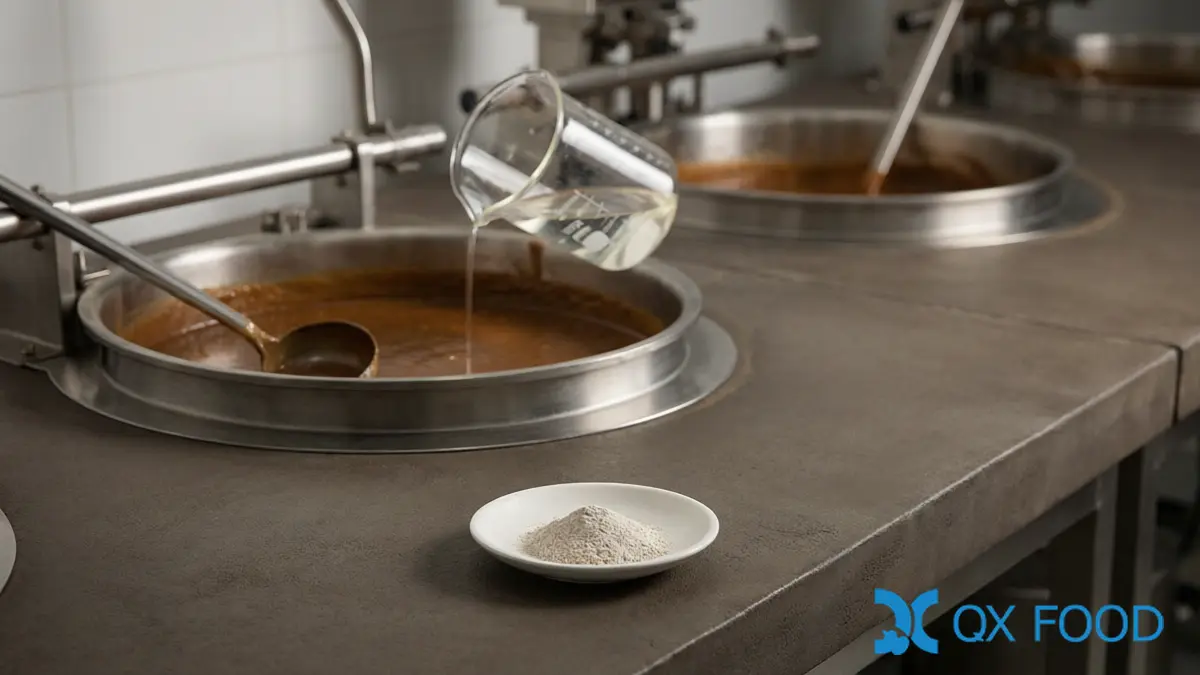
Liquid vs Powder Is a Process Decision
The choice between liquid and powder HVP is not a quality ranking; it follows the process and the finished-sauce target:
| Process question | Liquid HVP | Powder HVP | What to verify |
|---|---|---|---|
| Wet-metering system | May simplify direct dosing | Requires a dissolution or dispersion step | Metering accuracy and mixing |
| Dry premix made before sauce production | Less convenient | Integrates directly into the dry blend | Homogeneity and dissolution |
| Storage and transport | Contains water; different handling needs | Lower-water format | Shelf life, packaging, storage |
| Finished sauce | Adds grade-specific salt, solids and color | Adds grade-specific salt, solids and color after dissolution | Finished-product sensory and analytical target |
Powder grades require adequate dispersion or dissolution according to the selected product and process. Solubility and particle behavior differ between grades, so dissolution should be confirmed in the actual sauce matrix rather than assumed from the form.
Dose Is Set by the Finished Sauce, Not by the Sauce Name
Two brown gravies can require very different HVP levels if the selected grades differ in salt, solids, color and sensory direction, or if the formulas use different yeast extracts, meat flavors, spices or sodium targets.
Dose should therefore be established at equivalent finished-sauce performance rather than copied from a category percentage. Nitrogen figures help describe the grade; they do not predict savory intensity or the required dose by themselves.
HVP Is One Layer in the Sauce Flavor System
Depending on the target, HVP may be combined with yeast extract, nucleotides, reaction flavors, meat extracts, vegetables, spices or other flavor materials. Their roles and ratios should be determined by the target sauce rather than treated as a fixed stack.
Choose the Grade From the Finished Sauce
Candidate grades should be compared on sensory direction, salt contribution, color, solids, nitrogen specification, allergen constraints and performance through the relevant manufacturing process.
A brown gravy does not automatically require a soy grade, and a pale sauce does not automatically require a corn grade. Color can be a useful selection constraint, but protein source and nitrogen specification do not independently determine finished-sauce flavor. Corn-based candidates may be considered where avoiding soy-derived protein is required, subject to complete formulation and cross-contact verification.
Balance Savory Performance Against Sodium Contribution
HVP can contribute savory intensity that may help a reduced-sodium sauce maintain flavor, but many grades also contribute sodium. Account for the grade’s actual salt or sodium specification at the intended dose; in acid-hydrolyzed HVP, part of the salt may result from the neutralization step.
The total sodium of the finished sauce should be evaluated together with sensory performance rather than treating HVP itself as a low-sodium ingredient (sodium-reduction strategies in processed foods).
Validate Through Processing and Shelf Life
HVP can be used in thermally processed sauce systems, but finished flavor performance should be validated under the actual manufacturing and storage conditions. Cooking, filling, pasteurization or retorting can alter the wider aroma and savory balance, while storage can introduce further changes over shelf life. An unprocessed bench sample therefore does not establish finished-product performance.
Soy-Sauce-Style Bases Need a Separate Decision
HVP may serve as a savory base, extension ingredient or adjustment layer in soy-sauce-style formulations, but it does not automatically reproduce brewed soy sauce fermentation character. Replacement ratio, labeling and grade selection require a separate evaluation, covered in our HVP in soy-sauce-style bases guide.
What to Compare When Selecting HVP for a Sauce
- Sensory direction: evaluated in the actual sauce, not in neat taste.
- Salt and sodium: contribution at the intended dose.
- Color: impact on the finished sauce.
- Solids and concentration: especially for liquid grades.
- Handling properties: where relevant to the customer’s dosing system.
- Nitrogen specification: a grade descriptor, not a standalone sensory score.
- Applicable contaminant requirements: for EU programs, verify 3-MCPD against Regulation (EU) 2023/915 using the applicable dry-matter basis.
How QXFOOD Evaluates Candidate Grades
QXFOOD evaluates HVP candidates for sauce systems on sensory direction in the actual sauce, salt and solids contribution, color, nitrogen specification and performance through the relevant process. Liquid grades such as YSA, YSB and YBI and the corn-based YYA can be evaluated as candidates rather than fixed answers, with the full matrix in the HVP liquid series and HVP powder series.
Questions Sauce Formulators Ask
Liquid or powder HVP for a sauce?
The form follows the process: liquid may simplify direct dosing in wet lines, while powder integrates into dry premixes and requires a dissolution step. Handling, storage and finished-sauce targets also enter the decision.
Is there a standard HVP dosage for gravy?
No. Two similar sauces can require different HVP levels if the grades, salt targets and flavor systems differ. Dose should be established at equivalent finished-sauce performance.
Can HVP support sodium reduction in a sauce?
Possibly. HVP can contribute savory intensity that may help a reduced-sodium formulation maintain flavor, but many grades also contribute sodium. Evaluate the total sodium of the finished sauce together with sensory performance rather than treating HVP itself as a low-sodium ingredient.
Does HVP remain stable through retort processing?
HVP can be used in retorted sauce systems, but finished flavor performance should be validated in the actual formulation and retort schedule. Heating can change the wider aroma and savory balance, so an unprocessed bench sample does not establish post-retort performance.