
Cooked-meat flavor does not come from one reaction. Maillard reaction flavor chemistry is one major source of roasted, savory and sulfur-containing aroma compounds, but lipid degradation and interactions between lipid-derived compounds and Maillard intermediates also shape the final profile.
For reaction-flavor development, this means there is no single “beef reaction” or “chicken reaction.” Amino-acid sources, reducing sugars, sulfur-containing precursors, lipids and process conditions all change the volatile profile.
The useful question is therefore not “Which recipe makes meat flavor?” but “Which reaction system produces the profile required in the finished food?”
Cooked-Meat Aroma Is More Than the Maillard Reaction
The Maillard reaction begins with reactions between carbonyl groups, commonly from reducing sugars, and amino groups from amino acids, peptides or proteins, followed by a network of rearrangement, degradation and condensation reactions. It can generate hundreds of volatile compounds, including aldehydes, furans, thiophenes, pyrazines and pyrroles.
But cooked meat is not a single-reaction system. A review of odorants identified in thermally cooked meat summarized 332 odor-active compounds, formed through lipid degradation, the Maillard reaction and lipid-Maillard interactions, with a large share of the species-specific character of beef, pork, poultry and sheep traced to lipid-derived compounds (aroma compounds identified in cooked meat: a review).
A Precursor Pair Is Not a Flavor Recipe
Some precursor systems are strongly associated with particular aroma families. Cysteine-containing systems, for example, can generate potent sulfur-containing compounds associated with cooked-meat character, while pentoses such as xylose are highly reactive in Maillard systems.
But precursor identity alone does not define a finished beef, chicken or roast profile. Protein or peptide source, sulfur level, sugar type, lipid composition, pH, temperature, time and water availability all influence which compounds dominate. A cysteine-xylose system can generate strong meat-like sulfur notes, but that does not make every cysteine-xylose reaction a finished beef flavor.
What Each Precursor Contributes to the Reaction System
Protein hydrolysates and peptides supply amino nitrogen and the taste background, and peptide composition influences which reaction pathways are available.
Reducing sugars provide the carbonyl reactants. Different sugar structures change reactivity and the intermediates formed, which is why glucose, xylose and ribose are not interchangeable in a formula.
Sulfur-containing precursors such as cysteine or thiamine can promote the formation of sulfur volatiles, some of which have very low odor thresholds and can strongly influence cooked-meat character. Small amounts can therefore have an outsized effect.
Lipids are not only a mouthfeel component. Lipid degradation generates its own volatile compounds and participates in lipid-Maillard interactions, and in cooked meat the differences between species are substantially linked to lipid-derived chemistry (odorant review in cooked meat).
Process Conditions Shift Pathways, Not Just Reaction Speed
Temperature strongly affects reaction rate, but there is no universal temperature at which Maillard chemistry suddenly begins. Lower-temperature systems can react over longer times, while higher temperatures accelerate multiple pathways and can also increase degradation and off-note formation.
| Variable | What it can change | Why it must be tested |
|---|---|---|
| Precursor system | Available reaction pathways | Changes sulfur, roast, caramel and savory compound balance |
| Temperature | Reaction rate and degradation pathways | More heat does not automatically mean better meat flavor |
| Time | Reaction progression | Too little may underdevelop; too much may create dark or burnt notes |
| pH | Reaction kinetics and pathway balance | Affects both aroma and color development |
| Water availability | Molecular mobility and reaction environment | Changes rate and pathway balance |
| Lipid system | Lipid-derived volatiles and Maillard-lipid interactions | Important for cooked-meat character |

More Maillard Reaction Does Not Automatically Mean Better Flavor
Increasing reaction severity can create more volatile compounds and deeper color, but sensory quality does not increase in a straight line. Excessive reaction can reduce desirable taste attributes or shift the profile toward burnt, bitter or overly dark notes.
In a rice-protein-hydrolysate and xylose model system with cysteine, higher temperature increased volatile formation while reducing overall umami, and the preferred sensory result occurred at an intermediate condition rather than at the highest temperature tested (temperature and cysteine effects on Maillard meat flavoring).
A Regulatory Limit Is Not a Formulation Target
In the EU, 180 degrees Celsius has a specific regulatory meaning for thermal process flavourings. Annex V of Regulation (EC) No 1334/2008 sets it as the maximum processing temperature, together with time-temperature and pH conditions. These are compliance boundaries, not recommended flavor-development settings (Regulation (EC) No 1334/2008).
Formulation work should stay inside applicable regulatory boundaries and then optimize within them for the target sensory profile.
Why “Beef” and “Chicken” Cannot Be Predicted From One Precursor
Sulfur chemistry is central to many cooked-meat aromas, but species character also depends on the starting protein matrix, lipid composition and interactions between lipid-derived carbonyls and Maillard intermediates. This is why an ingredient described as a beef reaction flavor is a developed system, not the inevitable output of a particular amino-acid-and-sugar pairing.
Reaction Flavor and Compounded Flavor Solve Different Problems
Thermal process or reaction flavors are produced from defined precursors under controlled conditions, while compounded flavors are blended from existing flavor ingredients. The useful comparison is not which one is more authentic, but which one solves the formulation problem:
| Format | What it offers | What still needs testing |
|---|---|---|
| Thermal process / reaction flavor | Integrated cooked, roasted or savory reaction profile | Dosage, process stability, final sensory profile |
| Compounded flavor | Precise adjustment of top notes and targeted aroma character | Volatility and process fit |
| Combined system | Reaction base plus top-note adjustment | Balance before and after processing |
Many commercial systems use both rather than choosing one exclusively. Process stability is product-specific: both formats contain volatile components, and behavior under retort, baking or frying depends on the volatile composition, carrier, encapsulation, dosage and food matrix, so it has to be confirmed in the actual application.
Evaluate the Flavor After the Customer’s Process
A reaction flavor that smells ideal in water may change after retort, baking, extrusion or frying. Heat can release, transform or drive off volatile compounds, while salt, fat, starch and protein in the finished food alter perception.
Evaluation should therefore compare samples at the intended dosage before and after the customer’s actual thermal process, covering aroma before and after processing, taste including umami and bitterness, and the dosage required for equivalent finished-food performance.
How QXFOOD Develops Reaction Flavor Systems
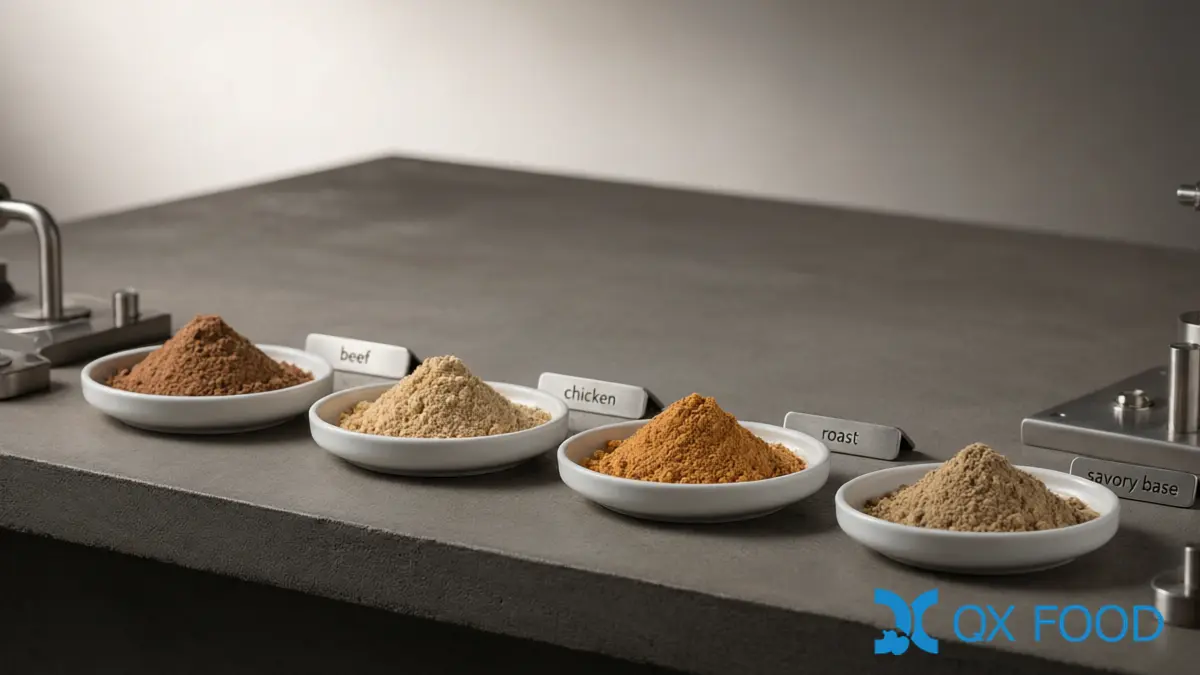
QXFOOD’s savory range includes thermal reaction and extract-based systems such as thermal reaction beef flavor powder, natural beef flavor powder and chicken extract powder. Each product is developed against its application route, and the relevant source materials, allergen status and compositional information are confirmed through the applicable specification and regulatory documentation; proprietary reaction formulations do not necessarily appear on a batch COA.
Specifications may include moisture, pH, salt, sensory profile or other product-specific parameters, while microbiological or contaminant testing follows the product specification and agreed testing plan. Buyers are welcome to evaluate samples under their own process conditions before committing a formula. For the umami base layer under reaction flavors, depending on the formulation, HVP products such as our HVP-FSA soy powder and HVP-FYA corn powder can provide an amino-acid and savory base, and the HVP vs MSG comparison explains where reaction flavor sits in the umami system.
Questions That Matter in Reaction-Flavor Development
Does cysteine automatically create beef flavor?
No. Cysteine-containing systems can generate potent sulfur compounds associated with cooked-meat character, but the finished profile depends on the full precursor system, lipid composition and process conditions.
Does higher reaction temperature create stronger meat flavor?
Not necessarily. In one rice-protein-hydrolysate model system, higher temperature increased volatile formation while reducing overall umami, with the preferred sensory result at an intermediate condition. More reaction is not automatically better flavor.
Can a Maillard reaction flavor be labeled “natural”?
There is no global answer. Regulatory categories and permitted “natural” claims differ by market. In the EU, thermal process flavourings are a defined regulatory category under Regulation (EC) No 1334/2008, and use of the term “natural” is subject to separate requirements. In the United States, natural-flavor status depends on source materials and permitted processing. Confirm the classification for the destination market and the specific formulation.
How should a reaction flavor be evaluated?
Compare the flavor at the intended dosage in the finished food before and after the customer’s actual thermal process, covering aroma, taste and the dosage needed for equivalent performance. A water test alone is not enough.