
HVP vs MSG is a common formulation and sourcing question in savory food manufacturing. Many comparisons oversimplify the decision by assigning fixed flavor profiles to each ingredient or by recommending a universal substitution ratio. MSG and HVP are different savory tools; substitution is a finished-product reformulation problem, not a fixed dose swap.
This guide compares the two across ingredient chemistry, FDA labeling, sodium, cost and reformulation practice, and explains how to run an MSG-replacement trial that does not rely on a made-up ratio.
Quick answer. MSG and HVP are not equivalent ingredients. MSG is a defined glutamate salt used primarily for umami; HVP is a multi-component protein hydrolysate whose composition, salt and sensory character depend on the grade. There is no universal replacement ratio. In the United States, HVP is declared by its own ingredient name, but foods containing HVP cannot claim “No MSG” or “No added MSG” under FDA guidance.
HVP and MSG Are Different Savory Tools
Neither ingredient is “better” in the abstract, and the hvp vs msg question only becomes answerable inside a concrete formula, label policy and market. The practical starting point is to stop comparing the two as interchangeable flavoring options and start comparing what each actually is.
What MSG Contributes
MSG is the sodium salt of glutamic acid, a defined molecule produced by fermentation and standardized as an ingredient. Its primary direct taste contribution is umami from glutamate, and it is declared as “monosodium glutamate” when added to food in the United States. Because the ingredient is defined, its composition does not vary by grade in the way a hydrolysate does.
In many formulas MSG works together with 5′-nucleotides such as inosinate and guanylate, whose umami synergy with glutamate is well documented. That matters for reformulation: if the reference formula relied on MSG plus a nucleotide layer, replacing the MSG does not automatically remove the need for the nucleotide layer, and vice versa. The whole savory stack has to be re-evaluated together.
What HVP Contributes, and Why It Varies by Grade
HVP is a multi-component protein hydrolysate: amino acids, peptides, salt and other compounds produced by breaking down plant protein. Its sensory profile depends on the protein source, the hydrolysis route, the salt level, the amino-acid and peptide composition, and the downstream processing of the specific grade. Research comparing soy, corn and wheat HVP systems found that different free amino-acid compositions generated clearly different volatile profiles: volatile compounds formed from the thermal interaction of hydrolyzed vegetable proteins with reducing sugars (Food Science and Biotechnology, 2023). No single “HVP flavor” exists across all grades.
HVP can also contain naturally occurring free glutamate, because glutamic acid is part of the plant protein being hydrolyzed. The proportion is grade-specific and depends on the raw material and process. If free glutamate matters to a formulation study, use product-specific compositional data for the selected grade rather than a generic category percentage.
HVP vs MSG: A Practical Comparison Table
The hvp vs msg comparison that survives scrutiny is a procurement table, not a winner table. Each dimension has a different thing to validate:
| Dimension | MSG | HVP | What to validate |
|---|---|---|---|
| Ingredient structure | Defined glutamate salt | Multi-component protein hydrolysate | Actual HVP composition of the grade |
| Direct taste function | Glutamate-driven umami | Grade-specific savory profile | Finished-product sensory result |
| Sodium contribution | Defined by the MSG dose | Depends on the HVP’s own salt plus dose | Total sodium of the finished product |
| Protein-source allergens | Not source-protein based | May involve soy, wheat or other sources | Actual source and destination-market rules |
| Process variability | Relatively standardized ingredient | Acid or enzyme route, source and grade differences | Product specification |
| Label declaration | “Monosodium glutamate” when added | Own ingredient name (for example hydrolyzed soy protein) | Destination-market labeling rules |
| Cost | Compare finished formula | Compare finished formula | Cost at equivalent finished-product performance |
FDA Labeling: Added MSG, HVP and “No MSG” Claims
The regulatory part of the hvp vs msg comparison is where the marketing versions usually go wrong, so it pays to quote the FDA Questions and Answers on Monosodium Glutamate precisely:
- Added MSG must be declared as “monosodium glutamate” in the ingredient panel.
- Free glutamate is not added MSG. Free glutamate occurs naturally in ingredients such as HVP, autolyzed yeast, yeast extract and soy extracts, and these ingredients are declared by their own names; FDA does not require the label to state that they naturally contain glutamate.
- “No MSG” claims are restricted. FDA states that foods containing ingredients with naturally occurring free glutamate, such as HVP, cannot claim “No MSG” or “No added MSG” on their packaging. MSG also cannot be listed as “spices and flavoring”.
- Glutamate is not gluten. A person with celiac disease may react to wheat present in an ingredient such as soy sauce, but not to glutamate itself.
Two further FDA points matter for context: FDA considers added MSG to be generally recognized as safe, and although many people identify themselves as sensitive to MSG, studies with such individuals have not been able to consistently trigger reactions. This is why a B2B reformulation article should not build health-sensitivity claims around either ingredient.
One more naming point for US labels: the common or usual name of a protein hydrolysate must identify the protein source under 21 CFR 102.22, so a soy-based product is declared as “hydrolyzed soy protein” rather than by a generic category name. Check the declaration against the actual source of the selected grade in every destination market.
There Is No Universal MSG-to-HVP Replacement Ratio
Rules such as “start at 1.5 to 2 times the MSG level” have no general basis. They compare a defined molecule with a hydrolysate whose composition changes by grade, source and process, so no category-level conversion factor exists. The dose question can only be answered per grade, per formula and per sensory target.
What you can do is run the trial properly. The hvp vs msg reformulation framework below replaces any fixed ratio with a sequence of checks.
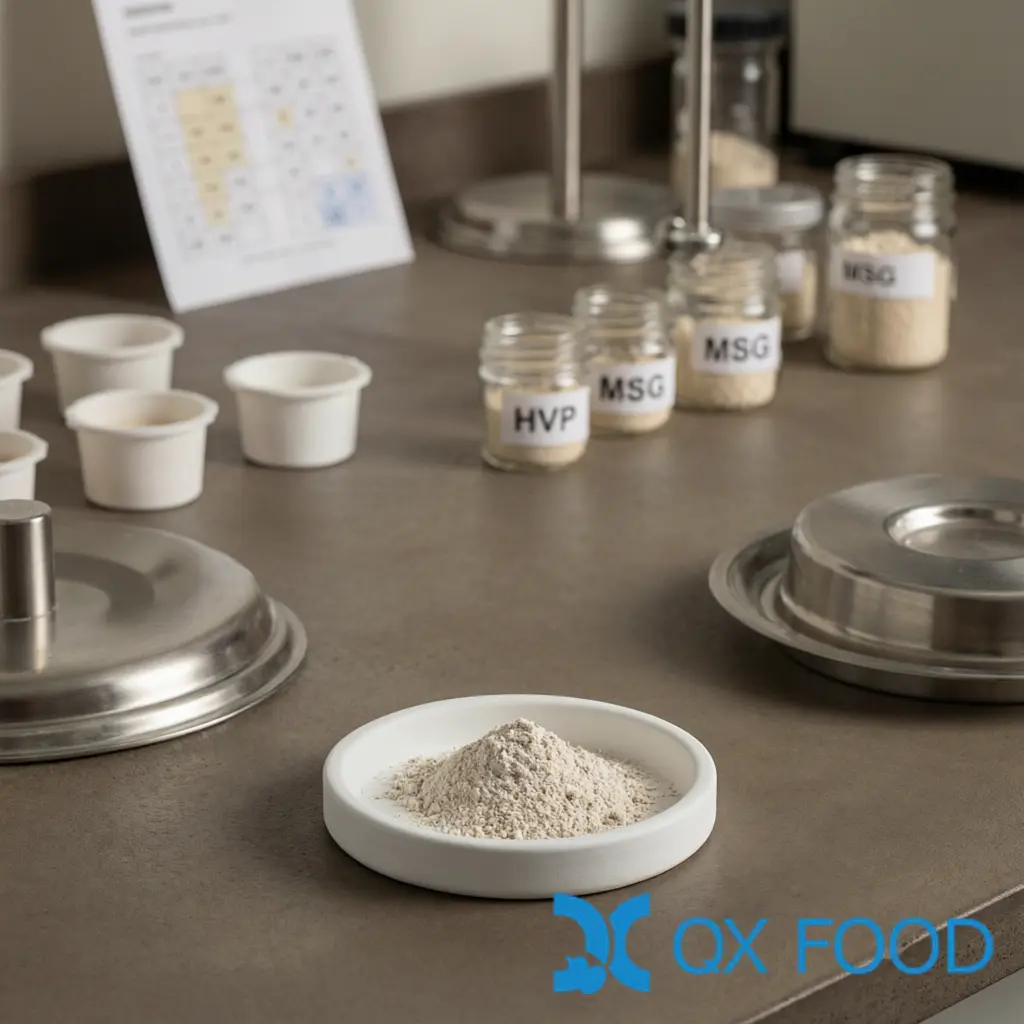
How to Run an MSG-Replacement Trial
A defensible replacement trial follows six steps:
- Define the MSG reference formula. Record the MSG level and the full savory system around it: salt, nucleotides, yeast-derived ingredients, flavors and carriers.
- Define the HVP candidate. Document protein source, hydrolysis route, salt, moisture or solids, nitrogen specification and any compositional data the supplier provides.
- Build a reference trial. Start from the supplier’s application guidance and internal bench screening rather than from a multiplier. Screen a small range of use levels against the reference product.
- Rebalance sodium and supporting savory ingredients. Account for the HVP’s own salt and adjust added salt, nucleotides, yeast-derived ingredients or flavors where the sensory gap requires it.
- Validate under the actual process. Run the real cook, retort, coating or drying step and evaluate the finished product, not a bench sample.
- Compare cost at equivalent finished performance. Only then is the economic comparison meaningful.
Two habits keep such trials honest. Document the specification and batch documentation of each candidate before testing, so the trial result can be traced back to a defined grade rather than to a category label. And treat the outcome as a result for your formula, not as a new industry rule: what closes the gap in your product may not transfer to a different formula, process or market.
Sodium and Supporting Ingredients Must Be Rebalanced
Two reformulation effects are often underestimated. First, sodium: MSG contributes sodium defined by its own dose, while an HVP brings its own salt, which varies by grade and neutralization chemistry, so the finished sodium must be recalculated rather than assumed. Second, the surrounding savory system: switching from MSG to HVP can change the amount of other savory ingredients required, but the direction is formula-specific. Include any changes to yeast-derived ingredients, nucleotides, flavors, salt and carriers when you calculate the total finished-product cost.
Compare Cost at Equivalent Finished-Product Performance
Unit prices can differ substantially between MSG and HVP grades, but price per kilogram does not determine the economic result. The useful comparison is total formula cost at equivalent finished-product performance: the use level that closes the sensory gap, the salt and supporting-ingredient changes, and any compliance or documentation costs. Evaluate that number after the trial, not before it.
How to Choose an HVP Candidate
Candidate selection for an MSG-replacement trial follows the same information discipline as any HVP purchase. Document these parameters for each candidate:
- Protein source (soy, corn, wheat or other) and the allergen and labeling consequences.
- Hydrolysis route, acid or enzymatic, and the process documentation behind it.
- Salt level and sodium contribution to the formula.
- Nitrogen specification and how to read it. Nitrogen figures characterize the grade; they do not score flavor, as covered in our HVP amino nitrogen and total nitrogen guide.
- Moisture or solids, and the basis every figure is expressed on.
- Sensory reference from the supplier and your own bench screening.
- Destination-market requirements for the finished product.
These parameters define the candidate; none of them ranks which grade will replace MSG best in your product. The process and 3-MCPD side of the route question is covered in our acid vs enzymatic HVP guide, the source comparison in our soy HVP vs corn HVP guide, and the format decision in our HVP liquid vs powder guide.
If the program is large enough to plan around category availability, the HVP market outlook for buyers covers how published estimates are assembled and the questions to ask before quoting a market figure.
Specification, COA and Technical Documentation
Keep the three records separate when you evaluate candidates. The product specification states the control targets for the grade, including salt, nitrogen and moisture or solids. The batch COA reports the actual measured parameters for a specific lot. Technical documentation carries the process identity, protein source and allergen information. Ask for each document at the right stage instead of expecting one certificate to answer everything.
How QXFOOD Supports MSG-Replacement Trials
QXFOOD provides product-specific specifications and batch documentation for the selected HVP grade. The analytical parameters shown on the batch COA depend on the SKU and its control plan; process identity, protein source and allergen information should be confirmed from the applicable technical documentation. Published grades to start a trial with include the standard soy HVP powder, the MF-01 specialty flavor grade, and the full range in the HVP powder series comparison; the umami base formulation guide covers how glutamate sources layer with nucleotide amplifiers in compound seasonings.
Request HVP samples for your MSG-replacement trials through the contact form on this page, and the application team will support the candidate selection and trial design.
Frequently Asked Questions
Is HVP the same as MSG?
No. MSG is a defined glutamate salt whose primary direct taste contribution is umami. HVP is a multi-component protein hydrolysate whose composition, salt and sensory character depend on the grade. They are different savory tools, not equivalent ingredients.
Can HVP replace MSG 1:1?
There is no universal ratio. MSG is a defined molecule, while HVP composition changes by source, process and grade, so the required use level has to be established by a reference trial in your finished product. Screen a small range of use levels against your current formula rather than applying a fixed multiplier.
Does HVP contain free glutamate?
Yes, in grade-specific proportions. HVP can contain naturally occurring free glutamate because glutamic acid is part of the plant protein being hydrolyzed. If free glutamate matters to your formulation work, use product-specific compositional data rather than a generic category percentage.
Can a food containing HVP claim “No MSG” in the US?
No. Under FDA guidance, foods containing ingredients with naturally occurring free glutamate, such as HVP, cannot claim “No MSG” or “No added MSG” on their packaging. Added MSG must be declared as “monosodium glutamate”, while HVP is declared by its own ingredient name.
Does replacing MSG with HVP remove free glutamate from a formula?
No. HVP can naturally contain free glutamate, so replacing added MSG with HVP changes the ingredient system and the label declaration; it should not be described as removing glutamate from the food.
Which HVP grade should I trial first?
Choose by your constraints, not by a fixed grade persona: protein source and allergens, hydrolysis route, salt budget, nitrogen specification, moisture or solids basis, sensory reference and destination-market rules all feed the decision. Start with one or two candidates that fit those constraints and screen them in your finished product.