
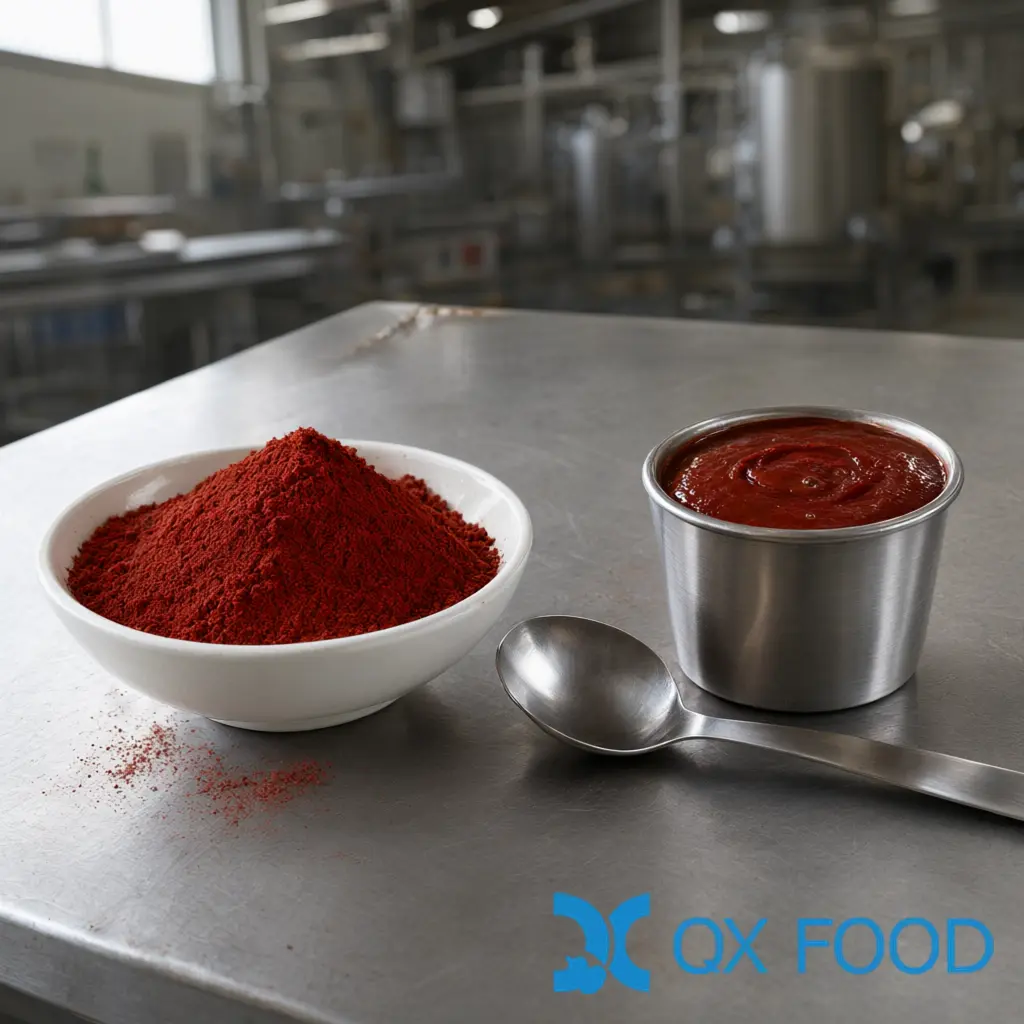
Dry sauce premixes and wet sauce bases transfer different amounts of formulation and processing work to the buyer. A wet base may be concentrated or ready to use, while a dry premix may require more than water addition. Compare both formats against the same finished-sauce target, and agree which steps remain at the buyer’s plant: dilution, mixing, heating, packing.
A Format Choice Is a Responsibility Trade
Buyers often compare the two formats as if one were a cheaper version of the other. In practice the purchase order also moves four tasks between supplier and factory: water addition, flavour lock, stability control and acceptance testing. Each task has a cost, and each one becomes someone’s risk after delivery.
That is why two quotations at a similar price per kilogram can be far apart in real cost. A dry sauce premix carries less freight weight but more work inside your plant. A wet base carries more weight and a different split of process control, and its shelf life and handling depend on the grade rather than on the word wet. Neither is automatically better. The right question is which of those burdens your plant is equipped to carry.
Where the Water Enters a Dry Sauce Premix Project
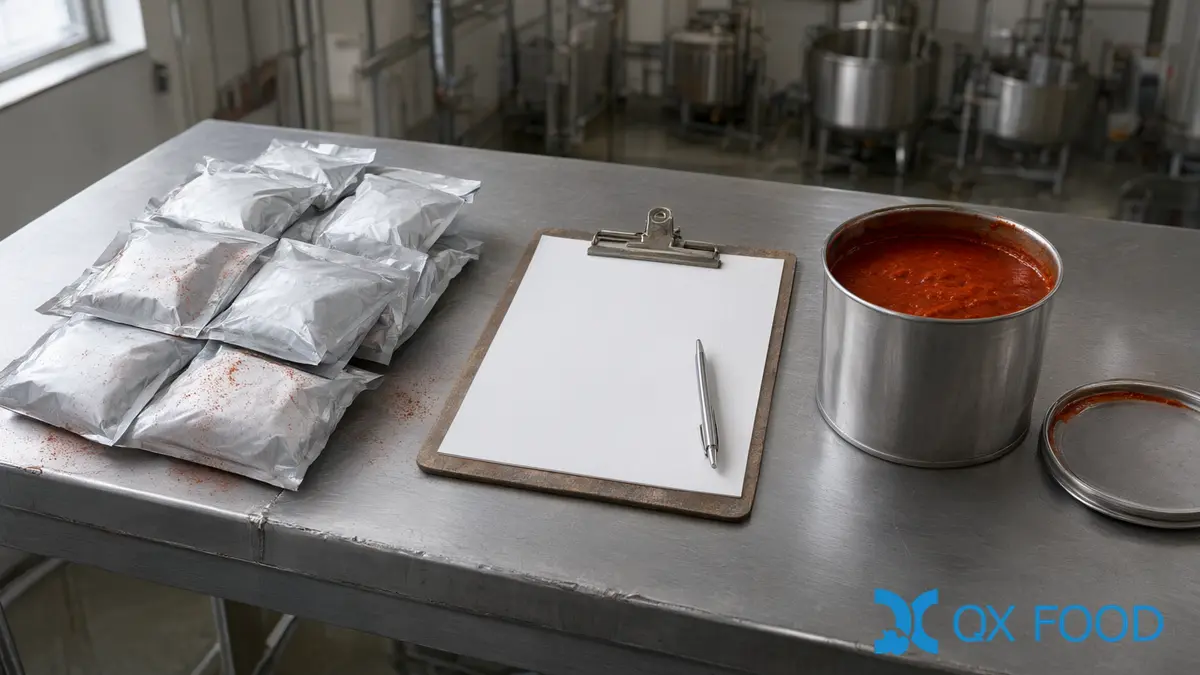
In a dry sauce premix, water is normally added at your plant, and the plant owns potable water quality, dosing accuracy, mixing time and the record that shows the batch reached its target. A wet base is not automatically the opposite. It may be delivered ready to use, or it may be a concentrate that still needs dilution, heating or further blending. Ask the supplier to state which steps are already complete and which remain yours.
Ask for the water source and the dilution instruction in writing either way. A premix designed to be reconstituted at one part powder to three parts water, and a base delivered ready to use, are not interchangeable at the same delivered solids. If the instruction is missing, the first trial will define it by accident, and that definition becomes hard to change later. The declaration consequence runs alongside this: water added in your plant may have to appear in the ingredient list and in the order of ingredients, which is the reading discipline covered in the tomato powder ingredient declaration guide.
For a dry sauce premix vs wet sauce base decision, write the intended final solids into the brief before asking for samples. Suppliers can then quote against one target instead of two interpretations of it.
Who Fixes the Flavour
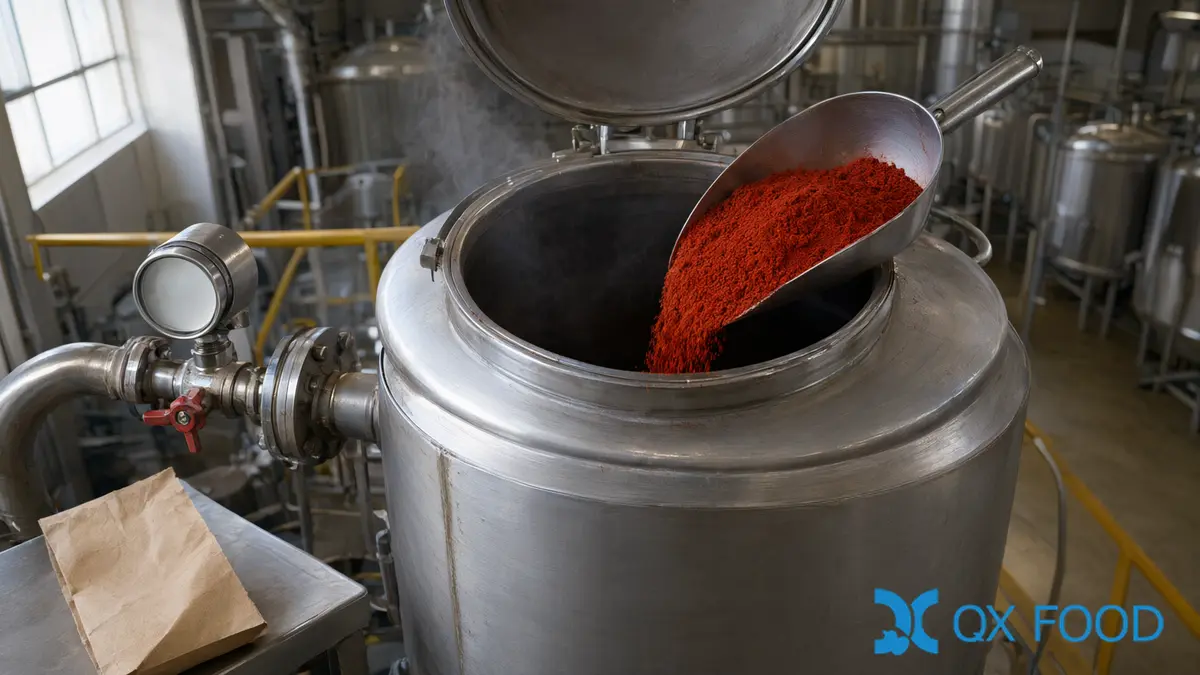
A dry sauce premix establishes the starting ingredient balance, but the final flavour must be confirmed after preparation. Rehydration and heating, holding, plus interactions with other recipe ingredients can change its sensory performance.
A wet base has its own processing history, and dilution or further processing can still change the result. Neither route fixes flavour at the point of delivery. Both are approved in the finished sauce, under the intended production and serving conditions.
This is the part buyers underestimate. Converting a wet formula to dry is not a matter of removing water: the heat step changes what the aromatics become, and the carrier quantity changes how they release. Run the comparison in your own finished product, with the same dose basis, as described in the tomato powder ketchup trial design.
Stability Depends on the Finished Product, Process and Storage Conditions
It is common to hear that wet bases need a retort and dry premixes do not. The regulation is more specific, and the difference matters when you or your customer is asked to describe the process.
Under the United States rules for thermally processed low-acid foods, a low-acid food has a finished equilibrium pH above 4.6 and a water activity above 0.85. The same definitions add that tomatoes and tomato products with a finished equilibrium pH below 4.7 are not classed as low-acid foods. Acidified foods are separately defined as low-acid foods to which acid or acid food has been added, with water activity above 0.85 and a finished equilibrium pH of 4.6 or below.
For U.S. regulatory classification, assess the full formulation; the finished equilibrium pH; water activity; the processing method; the packaging; and the intended storage conditions. Apply the relevant scope and exclusions in 21 CFR Part 113 and 21 CFR Part 114, and check the tomato-product exception against the actual formulation.
| Question | Dry sauce premix | Wet sauce base |
|---|---|---|
| Who adds water | Your plant, unless the premix needs other additions | Depends on the grade: concentrated or ready to use |
| Typical water activity | Below the 0.85 threshold, to be confirmed by test | Above 0.85 unless the formula is designed otherwise |
| What shapes the process assessment | Water activity, formulation, intended use | Finished pH, water activity, process, packaging |
| What to ask the supplier | Moisture and water activity limits, dilution instruction | pH, water activity, thermal process record and the basis of both |
| Where flavour is approved | In the finished sauce after preparation | In the finished sauce after dilution or further processing |
Assess the supplied powder separately from the finished sauce. Low water activity does not establish sterility: pathogens can survive in low-moisture foods even where growth is inhibited, as the joint FAO/WHO Codex code of practice for low-moisture foods (CXC 75-2015) sets out. Adding water or other ingredients changes the product that has to be evaluated.
Confirm the classification with a qualified process authority for the destination market rather than inferring it from the format name. The table above describes what usually follows; it is not a legal determination for a specific formula.
What Acceptance Looks Like at Each Handover
Do not skip the water activity line just because the powder looks and flows well. Incoming acceptance establishes whether the supplied premix or base meets its agreed specification. It does not replace confirmation that the buyer’s preparation and packing process produces the intended finished sauce, or any required validation and finished-product release checks.
| Check | Dry sauce premix | Wet base |
|---|---|---|
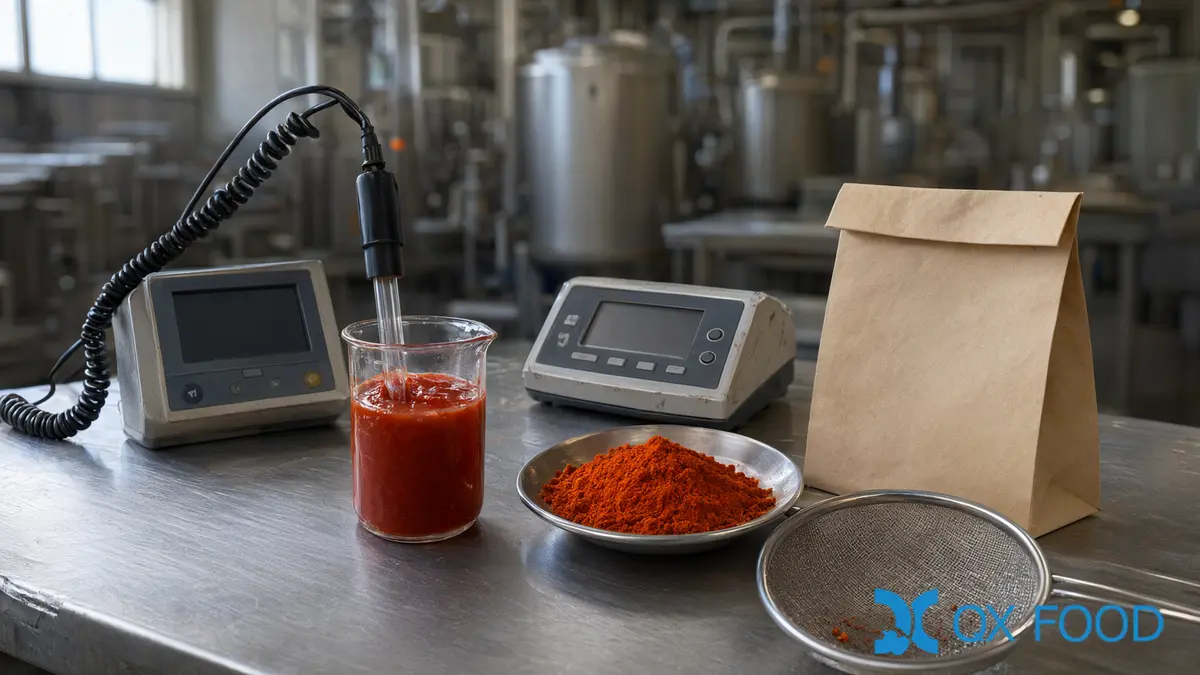
| Composition | Moisture and water activity; salt and acid content | Solids or Brix, pH, water activity |
| Physical | Particle size and sieve residue, lumps, flow | Homogeneity, separation, colour |
| Performance | Dispersion and flavour release at the agreed dilution | Sensory at the agreed dilution, reheating behaviour |
| Safety evidence | Microbiological results, water activity record and agreed evidence of relevant hazard controls | Microbiological results plus the thermal process record |
| Documents | Specification, COA, allergen statement and additive statement | The same, plus the process and packaging basis |
Agree which checks are required for each lot, which are verified periodically, and which belong to initial qualification or change control. Select the tests and limits, and the sampling frequency, from the product requirements and relevant risks.
Water Is Weight You Pay to Move
A wet base ships water. That is not automatically a cost penalty, because the water may be doing useful work in texture, handling or process time, but it has to be counted. Compare the total relevant cost per kilogram of finished sauce that meets the same agreed specification, using the same production and packaging boundary. Include ingredient usage, usable yield, freight, preparation, processing, testing, storage, losses. Cost per kilogram of tomato solids can be an additional measure when tomato-solids delivery is the purchasing objective. The freight and storage comparison sets out how to build that sheet without mixing bases.
Compare the declared unopened shelf life, storage conditions and remaining life at delivery for the actual grades. Set separate limits for opened wet bases and reconstituted premixes. These storage windows cannot be inferred from dry or wet alone.
The Brief That Prevents a Wrong Choice
The short version: six answers are usually enough to choose a format without a sample round that nobody can interpret.
- Where does the water in the finished product come from today, and who is allowed to change that?
- What final solids, pH, and water activity must the finished sauce reach?
- Who owns the thermal step, and can they show the record for each batch?
- Which acceptance criteria, test methods and sampling frequencies will apply?
- Who owns the ingredient declaration and the claims on the finished pack?
- What annual volume and pack size make the freight and storage difference material?
Whichever route the answers favour, the project stays a shared responsibility: the supplier confirms what is delivered, and the buyer confirms what the process produces. Agree the remaining processing and stability work in writing before the first sample round.
Where QX Food Ingredients Fits
For dry sauce premix projects, our ketchup style seasoning powder TMP-H18 is a ketchup-style compound seasoning produced by mixing and screening. It is listed for snack and coating applications, and it can be evaluated as a flavour ingredient for a sauce premix, subject to application testing. The reference pack is two 10 kg foil inner bags in one carton; other packaging options should be confirmed for the quoted grade. The current product record gives a moisture limit of 10.00 g/100 g or below, a total acid limit of 9.00 g/100 g or below and a lycopene specification of at least 40 mg/100 g. The plant operates under ISO 9001, ISO 22000 and HACCP with Halal documentation available.
Standard grades are a starting point rather than the limit of what can be discussed. Relevant parameters, colour, flavour direction and formulation can be reviewed against your application, destination market and acceptance criteria, subject to technical feasibility, sample validation, agreed specifications and batch verification. That is the same pattern used across the compound seasoning powder range, and it is why a project brief is more useful to us than a product name alone.
Questions Buyers Ask Before Choosing a Format
Which costs less: a dry sauce premix or a wet sauce base?
Neither format is inherently cheaper. Compare total cost per kilogram of finished sauce that meets the same agreed specification, including preparation, processing, packaging, storage, losses. The cheaper quotation is often the one whose hidden work your plant already does well.
Who is responsible for the water in a dry premix?
Your plant is, for whatever water the process adds, including potable water quality, dosing accuracy and the record that shows the batch reached its target solids. Ask the supplier to state what is already complete in the delivered base and what remains at your plant, and confirm that the declaration on your pack reflects the water you add.
Does a wet sauce base always need a retort?
No. The required controls depend on the formulation, pH, water activity, processing method, packaging, storage conditions. Part 113 also covers aseptic processing and packaging, so an obligation under that part does not by itself mean a conventional in-container retort. Have a process authority assess the actual formula and processing system.
Can a wet formula be converted to a dry premix?
It can be attempted, but it is a reformulation rather than a drying step. Heat changes the aromatics, the carrier changes release, and the dilution changes the dose basis. Expect a new sensory and shelf-life trial, and do not assume the two products will match in the finished dish.
Which acceptance tests should be written into the contract?
For a dry premix, typical checks are moisture, water activity, particle size, salt and acid content, microbiological results and performance at the agreed dilution. For a wet base, they are solids or Brix, pH, water activity, microbiological results, sensory at the agreed dilution and the thermal process record. Agree which of these apply to each lot, which are verified periodically and which belong to initial qualification or change control.
Which format suits a first trial?
Start with the format that matches the intended production process and the main uncertainty you need to test. If both routes are feasible, compare them in the same finished sauce using agreed acceptance criteria, rather than assuming the smaller sample is the better first trial.
Share your sauce application, target flavour and texture, available processing equipment, destination market and required volume. We can then confirm the matching product, available format, supporting documents and sample plan.
Share your sauce application, target flavour and texture, available processing equipment, destination market and required volume. Our global trade division will respond within 1 business day.