
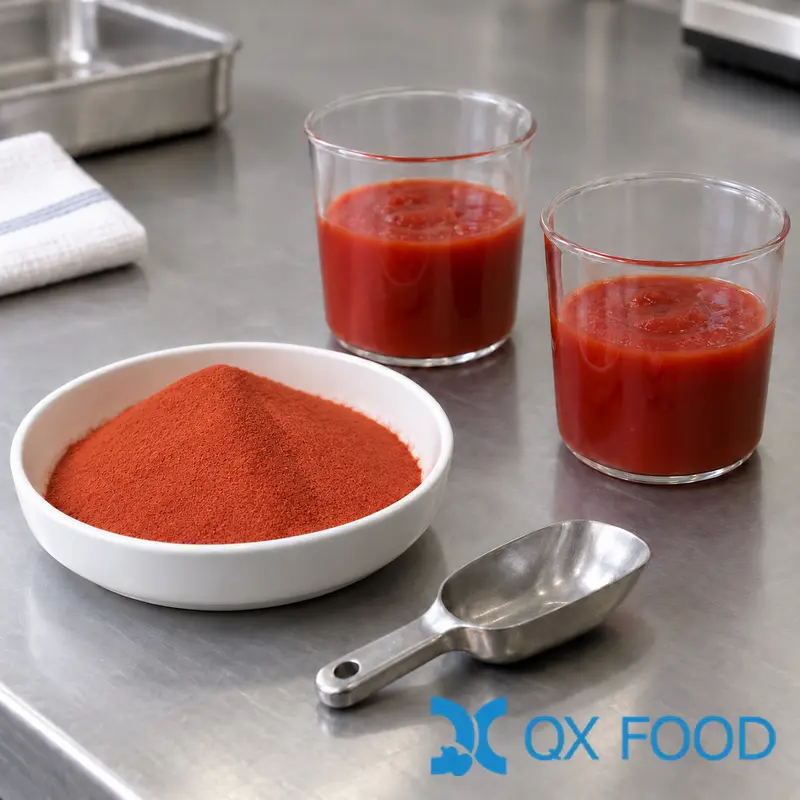
Evaluating tomato powder for ketchup manufacturing means testing a named ingredient in a defined sauce formulation. Record what changes, compare it with a reference batch, and assess hydration, consistency, acidity, color and flavor separately. A successful powder-and-water mix is not yet an approved ketchup formulation.
A sauce developer needs to know more than whether the sample turns red in water. Does it disperse under the available mixing conditions? What happens after the intended heating and cooling sequence? Can the result be reproduced without adjustments that were never written down?
The tomato powder and paste comparison covers the broader ingredient-form decision. This guide takes the next step: a suggested development record for comparing a powder-containing ketchup with an existing reference. It is not a finished recipe, a QXFOOD trial report or a validated food-safety process.
Define What the Trial Is Changing
Write the purpose at the top of the trial sheet. Replacing part of the tomato paste, developing a sauce around a dry ingredient, and adjusting tomato flavor in an existing recipe are different experiments. Choose one purpose for the first comparison.
Identify the intended sauce category and destination country before selecting samples. Check the complete ingredient declaration, including carriers, sweeteners, acidulants, flavors and anticaking agents, against the requirements for that use. A grade intended for dry seasoning should not be assumed suitable or permitted for a wet ketchup formulation.
Then identify the sample by grade, lot and ingredient declaration. A tomato-derived powder and a formulated tomato seasoning do not bring the same ingredients into the kettle. If the candidate already contains sweetening, acid or flavor components, record those contributions before treating it as a replacement for another tomato ingredient. The tomato powder application overview explains the wider distinction between ingredient types.
Record the reference paste specification, the complete reference formula and the finished batch mass. For the powder, request the solids information needed for the proposed comparison, including its reporting basis. If tomato-derived solids are not established, mark that field as unknown. Total powder solids must not simply be relabeled as tomato solids.
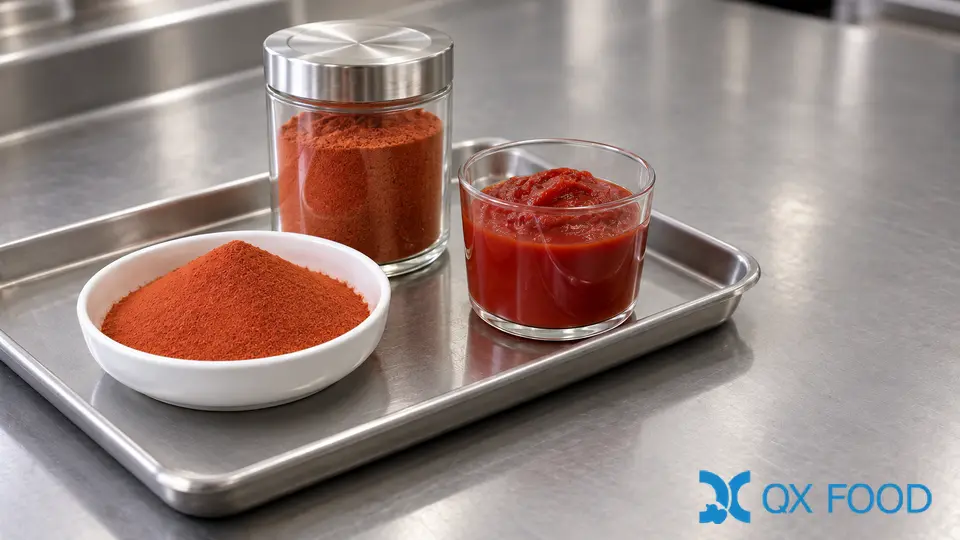
A Trial Plan for Tomato Powder for Ketchup Manufacturing
Separate the first screening run from later formula optimization. Otherwise, a change in powder, water, sweetener and mixing can produce an acceptable sauce without showing which adjustment mattered. The following sequence is a proposed way to organize the work, not a required test standard.
| Run | Question | Record before interpreting it |
|---|---|---|
| Reference | What does the accepted formula produce under the trial conditions? | Ingredient lots, actual quantities, processing record and measured reference results |
| Candidate screening | What happens when the specified powder is introduced for the stated purpose? | Powder dose, water adjustment, comparison basis and any unavoidable changes in other ingredients |
| One defined adjustment | Does a particular change address the observed shortfall? | The variable changed, the reason and the resulting observations |
| Confirmation | Can the selected formulation be reproduced as written? | A separate preparation, full formula version and results against the agreed criteria |
| Pilot evaluation | What still needs checking on the intended production equipment? | Scale-up conditions, filling/packaging requirements and QA/process-review responsibilities |
Keep non-test conditions consistent where practical and record exceptions. If changing the ingredient also requires changing the sugar or acid addition, that is a formulation comparison with several changes, not proof of the powder’s effect alone. Keep the first record intact rather than overwriting it with the successful reformulation.
Record Hydration Before Judging the Sauce
Use a distinct observation point for the powder’s introduction into the liquid phase. Write down the water quantity and temperature, addition order, mixer and attachment, mixing setting, actual mixing time and the point at which the sample was taken. Use conditions selected by the development team; there is no temperature or mixing time prescribed by this article.
Describe what is visible: floating powder, dry-centered lumps, sediment, entrained air or an apparently uniform dispersion. Note whether the observation was made before heating, during the process or after cooling. A note such as “smooth after mixing” needs a sampling point and preparation conditions to be useful on the next run.
Do not use complete clarity as the acceptance criterion unless the intended product actually requires it. Nor should disappearance of visible lumps be reported as a measured solubility result. De Sousa and colleagues’ spray-dried tomato study assessed wettability, solubility and consistency as distinct properties. In that study, the reconstituted powder also differed in consistency from the pulp at the same soluble-solids concentration. The experimental formulation included maltodextrin and silicon dioxide. The consistency result applies to that formulation; it does not isolate the effect of drying or predict the performance of every tomato powder. It is not a performance specification for a QXFOOD grade.
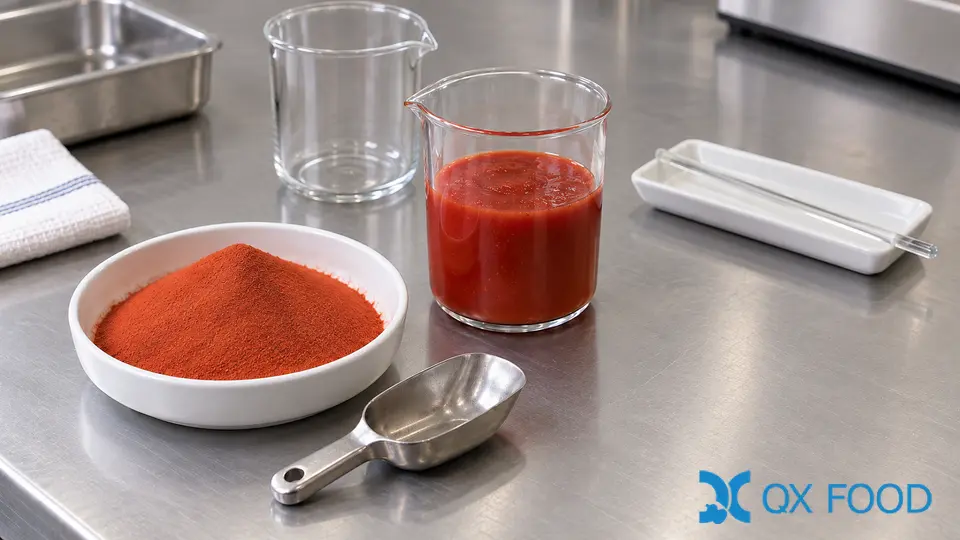
Read the Finished Ketchup at Defined Conditions
Assess the finished candidate beside the reference at recorded, comparable conditions. In the 2004 comparison of tomato paste and spray-dried powder solutions, concentration, temperature and shear conditions were part of the rheological investigation, and the two materials did not show identical flow behavior. A viscosity number without its method and conditions is therefore an incomplete comparison.
Consistency and Separation
If the factory uses a Bostwick test, report flow distance, elapsed test time, sample temperature and preparation method together. If it uses a viscometer, report the instrument, measuring geometry or spindle, speed and temperature. Record the cooling and resting interval before consistency measurement, alongside temperature and instrument settings. Do not convert one measurement into the other without a validated relationship for the product and method.
Record visible liquid separation separately, using a defined container, storage condition and observation interval selected for the trial. Keep the immediate result and the later observation in separate fields. Neither is a shelf-life conclusion by itself.
Color and Flavor
Compare color in the finished sauce rather than ranking the dry powders by shade. Record the lighting and sample presentation used for a visual check, or the instrument and settings for a measured one. Label photographs with the trial code and preparation stage; an unlabelled photograph is difficult to interpret later.
For flavor, ask the panel to record specific differences such as tomato character, sweetness, acidity, seasoning balance and aftertaste rather than only “preferred.” Use coded samples under a consistent evaluation procedure. Taste only samples cleared under the site’s food-safety procedures.
Solids, pH and Acidity
Keep refractometer readings, total solids, pH and titratable acidity in their own fields, with the method and reporting basis. Do not substitute one for another or treat a matching Brix reading as proof that the full formulations are equivalent.
The USDA ketchup quality framework treats color, consistency, flavor, finish, defects and total solids as separate quality dimensions, and lists distinct soluble-solids and total-solids methods. It is a useful example of keeping observations separate, not a universal specification for every export market. The buyer’s applicable requirements and agreed methods still need to be identified.
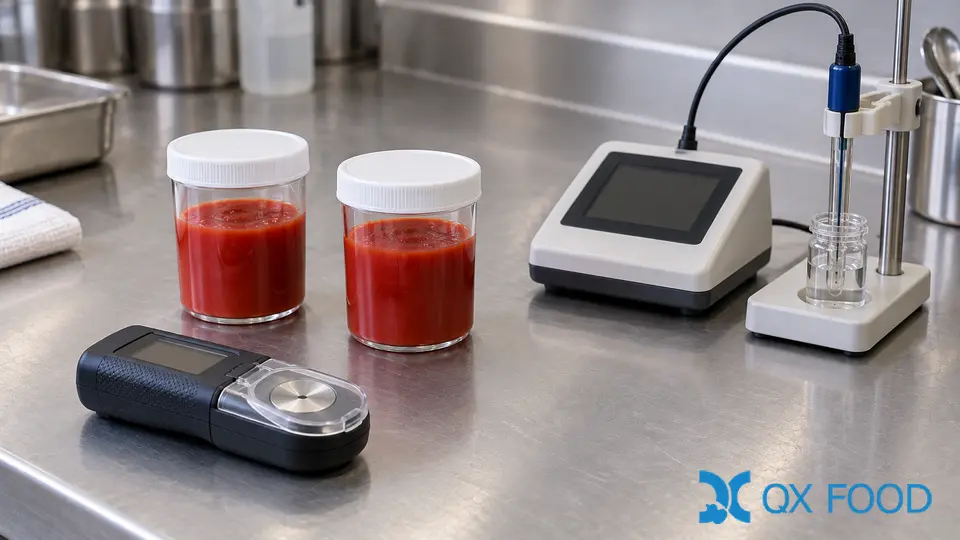
Use a Record That Explains the Result
Use the following sheet as a starting point for each comparison. Fill in the proposed method and acceptance criteria before reviewing the candidate result. Empty entries are intentional: they require project data, not a typical value borrowed from another powder.
| Record field | Reference run | Candidate run | Method / criterion agreed before evaluation |
|---|---|---|---|
| Trial code, formula version and ingredient lots | To record | To record | Identify each preparation separately |
| Target country and finished-sauce category | To record | To record | Identify applicable ingredient requirements before selecting samples |
| Comparison purpose, solids definition and calculation reference | To record | To record | Identify the solids definition, reporting basis and any calculation used; flag unknown tomato-derived solids information |
| Ingredient quantities, added water and final batch mass | To record | To record | Use actual weighed amounts and units |
| Other formulation changes | To record | To record | List changes rather than attributing the whole result to the powder |
| Addition order, mixing and thermal history | To record | To record | Use the recorded trial procedure; identify sampling points |
| Hydration / dispersion observations | To record | To record | Define the observation point and description |
| Cooling and resting before consistency measurement | To record | To record | Record the cooling procedure, resting interval and sample temperature at measurement |
| Consistency and liquid separation | To record | To record | Specify the test, temperature, timing and separate acceptance criteria |
| Finished-sauce color and flavor | To record | To record | State presentation and evaluation conditions |
| Brix, total solids, pH and titratable acidity | To record | To record | Keep methods, units and reporting bases separate |
| Decision and next run | To record | To record | Name the approver, unresolved issue and permitted next stage |
Keep repeat preparations as separate records. If a mixer setting or water addition changes during a run, record the change when it happens. A final formula copied from memory does not preserve the sequence that produced the sample.
Decide What Moves Forward
Use a conclusion that matches the evidence. “Needs a different dispersion procedure,” “acceptable after a documented formula adjustment” and “ready for pilot evaluation” lead to different next steps. If the solids basis or reference preparation is unresolved, record the outcome as inconclusive rather than a pass or fail for the ingredient.
Before moving to a production run, hand the selected formula and trial record to the responsible development, production and QA teams. They need to establish what must be checked on the intended mixer, heating system, filling line and package. The bench result does not qualify those conditions automatically.
Keep safety-process and shelf-life approval separate from sensory approval. For example, the FDA’s inspection program for applicable US acidified and low-acid canned-food operations specifically addresses evaluation of changes to formulation, ingredient specifications and processing conditions. That is a US-scoped reference, not a classification of every ketchup product. The factory’s qualified team must determine the requirements for its actual formulation, package and destination market.
FAQ: Tomato Powder in Ketchup Development
What water ratio should be used in a ketchup development trial?
Select and record the water addition for the specific powder, reference ingredient and intended formula. There is no ratio supplied by this guide. If the powder’s tomato-derived solids basis is unknown, obtain that information before claiming solids-equivalent replacement.
Does matching Brix prove that the candidate ketchup matches the reference?
No. Matching a refractometer reading does not establish matching consistency, color, flavor or composition. Compare the finished sauces using separately defined methods and criteria, and identify what the reported solids value includes.
Is ketchup-style seasoning powder a ready-to-reconstitute ketchup?
Not on the basis of the name alone. Request the ingredient declaration and intended-use documentation. QXFOOD’s TMP-H18 is a formulated seasoning grade; this article provides no validated water ratio or finished-ketchup result for it.
Can a successful bench trial establish the ketchup’s shelf life?
No. A bench trial records application performance under stated conditions. Safety-process, packaging and shelf-life approval require separate work by the responsible qualified team for the actual product and destination market. The dry ingredient’s shelf life does not establish the reconstituted sauce’s shelf life.
Discuss the Sample With QXFOOD
When requesting a sample, identify the ingredient rather than relying on the word “tomato.” Review the current declaration for tomato powder grade TMP-H20, which includes silicon dioxide. The separately formulated ketchup-style seasoning powder TMP-H18 includes a carrier, sweetening, acid and flavor components. Its name is not evidence of a validated wet-ketchup reconstitution formula. Neither linked grade is presented here as having passed the proposed trial.
If the standard grade does not fit the development brief, QXFOOD can discuss relevant formulation, color and flavor directions. Any proposed change remains subject to technical feasibility, sample validation, agreed specifications and batch verification. The development target should be written separately from the standard ingredient specification.
Share the ketchup application, reference ingredient, intended process, destination market, custom packaging needs and expected annual volume. Our global trade division will respond within 1 business day.