
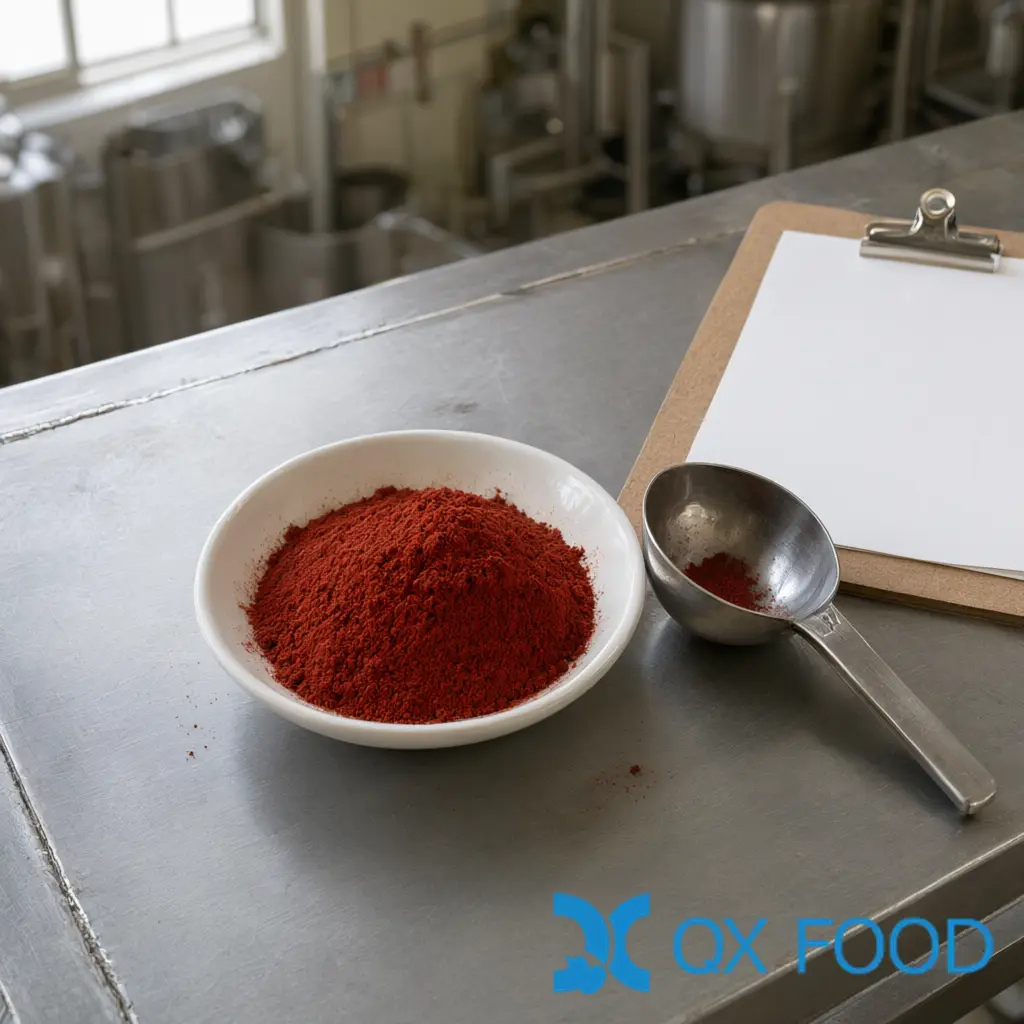
Two tomato powders can match on colour, mesh and moisture and still be different materials. One is dried tomato; another is dried tomato with a carrier; a third is a compound seasoning built around tomato. The tomato powder ingredient declaration is where that difference becomes visible, and it is worth reading before you compare any technical number.
Why the Tomato Powder Ingredient Declaration Comes First
A specification sheet answers “how does this powder behave”. The declaration answers “what is this powder”. If the second question is unresolved, the first produces numbers you cannot compare: a carrier dilutes tomato solids, so two powders with the same moisture, mesh and colour can deliver different tomato character per kilogram. Read the declaration, then decide which specification lines matter.
This is also the cheapest check available to a buyer. It needs no laboratory, and it catches a common mismatch in procurement: a supplier quoting a compound seasoning against a competitor’s single-ingredient powder and letting the technical values do the talking.
Composition Patterns That Can Overlap
The examples below show composition patterns that can overlap. A carrier-formulated powder may also contain an anti-caking agent, and a compound seasoning may contain both. These are illustrative compositions, not finished label templates; ingredient names, additive descriptions and allergen information must follow the destination-market rules.
| Pattern | Typical declaration | What it tells you | What it does not tell you |
|---|---|---|---|
| Single-ingredient powder | tomato | No carrier or additive appears in this document | Variety, origin, drying method, whether a processing aid was used |
| Carrier-formulated powder | tomato, maltodextrin | Part of the mass is carrier, not tomato | The ratio, unless the supplier states tomato solids or the carrier percentage |
| Powder with a free-flow agent | tomato, silicon dioxide | An anti-caking agent is present at some level | The level, and whether it has a function in your finished food |
| Compound seasoning | tomato powder, salt, maltodextrin, citric acid, flavouring | The product is a formulated tomato seasoning rather than a single-ingredient tomato powder | How much of the flavour comes from tomato |
The fourth pattern is the one most often compared against the first, and the two should not be treated as interchangeable without reformulation and application testing. Both are legitimate products; they answer different briefs.
What a Carrier Changes
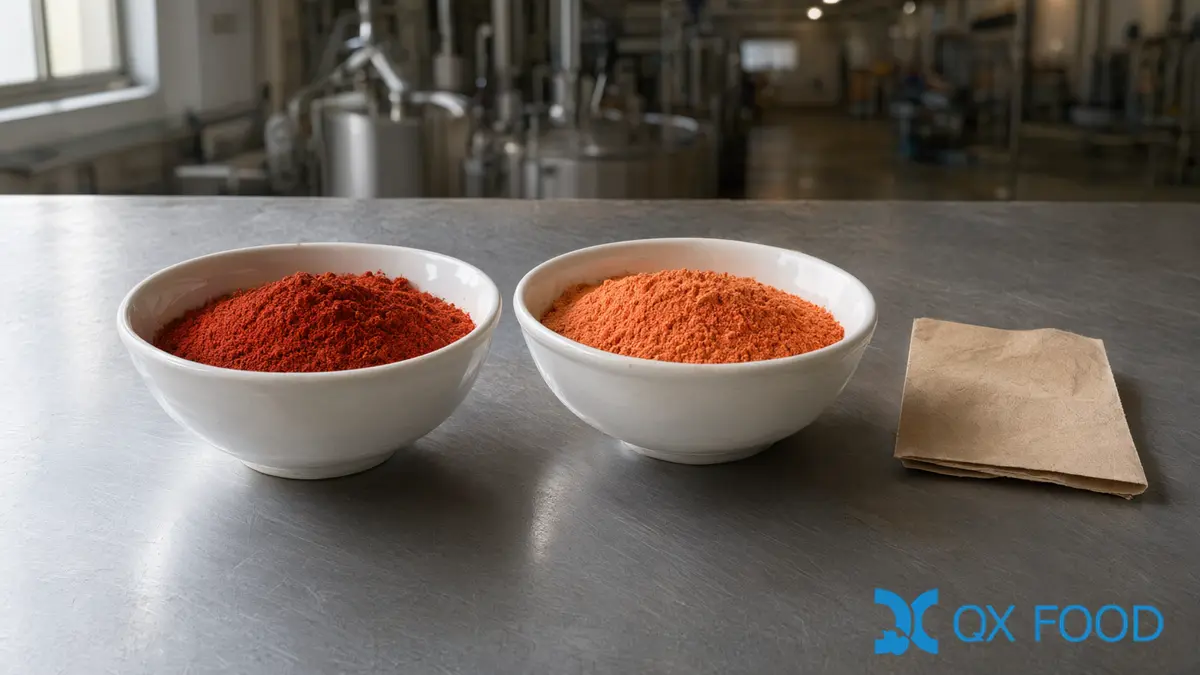
A carrier is a supplier’s description of a functional ingredient added to make a powder possible or easier to handle. In spray drying it can raise the solids load, reduce stickiness and protect the powder during drying. The maltodextrin carrier guide covers how that works in practice. What the substance is called commercially does not settle how it is treated on a label; that depends on its legal role, the level used and the rules where you sell.
For a buyer, the carrier changes four things at once. It lowers the tomato content per kilogram, so cost per kilogram is not cost per unit of tomato solids. It changes flavour intensity and colour strength, which is why two powders at the same dosage can taste different. It may affect the ingredient declaration of your finished food, and that effect has to be confirmed rather than assumed. And maltodextrin and tomato tissue differ in wettability and dispersibility, and the direction of the effect depends on the grade and dosage; confirm it on your specific grade.
None of that makes a carrier a defect. It makes the ratio a commercial term that should be written down. Two tomato powder ingredient declarations can both be accurate and still describe different products, which is why the carrier level and the measurement basis belong in the specification.
Reading the Order of Ingredients
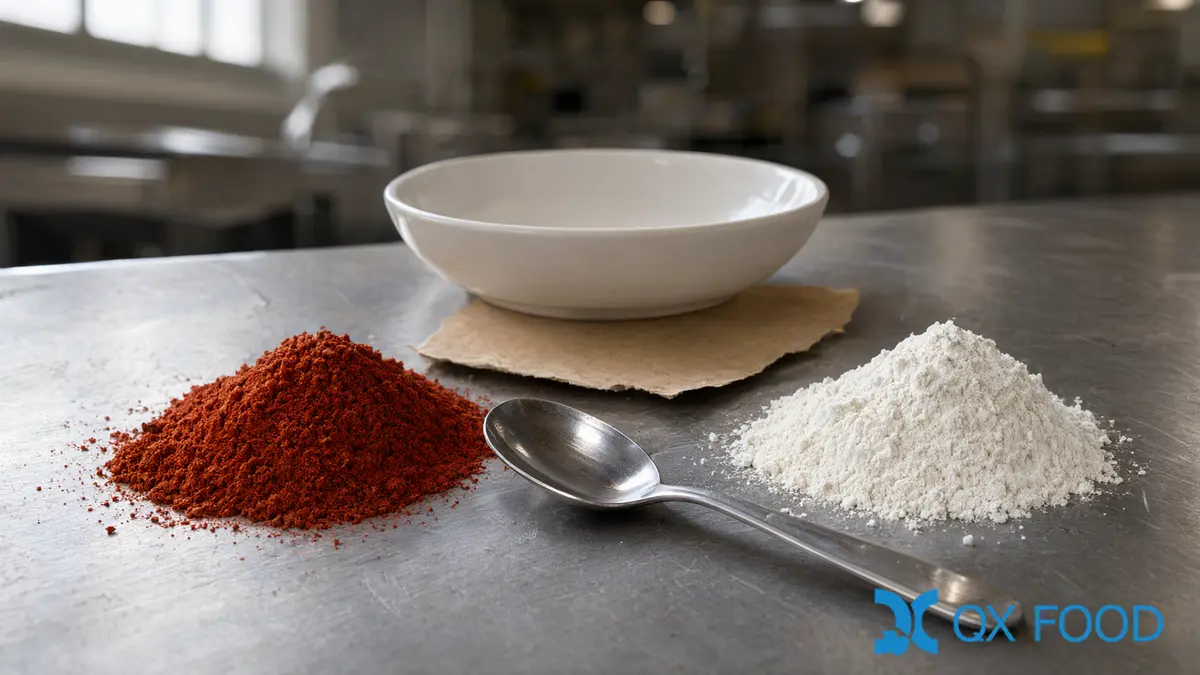
EU ingredient lists generally follow ingredient weights at the time of use, subject to the applicable rules and exceptions (Regulation (EU) No 1169/2011, Article 18). The order provides a composition clue, but does not establish an exact percentage or a dry-matter ratio in the finished powder. Confirm the form of the tomato ingredient and request composition data on a clearly stated basis.
Two cautions follow. A supplier’s technical declaration is not always the label declaration, and it may not be ordered by weight at all, so ask which version you are reading. And the order tells you relative weight inside the powder, not the tomato solids content, because water removed during drying changes the arithmetic.
Naming or emphasising tomato can trigger EU quantitative ingredient declaration requirements, subject to the exceptions and calculation rules in Annex VIII (Article 22). The labelling percentage is not automatically the tomato dry-solids percentage used for purchasing. Request sufficient composition information from the supplier to support the finished-food label.
Processing Aids and Carry-Over: Why Something Can Be Absent
A tomato powder ingredient declaration is not a full process history. Two omissions are common and legitimate, and both depend on the rules of the market where the finished food is sold.
In the European Union, food additives and food enzymes do not have to appear where their presence is solely due to carry-over from an ingredient and they serve no technological function in the finished product, or where they are used as processing aids (Article 20). In the United States, the comparable provision covers incidental additives present at insignificant levels with no technical or functional effect, including substances carried over from another ingredient, processing aids removed before packaging, substances converted into normal food constituents without significantly increasing the amounts naturally present, and processing substances present at insignificant levels without function in the finished food (21 CFR 101.100(a)(3)).
An exemption from the ingredient list does not automatically remove applicable allergen-labelling obligations. Check the substance, its source and any relevant exceptions under the destination-market rules.
The practical consequence for a tomato powder buyer is narrow and important: absence from the list is not proof that nothing was used in processing. If the question matters to your own label or to a customer specification, ask the supplier directly what processing aids were used and whether any residue has a function in your finished food. That is a conversation, not an inference from a document.
What the Declaration Cannot Tell You
Even a clean, complete declaration leaves gaps. It does not tell you the tomato variety, the origin, the drying method, the mesh, the moisture, the microbiological status or the colour value. It does not establish that a product is organic, and it does not prove an allergen-free claim, because cross-contact is a plant question rather than a list question.
It also does not settle naming. Whether a blend may be sold as “tomato powder” depends on the naming rules of the destination market and on how the product is presented, which is a question for a regulatory specialist in that market. The declaration is the start of the file, not the whole file.
A Document Request List
A tomato powder ingredient declaration describes composition, not release testing, so it has to be read next to the specification and the certificate of analysis. Ask for four documents and read them against each other; the point is to find the places where two documents disagree.
| Document | What to compare | What counts as a mismatch |
|---|---|---|
| Ingredient declaration or label mock-up | Ingredient names and order against the technical data sheet | Carrier declared in one document and absent from the other |
| Technical data sheet | Tomato solids, carrier, moisture, mesh | Tomato-solids content or its reporting basis is missing, which limits a solids-based cost comparison |
| Certificate of analysis, current lot | Agreed release parameters against the specification | Agreed release results are missing, methods or units are inconsistent, or the COA cannot be linked to the supplied lot |
| Allergen and processing-aid statement | Declared aids against your finished-food requirements | Silence treated as confirmation that nothing was used |
Request the current version identifier and effective date of the tomato powder ingredient declaration and specification, and confirm that they apply to the quoted grade and the supplied lot. Version information helps identify the applicable documents; product comparability still depends on composition, measurement basis and application requirements.

Red Flags in Tomato Powder Documents
The first test of a tomato powder ingredient declaration is whether it agrees with the specification, the certificate and the quoted grade. The rows below mark the conflicts worth resolving before a trial.
| What you see | Why it matters | Question to ask |
|---|---|---|
| A “100% tomato” claim conflicts with a declaration listing a carrier or additive | The composition claim and the supporting document do not agree | Which current document describes the quoted grade, and what does the “100%” claim refer to? |
| The declaration and the data sheet list different ingredients | The two documents may refer to a different grade, market or version, or one may contain an error | Which document applies to the grade and lot you are quoting? |
| Compound seasoning quoted against a single-ingredient powder | The comparison is between different products | Is this a tomato ingredient or a finished flavour system? |
| No declaration at all, only a COA | A COA cannot substitute for an ingredient list | Can you send the current declaration and specification? |
Here is the catch: none of these flags proves a problem. They mark the questions that separate a comparable quote from a confusing one. The tomato powder applications guide covers what each pattern is used for once the declaration is clear, and the natural plant powder clean-label guide covers how carriers and additives sit inside a clean-label brief.
Comparing Cost on the Right Basis
Two purchase goals need two comparisons. A buyer who needs a quantity of tomato solids compares the cost of tomato solids on a stated basis. A buyer who needs an approved flavour profile compares the dose and finished-product cost needed to reach that profile. A tomato powder ingredient declaration that states its measurement basis is worth more than a lower price with no basis at all.
| What you are buying | Comparison that fits |
|---|---|
| A quantity of tomato solids | Cost per unit of tomato-derived dry matter, on the same stated basis |
| An approved flavour and colour performance | Dose needed to reach the target profile, and the resulting cost in the finished food |
Missing tomato-solids data does not make every commercial comparison impossible. It makes a solids-based comparison incomplete, and that is a reason to ask for the figure or its reporting basis before the quote is approved.
Where QX Food Ingredients Fits
QX Food Ingredients lists tomato-based powders with different compositions, so the grade name alone will not tell you what you are buying. The TMP-H17 page, for example, lists a formulated seasoning containing tomato powder, maltodextrin, glucose, citric acid, flavourings and silicon dioxide, which is a different purchase from a single-ingredient tomato powder. Confirm the current declaration and specification for the quoted grade before approval.
Tell us your application, target tomato profile, destination market, and whether you need a single-ingredient powder or a formulated seasoning. We can provide the current grade-specific declaration and specification and arrange an evaluation sample. The tomato flavor seasoning powder page shows a formulated grade, and the tomato powder product page is the entry for the single-ingredient direction. For the concentration question behind the choice, see how tomato powder compares with paste on concentration.
Tomato Powder Ingredient Declaration: Common Questions
Is tomato powder always 100% tomato?
No. Some tomato powders declare tomato alone, others declare a carrier such as maltodextrin, a free-flow agent such as silicon dioxide, or both. A compound seasoning can carry tomato in its name while much of its mass comes from other ingredients. Read the list, and check that the composition claim matches the document.
What does maltodextrin mean on a tomato powder declaration?
It means a carrier is part of the powder. Maltodextrin can help a spray-dried tomato base dry and flow, and it dilutes tomato solids per kilogram. Ask for the carrier level or the tomato solids content, with its basis, so that cost and dosage can be compared on the same footing.
Does a carrier have to appear on my finished label?
Calling a substance a “carrier” does not determine whether it may be omitted from the finished-food label. Check its legal role, use level and the destination-market rules. EU rules distinguish qualifying carrier exemptions from additive carry-over and processing-aid exemptions. In the United States, an incidental-additive exemption requires the relevant conditions to be met, including insignificant levels and no technical or functional effect in the finished food. Applicable allergen-labelling requirements must also be checked.
Why is silicon dioxide in some tomato powders?
It is used as an anti-caking or free-flow agent. Its presence tells you the powder was formulated for flow, not that the tomato material is poor. The useful questions are the declared level, whether it has a function in your finished food, and whether your destination market permits it for your application.
Why does the COA not list the carrier?
A certificate of analysis reports test results, not the recipe. It may test moisture, colour or microbiology without naming every ingredient. The declaration and specification are the documents that describe composition, so a COA alone cannot confirm what the powder contains.
Can a blend be called tomato powder?
Naming rules differ by market and depend on how the product is presented and what consumers expect from the name. A blend sold as tomato powder in one country may need a different name in another. This is a regulatory question for the destination market, and it is separate from the question of what the powder contains.
Does the ingredient declaration differ between markets?
Yes. The same powder can require a different declaration in the European Union, the United States and an Asian market, because the omission rules, the additive lists and the naming conventions are set locally. Ask for the declaration that matches the market where your finished product will be sold.
What should I request before approving a tomato powder?
Ask for the current ingredient declaration, the technical data sheet, a certificate of analysis for the lot you will receive, an allergen and processing-aid statement, and the version identifier and effective date of both documents. Then check that they agree with each other before you run a trial.
The Short Version
The declaration helps you see whether a tomato powder is a single-ingredient material, a carrier-formulated powder, a free-flow powder or a fuller seasoning system, and those patterns can overlap. Read it before the specification, check the measurement basis before comparing cost, and treat silence about processing aids as a question rather than a clearance. The tomato powder and paste comparison explains the concentration side of the same decision.