


Certified compound seasoning powder B2B sourcing is no longer only about flavor — it is about food safety, import compliance, batch consistency, and documentation that procurement teams can trust.When a food manufacturer sources compound seasoning powder at scale — hundreds of kilograms per month, shipped across borders, applied directly onto finished food products that will carry their brand — the question is never just “does this taste right?” The question is: can I trust this supplier with my brand’s reputation, my customers’ safety, and my import compliance?
Certification is the answer the food industry has developed to that question. Not marketing language, not supplier promises — but independently verified, internationally recognized documentation that a factory’s processes, ingredients, and outputs meet defined safety and quality standards. At Qianxuan Food, every compound seasoning powder in our range is produced under a full certification stack: ISO 22000:2018, ISO 9001:2015 (GB/T 19001-2016), HACCP, and Halal — plus individual Certificates of Analysis (COA) for every product. This article explains what each certification means, why it matters to B2B buyers, and how they work together to protect the buyers who source from us.
Quick answer for buyers: Qianxuan Food supplies 12 certified compound seasoning powder SKUs for B2B food manufacturers, supported by ISO 22000:2018, ISO 9001:2015, HACCP, Halal certification, batch-level COA, and export documentation for import clearance.
Why Certification Is Non-Negotiable in B2B Compound Seasoning Sourcing
The global food certification services market was valued at approximately USD 15.3 billion in 2023 and is projected to reach USD 27.4 billion by 2032, growing at 6.7% CAGR — a market size that reflects the reality that certification has become a baseline procurement requirement, not a differentiator. For B2B food manufacturers, this means: working with uncertified ingredient suppliers is increasingly not an option. Retailers, QSR chains, and importers now routinely require suppliers to provide certified-factory documentation before approving a new ingredient source.
For compound seasoning powders specifically, the certification requirement is even more critical than for single-ingredient spices. A compound seasoning is a multi-component system — spices, meat extract, salt, amino acids, flavor enhancers — and each component introduces its own food safety risk profile. An ISO 22000-certified production process means every one of those inputs has been assessed for hazards, controlled through validated procedures, and documented at every stage from raw material receipt to finished product dispatch.
For buyers sourcing for markets where religious dietary compliance is a purchasing requirement — whether in faith-observant communities across Europe, North America, or globally distributed consumer bases — Halal certification provides the documentary chain of custody that makes a product commercially deployable in those channels. The global halal condiment and seasoning market was valued at USD 3.55 billion in 2024 and is projected to reach USD 6.5 billion by 2035 at a CAGR of 5.6% — a growth trajectory that reflects the expanding commercial relevance of halal-certified ingredient sourcing across global food manufacturing.
ISO 22000:2018 — The Gold Standard for Food Safety Management
ISO 22000:2018 is the international standard for Food Safety Management Systems (FSMS), published by the International Organization for Standardization and widely recognized by international food manufacturers, auditors, and supply chain buyers as a food safety management framework.. ISO 22000 integrates the principles of HACCP with broader organizational management system requirements, creating a framework that addresses food safety risks systematically rather than reactively.
For B2B buyers evaluating a compound seasoning powder supplier, ISO 22000:2018 certification means the following has been independently verified:
- Hazard Analysis is systematic and documented: Every raw material input — cumin, chili, meat powder, salt, amino acids — has been assessed for biological, chemical, and physical hazards. Control measures are validated and monitored at defined Critical Control Points throughout the production process.
- Prerequisite programs are in place: Facility hygiene, pest control, allergen management, cross-contamination prevention, equipment maintenance, and personnel training all operate under documented, audited programs — not informal practices.
- Traceability is end-to-end: Every batch of finished compound seasoning can be traced back to specific raw material lots, production dates, and process parameters. In the event of a quality concern, a full trace-back investigation can be conducted within hours.
- Continuous improvement is built in: ISO 22000:2018 requires regular management reviews, internal audits, corrective action procedures, and ongoing system updates — meaning the food safety system improves over time rather than remaining static.
The 2018 revision of ISO 22000 introduced the High Level Structure (HLS) framework, aligning it with ISO 9001:2015 and enabling integrated management system implementation. This means Qianxuan Food’s ISO 22000:2018 and ISO 9001:2015 certifications operate as an integrated management system — food safety and quality management are not separate silos but a unified, organization-wide framework.

ISO 9001:2015 (GB/T 19001-2016) — Quality Management System Certification
ISO 9001:2015 is the world’s most widely adopted quality management system standard, with over one million certified organizations globally across all industries. In the food manufacturing context, ISO 9001:2015 certification addresses a dimension of production quality that goes beyond food safety: consistency, process control, and customer satisfaction — the factors that determine whether a supplier delivers the same product specification order after order, month after month.
GB/T 19001-2016 is the Chinese national standard that is technically equivalent to ISO 9001:2015, issued by the Standardization Administration of China. For international buyers sourcing from Chinese manufacturers, a supplier holding both GB/T 19001-2016 and ISO 9001:2015 certification demonstrates compliance with both the domestic Chinese quality system framework and the internationally recognized ISO standard — providing dual-market regulatory assurance.
For compound seasoning powder buyers, ISO 9001:2015 certification provides assurance on the following quality dimensions:
- Process consistency: Every production run follows documented, validated processes with defined parameters — mixing ratios, screening specifications, moisture control targets — ensuring batch-to-batch flavor consistency that production line managers depend on.
- Incoming material quality control: Raw material suppliers are evaluated, monitored, and managed under a formal supplier qualification system. The cumin, meat powder, and spice inputs that go into every SKU meet defined incoming quality specifications before entering production.
- Non-conformance management: When a batch does not meet specification, a formal non-conformance procedure is triggered — preventing out-of-spec product from shipping, documenting the root cause, and implementing corrective action. Buyers benefit from this system without needing to manage it themselves.
- Customer-focused continuous improvement: The ISO 9001:2015 framework requires active measurement of customer satisfaction and systematic use of feedback to improve products and processes — a structural commitment to getting better at delivering what buyers need.
HACCP Certification — Hazard Analysis and Critical Control Points
HACCP (Hazard Analysis and Critical Control Points) is the foundational food safety methodology on which ISO 22000 is built — and holding a standalone HACCP certification in addition to ISO 22000:2018 provides buyers with explicit, documented evidence that the seven HACCP principles have been implemented, verified, and certified by an independent third party.
The seven HACCP principles applied to Qianxuan Food’s compound seasoning powder production cover:
- Principle 1 — Hazard Analysis: Identification of all potential biological (pathogens, mold), chemical (heavy metals, pesticide residues, allergens), and physical (foreign body) hazards associated with compound seasoning powder production and its raw material inputs.
- Principle 2 — Critical Control Points (CCPs): Identification of the specific production process steps where hazard control is essential — including raw material screening, moisture control during processing, and packaging integrity verification.
- Principle 3 — Critical Limits: Defined, measurable limits at each CCP — for example, moisture content ≤8.0 g/100ml as specified in every product’s technical parameters, which is simultaneously a flavor quality indicator and a food safety control parameter (moisture above the limit risks microbial growth).
- Principles 4-7 — Monitoring, Corrective Actions, Verification, and Records: Systematic monitoring of CCPs, defined procedures for corrective action when limits are exceeded, verification through testing and auditing, and comprehensive record-keeping that provides documentary evidence of ongoing compliance.
For buyers importing into markets with HACCP-mandatory import inspection requirements — including food products entering European Union channels and many North American retail supply chains — a supplier’s HACCP certification provides direct import compliance support.

Halal Certification — Global Market Access for Faith-Observant Consumers
Halal certification verifies that a food product’s ingredients, production processes, and facility practices comply with Islamic dietary law — confirming the absence of prohibited ingredients and the use of compliant slaughter methods for any animal-derived components. For compound seasoning powders, this certification is commercially significant far beyond any single geographic market.
The global halal food market now extends well beyond traditionally Muslim-majority markets. Faith-observant consumer communities exist in significant numbers across the United Kingdom, France, Germany, Canada, the United States, and Australia — and major retailers in these markets increasingly carry halal-certified product ranges to serve these consumer segments. For a food manufacturer sourcing compound seasoning powder for any product that will be sold through international retail channels, halal certification of their ingredient inputs provides market access flexibility that uncertified ingredients cannot.
All 12 compound seasoning powder SKUs in the Qianxuan Food range carry Halal certification. For each SKU, the halal certification confirms:
- All animal-derived ingredients (pure meat powder) are sourced from halal-compliant slaughter processes
- No prohibited ingredients (alcohol-based flavoring carriers, lard-derived processing aids, or cross-contaminating non-halal substances) are used in production
- Production equipment is managed under cleaning and changeover protocols that prevent cross-contamination from non-halal production runs
- The certification is issued by a recognized halal certification body and maintained through periodic facility audits
Halal certificates with full ingredient declarations are available upon request for all SKUs, in English and Arabic as required for specific market documentation packages.

Certificate of Analysis (COA) — Batch-Level Quality Verification
While ISO 22000, ISO 9001, HACCP, and Halal certifications verify the system — the processes, controls, and management frameworks that produce quality outcomes — the Certificate of Analysis (COA) verifies the product: the specific batch of compound seasoning powder that will arrive in your warehouse.
Qianxuan Food issues individual COAs for every compound seasoning powder product, with each document containing:
| COA Parameter | What It Verifies | Why Buyers Need It |
|---|---|---|
| Moisture Content | Actual tested moisture vs. ≤8.0 g/100ml specification | Confirms product will not cake in transit or storage; validates microbial safety control |
| Total Nitrogen | Protein-derived amino acid content vs. stated minimum | Verifies meat extract content and flavor intensity; confirms product matches specification |
| Sodium Chloride | Actual salt content vs. maximum specification | Essential for formulation dosing calculations and finished product nutrition labeling |
| Batch / Lot Number | Production batch traceability reference | Enables full supply chain trace-back; required for import inspection in many markets |
| Production Date & Expiry | Manufacturing date and 12-month shelf life calculation | Confirms remaining shelf life for import logistics and inventory management planning |
| Sensory Evaluation | Color, aroma, and flavor conformance to product standard | Confirms this batch matches the flavor profile evaluated at sampling stage |
| Microbiological Results | Total plate count, coliform, pathogen absence verification | commonly requested by importers, retailers, and quality assurance teams in regulated markets, including Europe and North America. |
COAs are issued per batch and are available with every shipment as standard. For buyers who require third-party laboratory verification — where an independent accredited laboratory tests the product rather than the manufacturer’s internal quality lab — third-party COAs can be arranged upon request. This provides an additional layer of verification for buyers in markets with strict import inspection requirements or for procurement managers conducting supplier qualification audits.
How the Full Certification Stack Works Together for B2B Buyers
Individual certifications each address a specific dimension of supply chain risk. The combined certification stack — ISO 22000:2018 + ISO 9001:2015 + HACCP + Halal + COA — provides interlocking coverage across all the dimensions that matter to a B2B food ingredient buyer:
| Buyer Concern | Addressed By |
|---|---|
| Is this ingredient safe to put in our food products? | ISO 22000:2018 + HACCP + COA microbiological results |
| Will it taste the same in every order? | ISO 9001:2015 process consistency + COA batch parameters |
| Can we use it in products sold to faith-observant consumers? | Halal Certification |
| Will it clear import inspection in our target market? | ISO 22000 + HACCP + COA + Halal cert + Health/Free-Sale certificates |
| If there is a quality issue, can we trace the problem? | ISO 22000 traceability system + COA batch/lot records |
| Does this supplier meet our retailer’s audit requirements? | ISO 9001:2015 + ISO 22000:2018 + HACCP — all auditable standards |
| Is the stated specification actually what we’re receiving? | COA per batch + third-party testing option |
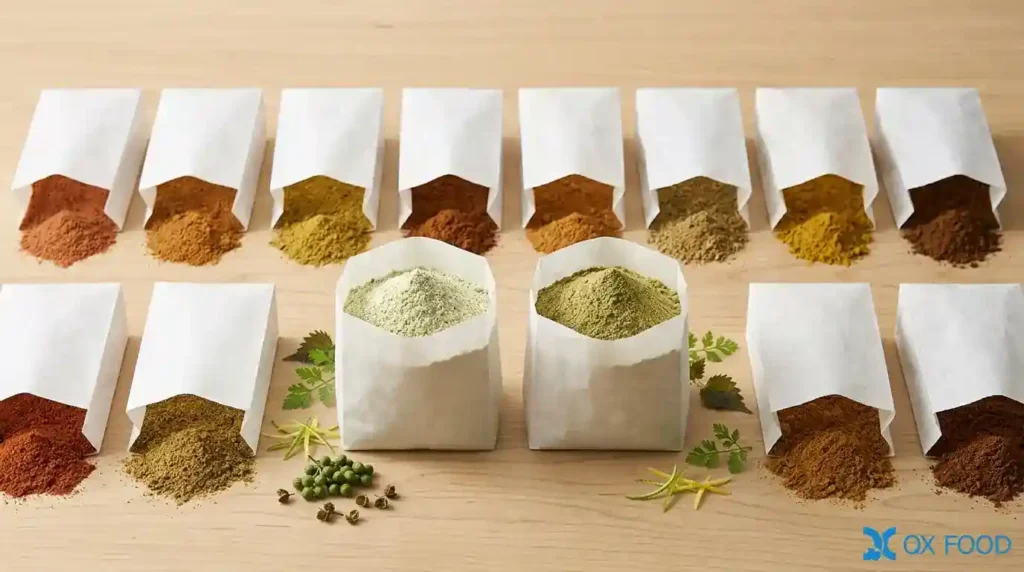
13 Certified Compound Seasoning Powder SKUs — Full Range Overview
Every product in the Qianxuan Food compound seasoning powder range is produced under the full certification stack described above. Here is a quick reference to all 12 SKUs and their primary commercial applications:
- Spicy Chicken Seasoning Powder WK9802 — Rich chicken flavor, spicy yet not greasy; premium nitrogen ≥1.5g/100ml; mainstream snack coating flagship
- Spicy Chili Chicken Seasoning Powder XLJ-002 — Bold chili-chicken, spicy and tasty; mid-bold tier for spicy snack category innovation
- Spicy Hot Chicken Seasoning Powder MLJ-002 — Spicy and refreshing clean heat; hot-tier for premium bold snack formats
- Curry Beef Seasoning Powder WK9805 — Rich and mellow curry beef; premium nitrogen ≥1.5g/100ml; for mainstream curry snack and instant noodle applications
- Curry Beef Seasoning Powder GLN-002 – Japanese Style — Authentic mild-sweet Japanese curry beef; for rice crackers and premium product formats
- Braised Beef Seasoning Powder HNP-002 — Authentic slow-cooked braised beef flavor; for snack coatings and instant noodle seasoning
- Brazil Churrasco Roasted Meat Seasoning Powder KR-001 — Rich smoky Brazilian churrasco BBQ flavor; for premium snack differentiation and OEM development
- Cumin Seasoning Powder WK9901 — Pure cumin flavor; premium nitrogen ≥1.5g/100ml; for BBQ-style coatings and OEM cumin blend development
- Cumin Lamb Seasoning Powder ZR-001 — Fresh and rich cumin lamb; halal-certified; for BBQ lamb seasoning and faith-observant market product lines
- Pepper Salt Seasoning Powder WK9704 – Prickly Ash Flavor — Bold Sichuan prickly ash aroma; for mainstream Asian snack coatings and mala OEM development
- Pepper Salt Seasoning Powder JYF-001 – Fresh Prickly Ash — Light citrus-forward prickly ash; for premium snack positioning and international market introduction
- Tomato Seasoning Powder TMP-002 — Natural sweet-sour tomato from tomato powder base; plant-based; for potato chip coatings and Western-style snack lines
- CFP-H19 chicken seasoning powder
For a broader view of this product family, explore our compound seasoning powder range.
For model comparison and product navigation, review our compound seasoning product selection.
Full Documentation Package for Global Import Clearance
Sourcing certified compound seasoning powder is only the first step. B2B buyers also need the documentation package to clear customs in their destination market. Qianxuan Food provides a full suite of export documentation for all SKUs:
- Certificate of Analysis (COA) — Per batch, all key parameters tested and documented
- Product Specification Sheet — Full technical specifications, ingredient composition, storage requirements
- Ingredient Declaration — Complete ingredient list in the format required for import declaration and finished product labeling
- Halal Certificate — Issued by recognized certification body; available in English and Arabic
- Health Certificate — Available upon request for markets requiring official health certification
- Free Sale Certificate — Confirms the products are freely sold in China; required by many markets for import registration
- Third-Party Laboratory Test Reports — Available for buyers requiring independent verification of COA parameters
- ISO 22000:2018 / ISO 9001:2015 / HACCP Certificates — Factory-level certification copies for supplier qualification files
To request a complete documentation package for any SKU, or to discuss specific import documentation requirements for your target market, contact our export team via the inquiry form below.
Sourcing Certified: The Decision That Protects Your Brand
In B2B food ingredient sourcing, certification is the difference between a supplier relationship that creates liability and one that reduces it. ISO 22000:2018 ensures food safety is systematically managed. ISO 9001:2015 ensures quality is consistently delivered. HACCP ensures critical hazards are identified and controlled. Halal certification opens doors to faith-observant consumer markets globally. And the COA provides the batch-level verification that turns system claims into documented proof.
Qianxuan Food’s full certification stack across all 12 compound seasoning powder SKUs means that every order — whether a 20 kg trial carton or a full container — arrives with the documentation your procurement team, your import compliance function, and your quality assurance team need to approve, deploy, and re-order with confidence.
Ready to request certificates, specifications, or a trial sample? Contact our export team below — we respond to all B2B inquiries within 1 business day.
Why Buyers Choose Qianxuan Food as a Certified Seasoning Powder Supplier
- 12 ready-to-supply certified SKUs covering chicken, beef, cumin, mala, curry, tomato and BBQ flavor profiles
- Batch-level COA available with every shipment
- Export documentation support for importer qualification and customs clearance
- Trial sample and specification review available before bulk ordering
For the category-level outlook behind certified compound seasonings, see our global savory flavor trends 2027 guide.
Request Certificates, Specifications, or a Sample
Request Certificates, Specifications, or a Sample
Fill in the form below and our export team will respond within 1 business day.