
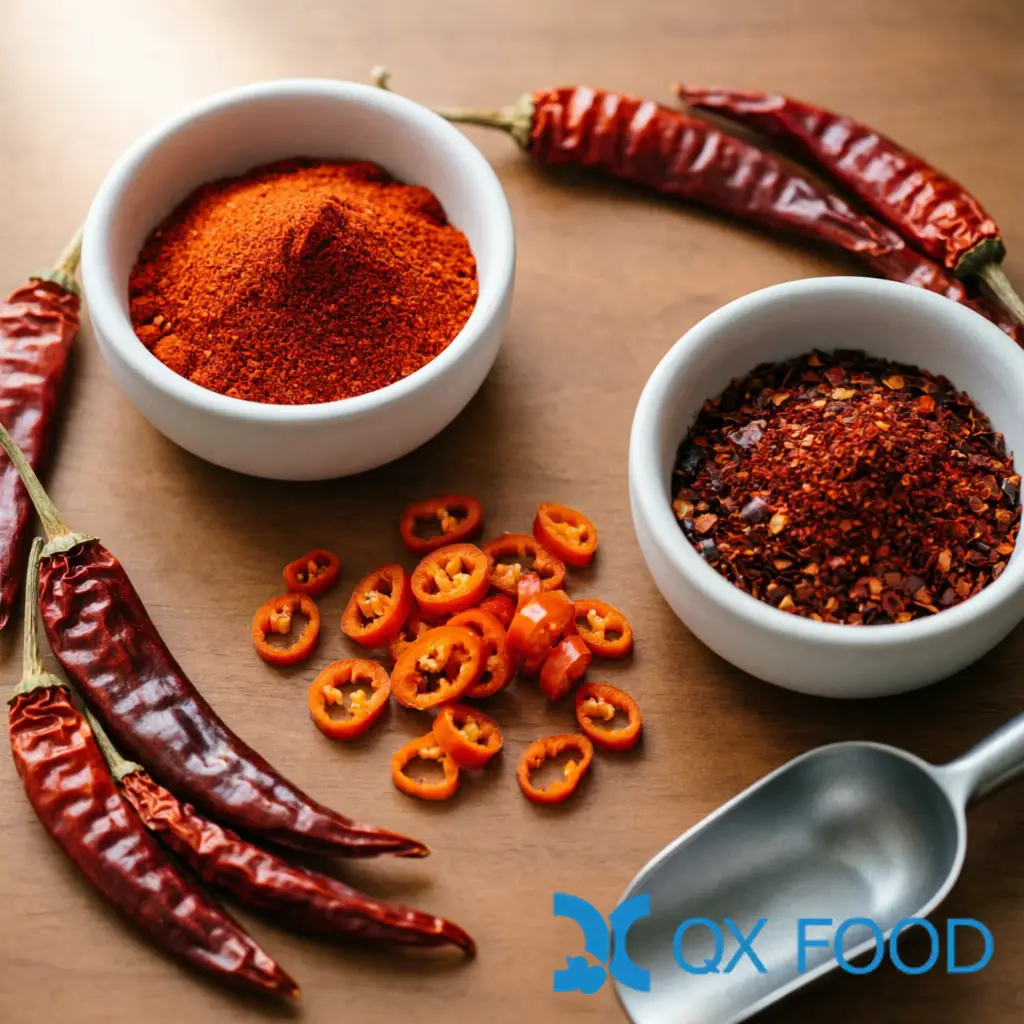
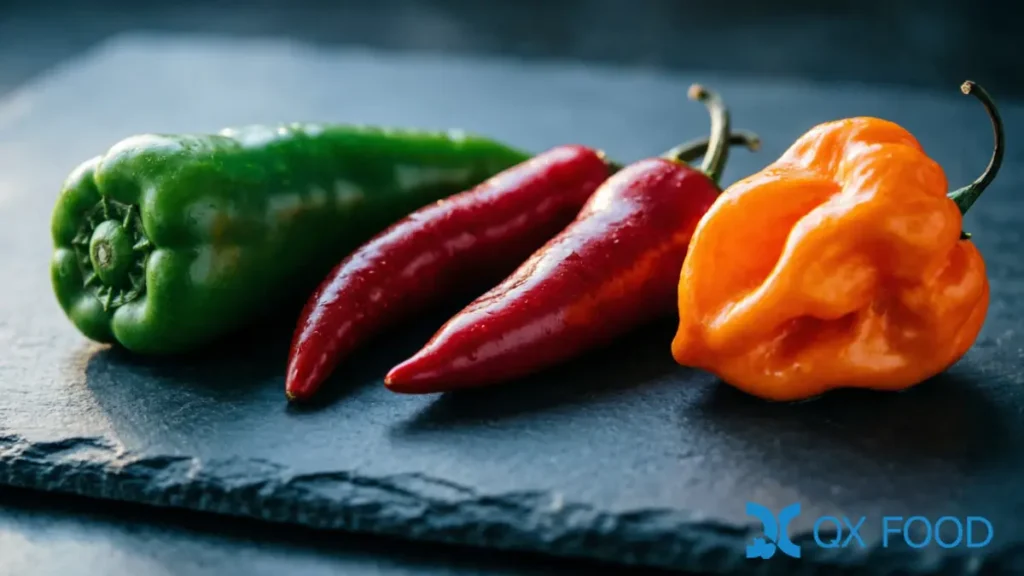
Walk into any commercial kitchen, food manufacturing plant, or seasoning development lab, and you will find chili. It is the most widely used spice on earth, going into everything from instant noodle sachets to pizza toppings, from hot pot base pastes to Korean fried chicken coating. But behind the word “chili” sits a surprisingly complicated world — hundreds of varieties, five domesticated species, a heat measurement system that runs from zero to two million, and at least seven distinct physical forms that each serve a different manufacturing purpose.
This chili pepper varieties guide is written for food industry professionals who need to make practical decisions about chili sourcing and specification. Not chefs picking peppers at a farmers market. Not home cooks choosing between red and green jalapeños. But the procurement manager deciding which chili specification goes into 50 tons of seasoning blend, the R&D formulator building a spicy snack product for three different markets with three different heat tolerances, the instant noodle brand wondering whether chili rings or chili powder belongs in their premium cup noodle garnish layer. Understanding chili types for food manufacturing — not just chili in general — is what separates consistent commercial production from guesswork.
We will cover the science, the species, the heat, and — most importantly — how to translate chili knowledge into real B2B chili sourcing decisions. Along the way, we will point to specific chili products that illustrate each point, because theory without a product to evaluate is just Wikipedia.
Chili Pepper Varieties and What Makes Them Hot (and Why It Matters for Your Product)
Chili heat comes from a group of compounds called capsaicinoids. The main one — capsaicin — binds to pain receptors in the mouth called TRPV1. These are the same receptors that detect actual heat from a hot surface, which is why spicy food feels physically hot even though no temperature change has occurred. Your brain is being tricked by chemistry.
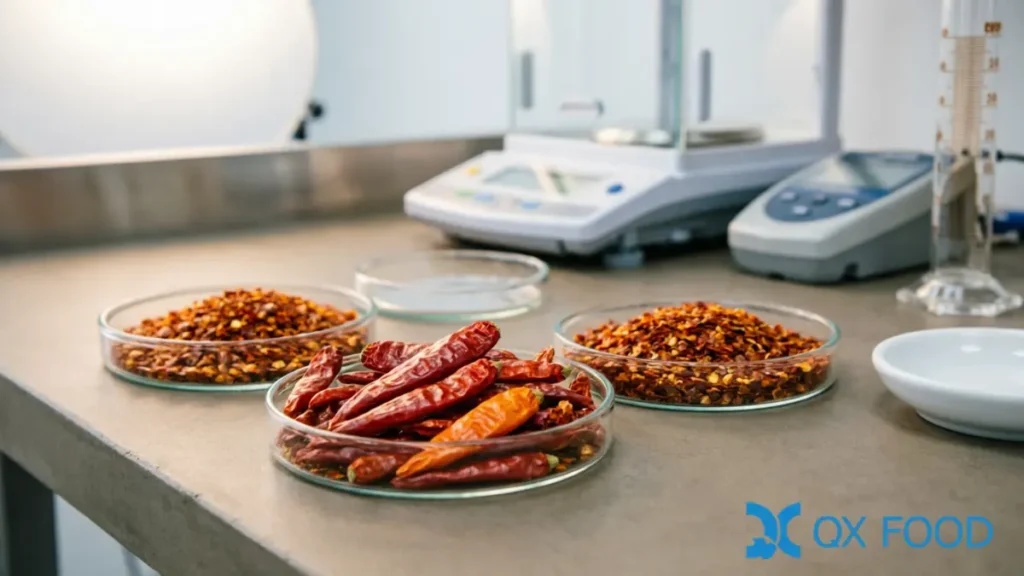
This mechanism has practical implications for food manufacturing. Capsaicin is oil-soluble, not water-soluble — which is why drinking water does nothing for chili burn but dairy (which contains fat) helps. It is also heat-stable within normal cooking and processing temperatures, meaning the chili heat you formulate into a retort-processed sauce or a baked snack will survive the process largely intact. You cannot cook the heat out.
Capsaicin concentration varies enormously between chili varieties — from zero in bell peppers to over two million Scoville Heat Units (SHU) in the hottest cultivars bred for competition. A single variety can also vary significantly depending on growing conditions: the same cayenne pepper grown in a hot, dry season will be significantly hotter than one grown in a cool, wet season. This variability is one reason commercial chili suppliers specify heat level by sensory profile (mild, medium, hot, extra-hot) rather than by precise SHU range in standard specifications. The SHU range comes with batch-specific testing when needed, not as a guarantee on the spec sheet.
For food manufacturers, understanding capsaicin’s behavior means three things. First, you can confidently formulate chili into any thermal process — frying, baking, retorting, boiling — without worrying about heat loss. Second, the heat will distribute through the fat phase of your product, not the water phase, which affects how and when the consumer experiences it. Third, if you need consistent heat across production batches, you are better off working with a supplier who understands sensory consistency than one who simply quotes a SHU range. The number matters less than the eating experience.
The Scoville Scale: A Useful Tool for B2B Chili Sourcing, Not a Procurement Specification
Wilbur Scoville invented his scale in 1912 by diluting chili extract in sugar water and asking a panel of tasters when they could no longer detect heat. One part chili extract diluted in 1,000 parts sugar water equaled 1,000 SHU. It was subjective, imprecise, and — remarkably — still the way most people talk about chili heat over a century later.
Modern measurement uses HPLC (high-performance liquid chromatography) to quantify capsaicinoid content directly, then converts to SHU. This is more precise than Scoville’s taste panels, but still only tells part of the story. Two chilies with identical SHU can deliver very different eating experiences because the other capsaicinoids present — dihydrocapsaicin, nordihydrocapsaicin, homocapsaicin — affect how the heat builds, where it hits the mouth, and how long it lingers. SHU measures total capsaicinoid load, not heat quality.
Here is how common chili varieties and products line up on the scale:
| Chili Type | Typical SHU Range | Commercial Use |
|---|---|---|
| Bell Pepper | 0 | Color, vegetable content |
| Paprika (sweet) | 100–1,000 | Color, mild flavor |
| Ancho / Poblano | 1,000–2,000 | Mild sauces, mole |
| Jalapeño | 2,500–8,000 | Salsas, snacks, pickling |
| Cayenne | 30,000–50,000 | Most commercial chili powder/flakes |
| Thai Chili (Bird’s Eye) | 50,000–100,000 | Asian sauces, hot condiments |
| Habanero | 100,000–350,000 | Extra-hot sauces, specialty snacks |
| Carolina Reaper | 1,500,000–2,200,000 | Challenge products, novelty |
Most commercial B2B chili products cluster in the cayenne range — 30,000 to 50,000 SHU — because this provides recognizable chili heat without the polarizing intensity that limits consumer acceptance. Products in this range can be described as “mild,” “medium,” or “hot” depending on application dosage, not just raw pepper heat. A “mild” chili powder might use the same cayenne base as a “hot” one, just at lower concentration in the finished product. The supplier’s job is to provide the consistent raw material; the formulator’s job is to dose it to the right heat level for the target market.
For buyers who need precise heat documentation — pharmaceutical applications, regulated products, or premium-tier products with specific heat level claims — HPLC testing with batch reporting is available. For most food manufacturing, the more practical specification is sensory consistency: does this batch of chili deliver the same eating experience as the last one? That is the question that matters more than a SHU number on a certificate.
The Five Chili Species (and Which Ones Matter for Food Manufacturing)
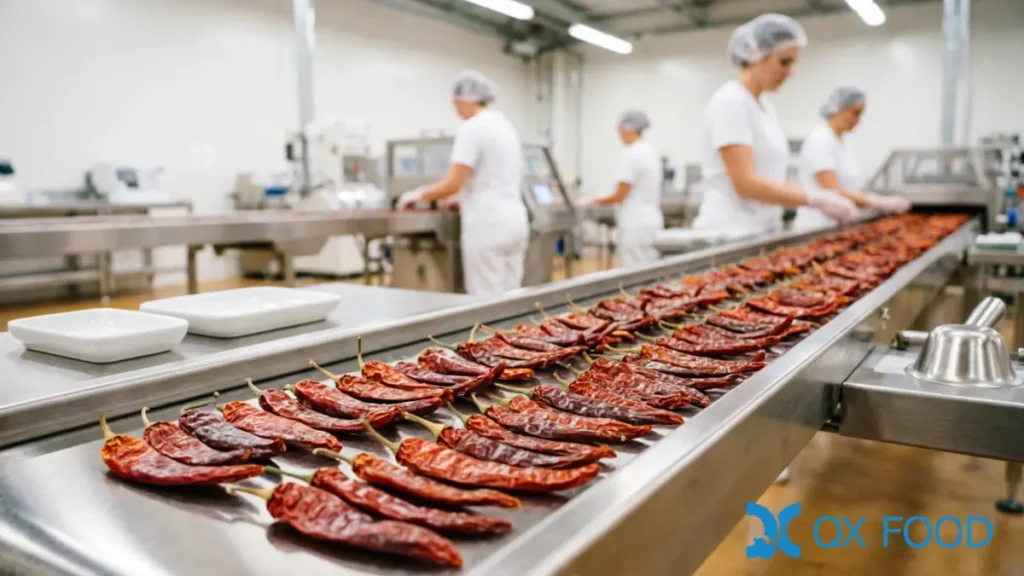
The genus Capsicum contains about 35 species, but only five have been domesticated and cultivated for food use. Of those five, three dominate global food manufacturing. Understanding which species your chili comes from tells you a lot about what kind of heat, flavor, and color to expect — and what applications it suits.
Capsicum annuum — The Workhorse
This is the most widely cultivated chili species and the source of virtually all commercial chili powder, flakes, crushed chili, and dried chili products used in industrial food manufacturing. It includes an extraordinary range of cultivars: sweet bell peppers at one end, fiery cayenne at the other, and everything in between — jalapeño, serrano, paprika, ancho, poblano, and dozens of regional varieties.
C. annuum chilies tend to have a sharp, straightforward heat that hits quickly and fades relatively fast. They do not have the fruity complexity of C. chinense or the slow-building burn of some C. frutescens varieties. This makes them well-suited to mass-market food products where chili heat should be recognizable but not complex — the consumer should think “spicy,” not “what kind of spicy and why does it taste like tropical fruit?”
Most chilies used in QXFOOD products — including the entire seven-product chili range from mild coarse powder to extra-hot fine powder to precision-cut rings — fall within C. annuum varieties selected for specific heat levels, colors, and physical characteristics suitable for their intended manufacturing applications.
Capsicum chinense — The Heavy Hitter
Despite its scientific name suggesting Chinese origin, C. chinense actually comes from the Amazon basin. It includes the hottest commonly cultivated chilies: habanero, scotch bonnet, and the super-hot varieties that dominate the extreme end of the Scoville scale. C. chinense chilies are notable not just for their heat but for their distinctive fruity, sometimes floral aromas — habaneros taste like something, not just burn like something.
In commercial food manufacturing, C. chinense is used primarily for extra-hot sauce products, specialty spicy snacks, and the “challenge” product category where extreme heat is the selling point. It is less common in mainstream food manufacturing because the heat level excludes a large portion of consumers. For products where habanero-level heat is desired, this species is the source material.
Capsicum frutescens — The Tabasco Chili
This is a smaller species, best known for the tabasco chili used in the famous sauce of the same name. C. frutescens chilies are generally smaller than C. annuum varieties, with a sharp, piercing heat that builds more slowly than cayenne-type heat. They are used in hot sauce manufacturing and in some Southeast Asian cuisine applications, but have less presence in mainstream B2B food ingredient markets than C. annuum.
The Other Two: baccatum and pubescens
C. baccatum includes the aji amarillo and other South American varieties prized in Peruvian and Bolivian cuisine for their fruity, complex flavor. C. pubescens (rocoto) is distinctive for its black seeds and thick walls, grown mainly in the Andes. Both are important in their regional cuisines but have minimal presence in global B2B chili supply chains. For most food manufacturing applications, knowing the difference between annuum and chinense — straightforward cayenne-type heat vs. fruity habanero-type heat — covers the practical decisions you will need to make.
China’s Chili Belt: Where Your Chili Probably Comes From
If you are sourcing dried chili from a Chinese supplier — which most B2B buyers in the global spice trade eventually do — you are tapping into one of the world’s largest and most diverse chili growing regions. China produces over 20 million tons of fresh chili annually, and several provinces have developed deep expertise in specific varieties, drying methods, and processing technologies. Understanding where your chili comes from tells you something about what you can expect in terms of flavor, heat, color, and consistency.
Sichuan (四川) — The Aromatic Heartland
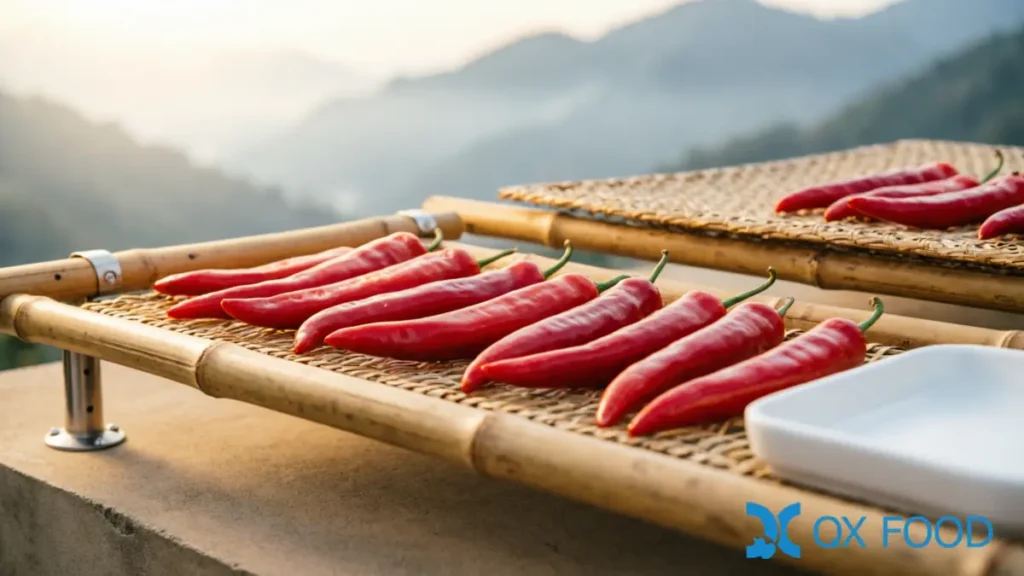
Sichuan is not just about Sichuan pepper. The province is also a major chili growing region, producing two varieties that are central to Chinese cuisine. The facing heaven chili (朝天椒, cháotiānjiāo) — named for the way the pods point upward on the plant — is medium-hot with a clean, straightforward burn and decent color. It is the standard chili for Sichuan home cooking and a common base for commercial chili products. The erjingtiao (二荆条) is milder, longer, more aromatic, and prized for its deep red color and complex flavor — it is the chili that gives Sichuan chili oil its signature character. For food manufacturers seeking an aromatic, medium-heat chili with good color, Sichuan varieties are worth knowing.
Guizhou (贵州) — Volume and Variety
Guizhou might be China’s most chili-obsessed province in terms of per-capita consumption, and it is also one of the largest producers. The province grows several varieties including lantern chili (灯笼椒), which is mild, fleshy, and valued for its deep red color — making it a good candidate for paprika-type products and products where chili color is more important than chili heat. Guizhou’s climate — humid subtropical with distinct wet and dry seasons — produces chilies with good color development and moderate heat levels suitable for broad commercial application.
Guangxi (广西) — The Southern Source
Guangxi’s tropical and subtropical climate supports multiple growing seasons and a long harvesting window. The region produces xiaomila (小米辣, literally “little rice chili”) — small, potent chilies that pack significant heat into a compact package, and zhitianjiao (指天椒), a pointing-to-sky variety similar to the facing heaven chili of Sichuan. Guangxi has become an important source for dried chili products, benefiting from favorable climate, established agricultural infrastructure, and proximity to major export ports in southern China.
Yunnan (云南) — Heat and Character
Yunnan’s diverse microclimates — from subtropical lowlands to temperate highlands — support a wide range of chili varieties. The province’s xiaomila is notably hotter than varieties from other regions, and Yunnan’s chili products often carry a distinctive fruity-floral note that reflects the province’s extraordinary botanical diversity. For food manufacturers seeking chili with both heat and aromatic complexity, Yunnan-sourced products deserve attention.
Xinjiang (新疆) — The Color Specialist
Far to the northwest, Xinjiang’s arid climate and intense sunlight produce chilies with exceptional color content. The region is known for banjiao (板椒) — mild, fleshy, high-pigment varieties that are processed primarily for their deep red color rather than their heat. If your product needs chili primarily for visual appeal — natural red coloring in sauces, seasoning blends, or processed meats — Xinjiang is where the raw material often comes from. These are the chilies that become high-ASTA paprika powder.
Henan and Shandong (河南, 山东) — The Volume Producers
These central and eastern provinces are China’s agricultural workhorses, producing large volumes of mild to medium-hot chili varieties for domestic and export markets. Henan in particular has developed significant chili processing infrastructure — drying, cleaning, grinding, and packaging facilities that serve both the domestic food industry and export channels. For buyers who need consistent volume at competitive pricing, Henan and Shandong supply chains are well-established.
What Chinese Origin Means for Your Sourcing
The diversity of Chinese chili growing regions is both an advantage and a complexity for B2B buyers. The advantage: you can source multiple chili profiles — mild, medium, hot, extra-hot; high-color, high-aroma, high-heat — from a single country with established export infrastructure. The complexity: quality varies significantly by region, season, and supplier. A “Chinese chili” from Guangxi will not taste or perform the same as one from Xinjiang. The variety and the growing region matter, not just the country of origin.
This is why working with a supplier who specifies the chili variety and origin — not just “Chinese dried chili” — matters for consistent procurement. A supplier who can tell you that this batch of mild chili powder comes from Xinjiang banjiao peppers and that batch of hot chili crushed comes from Sichuan facing heaven peppers is providing the traceability that supports reliable product development. Generic sourcing yields generic results.
Questions B2B Buyers Should Ask Before Sourcing Chili
Chili procurement is not complicated, but it does reward asking the right questions early. Here are the issues that experienced buyers raise before committing to a supplier relationship — and why each one matters for your finished product.
Can you provide batch-specific testing for pesticide residues and heavy metals?
This is the most common buyer concern, and for good reason. Dried chili products concentrate whatever was on the raw pepper — pesticides applied in the field, heavy metals absorbed from the soil — into a much smaller volume of finished product. Reputable suppliers test for the standard suite: organophosphates, organochlorines, pyrethroids, lead, arsenic, cadmium, mercury. The results should be available on the COA (Certificate of Analysis) for each batch, not just as a one-time “our product is safe” statement. Ask for actual numbers, not reassurances. If a supplier cannot or will not share batch-specific pesticide and heavy metal data, find one who will.
How do you ensure consistent heat level from batch to batch?
Chili heat varies naturally by variety, growing season, and individual plant. A scorching hot summer produces hotter chilies than a cool, wet one — same variety, same field, different heat. Suppliers who understand this reality maintain consistency through blending and sensory evaluation rather than relying on a single harvest to deliver a specific SHU target. Ask how your supplier manages seasonal heat variation. The answer you want involves blending protocols, trained sensory panels, and — for applications that require it — HPLC testing. The answer you do not want is “our chili is always 40,000 SHU” — no supplier can guarantee that without controlling the weather.
What is the moisture content specification, and how is it controlled?
Moisture matters for two reasons. First, it directly affects shelf life — chili at 12% moisture will mold significantly faster than chili at 8%. Second, it affects processing behavior — wet chili clumps in grinding equipment, does not flow properly in automated dispensing systems, and can create dangerous splatter when added to hot oil. For dried chili products, moisture below 10% is standard; below 8% is better for long shelf life and consistent processing. Ask for the moisture specification and verify it on the COA. If your application involves hot oil infusion, this is not a minor detail — it is a safety concern.
How do you screen for aflatoxin and mycotoxin contamination?
Dried agricultural products are susceptible to mold growth during drying and storage, and some molds produce aflatoxins — carcinogenic compounds that are tightly regulated in most destination markets, particularly the EU. Reputable chili suppliers test for aflatoxin B1, B2, G1, G2 (total aflatoxins) and ochratoxin A on each batch. EU limits for aflatoxin B1 in spices are typically 5 ppb (parts per billion); for total aflatoxins, 10 ppb. These are trace-level limits that require proper drying, clean storage, and batch testing to meet consistently. Ask for the aflatoxin specification and verify it on the COA before shipping.
What is the ASTA color value, and can you provide batch consistency?
If your product relies on chili for its red color — paprika, chili powder blends, processed meats, snack seasonings — the ASTA (American Spice Trade Association) color value measures extractable red pigment. Higher numbers mean deeper red. Xinjiang banjiao chilies can reach ASTA values of 150-200; standard cayenne might be 60-100. If color is a critical quality parameter for your product, specify a minimum ASTA value and ask for batch-specific measurement. A supplier who treats chili as an interchangeable commodity will not know their ASTA values. A supplier who understands B2B quality requirements will.
What certifications do you hold, and can you provide documentation for my destination market?
Common certifications for chili export include ISO 9001 (quality management), ISO 22000 (food safety management), HACCP (hazard analysis), and Halal certification for Muslim-majority markets. Each has specific audit requirements and annual renewal — ask to see the actual certificates, not just a claim on the website. For destination-market-specific documentation — FDA prior notice for US imports, phytosanitary certificates, certificates of origin, EU contaminant compliance statements — confirm before ordering that your supplier can provide what your customs broker requires. Discovering at the port that a document is missing is an expensive way to learn this lesson.
What is your supply model — contract growing, spot market, or both?
Suppliers who work with contract growers have planted specific varieties to agreed specifications months before harvest. They know what is coming before the season starts. Suppliers who buy on the spot market buy whatever is available at harvest time and blend to approximate a specification. Contract growing produces more consistent quality year to year but requires longer lead times and committed volumes. Spot market buying can be cheaper in a good season but creates variability that complicates product development. For buyers who need consistent chili specification year after year, contract growing offers better predictability. Ask which model your supplier uses and what it means for your procurement timeline.
Chili Forms: Why Shape Matters as Much as Heat
Most conversations about chili focus entirely on heat level. For B2B food manufacturers, heat is only half the story. The physical form of the chili — powder, crushed, flake, slice, ring, strip — determines how it integrates into the manufacturing process and how the consumer experiences it in the finished product. A fine chili powder and a ring-cut chili garnish might come from the same pepper variety, but they serve completely different manufacturing functions.
Consider a spicy instant noodle cup. The heat comes from fine chili powder dispersed in the seasoning sachet — invisible, evenly distributed, hitting the consumer’s palate from the first sip. But the visual signal of “spicy” comes from the chili rings floating on the broth surface — visible through the cup lid before the consumer adds water, communicating quality and authenticity without a word of marketing copy. Both chili products come from the same raw material. Both serve the same product. But they solve entirely different problems: one delivers dispersed heat, the other delivers visual quality communication.
Here is how the seven physical forms map to their core B2B functions:
| Chili Form | Particle Size | Primary B2B Function | Example Application |
|---|---|---|---|
| Fine Powder | Below 60 mesh | Invisible heat dispersion | Snack coating, noodle sachet, sauce base |
| Coarse Powder | 20–40 mesh | Visible spice identity + gradual heat release | Compound seasoning, soup base, meat processing |
| Crushed | Between powder and flake | Visual chili layer + sustained heat in broth | Hot pot base, chili oil |
| Flakes / Slices | Visible, irregular | Consumer-facing visual chili content | Pizza, pasta, Korean fried chicken, retail seasoning |
| Rings (2–3mm) | Precision-cut circles | Uniform visual garnish quality signal | Premium instant noodle cup, soup garnish |
| Strips | Fine threads | Delicate visual accent for refined cuisine | Korean banchan, Japanese ramen, bibimbap |
The key procurement insight here is that form and heat are independent variables. You can have a mild ring-cut chili for visual garnish on a mainstream product, or an extra-hot ring-cut chili for visual garnish on a spicy premium product. You can have a mild fine powder for background warmth in a soup base, or an extra-hot fine powder for the forward heat in a spicy snack coating. The chili range exists so that formulators can select the right combination of heat level and physical form for each specific product — not just pick “chili” off a spec sheet.
This is why QXFOOD maintains seven distinct chili product specifications rather than one generic “chili powder.” A hot pot base manufacturer needs crushed chili for the visual layer and fine powder for the dispersed heat. A pizza chain needs visible chili slices — powder would disappear into the cheese, crushed would be texturally wrong. A Korean banchan manufacturer needs fine strips for delicate visual accent — powder would be invisible, rings would be too chunky. Different forms for different functions. Same raw material, different engineering.
How B2B Buyers Should Think About Chili Selection
If you take one thing away from this guide, let it be a framework rather than a fact. When evaluating chili for a food manufacturing application, ask four questions in order:
First, what does the consumer see?
If the chili is visible on the finished product — pizza, instant noodle cup, prepared meal garnish — you need a visible form: slices, rings, strips, or flakes. If the chili is invisible — dispersed in a sauce, coating, or seasoning blend — powder or crushed form is more appropriate. The consumer’s visual experience dictates form first.
Second, what heat level does the target market expect?
A Korean banchan sold in Seoul has different heat expectations than a spicy potato chip sold in Texas. Mild products for broad markets, medium products for spice-aware markets, hot products for spice-seeking markets. Define the target consumer before defining the chili specification. The same cayenne variety can serve all three heat levels through dosage and formulation — the raw material choice matters for the upper end of heat, where hotter base material avoids excessive usage rates that would alter product color and texture.
Third, how does the chili interact with the manufacturing process?
Fine powder works in coating drums and retort sauces; crushed chili creates the visual layer in hot pot broth; rings must survive rehydration in 95°C water without disintegrating; strips must remain intact through mixing and distribution in prepared foods. The form must survive your process and look right in your product. Test with your actual equipment and process conditions — do not assume that a chili specification that works in a lab kitchen will work on a production line.
Fourth, what is the procurement reality?
Does your supplier offer the full range of chili forms and heat levels, or do you need to manage multiple chili suppliers? Can they provide batch-to-batch consistency across the forms you use? Do they understand that your noodle cup needs chili rings that look the same in cup number 10,000 as cup number 1? Supplier capability matters as much as product specification — and a supplier with a dedicated chili product range is more likely to deliver consistent results than a generalist spice supplier treating chili as one SKU among hundreds.
Manufacturers planning 2027 product lines will find the evidence-based direction in our global savory flavor trends 2027 guide.
Learn More
Chili pepper science and commerce are rich topics. For further reading:
- The Wikipedia entry on chili peppers has a thorough overview of botany, history, and culinary use.
- The Scoville scale article explains the measurement history and modern HPLC alternatives.
- For B2B buyers ready to evaluate specific chili products, browse QXFOOD’s Natural Plant Powders category, which includes the complete chili range: mild coarse powder for compound seasoning, extra-hot fine powder for snack coating, visible chili slices for food presentation, and fine chili strips for East Asian cuisine.
Our second guide in this series covers chili processing methods in detail — sun drying vs. mechanical dehydration, cutting specifications, and how processing choices affect the final product in your manufacturing application.