
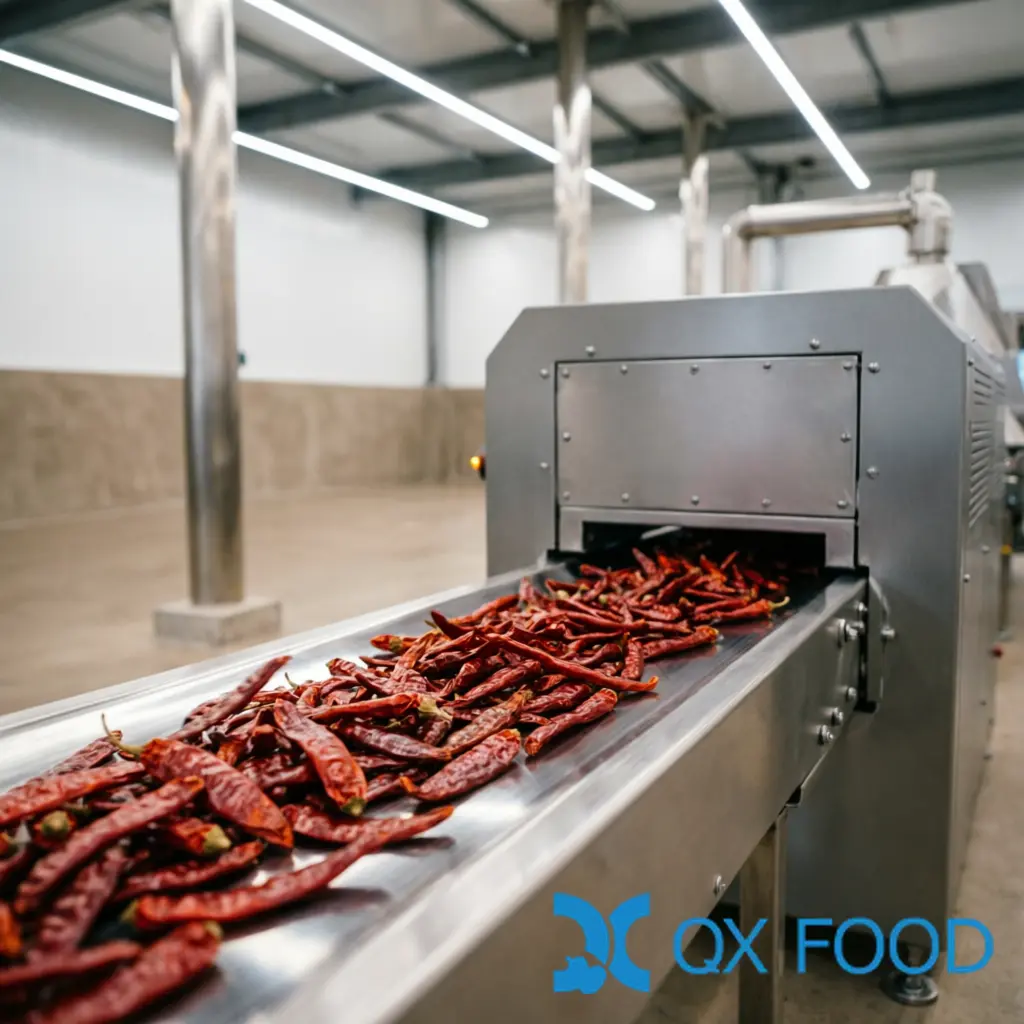
In the first guide of this series, we covered chili varieties, the Scoville scale, and how to think about chili selection for food manufacturing. This second guide — a practical chili processing guide for B2B buyers — goes one step deeper: what happens between the farm and your factory. Because the chili you buy has already been dried, cut, ground, sieved, and inspected — and every one of those steps changed the product you receive. Understanding how chili is processed is how you understand why one supplier’s dried chili powder behaves differently from another’s, why one batch of chili rings keeps its shape in your noodle cup while the last batch turned to mush, and why the same raw chili can be sold as fine powder, crushed chili, flakes, slices, rings, and strips at very different prices.
If you are a food manufacturer, a procurement manager, or an R&D formulator working with chili ingredients, this chili processing guide walks through the processing chain step by step: drying methods and what they change, the cutting and grinding specifications behind each chili form, the food safety controls that separate professional processors from casual traders, and the questions you should ask a processing partner before committing to a supply relationship. It is written from the perspective of a buyer who needs to understand the product well enough to specify it — not from the perspective of someone who will ever operate a drying line. Honestly, most of us will never touch a drying rack — but we all need to know what good drying looks like, because it shows up in every batch we buy.
From Field to Factory: A Chili Processing Guide to How Drying Shapes the Product You Buy
Fresh chili is roughly 80-90% water. Removing that water — down to the 8-12% moisture that makes chili shelf-stable — is the first and most consequential step in any chili processing guide worth reading. The drying method determines color retention, aroma preservation, heat stability, microbial quality, and even the physical structure of the final product. This is why two chili powders from the same variety can look and taste completely different depending on who dried them — and why the drying section of this chili processing guide matters more than any other.
Sun Drying: The Traditional Standard
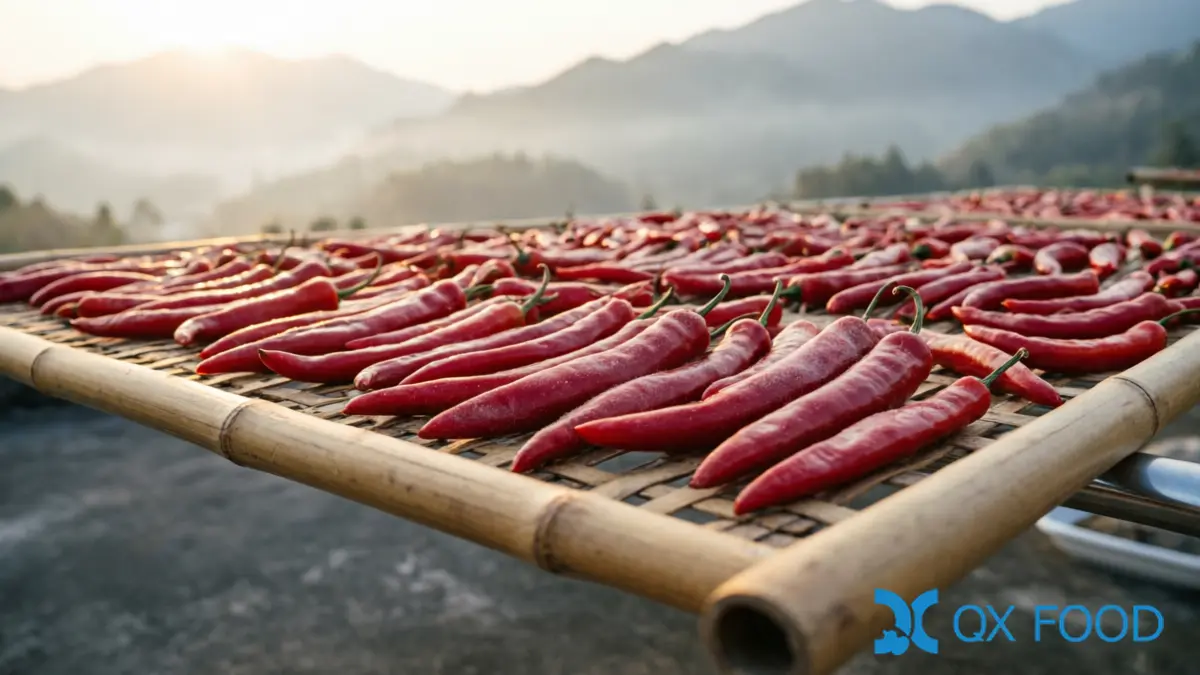
Sun drying is the oldest method and still the preferred approach for many premium chili products, particularly in China. Fresh chilies are laid out on raised bamboo racks or woven mats — never on bare ground in professional operations — and dried over several days under open sun. The slow, gentle drying preserves more of the chili’s natural red pigments (carotenoids) and volatile aromatic compounds than forced hot-air drying. The result is a brighter red color and more complex aroma.
Sun drying has real constraints. It requires several consecutive days of good weather, which means harvest timing matters and regions with reliable sunshine — like Xinjiang’s arid northwest or parts of Shandong and Henan — have structural advantages. It also carries hygiene requirements that professional operations manage carefully: raised drying surfaces, regular turning, protection from insects and dust, and moisture monitoring throughout the process. In the previous guide we covered China’s chili growing regions; the same regional logic applies to drying capability. A supplier who controls its drying environment is controlling your product quality.
Mechanical Dehydration: Scale and Consistency
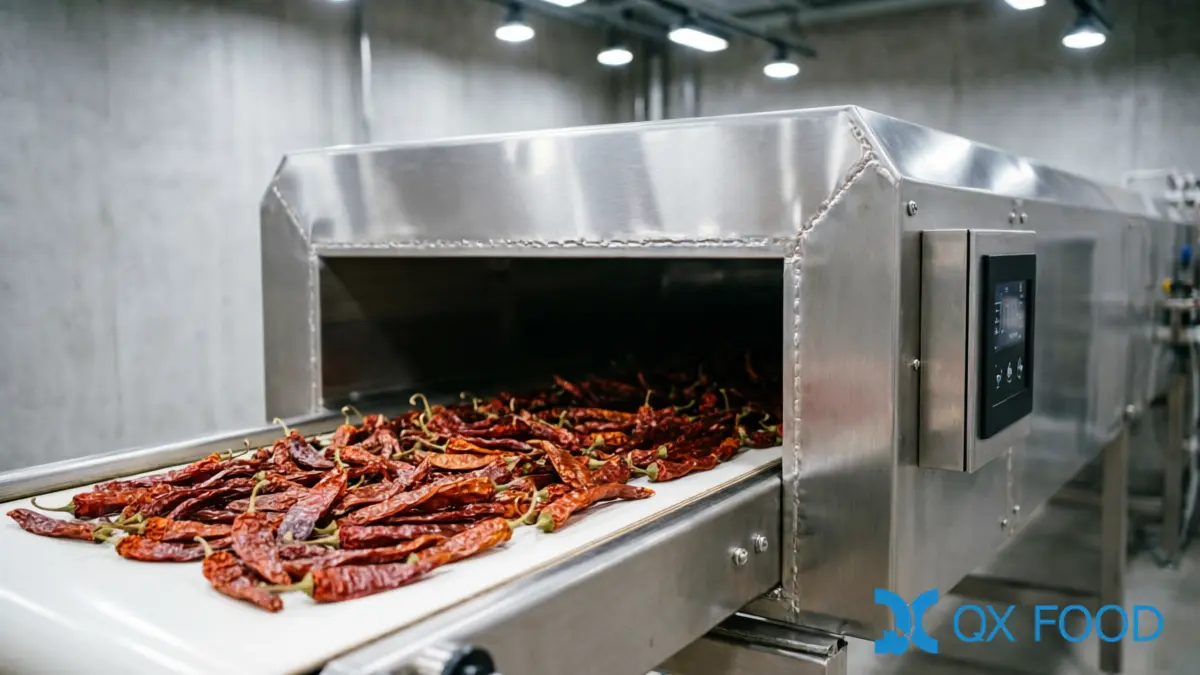
Mechanical drying uses heated air in controlled chambers or tunnels to remove moisture in hours rather than days. The advantages are scale and consistency: mechanical dryers can process large volumes regardless of weather, and operators can control temperature, airflow, and drying time to achieve repeatable results. The trade-off is that aggressive heat can dull the red color and drive off aromatic compounds. Good mechanical drying operates at relatively low temperatures with controlled humidity to minimize these losses; poor mechanical drying produces brown, flat-tasting chili that no amount of blending can fix.
For B2B buyers, the practical question is not “sun-dried or mechanically dried” in the abstract — it is whether the supplier’s method delivers the color, aroma, and consistency your product needs. Some premium products genuinely benefit from sun drying. Others — where chili is one ingredient among many and color is less critical — are well served by consistent mechanical drying at a better price. A good supplier should be able to tell you which method their product uses and why.
What Drying Changes: Color, Aroma, Structure
Three properties are most affected by drying, and all three matter downstream in your product. Color: chili’s red pigments are sensitive to heat and light. Slow, gentle drying retains bright red; harsh drying produces brown. If your product relies on chili for visual appeal — paprika-style powders, snack coatings, visible garnish — color retention is a specification issue, not an aesthetic preference. Aroma: the volatile compounds that give chili its characteristic fragrance are lost at high temperatures. Sun-dried chili has more aromatic depth; aggressively dried chili tastes flat even at the same heat level. Structure: drying determines how the chili behaves when cut or ground. Properly dried chili cuts cleanly into rings, flakes, and strips; under-dried chili is leathery and tears instead of cutting; over-dried chili shatters into dust. The form you need dictates the drying quality you must demand.
The Seven Chili Forms and What Each One Does in Your Product: A Processing Guide
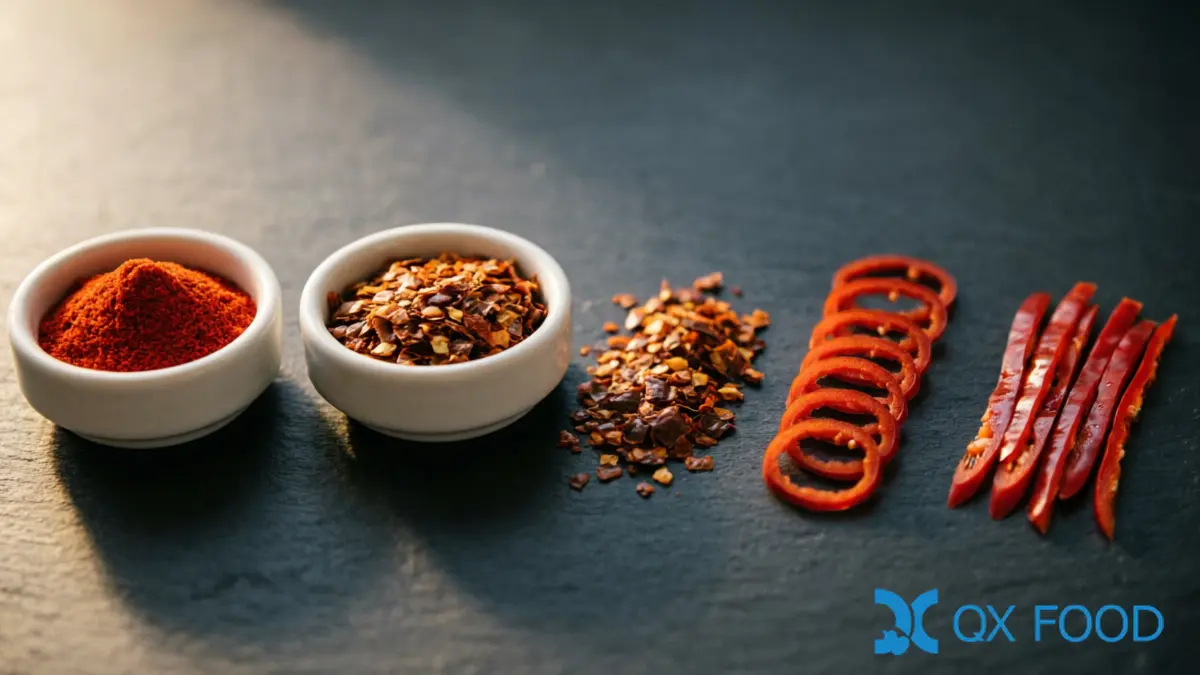
Chili is not one ingredient; it is seven different ingredients that happen to share a raw material. The form — powder, crushed, flake, slice, ring, strip — is a processing decision made to solve a specific manufacturing problem. This section maps each form to its function, with reference to the actual product specifications available from QXFOOD’s chili range. If you are new to the subject, consider this the practical half of the chili processing guide — the part that tells you which form belongs in which product.
Fine Chili Powder: The Heat That Disappears
Fine powder — typically below 60 mesh — is the form that integrates invisibly. It disperses evenly through seasoning blends, dissolves into sauce systems, adheres uniformly in snack coating drums, and delivers heat in every bite without any visible chili content. If your product should be spicy but should not look spicy, fine powder is the answer. QXFOOD’s HCP-C14 hot chili powder is the extra-hot fine-grind specification in this category, engineered specifically for snack coating lines and instant noodle seasoning sachets where even heat distribution is the critical quality parameter. Think of it as the quiet workhorse of the chili forms — it does not ask for attention, it just makes everything reliably hot.
Coarse Chili Powder: Visible Spice, Gradual Release
Coarse powder — roughly 20-40 mesh — keeps visible chili particles in the finished product. Those visible specks signal real spice content to buyers and consumers reading labels or inspecting samples. The larger particle size also releases flavor more gradually in liquid applications, which matters for soup bases, braising sauces, and any product with a long cooking cycle. CCP-C15 coarse chili powder is the mild-heat specification in this category, positioned for compound seasoning, soup base, and meat processing applications where visible chili identity and sustained flavor release are the requirements.
Crushed Chili: The Hot Pot Standard
Crushed chili sits between powder and flakes — coarse enough to be visible, small enough to be spoon-friendly. Its defining application is hot pot base: crushed particles float on the broth surface, creating the red chili layer that consumers recognize as authentic Sichuan and Chongqing hot pot, while releasing heat gradually over the 30-90 minutes of a meal. It is also the preferred form for chili oil infusion, where the particle size provides an optimal balance of extraction surface and visual presence. HCC-C19 extra hot chili crushed is the specification in this category, with the extra-hot heat level that hot pot base manufacturing requires. If your product lives or dies by its visual chili layer — and hot pot is exactly that kind of product — this is the form to spec.
Chili Slices and Flakes: The Chili You Can See
Slices and flakes are the consumer-facing forms — chili that is meant to be seen on the finished food. On pizza, in pasta, on Korean fried chicken, in clear-packaged instant noodle cups, visible chili communicates quality and authenticity before the first bite. The bright red sun-dried color is the product: when consumers see real chili flakes, they perceive real ingredients. CF-C20 chili slices delivers this function with a spicy-but-mellow profile calibrated for mainstream products from pizza chains to Korean cuisine brands. Ask any brand manager who sells spicy pizza: the flakes on top are doing marketing work that no label copy can match.
Chili Rings: Precision Garnish
Ring-cut chili — uniform circular pieces in the 2-3mm range — is the most visually disciplined chili form. Where flakes vary naturally, rings are cut to specification, producing consistent visual presentation across every product unit. This matters in premium instant noodle cups, where the visible ingredient layer is the quality signal consumers evaluate through the transparent lid, and where consistency from cup to cup is a brand promise. Rings must also survive rehydration in 95°C water without losing their shape — a specification that requires the right raw material and the right drying quality. CR-C16 chili rings 2-3mm is this category’s specification. If you have ever opened a noodle cup and found the garnish looked nothing like the picture on the lid, you already understand why ring consistency is worth paying for.
Fine Chili Strips: The Delicate Accent
Fine strips — thin, thread-like cuts — serve East Asian cuisines where chili is a visual accent and gentle warmth rather than a heat source. Korean banchan uses fine red strips as a color element on white vegetables. Japanese ramen uses them as a restrained garnish. Bibimbap relies on them as part of the dish’s color composition. The strip form distributes evenly in mixed dishes and remains individually visible — chili as design element rather than chili as ingredient. SCT-C18 fine chili strips carries the mild-medium heat profile this cuisine demands.
Economical Flakes: The Volume Workhorse
Not every application needs premium visual presentation. Chain restaurant kitchens, institutional cafeterias, and value-segment private-label manufacturers need dependable chili character at a competitive price — chili that goes into sauces, soups, stews, and seasoning blends where the consumer never sees it as an individual ingredient. CFE-C17 economical chili flakes fills this role with moderate heat, reliable batch consistency, and volume-oriented pricing — the same certification and food safety standards as every product in the range, positioned for the applications where cost per serving is the deciding factor. There is no shame in the economical tier; a cafeteria feeding ten thousand people a day is not buying chili for its photogenic qualities.
Cutting and Grinding Specifications: The Language of Chili Forms
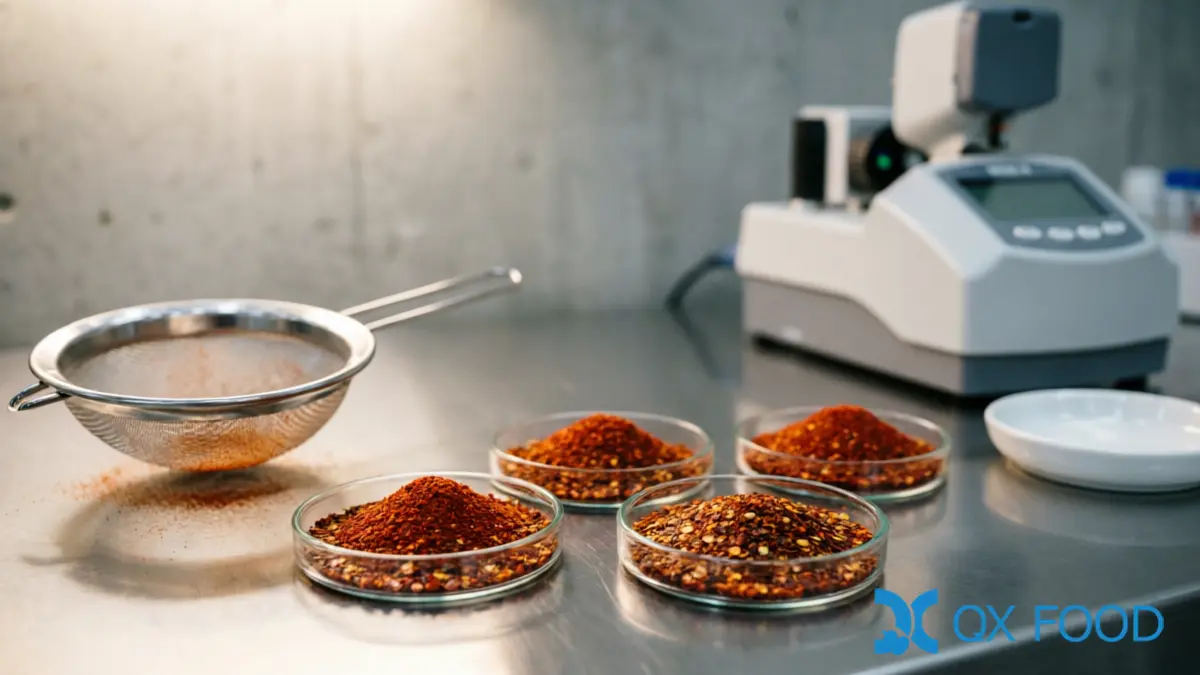
Every chili form is defined by a particle size specification, and understanding this language lets you specify exactly what you need rather than relying on vague descriptions like “powder” or “flakes.” The standard reference is mesh size — the number of openings per linear inch in a sieve. Higher mesh numbers mean finer particles. Common reference points: 40 mesh is a medium powder, 60 mesh is a fine powder, 80 mesh and above is very fine. Crushed chili is typically specified by particle size range in millimeters rather than mesh. Rings and strips are specified by cut dimensions — ring diameter, strip width and length. Flakes are often specified by size distribution: what percentage passes through which sieve.
For B2B buyers, the practical takeaway is that particle size is a specification to be agreed, not assumed. If your coating line needs chili powder that flows consistently through a dosing auger, particle size distribution affects flowability. If your instant noodle cup needs rings that survive rehydration, the ring size tolerance and the raw material’s structural quality both matter. If your seasoning blend calls for “chili flakes,” asking for the size distribution — and getting a written specification — prevents the expensive discovery that the flakes you received behave differently from the flakes you approved.
Custom specifications are common in this industry. QXFOOD’s chili products are available in standard specifications, but grind size, cut size, heat level, and packaging can all be adjusted for qualified volume requirements — the standard product is the starting point for evaluation, not the ceiling of what is possible. For buyers with automated dispensing equipment or specific textural requirements, discussing custom particle size specifications with the supplier’s technical team before ordering is the difference between a smooth production launch and a series of line adjustments.
Processing and Food Safety: What Happens Between Cutting and Packaging
The processing chain does not end at cutting and grinding. Professional chili processing includes a series of food safety control points that distinguish certified manufacturers from casual processors. Understanding these controls helps you evaluate supplier claims and ask the right questions during supplier qualification.
Raw material inspection is the first gate: incoming chili is checked for moisture, color, foreign matter, and visual defects before entering production. Sieving and grading after cutting or grinding removes oversize particles and foreign material — a control point where physical contaminants such as stems, stones, or metal fragments are caught. Metal detection is a critical control point in any professional chili line, given that grinding and cutting equipment can shed metal particles over time. Finished product testing verifies moisture, particle size, color, and sensory characteristics against the specification before release.
Microbiological control is particularly important for dried chili. Low moisture is the natural protection, but aflatoxin risk from improper drying or storage is a documented concern across the global chili trade — which is why professional suppliers test for aflatoxins and ochratoxin A on a batch basis, particularly when exporting to the EU where limits are strict (typically 5 ppb for aflatoxin B1 and 10 ppb for total aflatoxins). Pesticide residue and heavy metal testing complete the standard safety suite. When a supplier talks about HACCP and ISO 22000 certification, these are the controls the certifications are auditing.
China’s Chili Processing Industry: Scale and Capability
China is not only the world’s largest chili producer — it has also built a deep processing industry around the crop. Henan, Shandong, and Xinjiang in particular have developed clusters of chili processing facilities: cleaning and drying lines, grinding mills, cutting workshops, and packaging operations that serve both the domestic food industry and export markets. The capability depth matters for buyers because it means Chinese suppliers can typically handle the full range of forms — from fine powder to precision-cut rings — from a single facility or a coordinated network, rather than forcing buyers to source each form from a different country or supplier. For buyers sourcing chili powder or chili flakes at industrial volume, this consolidation is a genuine logistical advantage.
There is also a practical quality signal in regional specialization. Xinjiang’s chili industry, built around high-color varieties, has developed expertise in color preservation through drying and grinding — relevant if you buy paprika-type products or need chili flakes with consistent red tone. Henan’s processing cluster is known for volume and standardization — relevant if you buy large quantities of consistent powder or flakes. A supplier who can tell you which region their processing capability draws on, and why that matters for your product, is demonstrating the industry knowledge that consistent sourcing depends on.
Questions to Ask Your Chili Processing Partner
Beyond the buyer questions covered in the first guide — testing, heat consistency, moisture, aflatoxin, certifications — the processing angle adds specific questions worth asking before you commit to a supplier. These are the questions that separate experienced chili sourcing from guesswork:
Can you provide the particle size distribution for each form I am buying?
A specification sheet with sieve analysis data tells you what you are actually getting — not just “powder” or “flakes” but the percentage passing each mesh size. This matters for flowability in your equipment, dispersion in your product, and consistency across shipments. If a supplier cannot provide particle size distribution data, they are not controlling their process tightly enough for industrial use.
How do you manage color consistency between batches?
Chili color varies naturally by harvest. Professional processors manage this through raw material blending — combining lots to hold a color specification — and through controlled drying. Ask what their color specification is (ASTA value where applicable) and how they verify it batch to batch. For products where chili color is a visible quality attribute, this answer determines whether your product looks consistent from batch to batch.
What is your rehydration testing protocol for ring and strip products?
If you buy chili rings for instant noodles or strips for prepared meals, rehydration behavior is a critical functional property: the rings must soften without disintegrating, the strips must remain visible in the finished dish. A professional supplier tests this. A supplier who does not understand why you are asking may not have a product that meets your needs.
Can your facility handle custom cut or grind specifications?
Standard specifications cover most needs, but textural requirements vary by application. Ask whether custom particle sizes, ring dimensions, or strip cuts are available, what the minimum volume is for custom work, and how long a custom specification takes to validate. The supplier’s flexibility here determines whether you can develop a differentiated product or are limited to commodity specifications.
What is your production capacity and lead time for each form?
Different forms run at different speeds through different equipment. Fine powder lines are fast; precision ring-cutting is slower and more labor-intensive. Ask for realistic lead times per form so your production planning is based on the supplier’s actual capability, not an optimistic average. Also ask how they handle peak-season demand when chili is harvested and processed — capacity constraints at harvest time are common across the industry.
For the 2027 outlook on savory flavor development across instant foods and seasonings, see our global savory flavor trends guide.
Learn More
This chili processing guide covered the chain behind the chili you buy — from drying and cutting to the food safety controls that define professional processing. For further reading:
- The first guide in this series — Chili Pepper Guide for B2B Food Manufacturers: Varieties, Heat Levels, and Selection — covers chili species, the Scoville scale, and China’s growing regions.
- Browse the full Natural Plant Powders category for the complete QXFOOD chili range in all seven forms.
- The dried chili overview on Wikipedia provides additional background on preservation and commercial forms.
The third guide in this series covers global chili trade, quality standards, and the complete sourcing checklist for buyers — from first inquiry through supplier qualification, sampling, and ongoing supply management.