
Selecting an HVP supplier is not the same as choosing an HVP grade. A technically suitable sample can still fail as a supply program if the production lot, analytical documentation, allergen status or destination-market requirements do not match what was approved.
HVP supplier qualification therefore needs an evidence chain: define the requirement, verify the specification, test the actual grade, confirm production-lot consistency and check the documents required for the destination market.
Qualification is not a document checklist. It connects a specification to a production lot and to performance in the finished food.
Define What You Are Actually Buying
An HVP RFQ normally needs enough information to define the application, grade requirements, compliance constraints and commercial delivery conditions. Grouping the request in four blocks keeps it complete without pretending there is a fixed number of fields:
- Application: finished product, process conditions, powder or liquid format.
- Technical specification: source and allergen constraints, agreed analytical parameters, sensory and color requirements.
- Compliance and documentation: destination market, contaminant and allergen requirements, required certificates.
- Commercial and logistics: sample policy, MOQ, packaging, lead time, Incoterm and destination.
Separate Product Specification From Regulatory Requirements
A product specification describes the agreed grade: nitrogen parameters, salt, moisture or solids, color and sensory direction. Regulatory requirements are a separate layer that depends on the destination market, the product classification and the buyer’s own compliance program.
What matters in the exchange is whether the supplier can distinguish confirmed specifications from items that require product- or market-specific verification, and can document those answers before approval. A supplier that asks for the final market before committing to a contaminant limit is often more reliable than one that confirms every requirement without asking.
A COA Supports Verification; It Does Not Replace It
Under 21 CFR Part 117, sampling and testing and review of relevant food-safety records are recognized supplier-verification activities, and FDA guidance notes that supplier testing results may be provided through documentation such as a Certificate of Analysis (COA) (21 CFR 117.410). A COA can therefore support verification, but it does not replace the receiving facility’s risk-based supplier-verification program. Where nitrogen figures are part of that comparison, our HVP amino nitrogen and total nitrogen guide explains how to read batch COA data on the correct basis and method before approving a grade.
For the buyer’s own review, the analytical method or method reference should be available for parameters where method differences affect comparability; it may appear on the COA, the specification or supporting analytical documentation. Independent or receiving-laboratory testing can be used periodically to confirm the reliability of supplier data for risk-significant parameters, with frequency based on hazard, supplier performance and the buyer’s verification plan.
Not Every COA Parameter Has the Same Regulatory Weight
Core compositional parameters may include total nitrogen, amino nitrogen, salt and moisture or solids, while pH, color, microbiological criteria, 3-MCPD or other contaminants should follow the agreed product specification and destination-market requirements. Process information normally belongs in the specification or technical documentation rather than necessarily on the batch COA.
3-MCPD is a good example of why parameters are not interchangeable. In the EU, Regulation (EU) 2023/915 sets a maximum level of 20 micrograms per kilogram for 3-MCPD in hydrolysed vegetable protein, expressed on the liquid product with 40% dry matter, corresponding to 50 micrograms per kilogram on a dry-matter basis, with adjustment for products at other dry-matter levels (Regulation (EU) 2023/915). Codex also maintains guidance on reducing 3-MCPD during the production of acid-hydrolysed vegetable protein (Codex codes of practice).
A contaminant requirement should therefore be tied to the product, the production route and the destination market rather than copied into every RFQ as a generic number.
A Sample Approves the Grade; a Production Lot Begins to Qualify the Supply Program
A laboratory or sales sample confirms whether the grade is worth pursuing. It does not demonstrate how the commercial production lot will perform.
After application approval, verify a representative production lot against the agreed specification and compare its sensory and analytical performance with the approved reference. Where practical, retain reference samples according to the buyer’s quality-retention procedure.
Qualify the System Behind the Specification
The useful qualification question is not “what equipment do you use” but how the supplier demonstrates that the critical or important product attributes are controlled:
| Qualification question | Evidence to review |
|---|---|
| Can the supplier reproduce the agreed grade? | Specifications, batch-release evidence and applicable trend data |
| How are allergens controlled? | Allergen program, segregation and cleaning controls, declarations |
| How are relevant contaminants controlled? | Hazard analysis, testing plan, results where applicable |
| Are analytical results reliable? | Methods, laboratory qualification, periodic verification |
| Can lots be traced? | Lot coding and traceability records |
Ask How the Supplier Handles Change
Qualification should establish which changes require customer notification before implementation. Raw-material source, formulation, processing aids, carrier systems, production site, specification or method changes can all affect the ingredient the buyer receives.
A supplier can remain within its own published specification while still making a change that alters the buyer’s labeling, allergen assessment or sensory performance. A documented change-notification procedure is therefore part of the qualification evidence, not an administrative extra.
Supply conditions themselves are another change variable. For how the wider HVP market is currently described — and why those descriptions vary — see the supply outlook for HVP programs.
Confirm Destination Documents Before the First Commercial Order
Commercial invoice, packing list and transport documents are commonly required, but official certificates such as health, origin or halal documentation depend on the destination, product classification, trade arrangement and customer program. The required set should be confirmed before shipment rather than assumed from a universal checklist.
Certificate of origin is required where applicable for customs origin or preferential trade treatment. Health and halal certificates apply where the destination market or the buyer’s program requires them, and the issuing basis follows the relevant national authorities and bilateral arrangements.
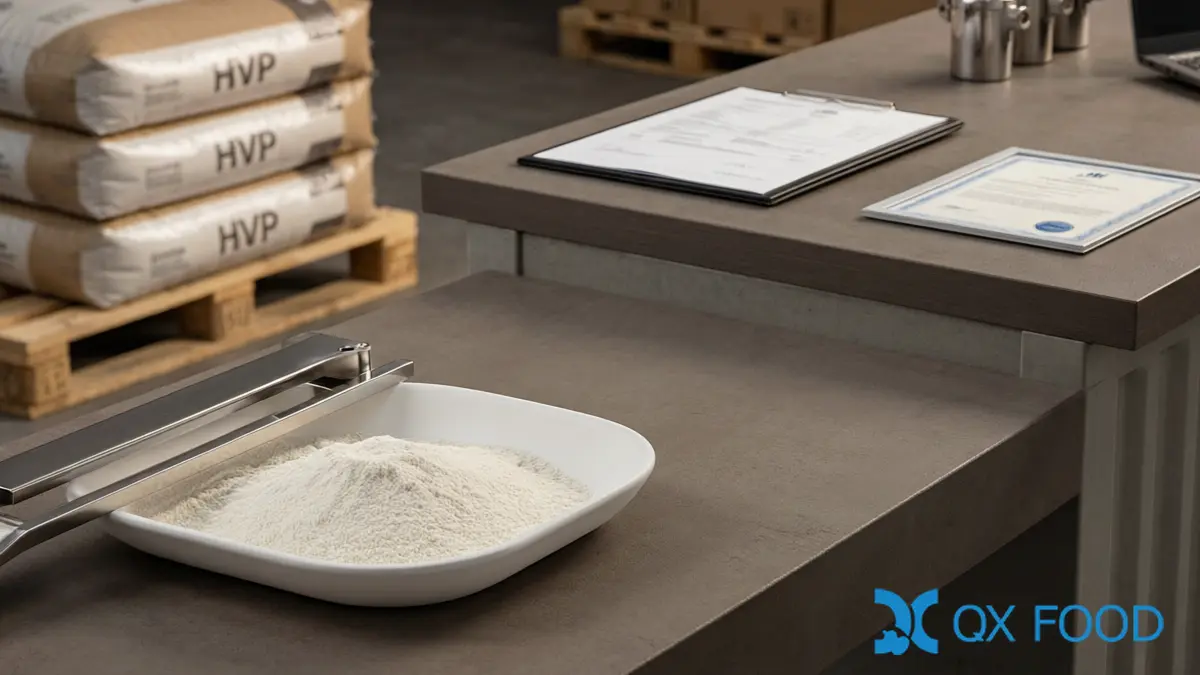
How QXFOOD Supports HVP Qualification
As part of an hvp supplier qualification program, QXFOOD operates soy-based, corn-based and mixed HVP grades across powder and liquid, with the full series compared in the HVP powder series and HVP liquid series.
Depending on the grade and agreed specification, lot documentation may include total nitrogen, amino nitrogen, salt, moisture or solids, color and applicable contaminant testing, alongside the management-system and certification documentation relevant to the buyer’s market. Sample evaluation and qualification documentation can be requested through the contact form, with the scope of documents confirmed against the destination program.
Questions Buyers Ask Before Approving an HVP Supplier
What should be fixed before requesting an HVP quote?
The application and process conditions, grade and specification requirements, allergen and compliance constraints, and the destination market. The clearer these are, the more comparable the responses.
Is a supplier COA enough to qualify HVP?
No. A COA supports verification as documentation of supplier testing, but qualification also covers the specification, production-lot consistency, allergen controls, change notification and the buyer’s own risk-based verification activities.
Does an approved sample qualify the commercial supply?
No. A sample approves the grade as worth pursuing; a representative production lot begins to qualify the supply program, and consistency should be confirmed across subsequent lots.
Which supplier or export documents are required?
It depends on the product and destination. Commercial and transport documents are commonly required, while official certificates such as health, origin or halal documentation depend on destination requirements, product classification and the customer program.