
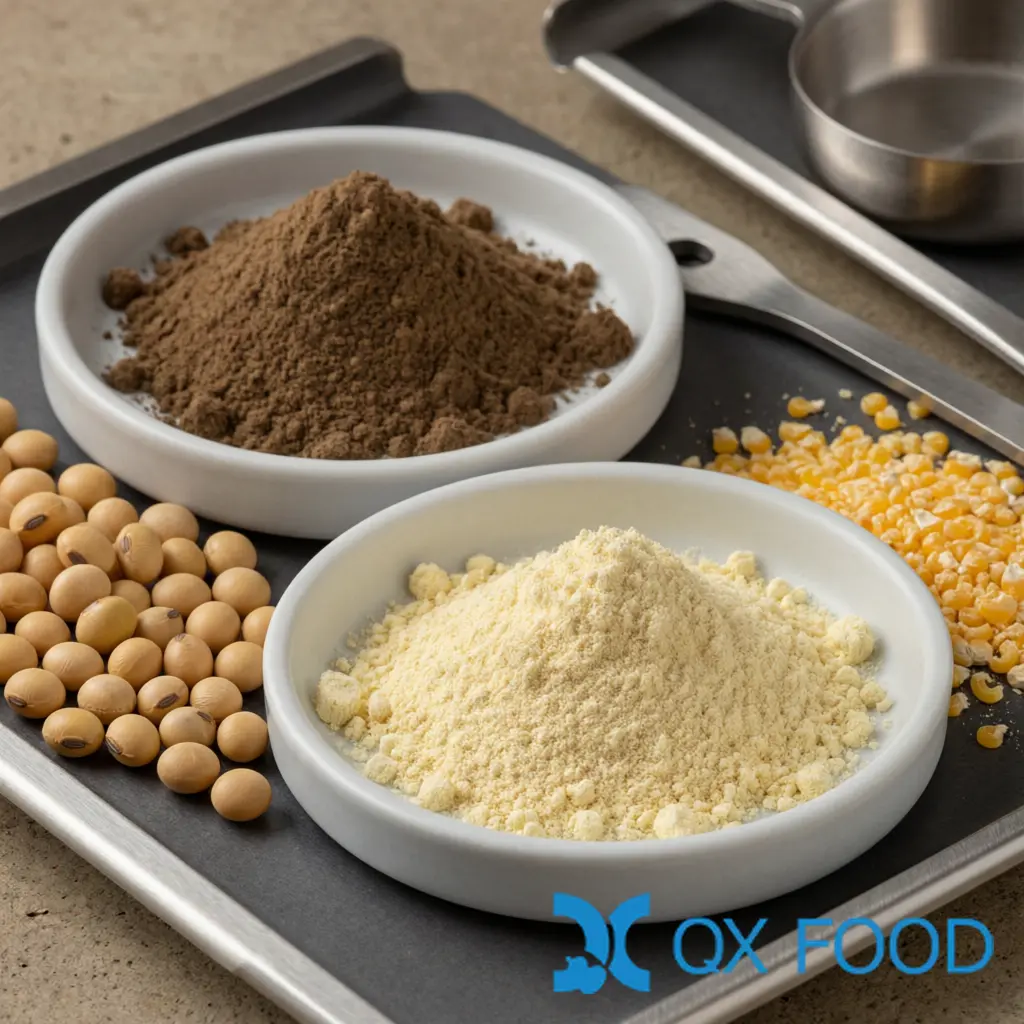
In the soy HVP vs corn HVP comparison, both ingredients start from different plant proteins, but protein source alone does not tell you which finished HVP will be stronger, darker, cleaner or better for a particular food.
Hydrolysis route, nitrogen level, salt, color treatment, downstream processing and the individual grade all influence the finished ingredient.
The useful comparison is therefore grade against grade at equivalent finished-food performance, not soy against corn as two fixed flavor categories.
Soy vs Corn Is a Starting-Material Difference, Not a Flavor Score
Source can influence the starting amino-acid and peptide pool, so soy- and corn-derived HVP may show different characteristic sensory directions. But hydrolysis, nitrogen level, thermal history, salt and post-processing can shift the final profile substantially, which is why source-based flavor rules such as “soy is always deep” or “corn is always clean” do not survive contact with real grades.
Both soy- and corn-based HVP can be produced through hydrolysis routes including acid or enzymatic processing, depending on the product and manufacturer. A soy HVP vs corn HVP decision therefore starts with the grade, not with the source name. Raw-material origin does not define the process.
What Protein Source Can Change
The starting protein determines the amino-acid composition and protein structures available for hydrolysis, which in turn influence the peptide and free-amino-acid profile of the resulting HVP. Soy protein brings a different composition to the reaction than corn protein, and that can influence the savory direction, possible Maillard precursors and some background flavor notes.
Source also carries a more reliable difference than flavor: allergen status. In the United States, soybeans are one of the nine major food allergens, while corn is not (FDA food allergen information). In the EU, soybeans and products thereof are listed in Annex II of Regulation (EU) No 1169/2011, while corn is not listed there. Soy-derived ingredients therefore carry soy-declaration implications, while the corn source itself does not introduce soy.
What Protein Source Cannot Tell You
Strength, color, salt, dosage and application fit cannot be read from the source. A corn grade can carry higher nitrogen specifications than a standard soy grade, yet sensory intensity still has to be established in the application. Color and salt levels vary within each source family as much as between them.
Protein source is one variable, not the finished HVP grade. The grade specification, hydrolysis route and application performance carry the information that source alone cannot provide.
Compare Grade to Grade, Not Source to Source
QXFOOD carries soy-based, corn-based and mixed grades in powder and liquid formats. Each grade has its own nitrogen specification, salt level, color and sensory direction, and current values are published on the individual product pages:
| Grade | Source | Format | Comparison role |
|---|---|---|---|
| FSA | Soy | Powder | Standard soy powder reference |
| FSAH | Soy | Powder | Higher-nitrogen soy grade |
| FYA | Corn | Powder | High amino-nitrogen corn grade |
| FYC | Corn | Powder | High total-nitrogen corn grade |
| YSB | Soy | Liquid | Soy liquid reference |
| YYA | Corn | Liquid | Corn liquid reference |
These grade structures describe where each product sits in the range; they do not by themselves tell you which sample will taste stronger in the finished product.
Nitrogen Numbers Describe the Grade, Not the Whole Flavor
Total nitrogen and amino nitrogen help describe the HVP grade and its hydrolysis characteristics. Amino nitrogen reflects the increase in free amino groups associated with protein hydrolysis, including contributions from free amino acids and peptide termini, while total nitrogen reflects the overall nitrogen content of the ingredient.
But neither value alone predicts finished-food flavor intensity. Perception depends on the free amino-acid composition, peptides, glutamate and salt levels, bitterness, volatile compounds, thermal history and the food matrix it is tasted in. Two grades with similar amino-nitrogen specifications can still show different sensory profiles, and grades with different figures can perform differently in opposite directions across applications.
Allergen Status Is a More Reliable Difference Than Flavor Stereotypes
The allergen question is where soy and corn HVP differ in a verifiable way, but the comparison still needs product-level care:
| Question | Soy-based HVP | Corn-based HVP |
|---|---|---|
| Soy allergen | Contains soy-derived protein; destination-market declaration applies | Corn source itself does not introduce soy |
| U.S. major allergen status | Soy is a major allergen (FALCPA, as amended) | Corn is not one of the major allergens |
| Gluten | Soy itself is not a gluten cereal | Corn itself is not a gluten cereal |
| Soy-free / gluten-free claim | Verify complete formulation and manufacturing controls | Verify complete formulation and cross-contact controls |
A corn-based HVP should only be treated as suitable for a soy-free or gluten-free program after the complete ingredient composition, allergen declaration and cross-contact controls are confirmed.
Changing Protein Source Is a Reformulation, Not a 1:1 Swap
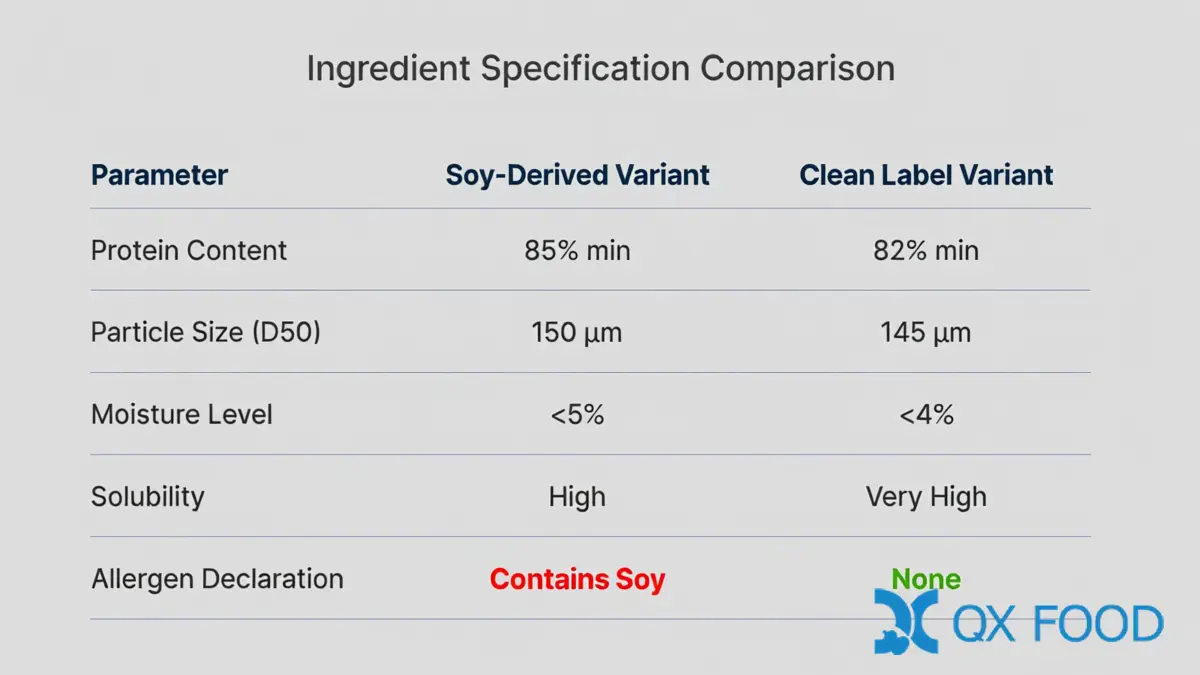
Replacing soy HVP with corn HVP, or the reverse, changes more than the allergen line. Nitrogen and salt levels differ, color and aroma direction differ, and the dosage needed to hit the same finished-food target can shift. The change should be treated as a reformulation: compare at equivalent finished-food performance and rebalance salt, color and flavor in the application.
Sometimes the Better Answer Is a Mixed HVP
QXFOOD also carries mixed soy-corn liquid grades such as YMA and YMB. Their existence is a useful reminder that formulation targets do not always fall into a binary soy-or-corn decision. A mixed base can be evaluated when the desired flavor direction, nitrogen specification or salt balance is not met by a single-source grade.
Mixed and single-source options also differ in availability by region. The supply picture for hydrolyzed vegetable protein covers source and regional share without treating any single published figure as a plan.
How QXFOOD Compares HVP Grades
Selection starts from the source and allergen requirement, then compares format, nitrogen specification, sodium, color, sensory direction and application performance across candidate grades. Current specifications are published on each product page, including the HVP powder series and HVP liquid series, and side-by-side samples can be evaluated in the buyer’s own application before a formula is committed.
Questions That Matter When Changing Protein Source
Is corn HVP always milder than soy HVP?
No. Source can influence sensory direction, but intensity must be compared grade by grade. A corn grade may have higher amino- or total-nitrogen specifications than a standard soy grade, but those numbers alone do not determine which will taste stronger in the finished food.
Does higher amino nitrogen always mean stronger umami?
No. Amino nitrogen is an important specification, but flavor also depends on amino-acid and peptide composition, salt, volatile profile and the finished-food matrix.
Does corn HVP automatically qualify as soy-free?
Raw corn protein does not introduce soy, but the complete ingredient composition, allergen declaration and manufacturing cross-contact controls need verification before making a soy-free claim.
Can corn HVP replace soy HVP 1:1?
Not necessarily. Compare at equal finished-food performance and adjust dosage, salt, color and flavor balance, because nitrogen, salt and sensory direction differ between grades.