
Quick answer. To scale up snack seasoning, treat the recipe as the part that travels and the process window as the part that does not. Contact time in the applicator, drum fill, feeder behaviour, the surface condition of the base and the validity of your samples all change with scale. Run the first production batches as a validation with written acceptance criteria, and measure retention across a defined handling step rather than judging a sample at the drum.
A bench trial and a production line can use the same blend, the same carrier, the same target dose and the same base, and still deliver different results on the piece. The blend is not necessarily the problem. What changes when you scale up snack seasoning is the environment the blend meets: a different drum, a different contact time distribution, a different feeder, a different thermal history between the fryer and the applicator, and a sample that no longer represents the whole run.
This guide covers what changes between a bench trial and a production run, and how to structure the transition so that a result on the line can be explained rather than guessed at. How to measure what stays on the product belongs to our guide to seasoning pickup and retention; the mechanisms behind powder loss are covered in why snack seasoning falls off after coating; and the choice of addition point on a baked line is covered in seasoning systems for baked snacks.
What Transfers from the Lab, and What Does Not
Three things travel well. The reference formula travels as the starting point: ingredient identity, intended flavour direction and target composition stay under control while the process is scaled, and the commercial formula should only be changed when line validation shows that a process or finished-product requirement cannot be met without adjustment. The specification travels: grade, particle size distribution targets and moisture can be held constant if the supplier commits to them. The sensory target travels: the flavour you approved on the bench is the flavour the line is trying to reproduce.
Four things do not travel, and they are the ones that decide whether the trial works. Contact time between powder and product is not a setting on a bench, it is your hand and your judgement. On a production line it emerges from the drum geometry, rotation speed, inclination, solids holdup, feed conditions and product properties rather than from one transferable bench setting. Drum fill, meaning how much product sits in the applicator at any moment, is a lab choice that becomes a line result. Powder delivery changes from a sieve or a shaker to a feeder that has to hold a rate. The sample changes from the several pieces you selected to whatever the line gives you, at a point you can actually reach.
Teams that scale up snack seasoning successfully usually make one mental shift early: they stop asking what the correct contact time is and start asking whether the production drum produces a comparable contact time distribution to the pilot. The second question is answerable. The first one is not, because there is no universal number.
Time in the Drum Is an Output, Not a Setting
Residence time in a continuous drum is an output of the equipment geometry, rotation speed, inclination, solids holdup, feed conditions and product properties together. Published rotary-drum studies show that these variables change both the mean residence time and its distribution, while their relative weight is system-specific: a study on non-spherical particles in a continuous drum found the mean residence time responded strongly to rotation speed and incline angle, and only slightly to feed rate, with particle size and mixture composition contributing as well (Mahdavy et al., 2022, Processes). A pilot drum and a production drum should therefore not be assumed to provide equivalent contact histories simply because the recipe and the nominal speed are similar.
Equipment suppliers describe the same coupling from the operations side. Drum angle is used to vary dwell time and drum speed is adjusted for the application, so the same machine can be set to very different contact times (MPD on coating and mixing drums). A drum that is too short or running too fast does not give seasoning enough time to adhere, while one that is too long risks mechanical damage to the product (KMG Systems, seasoning accuracy). Both statements point at the same variable: contact opportunity.
The practical consequence is that your pilot drum and your production drum are different machines, not the same machine at different sizes, and the difference cannot be reduced to a single setting. If the line also changes the base (thicker pieces, higher moisture), the contact time needed changes again. Contact history carries into every result measured after the drum, which is why it is worth estimating or observing on the equipment you will actually run.
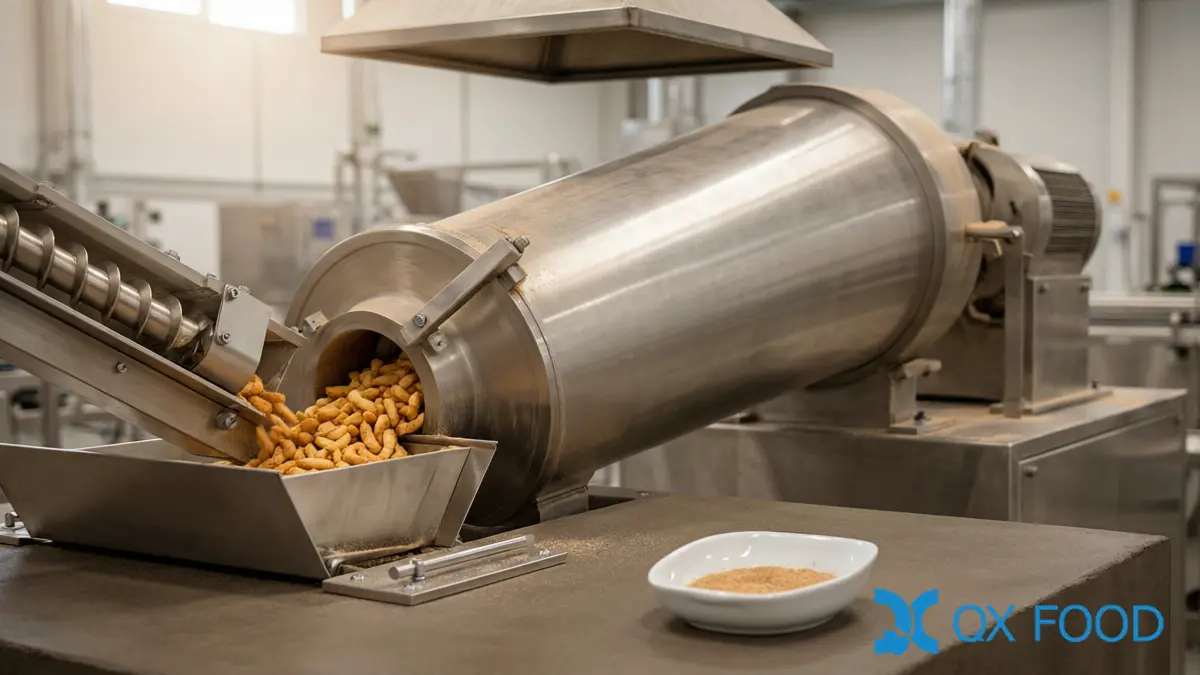
What the Applicator Does at Production Rates
On the bench, powder arrives by hand. On a line it arrives from a feeder, and the feeder’s behaviour at your operating rate is a scale-up variable in its own right. Loss-in-weight feeders can dose very accurately under controlled conditions, but performance depends on the feeder, the material, the operating rate and the refill behaviour. During a hopper refill many systems operate in volumetric mode, and published work shows that the refill system, the filling level at which refilling starts, and the material itself can each shift the delivered rate, in either direction (Santamaría Alvarez et al., 2024, Powder Technology). Here is the catch: an accuracy figure means little without the conditions it was measured under, so the rate has to be verified where it will actually run.
The verification method matters as much as the specification. Feed rate testing on a production line is done differently from the manufacturer’s performance test and is correspondingly less precise, which is why modern feeder controllers include an online rate test that can be run without shutting the line down (Powder Bulk Solids, feed rate testing). If a trial report contains a feed rate but not how it was checked at the operating rate, the number is decoration.
Carrier application scales on its own logic. In film coating, which faces the same problem of moving a spray process from small to large equipment, the published approach is to scale through relationships rather than through a single multiplier: pan load, pan speed, spray rate and air flow are adjusted together so that the rate per nozzle and the exposure per unit of product stay comparable (Pandey et al., 2006, AAPS PharmSciTech). The pharmaceutical study is not a direct seasoning model, but it illustrates the broader principle: preserve process relationships and product exposure rather than copying individual machine settings. When scaling carrier application, do not compare pump pressure or nozzle settings alone. Compare the carrier delivered per unit of product together with coverage or atomisation, the product exposure, and the finished surface condition.
Batch in the Lab, Continuous on the Line
Bench work is usually batch work, and batch work is forgiving in a way that continuous production is not. In a batch you can add powder in stages, look at the piece, and add more; you can hold product back and re-tumble it; you can discard a bad kilogram without anyone noticing. A continuous line gives each piece a single pass through the application zone, and whatever happens in that pass is the result.
That difference changes which powder properties matter. In a batch, flow behaviour is a convenience: if the powder bridges in a sieve, you knock the sieve. In continuous feeding, flow behaviour decides whether the dose stays where you set it, because a feeder cannot correct for a powder that arrives in surges. The flow and dust behaviour discussed in our guide to how powder flow and dust affect adhesion matters more after scale-up, not less.
It also changes how corrections work. In a batch, a light coating can be topped up. On a continuous line there is no second pass unless the product is re-circulated, and re-circulating changes the handling the coated product experiences, which changes retention. Recirculation adds another handling step and can change retention or breakage, so it belongs in the trial as a separate validated process rather than as an automatic correction.
The last consequence is about evaluation. A batch can be judged by sampling from the batch; a continuous run has a beginning, a steady state and an end. For routine run-to-run comparison, define a steady-state sampling window. Start-up, shutdown, speed changes and changeovers should be sampled separately when they are part of the intended operating range, rather than mixed into the steady-state baseline. When you scale up snack seasoning into continuous operation, the definition of when a sample counts is part of the process specification, not an administrative detail.
The Surface Window Moves When the Line Gets Longer
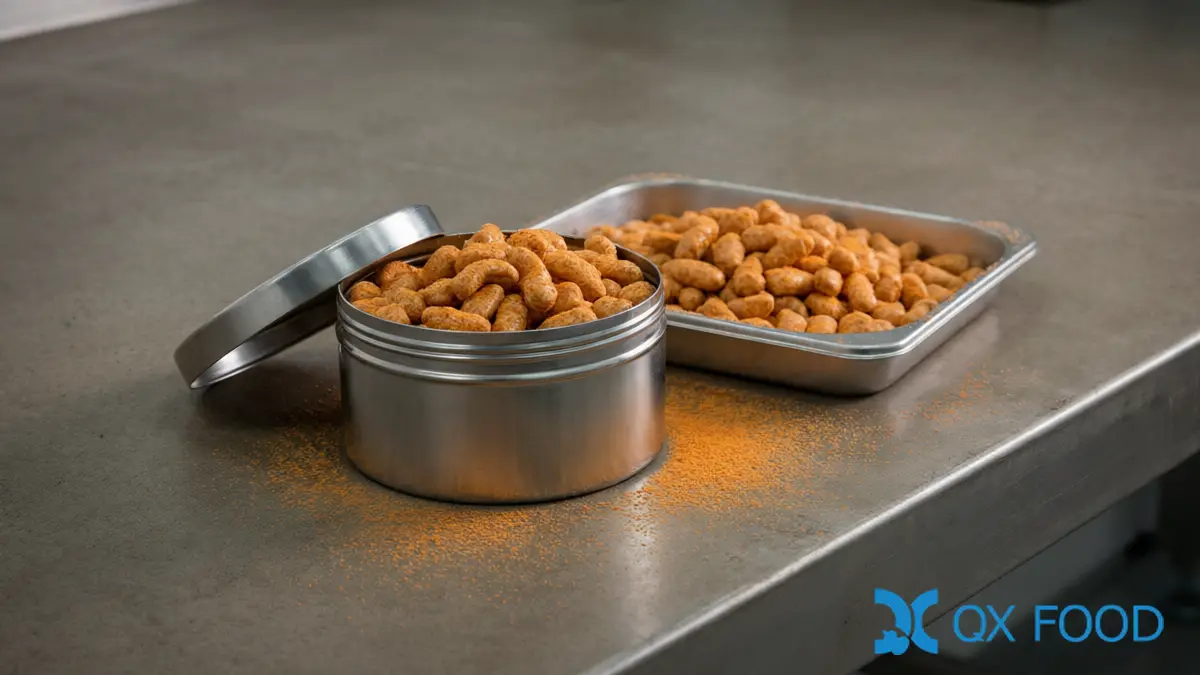
A bench sample is usually coated minutes after it was made, on a base you hand-selected. A production line inserts minutes of conveying and cooling, then waiting, between the fryer or oven and the applicator, and that interval changes what the surface looks like when powder arrives: surface oil redistributes, temperature falls, and moisture moves between the centre of the piece and its surface. The state of that surface at the moment of coating is itself one of the factors that decide how well powder stays put (Buck and Barringer, 2007, Journal of Food Science). The mechanisms behind that are set out in our guide to the mechanisms behind powder loss; what matters for a scale-up is that the transit time is part of the process recipe.
The base also stops being one thing. A bench trial uses one lot, often one tray. A production run uses lots that differ in moisture, surface oil and geometry within the agreed specification, and it produces the material at the start of a run, after a changeover and during speed changes. The first minutes of a run and the tail of a changeover are not representative of steady state, which is why a validation plan has to define when a sample counts rather than assuming that every kilogram is equal.
Sampling: Why Lab Numbers Do Not Transfer Directly
A pickup figure only means something with a stated basis, a defined sampling point and a defined handling step, as set out in our guide to how to measure what actually stays on the piece. Scale-up breaks that chain in a predictable way. The bench sample is taken from a small batch that was coated in one go; the line sample is taken from a stream that has been coated continuously, conveyed, and possibly vibrated, and it can only be collected at the points where a person can actually stand.
The sampling plan is where most scale up snack seasoning projects lose their evidence. Two consequences follow. First, comparing a bench figure with a line figure directly is usually invalid unless both were produced by the same method and basis, so the useful comparison is between line samples taken at two points, with the earlier one acting as the reference. Second, sampling at the drum exit assesses the coating outcome; it does not measure residence time itself. Third, matched sample groups are needed for anything measured destructively. If the test consumes the sample, the coated and uncoated states cannot come from the same pieces, so the plan has to build in equivalent groups from the same run window.
How to Scale Up Snack Seasoning: Design the First Runs as Validation
A first production run that is meant to demonstrate something tends to end with an opinion. A first run that is designed as a validation ends with a result. The difference is written down before the line starts.
- Fix acceptance criteria at finished-product level. Define the sensory target, and define the physical measure as a retention ratio across a stated step, using the method in our measurement guide. A criterion that only refers to the feeder setting is not an acceptance criterion.
- Challenge the edges of the range you intend to run. Which edges matter depends on the process and the decision: throughput, base condition and carrier dose are common candidates, but a full four-corner design is not mandatory. One comfortable mid-range run on its own proves very little.
- Change one variable at a time, and keep comparisons honest. When carrier or powder options are compared, hold either the dose or the finished sensory target constant, and say which one you held.
- Repeat at identical settings. Repeated runs at the same setpoints separate ordinary run-to-run variation from the effect you are trying to measure, and the number of repeats should reflect the process risk and the decision being made rather than a fixed rule.
- Pre-agree the sampling plan. Decide who samples, at which points, in which steady-state window, and how the samples are handled and labelled before the first bag is filled.
- Pre-agree the troubleshooting options. Carrier, powder specification, line settings and addition point are the usual levers, and they should be evaluated against technical impact, label or regulatory consequences, implementation cost and the validation burden each one adds. There is no universal order, because a line setting that is free in one plant is capital work in another. The addition point question is covered in our guide to choosing the addition point on a baked line.
| Item | What a bench trial controls | What the line decides for you | How to verify it on the line |
|---|---|---|---|
| Contact time | When you stop | Geometry, rotation speed, inclination, holdup and feed conditions together | Use a tracer or direct timing where practical, or estimate from solids holdup and throughput and document the limitation |
| Powder delivery | How you shake or sieve it | Feeder rate and turndown, plus refill behaviour at your rate | Run the feeder’s online rate test at the operating rate, not at a test rate |
| Carrier application | Spraying until it looks even | Nozzle count and atomisation, plus exposure per unit of product | Compare dose per unit of product, not pump or pressure settings |
| Base condition | One hand-picked lot | Lot-to-lot variation and transit time before the applicator | Record moisture, surface oil and temperature by lot across the run |
| Sample validity | Pieces you chose yourself | Only the points you can reach, after start-up and changeovers | Define the steady-state window and use matched groups for destructive tests |
How to Brief a Seasoning Supplier on a Scale-Up
A supplier can hold powder properties constant, supply samples that represent production rather than the laboratory, and document the parameters that matter for delivery. A supplier cannot promise a pickup figure for a line they have not seen, because half of the system is your base and your process. When you scale up snack seasoning with a new supplier, four questions keep the conversation useful: which powder properties will be held batch to batch, and how are they reported? Can the sample come from production-representative material? Which carrier does the blend expect, and what does it do if the line provides less? What documentation travels with the shipment?
Read the documentation for what each document can establish. A specification defines grade and intended use; a batch certificate reports that lot against the control plan; application and method documents support how the powder is used. A single batch certificate cannot demonstrate batch-to-batch consistency, and no document set replaces a trial on your own line. Our guide to seasoning powder supplier evaluation covers the wider evaluation process.
QXFOOD supplies seasoning powders and compound seasonings for snack applications, including chilli and pepper systems, tomato styles, savoury blends and HVP-based flavour components, and we work with customers on the powder properties that affect how a blend behaves in an applicator. Where a project moves from a sample to a production trial, we can supply production-representative samples against the agreed specification and discuss particle size targets, carrier direction and formulation adjustments, subject to technical feasibility, sample validation and agreed specifications. Whether a specific blend performs on your line is settled by the trial, and we plan for that trial rather than around it.
- Application and formulation context: snack seasoning for chips and extruded snacks and seasoning formulation by application
- Coating systems and powder form: seasoned nuts and bakery coating systems and seasoning granules and powders
- Product routes: pepper salt seasoning powder, spicy chicken seasoning powder and tomato seasoning powder
Frequently Asked Questions
Why does a seasoning blend behave differently on the line than in the lab?
Because the recipe is only one input. When teams scale up snack seasoning, the blend is usually the last thing that should change and the first thing that gets blamed. Contact time, drum fill, feeder behaviour at the operating rate, the time the base spends between the oven and the applicator, and the representativeness of the sample all differ between a bench and a production line. The blend can be identical while the result changes.
How do you scale up snack seasoning without changing the recipe?
Keep the formula and change the conditions deliberately. Establish the contact time and dose the line actually produces, verify the feeder at the operating rate, record the base condition by lot, and validate against acceptance criteria written before the run. If the result is short, the carrier, the powder specification, the line settings and the addition point are the usual levers, and they are weighed against technical impact, label consequences, cost and the validation burden each one adds.
Does a longer residence time always improve coating?
No. More contact time gives the powder more opportunity to meet the surface, but it also exposes the product to more mechanical action, and equipment suppliers warn that an oversized or slow drum can damage the product. The target is a contact time distribution that is long enough for adhesion and short enough for the product to arrive intact, and it has to be found on the equipment you will run.
What should be measured during the first production run?
Pickup at two points with a defined handling step between them, so that retention can be calculated; the feeder’s actual rate over the same window as the product throughput; the base condition by lot; and the line settings that produced each sample. Sensory assessment belongs at the finished-product level, against the target you approved, not against the drum sample.
Can I keep the same oil level as the bench trial?
The dose can stay the same, but how that oil is applied will not be identical: a hand application and a production nozzle deliver different coverage and different droplet behaviour. Judge the carrier by what it achieves on the piece, at the dose you specified, rather than by the setting on the pump. Our guide to seasoning adhesion after coating covers how carrier choice interacts with the powder and the surface.
How many production runs are needed to validate a seasoning change?
Enough runs to separate the effect you are measuring from ordinary variation. Repeated runs at identical settings are a common starting point for estimating run-to-run scatter; runs at the edges of the operating range you intend to use show whether the process window is wide enough to live in. The number is a decision about risk, not a universal constant.
Do I need a pilot line between the lab and production?
A pilot line is useful when it lets you control the variables that the production line decides for you, such as contact time and fill level. It is not automatically representative just because it is bigger than a bench. The question to ask is which variables it holds fixed and which it shares with the production line.
How does throughput affect seasoning pickup?
Throughput changes how much product sits in the drum at any moment and what a given feed rate means relative to the product passing through, and published drum studies show that the size of the resulting change in contact time depends on the equipment and the product rather than following one fixed direction. That is why teams that scale up snack seasoning at a new speed should re-run the sampling plan rather than assume the previous result holds.
The Short Version
When you scale up snack seasoning, the formula travels and the process window does not. Contact time is produced by throughput, fill and drum geometry rather than chosen; the feeder’s behaviour at your operating rate is a variable in its own right; the base changes between lots and along the run; and only the samples you can actually take are able to explain the result. Write the acceptance criteria and the sampling plan first, challenge the relevant edges of the intended operating range rather than relying only on a comfortable mid-range run, and treat the first production runs as validation rather than as a demonstration.