
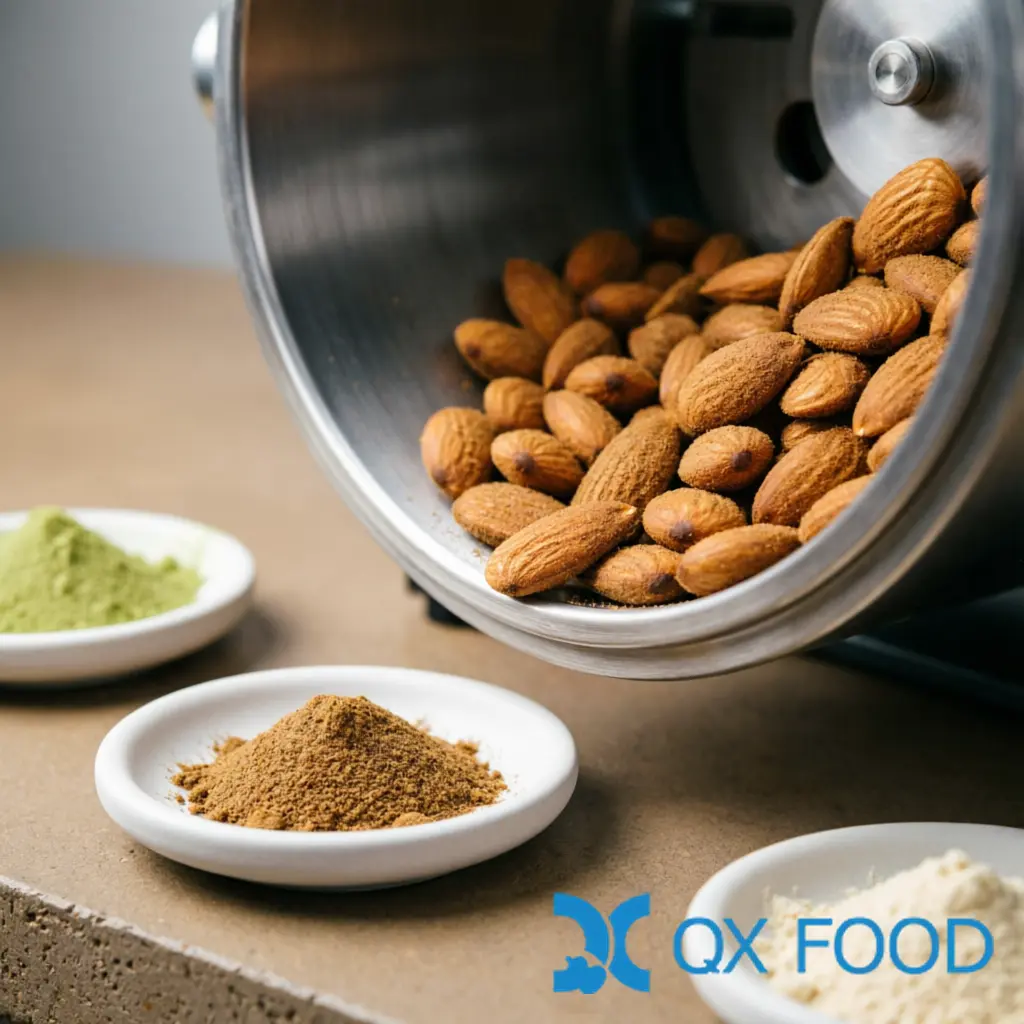
Seasoned Nuts and Bakery Snack Coating: Five-Spice, Garlic and Matcha Systems for Production
Seasoned nuts are the fastest-growing segment of a global nut market where flavored seasoned nuts varieties are projected to expand at 6.63% CAGR through 2031 while plain and salted formats hold 68.75% share (Mordor Intelligence, 2025). For nut processors, bakery snack lines and contract manufacturers, the seasoning system is what makes seasoned nuts a growth lever — and it is also where production complexity concentrates. Coating adhesion, color stability and flavor layering behave differently on nuts than on chips, and the coating step sits between roasting and packing where every variable in seasoned nuts production is visible. This guide covers seasoned nut and bakery snack coating systems for industrial production: the coating mechanics, the flavor architectures, and the raw material choices that survive the line.
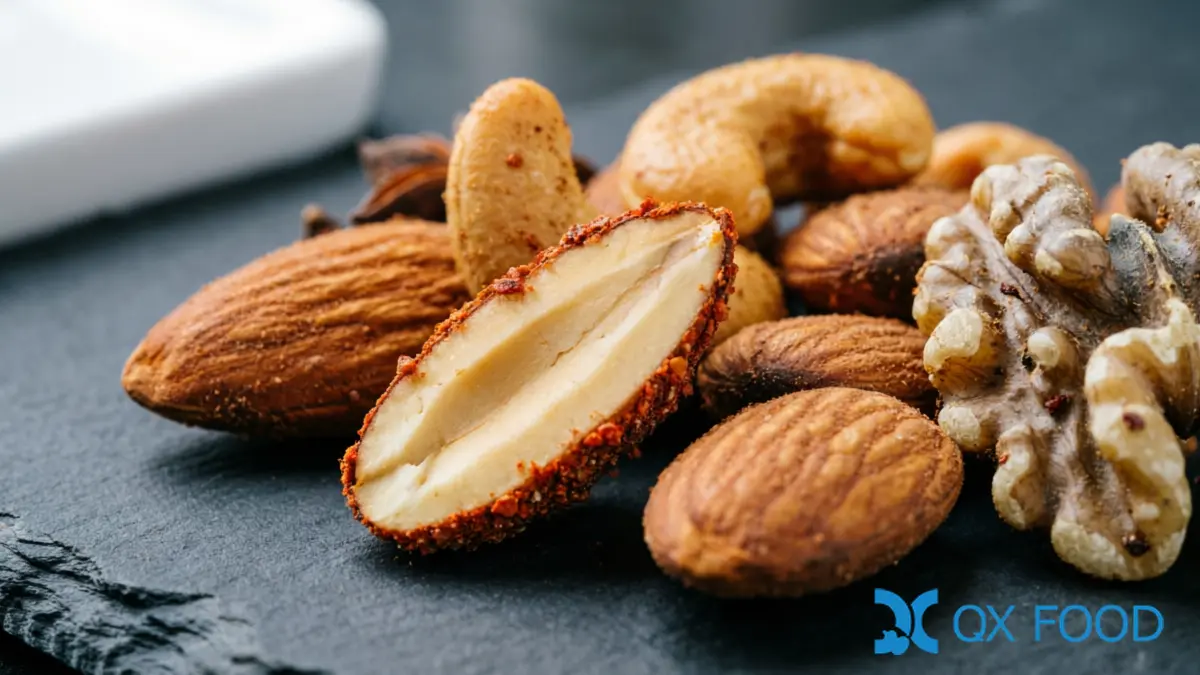
How Coating Works on Nuts and Bakery Snacks
Coating seasoned nuts follows the same oil-and-dust principle as chip seasoning, but with two differences that change the engineering: the surface is curved and uneven, and the base is often hot from roasting. The practical consequences:
- Oil level — nuts typically need 5-10% oil for adhesion, applied while the nut is still warm from roasting so the oil penetrates the surface layer.
- Two-stage coating — oil, then a portion of seasoning, then a second oil pass, then the rest; this improves both adhesion and flavor depth on curved surfaces.
- Particle size — fine powders (100-200 mesh) coat curved surfaces evenly; coarse bits need an oil-rich base to stay attached and are best for premium visible-ingredient lines.
The same physics applies to bakery snacks — cookies, pretzels and baked snack mixes — where the coating must survive packaging without migration into the packaging film.
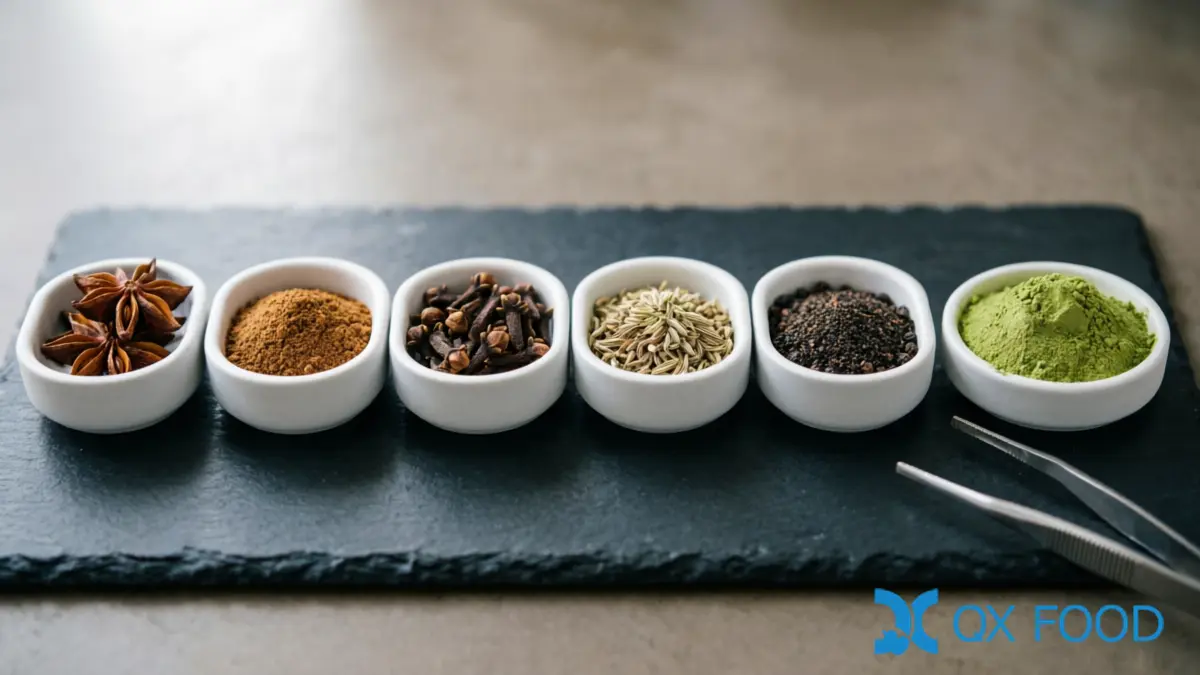
Five-Spice Systems for Savory Nut Lines
Five-spice is a proven savory architecture for seasoned nuts in both Asian and Western premium segments. The classic five-spice core maps directly to production-grade raw materials:
| Five-Spice Component | Function in Coating | Production Grade |
|---|---|---|
| Star anise | Licorice-sweet anchor | Star anise STA-23 ground fine |
| Cassia | Warm sweet-bark depth | Cassia powder CP-B04 |
| Clove | Pungent aromatic roundness | Clove powder CLO-D11 |
| Fennel | Cooling anise-adjacent balance | Fennel powder FP-B01 |
| Pepper | Sharp heat finish | Black pepper BPP-K45 |
For five-spice seasoned nuts, grind the components to a uniform fine mesh (100-120) so the blend coats evenly without streaking. A locked blend with a COA-verified reference sample is the production standard for chain-scale flavored nut lines.
Garlic Systems: Savory Punch with Heat Tolerance
Dehydrated garlic powder GP-W04 is the workhorse of savory nut and bakery snack coating. Garlic systems for seasoned nuts need two design decisions:
- Mesh selection — 80-120 mesh for even coating with visible texture; finer for smooth, salt-adherent blends.
- Heat timing — garlic added before roasting develops toasted savory notes; garlic added after roasting keeps raw pungency. Many seasoned nut lines split the dose: a base layer before heat, a top layer after.
Garlic pairs with dried ginger DGR-27 for warm complexity and with white pepper for heat without visible specks in light-colored coatings.
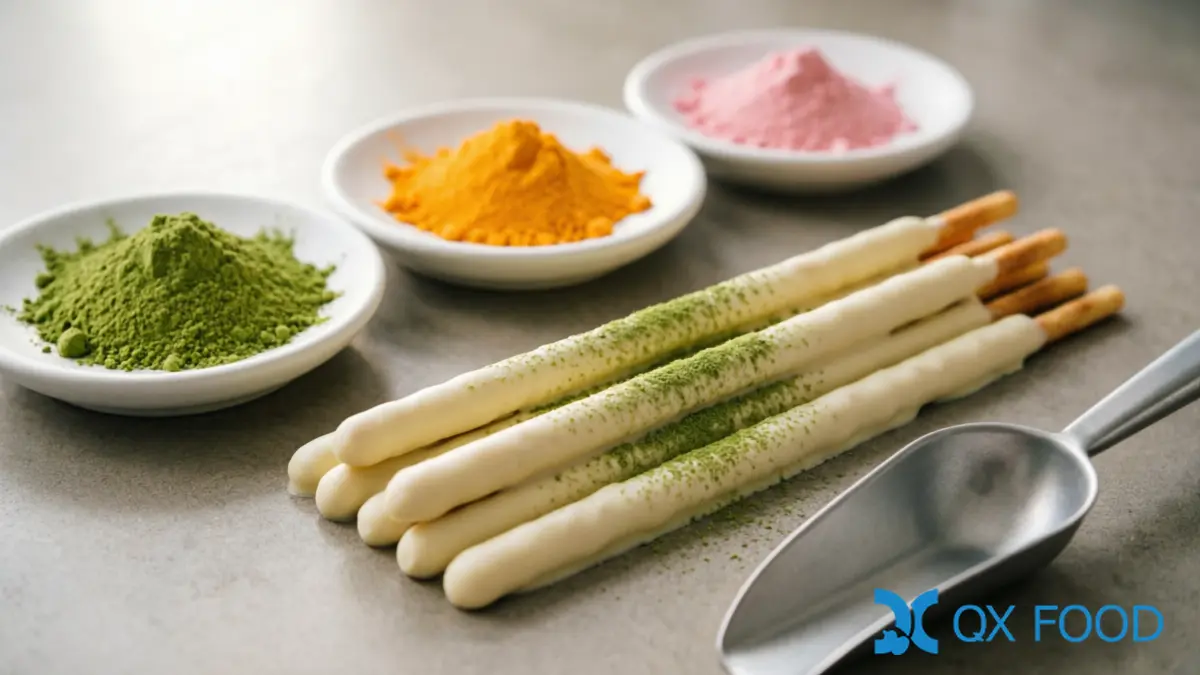
Matcha and Fruit Powders: Color-Loaded Sweet Coatings
The sweet-savory frontier of seasoned nuts and bakery snacks is color-loaded coating: matcha powder MP-K40, mango powder MGO-15 and strawberry powder STB-18 deliver both color and flavor in one ingredient. Three production rules apply:
- Color budget — matcha green, mango yellow and strawberry pink are the visual identity of premium seasoned nuts; specify color values on the COA and protect them from light and heat in storage.
- Moisture control — fruit powders are hygroscopic; blend them into the coating immediately before use and store the blend sealed to prevent clumping.
- White-chocolate base synergy — matcha and fruit powders perform best on a white-chocolate or sugar-coating base, where their color reads cleanly; dark coatings mask both color and flavor.
For matcha specifically, the bulk culinary matcha guide from First Agri covers grade selection for baking applications — a useful reference when qualifying matcha for coated snack lines.
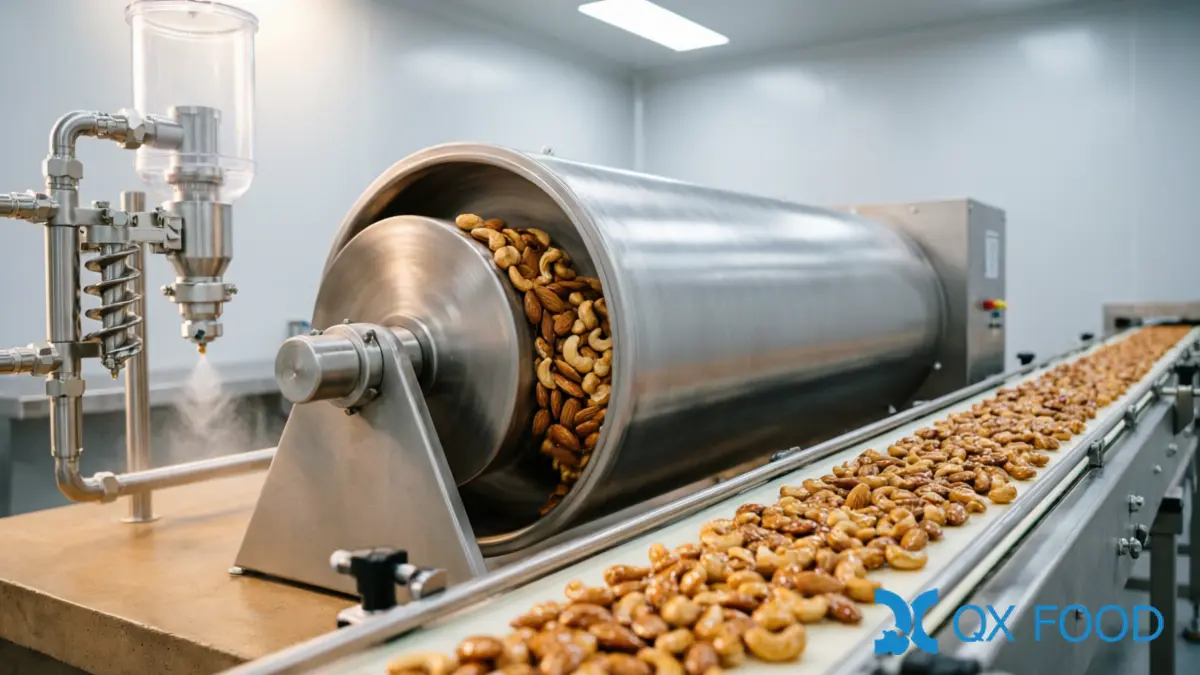
Coating Line Parameters That Decide Success
Beyond the formula, three line parameters decide whether a seasoned nut coating succeeds at scale:
- Drum speed and residence time — too fast and seasoning never adheres; too slow and the nuts abrade each other, shedding the coating.
- Oil application temperature — warm oil spreads evenly; cold oil beads on the nut surface and collects in the drum.
- Fines recovery — a fines-collection system that returns lost seasoning to the line can cut coating cost by 10-20%.
The industry outlook for 2025 confirms the direction: flavored kernels and snack mixes are the growth drivers of the nut category, with health-positioned and boldly flavored lines leading (Snack Food & Wholesale Bakery, 2025). The state-of-the-industry analysis is a useful benchmark when planning new seasoned nuts SKUs.
Sourcing Coating-Grade Raw Materials
Coating-grade sourcing differs from general spice buying in one respect: color and adhesion parameters matter as much as flavor. The sourcing checklist for seasoned nut and bakery coating lines:
- Color values — ASTA for paprika-type, bright-green grading for matcha, defined color readings for fruit powders.
- Mesh specification — uniform particle distribution for even coating; oversize fractions streak on curved surfaces.
- Moisture — low-moisture powders prevent clumping in the coating blend and migration in the pack.
- COA consistency — volatile oil for spices, color values for matcha and fruit powders, microbiology for all.
QXFOOD’s coating-grade set — star anise STA-23, cassia CP-B04, clove CLO-D11, fennel FP-B01, garlic GP-W04, ginger DGR-27, black pepper BPP-K45, matcha MP-K40, mango MGO-15 and strawberry STB-18 — ships with color and mesh data, ISO9001, ISO22000, HACCP and HALAL certification, and 1 kg samples for coating trials.
For the full category view, visit the Natural Plant Powders category page.
Request seasoned nut coating samples through the contact form on this page and our application team will support your coating trials.
Coating systems for nuts share their physics with chips — our snack seasoning application guide covers tumble and slurry systems in depth, and for the plant-based shelf, the plant based meat flavor guide shows the same powders at work.
Frequently Asked Questions
Why does seasoning fall off my nuts?
Nut coating falls off when the oil level is too low (aim for 5-10% on warm nuts), the powder is too coarse for the curved surface, or drum residence time is too long, causing nut-to-nut abrasion. Two-stage coating improves adhesion on curved surfaces.
What mesh size for seasoned nut coating?
Fine powders (100-200 mesh) coat curved nut surfaces evenly; 80-120 mesh suits savory garlic and pepper blends with visible texture. Coarse bits need an oil-rich base and are best for premium visible-ingredient lines.
Can matcha and fruit powders work in savory nut coatings?
Yes — they work best on sweet or white-chocolate coating bases where their color reads cleanly. Matcha green, mango yellow and strawberry pink double as the visual identity, so protect their color values from light and heat.
Why do my coated nuts look streaky?
Streaking comes from uneven particle size in the seasoning blend or uneven oil application. Specify a uniform mesh distribution and check oil temperature — warm oil spreads evenly while cold oil beads on the nut surface.
How much seasoning is lost in nut coating?
Line losses of 10-20% are common. A fines-collection system returning lost seasoning to the line, plus tuned drum speed and two-stage coating, can cut losses significantly.
What color parameters should I check on matcha for coating?
Check the bright-green grading value on the COA, plus moisture (fruit and tea powders are hygroscopic) and particle size. Specify color values and mesh on the PO so the coating color is reproducible.
How do I keep a five-spice nut coating consistent?
Lock the blend with a COA-verified reference sample, grind all components to a uniform mesh, and verify volatile oil on every lot. Batch-to-batch consistency of the blend is what makes the coating reproducible.