
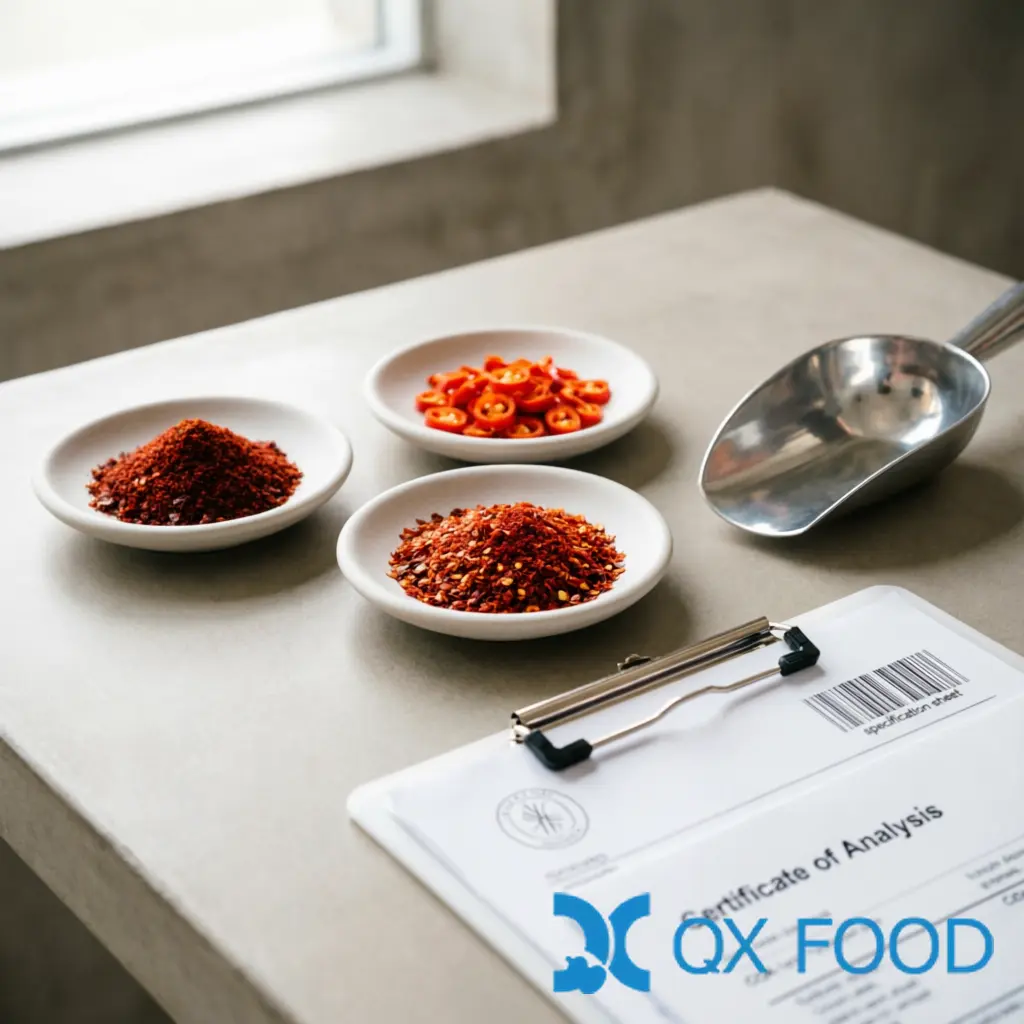
The first guide in this series covered chili varieties and heat levels; the second covered processing and the seven chili forms. This third guide is the one you likely came for: how to actually buy chili at industrial scale — where it comes from, what quality standards exist, what the certificates actually mean, and how to run a sourcing process that does not end in a warehouse full of chili you cannot use. It is a sourcing guide in the practical sense: the questions, documents, and checks that sit between a first inquiry and a signed supply agreement.
We will look at the global chili trade — who produces, who exports, and why China has become the default sourcing origin for so many processed chili forms. Then we move to quality standards and the certifications buyers actually see on COA and certificate packs. Finally, we walk through the full sourcing checklist, from sampling through supplier qualification to ongoing supply management, with the practical details that only show up when you have been on the buying side of this market for a while.
The Global Chili Trade: Who Produces, Who Exports, Who Buys
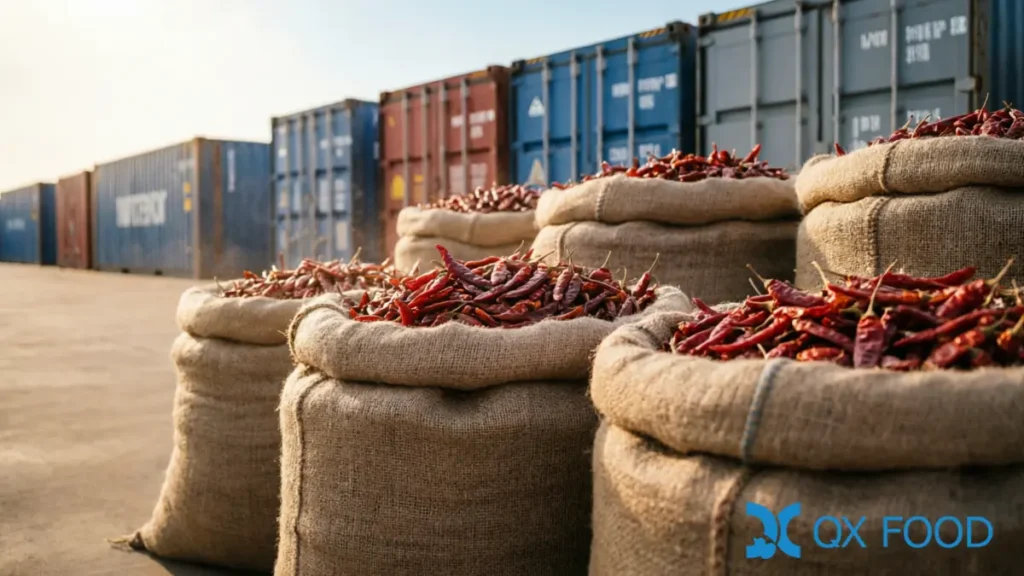
Chili is grown on every inhabited continent, but commercial production concentrates in a handful of countries. India is the largest producer by volume, growing roughly a third of the world’s chili, with a significant share going to domestic consumption and a strong export position in dried whole chilies, chili powder, and oleoresin. China is the second-largest producer and, more importantly for industrial buyers, the world’s largest exporter of processed chili forms — powders, flakes, crushed, rings, strips, and slices. Mexico supplies the North American market with fresh and dried chilies, particularly the large-flavor varieties like ancho and guajillo. Turkey, Spain, and Peru round out the significant commercial producers, each with regional specialties.
For industrial food manufacturers, the trade map matters in three ways. First, price: chili prices move with production seasons in the major growing regions, and a supply contract signed at the wrong time can lock in an unfavorable price for a year. Second, specification: not every origin produces every form well — precision chili rings demand the structural quality of properly dried Chinese chili, while paprika-type color concentrates favor Xinjiang’s high-ASTA varieties. Third, compliance: different destinations apply different import rules, and the origin you choose must be able to document compliance with your destination market’s standards, whether that is the EU, North America, the Middle East, or Southeast Asia.
Why China Has Become the Default Origin for Processed Chili
China’s position in processed chili is not accidental. The country grows enormous volumes across several climates — Xinjiang’s dry northwest, Henan and Shandong’s central plains, Sichuan and Guizhou’s humid southwest, Guangxi and Yunnan’s tropical south — which gives suppliers flexibility in variety, heat profile, and harvest timing. But the real advantage is the processing industry built on top of that production: decades of export-oriented development created a dense network of cleaning lines, drying facilities, grinding mills, and cutting workshops that can produce any of the seven chili forms at industrial scale, with certifications and testing infrastructure to match.
For buyers, the practical consequence is consolidation: one Chinese supplier can often supply your entire chili requirement — fine powder for seasoning blends, crushed for hot pot base, rings for noodle garnish, strips for Korean cuisine — from a single qualified facility, under one quality system, with one set of certificates. That is not a trivial advantage when you are managing supplier qualification across multiple origins. It also means Chinese suppliers compete on processing capability, not just raw chili price, which keeps quality standards genuinely competitive.
Chili Quality Standards: The Language of Specifications
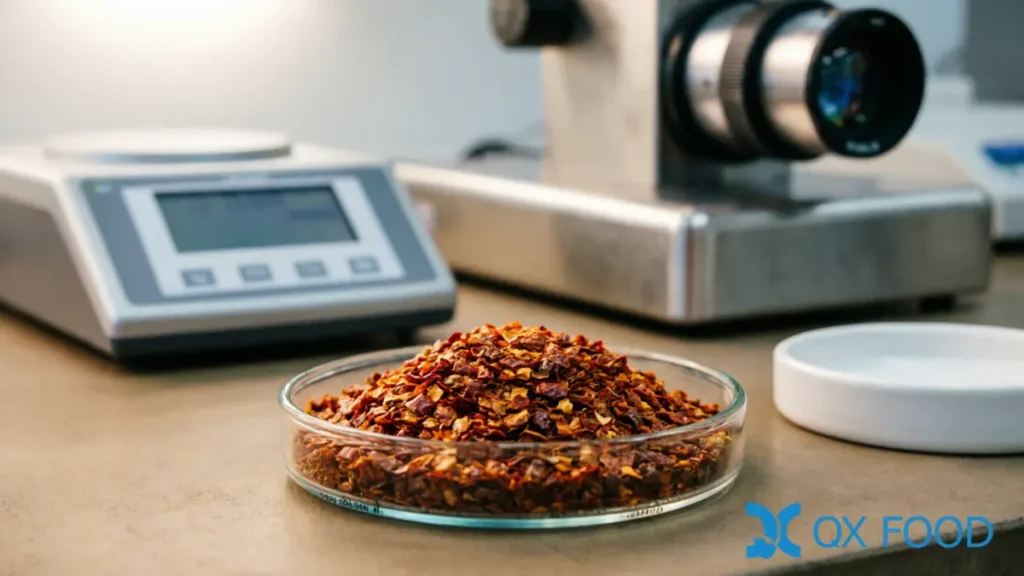
Quality in dried chili is defined by measurable parameters, and buyers who can speak this language get what they specify instead of what they hope for. The core specification parameters are moisture, particle size, color value, heat level, and purity — each verified against written limits on the COA (Certificate of Analysis) that accompanies each batch.
Moisture
Moisture content is the single most important quality parameter in dried chili. Below 10% is the industry standard; below 8% is better for long shelf life and safe hot-oil infusion. Moisture above spec invites mold, aflatoxin risk, and caking in storage — and it silently reduces your yield, because you are paying for water. Every reputable supplier tests moisture on every batch, and the result should appear on the COA. If it does not, ask why.
Particle Size Distribution
For powders, particle size is specified in mesh; for crushed, rings, and strips, in millimeters. The specification should include the size distribution — what percentage passes which sieve — not just a single nominal value. This matters because your dosing equipment, your dispersion characteristics, and your product’s texture all depend on the actual distribution, not the label. A supplier who provides sieve analysis data is controlling the process; one who provides only a nominal size is hoping.
Color Value (ASTA)
ASTA color value measures the extractable red pigment in chili and is the standard color specification for industrial buyers. Values vary widely by variety: Xinjiang’s high-color varieties can reach 150-200 ASTA, while standard cayenne sits around 60-100. If color matters in your product — paprika-type powders, visible flakes, snack coatings — specify a minimum ASTA and request batch-specific measurements. Color is the most visible quality attribute consumers judge, and the easiest one to verify on arrival.
Heat Level (SHU and Capsaicinoids)
Heat is measured either by sensory methods (Scoville units, SHU) or analytically by HPLC for capsaicinoid content. For B2B specification, HPLC data is the reliable reference — it is objective, repeatable, and appears on professional COAs. The relationship between SHU and capsaicinoid percentage is roughly linear but varies with the method used, so specify the method alongside the number. And remember the practical point from the first guide: heat consistency across batches matters more than the exact number, so ask how the supplier manages blending and sensory verification.
Purity and Foreign Matter
Purity specifications cover stems, seeds (within acceptable limits), foreign material, and extraneous matter. Premium chili products are destemmed and cleaned to very low tolerance levels; commodity grades allow more. The specification should state the maximum permitted foreign matter and how it is verified. Sieving and optical sorting are the standard controls, and metal detection results should be recorded for each batch.
Certifications: What They Actually Mean for Your Supply Chain
Buyers see a long list of certifications in supplier marketing, and it is worth knowing what each one does and does not guarantee. Certification documents, not website claims, are what matter — ask for current certificates with the supplier’s name and facility address, and check the validity dates.
ISO 9001 certifies a quality management system — process documentation, corrective action, continuous improvement. It does not certify product quality directly, but it indicates a facility runs disciplined processes. ISO 22000 is the food safety management standard, covering hazard analysis and control across the food chain — a meaningful indicator for food manufacturers. HACCP (Hazard Analysis and Critical Control Points) is the underlying methodology most food safety systems use: identify hazards, establish control points, monitor, verify. Halal certification is required for Muslim-majority markets and increasingly requested elsewhere; it certifies the product and facility comply with Islamic dietary requirements. Kosher certification serves the Jewish market and is a quality signal beyond its religious function.
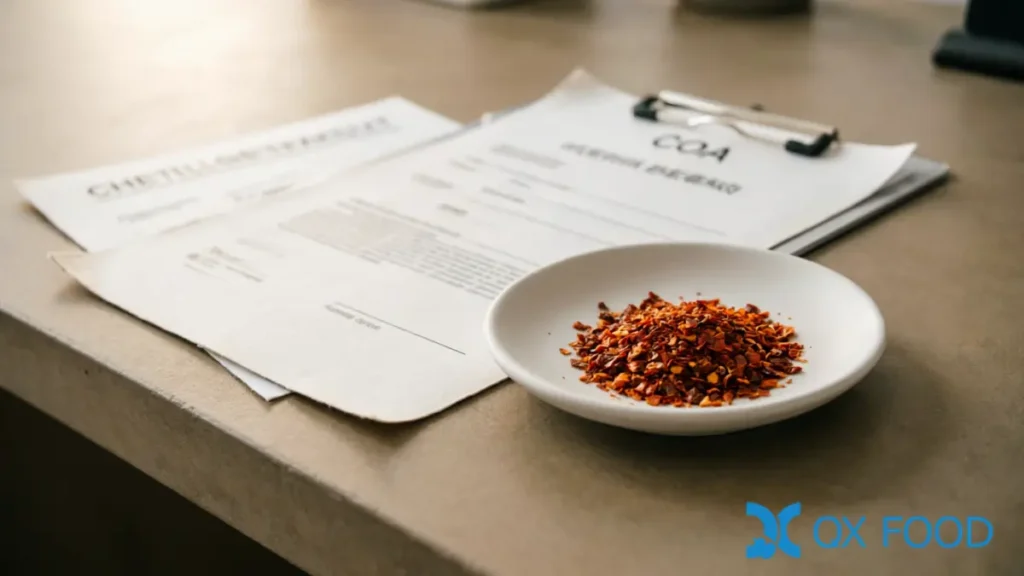
Beyond certificates, the documents that matter operationally are the COA (batch-specific analysis), the phytosanitary certificate (export clearance from the origin country’s inspection authority), and any destination-specific documentation your market requires — FDA prior notice for the US, EU compliance statements for Europe, and so on. A supplier that routinely ships to your region will produce these without drama; one that has never shipped there may discover the requirements after you order, which is when problems happen.
The Sourcing Checklist: From Sampling to Supply Agreement
Industrial chili sourcing follows a recognizable path, and each stage has a clear purpose. Skipping stages is how buyers end up with a container of chili that fails their spec at destination.
Stage 1: Sample Evaluation
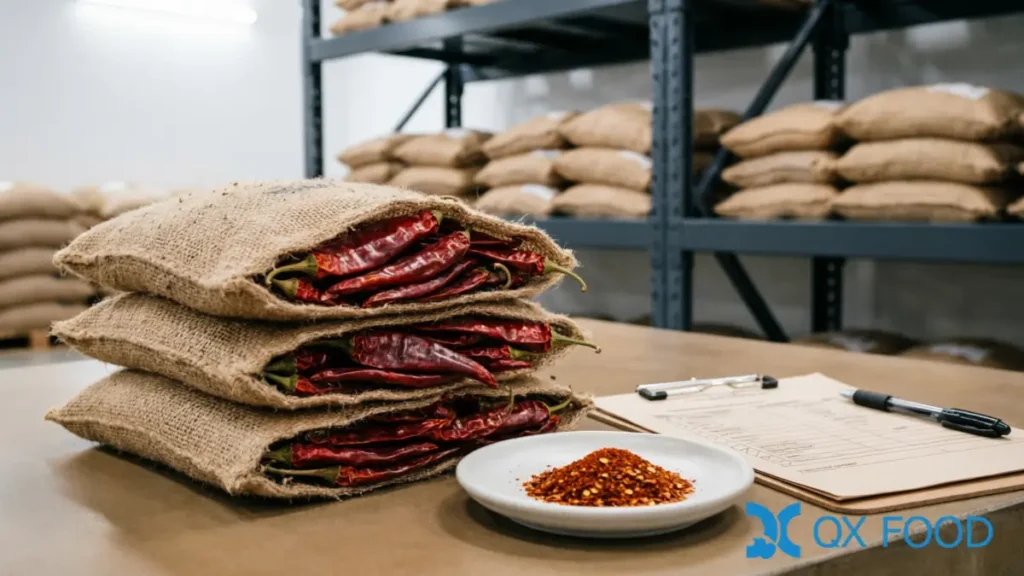
Start with samples — both physical and documentary. Physical samples show color, particle size, aroma, and cleanliness in a way no spec sheet can. Request samples that represent actual production, not hand-picked showpieces, and ask whether the sample matches the current production batch or a future one. Documentary samples mean the full package: draft COA, spec sheet, certificate copies, and a commercial proforma invoice. If the supplier hesitates on any of these, that hesitation is information.
Stage 2: Supplier Qualification
Qualification goes beyond certificates. Ask about the facility’s production capacity per form, its testing capabilities (in-house laboratory vs outsourced), its raw material sourcing (contract growing vs spot market), and its quality history — recall and non-conformance records, if they will share them. If you can, visit the facility or arrange a third-party audit; for volume sourcing, an on-site audit is the difference between trusting documents and verifying reality. Also confirm the facility list: the factory on the certificate should be the factory that produces your product.
Stage 3: Specification Agreement
Agree the full specification in writing before ordering: moisture limit, particle size distribution, ASTA minimum, heat level range with method, foreign matter limit, packaging specification, and labeling requirements. Include the testing protocol — which parameters are tested on every batch, which on a sample basis, and which methods are used. A written specification with agreed test methods is the contract that matters; the commercial contract just prices it.
Stage 4: Pilot and Trial Orders
Run a trial order before committing volume. The trial validates three things the sample cannot: batch-to-batch consistency at production scale, packaging and documentation accuracy for your destination, and the logistics chain from factory to your door. Trial orders are also when you discover whether the supplier’s communication matches its documentation — response times, issue handling, and honesty about problems.
Stage 5: Ongoing Supply Management
Once in regular supply, the relationship runs on verification: check every COA against spec, retain samples from each shipment, and test on arrival at a frequency proportional to your risk tolerance. Track non-conformances and how the supplier responds. Re-qualify annually or when anything changes — new facility, new ownership, new product line. And keep the relationship human: the buyers who get the best supply during a chili shortage are the ones who have been reliable customers and clear communicators during the good years.
Common Sourcing Mistakes and How to Avoid Them
Every experienced chili buyer has a story about a sourcing mistake, and most fall into a few recognizable patterns. Buying on price alone is the classic: the cheapest quote usually reflects the weakest specification, and the difference shows up in yield, color, or compliance costs at your facility. Skipping the sample-to-production verification means discovering that the golden sample does not match the container — always confirm the sample represents current production. Ignoring destination compliance until after ordering turns a routine purchase into a customs incident; confirm documentation capability before you commit. Treating the COA as paperwork — the COA is your quality contract; read every line and verify it against your agreed spec before accepting the shipment. And single-sourcing without a plan: even the best supplier has crop years and capacity constraints, so maintain a qualified backup and revisit your sourcing strategy at least annually.
China and the Future of Chili Sourcing
China’s role in the global chili trade is likely to keep growing for structural reasons: the scale of domestic production, the depth of processing capability, and the export infrastructure built over decades. For B2B buyers, this means Chinese suppliers will remain the default reference point for processed chili forms — and the quality bar they set will keep rising as competition pushes processors toward better testing, more transparent documentation, and more consistent specifications. The suppliers who survive that competition are the ones worth building long relationships with.
For the consumer and category side of sourcing decisions, our global savory flavor trends 2027 guide reviews IFT, WINA and GFI research in one place.
Learn More
This completes the chili sourcing guide series. For further reading:
- Chili Pepper Guide for B2B Food Manufacturers: Varieties, Heat Levels, and Selection — the species, the Scoville scale, and China’s growing regions.
- Chili Processing Guide: Drying Methods, Seven Chili Forms, and Supplier Questions — how processing shapes the chili you buy.
- Browse the full Natural Plant Powders category for the complete QXFOOD chili range in all seven forms.
- For a global perspective on chili production and trade statistics, the Capsicum overview on Wikipedia is a useful reference point.
If you are sourcing chili for a specific application and want to discuss specifications — heat level, particle size, color, certifications, destination market requirements — contact the QXFOOD team with your product profile and target market, and we will work from your application backwards to the right specification.