What Is Pure White Pepper Powder WPP-K44?
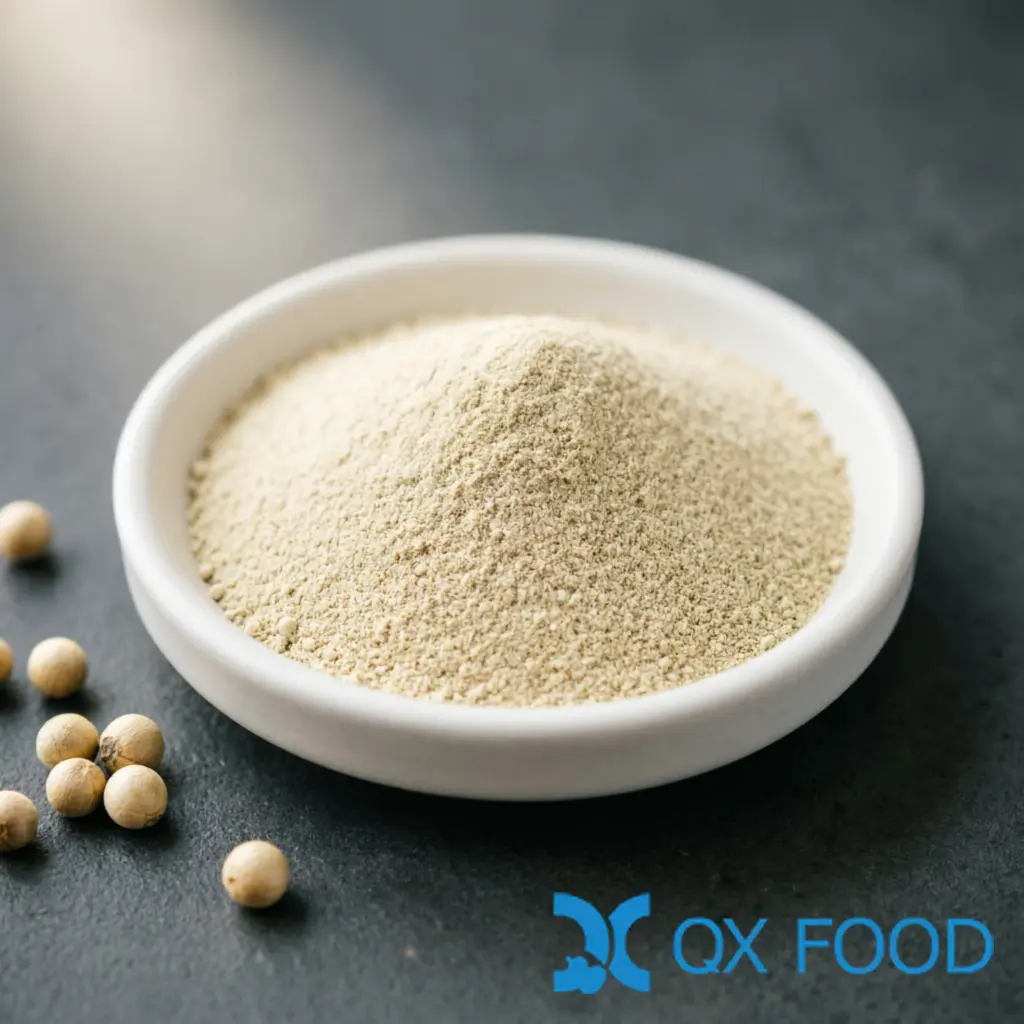
Pure white pepper powder WPP-K44 is made from fully ripe pepper berries that go through a soaking and fermentation step to loosen the outer pericarp, followed by mechanical de-husking to remove the dark skin entirely. The decorticated white seed is then dried, ground and sieved to a fine powder. Nothing else is added — no flow agents, no fillers, no anti-caking silica. What you get is 100% ground white pepper, with the clean, sharp heat and earthy-floral aroma that only de-husked peppercorns produce.
The difference between white pepper powder and pure black pepper powder comes down to the pericarp. Black pepper keeps it; white pepper sheds it. Removing the skin changes the aromatic profile: white pepper loses the piney, citrusy top notes that the outer pericarp carries, and instead develops a deeper, more sustained warmth with earthy undertones and a subtle floral lift. In food manufacturing, the choice between pure white pepper powder and pure black pepper powder is often a visual one — white pepper disappears into a light-colored sauce, soup or sausage emulsion, while black pepper leaves visible dark speckles. But the flavor difference also matters: white pepper’s heat builds more slowly and lingers longer, making it the preferred choice for dishes where a steady, background warmth is wanted rather than an upfront spicy punch.
The moisture spec on pure white pepper powder WPP-K44 runs at 4.03 g/100g against an 8.0 g/100g limit — the same drying discipline that produces a free-flowing black pepper powder also keeps the white pepper powder dry, stable and easy to dose in industrial blending equipment. Total nitrogen reads 1.13 g/100g, reflecting the pepper’s intrinsic protein and alkaloid content — piperine, the pungent alkaloid in both black and white pepper, carries through the de-husking process because it resides primarily in the seed, not the skin. Microbiological loads are well-controlled: aerobic plate count at 90 CFU/g against a 10,000 ceiling, coliforms below detection at the 0.3 MPN/g limit. For a pure white pepper powder going into ready-to-eat products, those numbers give the formulation team room to work.
Specification Data — Standard Grade
| Parameter | Unit | Standard | Measured | Method |
|---|---|---|---|---|
| Moisture | g/100g | ≤8.00 | 4.03 | GB 5009.3 |
| Aerobic Plate Count | CFU/g | ≤10,000 | 90 | GB 4789.2 |
| Coliforms | MPN/g | ≤0.3 | <0.3 | GB 4789.3 |
| Total Nitrogen | g/100g | Standard requirements | 1.13 | GB 5009.5 |
| Sodium Chloride (NaCl) | g/100g | Standard requirements | 9.60 | GB 5009.44 |
| Appearance | — | Fine powder, uniform light cream color | Off-white to pale cream powder | Q/HKSP 0002S |
| Odor & Taste | — | Characteristic warm, earthy, pungent | Compliant | Q/HKSP 0002S |
| Impurities | — | No foreign debris visible | No foreign debris visible | Q/HKSP 0002S |
The measured values are from a representative production batch. Each shipment comes with a batch-specific certificate of analysis. The sodium chloride reading (9.60 g/100g) appears on the standard factory COA for this grade — buyers who need a detailed breakdown of this parameter for formulation or labeling purposes should discuss it with the QA team during the inquiry stage, as it can vary with the pepper lot and the processing conditions applied during de-husking and drying.
White Pepper vs Black Pepper: When the Pericarp Matters
If your production line already runs pure black pepper powder and you are considering adding a white pepper grade, or if you are choosing between the two for a new product, the decision comes down to three practical considerations that go beyond simple taste preference.
First, appearance. Pure white pepper powder blends invisibly into light-colored food matrices — cream sauces, white soups, chicken or fish sausage emulsions, mashed potato products, white sauce bases. There is no speckling, no dark particulate. If your product’s color specification is tight and any visible dark flecks would be flagged as a quality defect, white pepper is the only option. This is why white pepper dominates in certain European sausage traditions, in East Asian clear soups and steamed dishes, and in institutional foodservice where visual consistency across large batches is non-negotiable.
Second, heat profile and aroma. White pepper’s heat comes from piperine in the seed — the same alkaloid that gives black pepper its pungency — but the absence of the pericarp’s volatile oils changes the sensory experience. White pepper builds warmth gradually on the palate rather than delivering an immediate sharp hit. The aroma is earthy, slightly fermented (a result of the soaking step in processing), with a clean floral finish. In a long-cooked dish — a soup stock, a braised meat, a retort-packed ready meal — white pepper’s sustained heat profile integrates more evenly than black pepper’s volatile front-loaded spice. In a short-contact application like a dry seasoning sprinkle, black pepper’s immediate aromatic punch usually wins.
Third, market preference. Some markets default to white pepper for cultural and culinary reasons. In much of East and Southeast Asia, white pepper is the standard table condiment and the default pepper in noodle soups, stir-fried dishes and steamed preparations. In parts of Europe, white pepper is preferred for light-colored sauces and mashed potato products. A buyer supplying multiple markets may need both a pure white pepper powder and a pure black pepper powder in the ingredient inventory — they serve different product lines, not just different recipes within the same line.
How Pure White Pepper Powder Performs in Food Manufacturing
Soups, Sauces and Light-Colored Liquid Systems
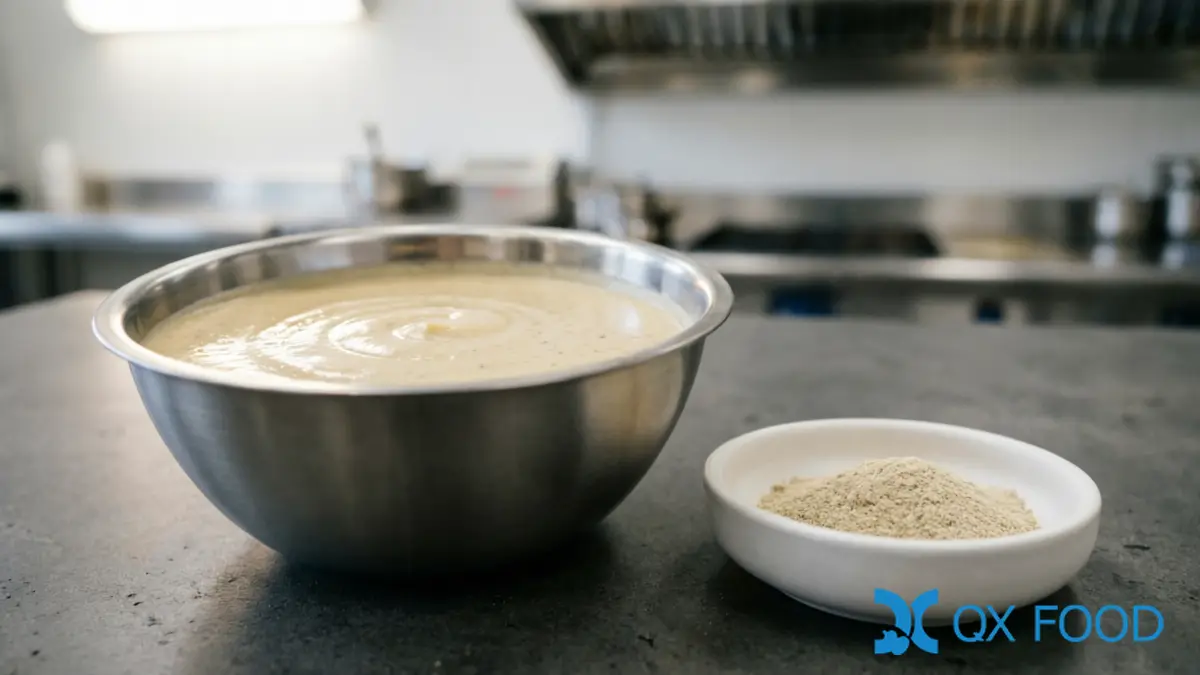
In cream-based soups, b?chamel-style sauces, white wine reductions and clear broths, pure white pepper powder disperses without leaving visible particles. The fine grind of pure white pepper powder means it hydrates almost instantly in warm liquid — no pre-soaking, no bloom time needed. For retort-packed soups and ready-meal sauce sachets, this is a processing advantage: the white pepper powder dissolves into the liquid matrix during the sterilization cycle and distributes evenly without requiring a separate dispersion step. The earthy warmth that white pepper brings to a cream soup or a chicken velout? is the reason chefs and food developers reach for white pepper rather than black in these applications — it provides the savory depth without the visual interruption.
Processed Meat and Sausage Manufacturing
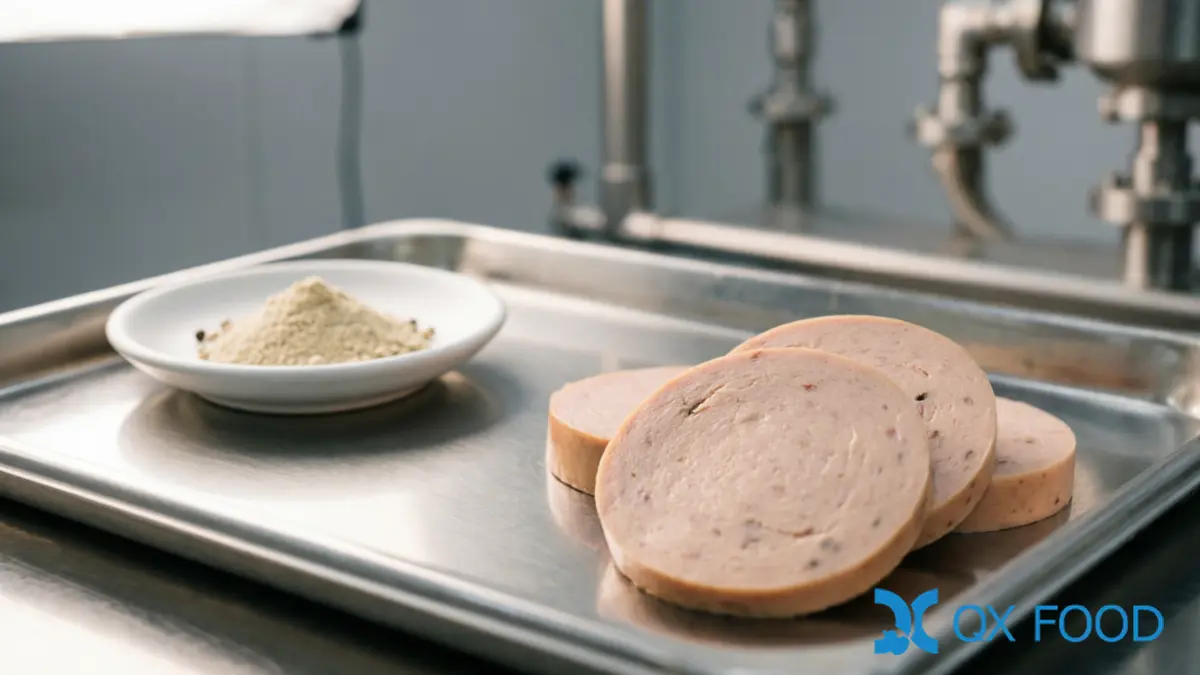
In emulsified sausage products — frankfurters, bologna, chicken sausages, white pudding — pure white pepper powder is the standard choice because it seasons without speckling. A frankfurter with visible black specks reads as a quality defect to consumers in most markets; the same product seasoned with white pepper reads as properly made. The typical dosage for white pepper powder in emulsified sausages is 0.2–0.5% of the meat block. In coarser ground meat products like breakfast sausage patties, white pepper is also used where the target appearance is a uniform pale or light-brown surface with no dark spice particles.
Seasoning Blends and Dry Mixes
Pure white pepper powder appears in commercial seasoning blends where a neutral color is required — cream sauce mixes, white gravy powders, instant mashed potato seasonings, and light-colored dry soup bases. In these applications, the white pepper powder is dry-blended with other powdered ingredients and must remain free-flowing in the mix. The low moisture content (4.03 g/100g) of pure white pepper powder keeps it stable in multi-component dry blends without causing clumping. Formulators usually dose white pepper at 0.5–2% of the total seasoning blend weight, adjusting upward for pepper-forward products and downward when it plays a supporting role alongside garlic, onion and herb powders.
Asian Food Manufacturing and Foodservice
In East and Southeast Asian food production — instant noodle seasoning sachets, frozen dim sum fillings, soup base pastes for hot pot, and ready-to-cook marinated meats — white pepper is often the default pepper choice. It is used more generously than in Western applications: a noodle soup seasoning sachet might carry 3–5% white pepper powder by weight, and a dim sum filling seasoning blend can go higher. The earthy, slightly fermented note that white pepper carries through processing complements the soy-based, fermented bean paste and sesame oil flavor profiles common in these product categories. For buyers supplying the Asian food manufacturing and foodservice sectors, a reliable pure white pepper powder supply is as essential as soy sauce powder or sesame oil in the ingredient portfolio.
Particle Size, Packaging and Shelf Stability
Pure white pepper powder is a natural single-ingredient product. The warm, earthy, slightly floral flavor comes from the de-husked peppercorn itself — there is no flavor addition, no carrier, no processing aid beyond the water used in the soaking step. What can be discussed for your specific production needs is the physical specification: the standard grade is a fine powder, but coarser particle sizes, tighter mesh specifications and custom packaging formats can be evaluated during the sample and pilot stage.
Standard packaging covers the usual order volumes — sample pouches for evaluation, mid-volume cartons for pilot production, and bulk drums or sacks for container loads. Private-label and OEM packaging — branded bags, custom carton sizes, multi-layer barrier packaging for extended shelf life — are available for qualified orders.
Storage: sealed container, cool dry environment, no direct sunlight, away from strong odors. The volatile oils in pure white pepper powder are sensitive to oxygen and light over time, though less so than black pepper because the oil-rich pericarp has been removed. Under proper conditions — sealed bag, below 25°C, humidity below 60% — shelf life is 18 months from production. For high-humidity production environments, nitrogen-flushed or vacuum-sealed packaging can be discussed.
Quality Systems and Documentation
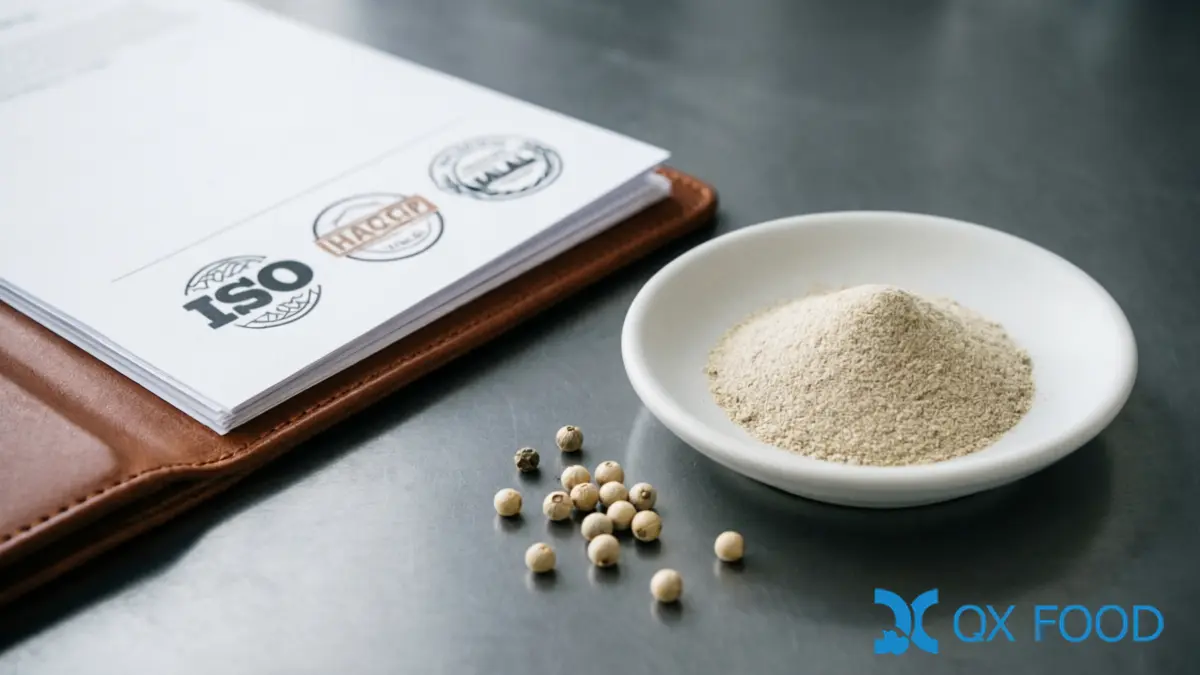
The production facility operates under an integrated quality management system:
- ISO 9001:2015 — quality management system
- ISO 22000:2018 — food safety management system
- HACCP — hazard analysis and critical control points
- HALAL — certified by an accredited halal certification body
Each shipment of pure white pepper powder comes with a batch-specific certificate of analysis covering the parameters listed in the specification table. Additional testing — heavy metals, pesticide residues, piperine content by HPLC, microbiological panels beyond the standard scope — can be arranged on request.
For import clearance, the standard export documentation package includes the commercial invoice, packing list, batch COA, certificate of origin and copies of active certifications. Compliance with Codex Alimentarius guidelines for spices and dried aromatic herbs is maintained across production. Any country-specific requirements should be communicated early so the QA team confirms availability and lead time.
Related reading: Why light-colored powders matter in instant noodle soup bases.
Frequently Asked Questions
What is the difference between pure white pepper powder and pure black pepper powder?
The processing step makes the difference. Pure white pepper powder WPP-K44 is made from fully ripe berries that are soaked and de-husked to remove the dark outer pericarp, then dried and ground. Pure black pepper powder is made from unripe green berries that are dried with the skin on. Removing the skin changes three things: the appearance (white pepper produces no dark specks in food), the aroma (white pepper has an earthy, slightly fermented character rather than black pepper’s piney-citrusy top notes), and the heat curve (white pepper builds warmth more slowly and lingers longer). In food manufacturing, the choice often comes down to whether the product’s visual specification can accept visible dark particles — if not, white pepper is the correct specification.
Does pure white pepper powder WPP-K44 contain any additives or fillers?
No. Pure white pepper powder WPP-K44 is 100% ground de-husked white peppercorns — no silicon dioxide, no maltodextrin, no rice flour, no anti-caking agents. If your ingredient label needs to read “white pepper” alone, this grade delivers that. The moisture content (4.03 g/100g) keeps the powder free-flowing in standard dry-blend operations without chemical flow aids.
Why does the specification table show sodium chloride at 9.60 g/100g?
The sodium chloride reading appears on the factory COA as a standard tested parameter for this grade. Pure white pepper berries do not naturally contain sodium chloride at that level; the value reflects conditions during processing, which can vary with the pepper lot and the water used in the soaking and de-husking stages. If sodium content is important to your formulation or labeling — for example, if you are developing a low-sodium product and need to account for every sodium source — discuss this parameter with the QA team during the inquiry stage. A lot-specific analysis can be provided before the order proceeds.
Is pure white pepper powder suitable for Halal-certified production lines?
Yes. The manufacturing facility holds active Halal certification. Pure white pepper powder is a single-ingredient plant product — pepper berries, soaked to remove the skin, dried and ground — and the production process involves no animal-derived materials, no ethanol, and no fermentation aids that would conflict with Halal requirements. The Halal certificate is renewed on schedule and included in the standard documentation package.
Can I get pure white pepper powder in a specific particle size or mesh specification?
Yes. The standard grade is a fine powder, but coarser grinds and tighter mesh specifications can be discussed at the sample and pilot stage. This is a physical specification adjustment — sieving mesh changes — not a formulation change. If your application requires a specific particle size distribution, reference a sample or provide the target mesh range when you inquire.
How should I store pure white pepper powder to maintain quality between production runs?
Store pure white pepper powder in a sealed container in a cool, dry environment — below 25°C with humidity below 60%. Keep away from direct sunlight and strong odors. The volatile oils in white pepper are less prone to oxidation than black pepper (because the oil-rich pericarp has been removed), but they still degrade over time if exposed to air and light. Opened bags should be re-sealed immediately or the contents transferred to an airtight container with a desiccant pack. Under proper storage, opened stock remains usable within the 18-month shelf life window, but we recommend using opened bags within 60 days for best aromatic quality.
What is the minimum order quantity and how does sampling work?
The standard MOQ for pure white pepper powder is 1 metric ton. For first-time evaluation, a sample from current production stock is provided with a batch COA so your R&D team can test the powder in your specific application. If you need a customized particle size, adjusted mesh specification or custom packaging, those details are confirmed during the sample or pilot stage before commercial production. The sequence — standard sample, pilot run (if customized), commercial order — is the standard approach for new buyers.
Explore Our Natural Spice Powder Range
Pure white pepper powder WPP-K44 belongs to the Natural Plant Powders family. Buyers sourcing multiple spice powders for a seasoning blend or production line often evaluate these grades together:
Cinnamon Powder CP-K38 — pure ground cassia bark for baking, beverage and meat processing.
Turmeric Powder TP-K37 — curcumin 4.5 g/100g, natural color and seasoning base.
Garlic Powder GP-B06 — pure ground garlic for snack seasonings and savory blends.
Onion Powder OP-B03 — spray-dried onion powder for dry seasonings and soups.
For the full category view, visit the Natural Plant Powders category page.