
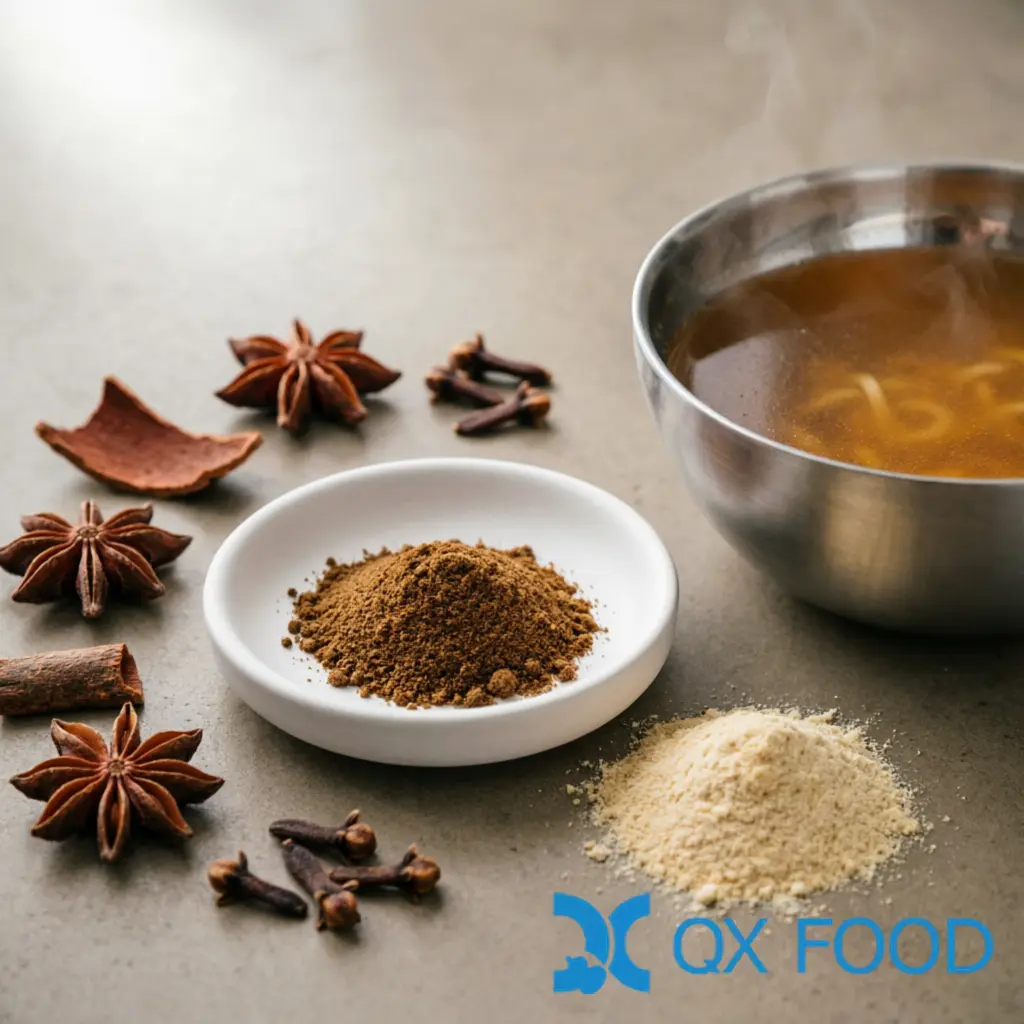
Instant Noodle Seasoning: The Flavor System Behind a Growing Global Market
Instant noodle seasoning is the single most important differentiator in a category worth USD 64.67 billion globally in 2025, projected to reach USD 111.71 billion by 2034 at a CAGR of 6.3% (Fortune Business Insights, 2025). For seasoning manufacturers, noodle factories and private-label brands, the seasoning sachet is where flavor identity is built — and where raw material quality, powder stability and formulation logic decide whether a product wins repeat purchase. This guide breaks down how food manufacturers design instant noodle seasoning systems, which raw materials carry which role, and how to build a soup base that survives production, storage and the consumer’s kettle.
Why Instant Noodle Seasoning Is a Three-Layer Flavor System
Every instant noodle soup base, from a simple chicken sachet to a complex braised beef broth, can be understood as three functional layers. Seasoning manufacturers who structure formulations this way find it easier to control costs, replicate flavor across batches and respond to market trends.
- Umami base layer — the savory foundation built from brewed soy sauce powder, HVP, yeast extract and amino acid systems. This layer delivers the “broth” character that reads as cooked, round and satisfying rather than flat.
- Spice and aromatic layer — garlic powder, ginger, white pepper, star anise, cassia and clove notes that give the product its recognizable cuisine signature, whether Sichuan-style, Japanese-style or Western-style.
- Mouthfeel and finish layer — salt, sugar, fats and flavor enhancers that control perceived richness, heat persistence and aftertaste.
In practice, the umami base layer does the heavy lifting in most instant noodle seasoning formulas, and its raw materials are the ones manufacturers should qualify most carefully.
Brewed Soy Sauce Powder as the Umami Backbone
Brewed soy sauce powder has become a core umami ingredient in instant noodle seasoning because it delivers the fermented, cooked-soy character that liquid soy sauce brings to a kitchen — without the water, the logistics or the labeling complexity. For noodle factories, powder form means precise dosing, no cold-chain storage and consistent batch-to-batch flavor.
Japanese-style brewed soy sauce powder FSP-BH is one example of a spray-dried brewed soy sauce powder designed for food manufacturing: high nitrogen content for umami strength, an ester-rich aroma profile that reads as “brewed” rather than “chemical”, and compatibility with both powder sachets and paste blends. Its role in instant noodle seasoning is to supply the dark, savory, fermented depth that distinguishes a noodle broth from a generic bouillon.
When formulating with brewed soy sauce powder, manufacturers should evaluate four parameters: nitrogen content (as a proxy for fermentation depth), salt carryover (which affects the total sodium budget of the sachet), solubility in cold and hot water, and color contribution to the finished broth. These four factors determine how much soy sauce powder the formula can carry before the broth turns too dark, too salty or too cloudy.
Dehydrated Alliums and Root Spices in Soup Bases
Garlic and ginger are the most widely used allium and root spices in instant noodle seasoning, appearing in nearly every flavor variant from chicken to mala. Dehydrated garlic powder GP-W04 provides the pungent, savory garlic note in a low-moisture form that keeps the sachet stable, while dried ginger DGR-27 contributes the warming pungency that balances rich broths. Both are produced from fresh Shandong raw material with low moisture specifications, which matters for sachet shelf life and anti-caking behavior.
The practical formulation question is particle size. Fine powders (60-120 mesh) disperse instantly in hot water and are ideal for powder sachets; coarser cuts suit paste formats or visible-ingredient positioning. Buyers should confirm the mesh size against their filling equipment, because oversized particles can clog seasoning sachet filling nozzles and undersized powders can dust during high-speed packing.
Whole Spices for Regional Soup Profiles
Regional instant noodle lines — braised beef, spicy Sichuan, Japanese miso-adjacent broths — rely on whole-spice character to differentiate. Whole star anise STA-23 brings the licorice-sweet aromatic note central to braised and five-spice profiles; cassia powder CP-B04 adds the warm, sweet-bark depth of Chinese braising; clove powder CLO-D11 supplies the pungent, numbing-adjacent aromatic that rounds out spice blends.
For seasoning manufacturers, these spices enter the formula either as whole pods in soup-bag formats (where they are brewed out during preparation) or as ground powders blended into the sachet. Ground formats require attention to volatile oil retention: spices ground fresh and blended quickly hold their aroma far better than pre-ground inventory sitting in warehouses. When buying ground spices, request the volatile oil specification and verify it against your formula target.
Formulation Logic: Building a Balanced Instant Noodle Seasoning
A balanced instant noodle seasoning sachet typically follows a structure that seasoning manufacturers can adapt to their target flavor:
| Layer | Typical Components | Function in Soup Base |
|---|---|---|
| Umami base | Brewed soy sauce powder, HVP, yeast extract | Savory depth, broth character |
| Salt system | Salt, potassium chloride blends | Salinity, preservative synergy |
| Sweetness | Sugar, maltodextrin | Balance, mouthfeel |
| Alliums | Garlic powder, onion powder | Savory pungency |
| Root spices | Dried ginger, white pepper | Warming heat |
| Whole-spice notes | Star anise, cassia, clove | Regional identity |
| Enhancers | Disodium inosinate/guanylate (I+G) | Umami amplification |
Dosage discipline matters more than exotic ingredients. A formula with a well-built umami base can carry a shorter spice list and still taste complete; the opposite — spice-heavy, base-weak formulas — tends to taste thin and “seasoned” rather than “cooked.” Start with the umami base, then build spice layers against a sensory benchmark of the target cuisine.
Quality and Stability Considerations for Seasoning Sachets
Instant noodle seasoning sachets face a demanding life: months of ambient storage, temperature swings in transit, and finally hot-water extraction at the consumer stage. Three quality parameters dominate:
- Moisture control — low-moisture raw materials (moisture 4-6% for powders) prevent caking, microbial growth and flavor loss. Every powder component should be verified against its moisture spec on arrival.
- Volatile oil retention — the aroma of ground spices degrades over time. Buy in smaller, fresher lots, and verify volatile oil content on the COA.
- Solubility and dispersion — the seasoning must dissolve without clumping in 90-100°C water within seconds. Test each powder’s cold-water and hot-water dispersion before locking the formula.
Raw material consistency is the foundation of all three. A single batch of off-spec garlic powder or a high-moisture soy sauce powder shipment can force rework across an entire production run. This is why qualified suppliers, documented COAs and stable supply chains matter more in seasoning production than in almost any other food category.
How QXFOOD Supports Instant Noodle Seasoning Production
QXFOOD supplies the raw material matrix for instant noodle seasoning production: brewed soy sauce powder FSP-BH, dehydrated garlic powder GP-W04, dried ginger DGR-27, whole star anise STA-23, cassia powder CP-B04, clove powder CLO-D11 and pure black pepper powder BPP-K45. Each product carries a documented certificate of analysis, ISO9001/ISO22000/HACCP certification and HALAL certification, with MOQ of 1 MT and 1 kg samples for formula evaluation.
For the full category view, visit the Fermented & Brewed Powders category page.
Request samples through the contact form on this page and our application engineers will support formula development against your target profile.
Soup stability work does not stop at formulation. Our guide on flavor stability in instant soups and self-heating foods covers the raw-material side of the same problem, and for the savory depth behind your broth, see how we build a umami base with soy sauce powder, HVP and yeast extract.
Frequently Asked Questions
What is the most important ingredient in instant noodle seasoning?
The umami base layer — typically brewed soy sauce powder, HVP or yeast extract — carries the broth character of the soup. It is the layer that distinguishes a “cooked” broth from a flat bouillon, and the one manufacturers should qualify most carefully.
Why use soy sauce powder instead of liquid soy sauce in seasoning sachets?
Powder form enables precise dosing, eliminates cold-chain logistics, reduces weight and simplifies labeling. Brewed soy sauce powder delivers the same fermented, cooked-soy character in a stable, low-moisture format suited to sachet filling lines.
What mesh size is best for seasoning sachet powders?
Fine powders (60-120 mesh) disperse instantly in hot water and suit powder sachets. Confirm the mesh against filling equipment — oversized particles can clog nozzles, and undersized powders can dust during high-speed packing.
How do manufacturers keep seasoning sachets stable during storage?
Moisture control is the key: low-moisture raw materials (4-6% moisture), sealed packaging and ambient storage away from heat. Volatile oil retention in ground spices also requires fresh lots and verified COA values.
Can instant noodle seasoning be made without MSG?
Yes. A brewed soy sauce powder plus I+G or yeast extract system can deliver strong umami without added MSG. Many clean-label instant noodle lines are built this way, though label claims must be validated against the final formula.
What certifications should instant noodle seasoning suppliers hold?
Look for ISO9001, ISO22000 and HACCP as a baseline, plus HALAL where destination markets require it. Each raw material batch should carry a certificate of analysis covering moisture, microbiology and relevant contaminants.
How much soy sauce powder goes into an instant noodle sachet?
Dosage depends on the flavor target and salt budget, typically in the single-digit to low-double-digit percent range of the sachet formula. Validate with sensory testing against your benchmark, since nitrogen content and salt carryover vary between suppliers.