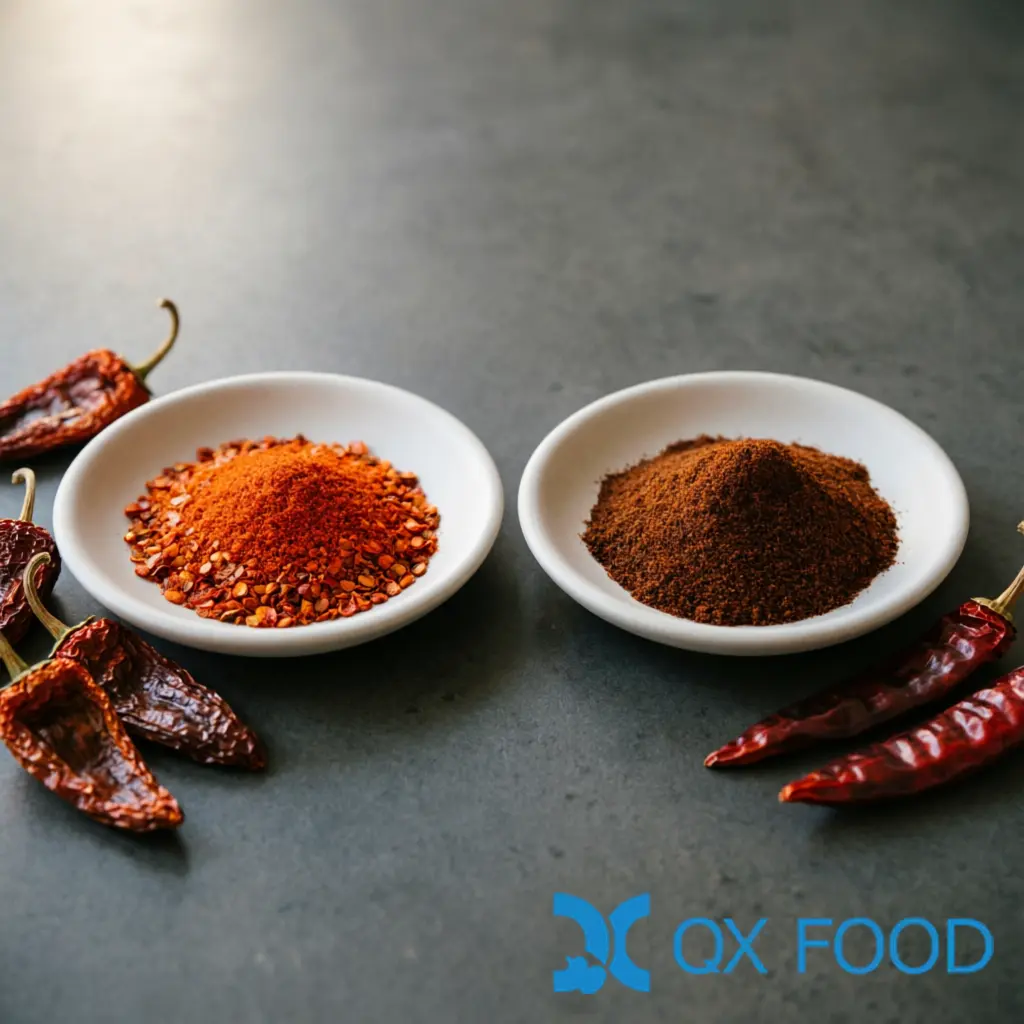
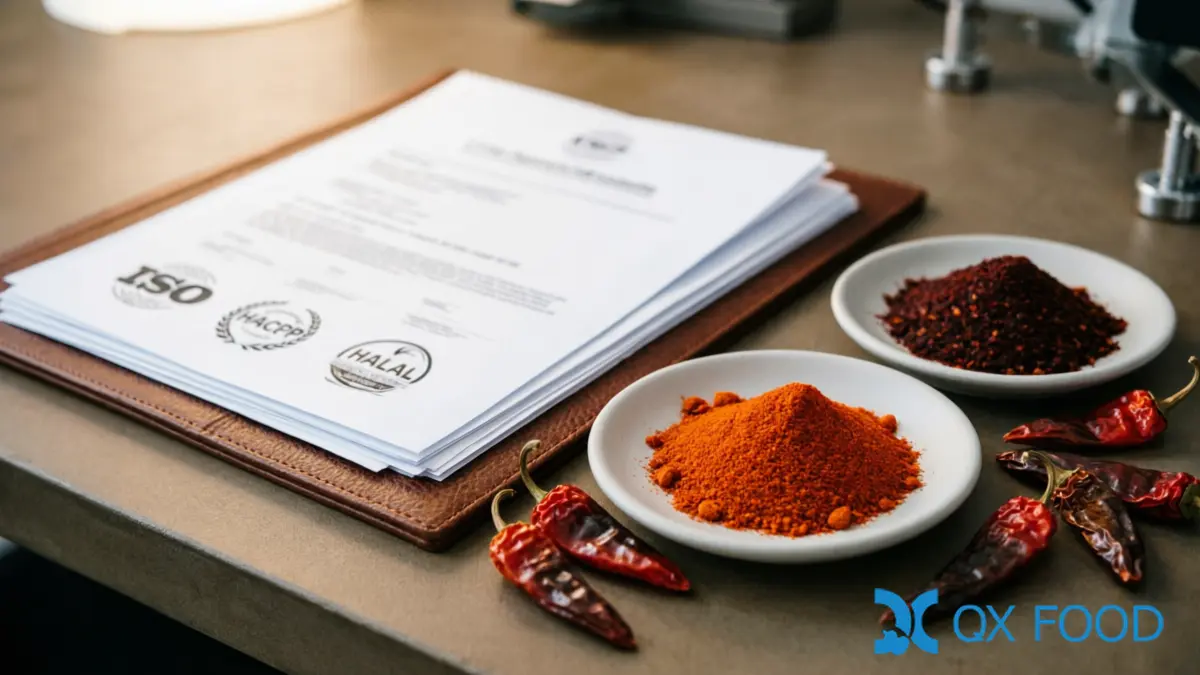
Introduction: Two Red Powders, Two Completely Different Functions
The question of paprika vs chili powder matters whenever a formulation depends on both color and heat. In snack seasoning, meat processing, soup bases and spice blends, the two ingredients may look similar, but they perform different functions. Choosing the wrong grade can change sensory results, color specifications and finished-product consistency.
This guide explains what paprika and chili powder are, how they differ, when to use each, and what to specify when sourcing them for B2B food manufacturing. It also covers the growing role of paprika as a natural food colorant, the functional properties of both spices in food preservation, and how to combine them with other ingredients in a commercial seasoning system.
What Is Paprika?
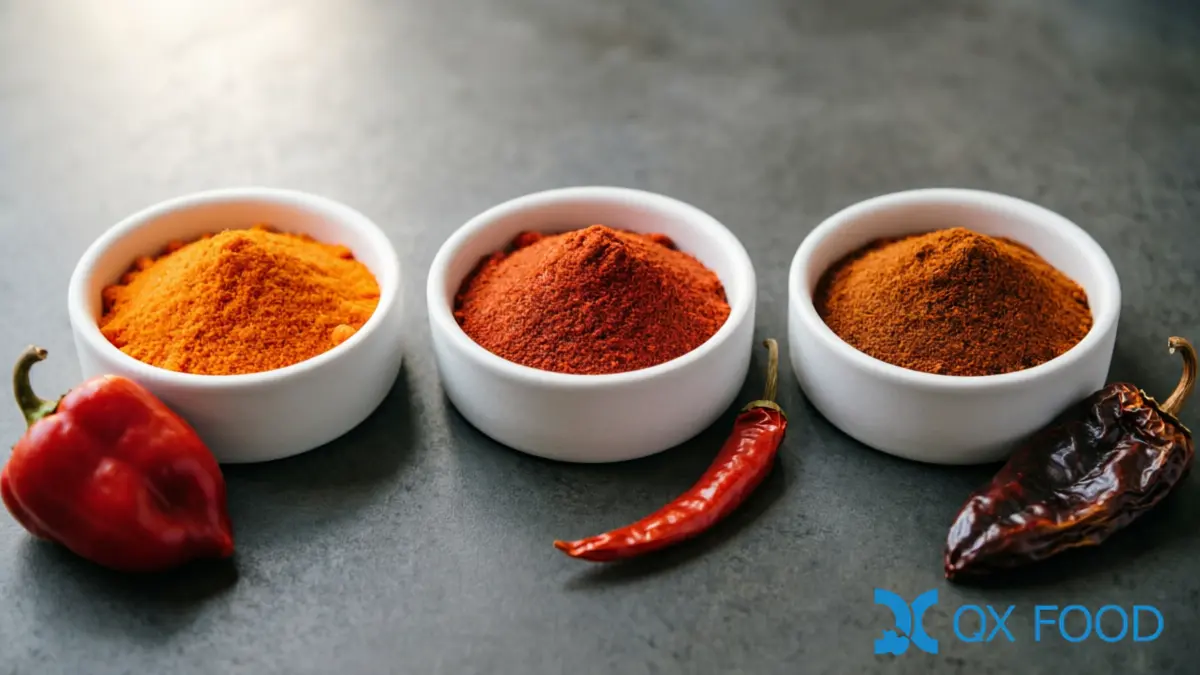
Paprika is a spice made from dried and ground sweet peppers — and in any paprika vs chili powder discussion, this is the starting point that separates the two categories — specifically Capsicum annuum varieties in the Longum group — that are selected for their high carotenoid pigment content rather than for capsaicin-driven heat. The peppers are harvested at full ripeness (deep red), dried through sun-drying, air-drying or low-temperature dehydration, and ground to produce a powder that ranges in color from bright orange to deep brick-red, depending on the pepper variety and the carotenoid concentration.
The word “paprika” comes from Hungarian, and Hungary and Spain are the two countries most closely associated with paprika production — though significant volumes are also produced in China, Peru, and California.
Paprika Varieties
Not all paprika is the same. The variety a buyer selects determines how the ingredient performs:
Type
Heat Level (SHU)
Flavor Profile
Primary Use
Sweet Paprika
0–500
Mild, sweet, no detectable heat
Natural food coloring, seasoning blends, sausage
Hot Paprika
500–5,000
Mild warmth, sweet-spicy
Goulash, spicy sausage, heat + color in one ingredient
Smoked Paprika (Spanish Pimentón)
Varies (dulce to picante)
Deep smoky aroma from oak smoking
Chorizo, paella, BBQ seasonings, products needing smoky character
Paprika Oleoresin
N/A (extract)
Concentrated color, minimal flavor
Maximum color intensity per gram, standardized ASTA value
Sweet paprika — the type most commonly used in B2B food manufacturing — has a Scoville rating of effectively zero. It delivers no heat whatsoever. Its function is purely visual and mildly aromatic: it provides a warm red-orange color that consumers recognize and a gentle sweet-pepper background note that supports other ingredients.
Paprika as a Natural Food Colorant
The commercial significance of paprika has grown substantially in recent years because of its role as a clean-label natural colorant. The carotenoid compounds in paprika — primarily capsanthin, capsorubin, and beta-carotene — produce shades from bright orange to deep red, covering much of the spectrum that food manufacturers traditionally achieved with synthetic dyes like Red 40 (Allura Red, E129) and Yellow 6 (Sunset Yellow, E110).
This matters because regulation is tightening. In April 2025, the FDA announced a voluntary initiative to phase out petroleum-based synthetic food dyes from the US food supply — a decision that affects thousands of processed food products. The EU has long approved paprika extract (E160c) as a food color. The global natural food coloring market is projected to grow at approximately 8.45% annually through 2033.
For a food manufacturer reformulating a product to replace synthetic red dye, paprika — in ground spice form or as oleoresin extract — is one of the most accessible and cost-effective natural alternatives. It appears on the ingredient label as “paprika,” “paprika extract,” or simply “spice” — all of which consumers recognize as food ingredients rather than chemical additives.
Related QX Product: Paprika PP-C13 — 100% sun-dried sweet pepper, granular, no additives.
What Is Chili Powder?
Chili powder is a broader category — and the paprika vs chili powder confusion usually starts here, because buyers sometimes assume both are just ‘ground red pepper’ term that can mean two different things depending on context:
Single-species ground chili pepper — Dried hot peppers (Capsicum annuum, Capsicum frutescens, or other species) that are ground into powder. The heat comes from capsaicin, the alkaloid compound concentrated in the pepper’s placental tissue. Common examples include cayenne pepper, ancho chili powder, and chipotle powder.
Chili powder blend — A mixed seasoning that combines ground chili pepper with cumin, garlic powder, oregano, salt, and sometimes paprika. This is the “chili powder” sold in American supermarkets for making chili con carne. It is a compound seasoning, not a single spice.
In B2B food manufacturing, the single-species form is what buyers specify. The heat level is measured in Scoville Heat Units (SHU), which quantifies capsaicin concentration:
Heat Category
SHU Range
Common Uses
Mild
1,000–5,000
General-purpose seasoning, snack dusting
Medium
5,000–20,000
Hot snacks, spicy sauces, sausage
Hot
20,000–50,000
Hot sauce base, spicy marinades
Extra Hot
50,000+
Specialty hot products, capsaicin extract
Unlike paprika, chili powder’s primary function is sensory: it delivers heat. It may also contribute a red-brown color, but the color is less intense and less stable than paprika’s — hot pepper varieties are typically not bred for carotenoid concentration, and the pigment degrades more quickly during storage.
Paprika vs Chili Powder: Side-by-Side Comparison
Dimension
Paprika
Chili Powder
Botanical Source
Sweet bell peppers (Capsicum annuum Longum group), selected for color content
Hot pepper varieties (Capsicum annuum, C. frutescens), selected for capsaicin content
Heat Level
0–500 SHU (sweet paprika = 0)
1,000–50,000+ SHU depending on variety
Primary Function
Visual: natural red-orange coloring
Sensory: pungent heat
Secondary Function
Mild sweet-pepper flavor, antioxidant activity through carotenoids
Red-brown color (less stable), antimicrobial activity through capsaicin
Key Active Compound
Capsanthin, capsorubin (carotenoid pigments)
Capsaicin (alkaloid)
Color Stability
Moderate — fades with light and oxygen exposure
Lower — degrades faster than paprika carotenoids
Oil Solubility
Carotenoids are oil-soluble; best performance in fat-based systems
Capsaicin is soluble in both oil and alcohol
Label Declaration
“Paprika,” “Paprika extract,” or “Spice”
“Chili pepper,” “Chili powder,” or “Spice”
ASTA Color Value
Relevant — buyers specify minimum ASTA for color strength
Less relevant — heat (SHU) is the primary spec
Typical Dosage
0.5–2% of formulation for color; lower for flavor alone
0.1–1% depending on target heat level
Regulatory Status
EU E160c approved as food color
Not regulated as a color additive
Can You Substitute Paprika for Chili Powder — or Vice Versa?
No. They are not interchangeable at any dosage.
Substituting chili powder for paprika in a product where red-orange color is the specification — and where heat is not wanted — will produce a product that is both the wrong color and unacceptably spicy. A cheese snack dusted with chili powder instead of paprika will burn the consumer’s mouth. A sausage that should be mild and red will be hot and brown.
Substituting paprika for chili powder in a product where heat is the specification will produce a product that looks right — good red color — but has no heat at all. The consumer expects spiciness and gets none. The product fails.
The only scenario where substitution is partially workable is when a formulator wants both heat and color in the same ingredient, and chooses hot paprika — which provides moderate heat (500–5,000 SHU) alongside the red carotenoid color. But even then, the heat level of hot paprika is unlikely to match the intensity of a dedicated chili powder at the same dosage, and the formulator will need to calibrate.
Paprika as a Functional Ingredient: Beyond Color
While paprika’s primary B2B value is as a natural colorant, it also contributes functional properties that formulators can factor into product design:
Antioxidant Activity: The carotenoids in paprika — particularly capsanthin and beta-carotene — are effective free-radical scavengers. In meat products, paprika at 0.5–1% slows lipid oxidation during storage, as measured by TBARS (thiobarbituric acid reactive substances). The result: a seasoned meat product may retain acceptable sensory quality for longer than an unseasoned control.
Antimicrobial Contribution: Capsaicin — present in hot paprika but absent from sweet paprika — has documented antimicrobial activity against a range of foodborne pathogens. Research published in Frontiers in Microbiology (2016) reviewed the potential of spice-derived compounds as food preservatives and identified capsaicin as one of the more promising candidates. However, the effect at food-use concentrations is modest — capsaicin is a supporting hurdle in a multi-barrier preservation strategy, not a standalone preservative.
Nutritional Contribution: Paprika is rich in vitamin A precursors (carotenoids) and contains measurable amounts of vitamin E and vitamin C in the raw pepper. Processing reduces the heat-sensitive vitamin C content, but the carotenoids survive drying and grinding. For products making a nutritional claim around vitamin A content, paprika’s contribution can be quantified.
Blending Paprika and Chili Powder in Commercial Seasoning Systems
In practice, most food manufacturers use paprika and chili powder together in formulations where both color and heat are needed. Neither ingredient alone delivers the full specification:
Paprika provides the visual appeal — the warm red-orange hue that consumers associate with barbecue, cheese, and “red” snack flavors.
Chili powder provides the sensory kick — the pungent heat that satisfies the consumer’s expectation for a spicy product.
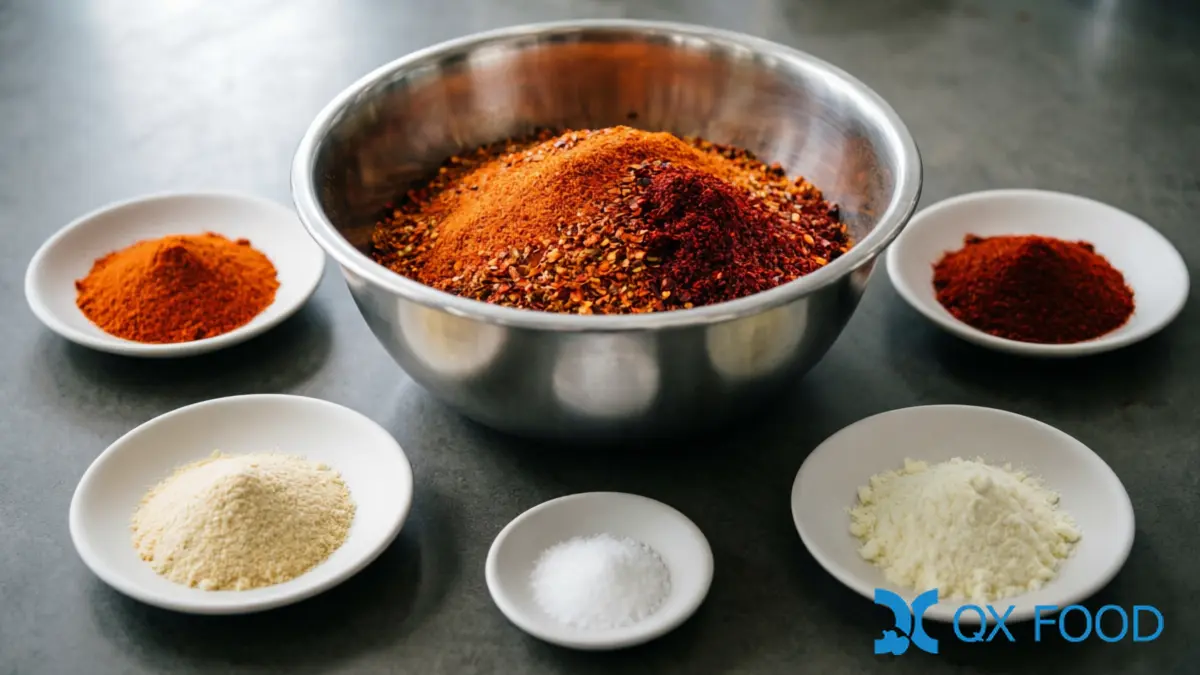
A typical “hot BBQ” seasoning blend might contain 15–25% paprika (for color), 5–10% chili powder (for heat), plus garlic powder, onion powder, salt, sugar, and smoke flavor. The two pepper-based ingredients serve complementary functions, and the blend would be incomplete without either of them.
B2B Buyer’s Guide: How to Specify Paprika and Chili Powder in an RFQ
Specifying Paprika
When issuing an RFQ for paprika, include these parameters:
ASTA Color Value — The standard industry measure of paprika’s coloring power. Sweet paprika typically ranges from 60–180 ASTA units; paprika oleoresin can reach 20,000–180,000 ASTA units. Specify a minimum ASTA value if color intensity is critical to your application.
Heat Level (SHU) — Even sweet paprika can carry trace capsaicin. Specify “0 SHU” or “<100 SHU” if your product cannot tolerate any detectable heat. For hot paprika, specify the target SHU range.
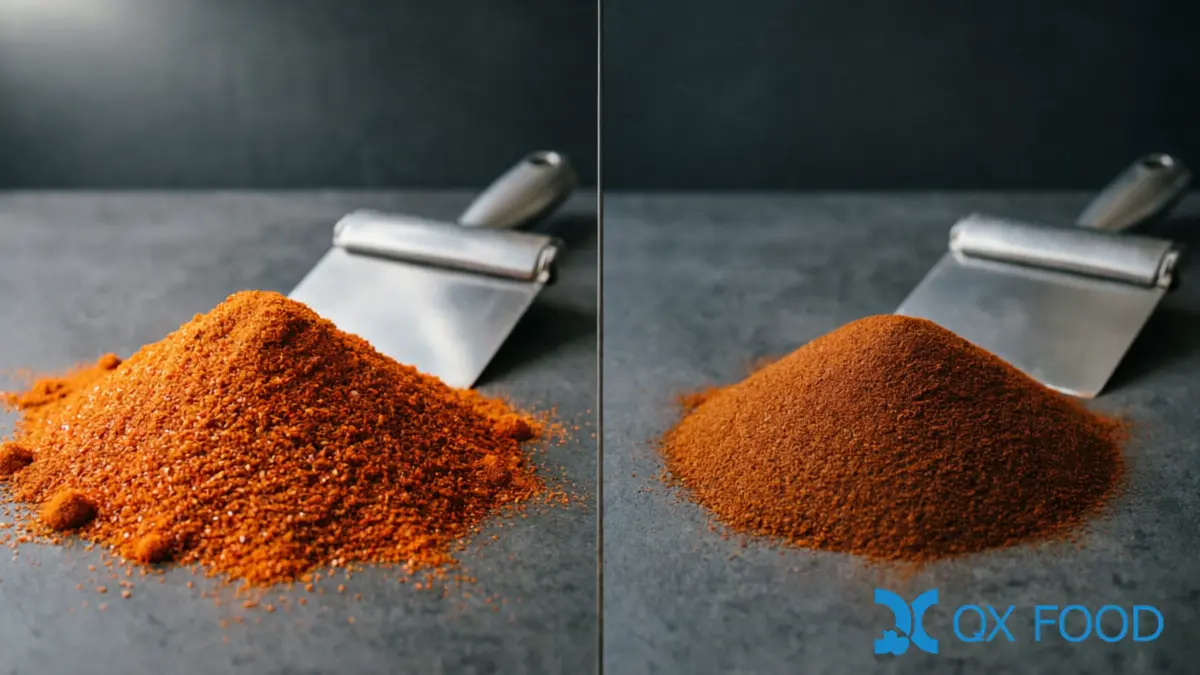
Particle Size — Granular (visible particles), fine powder (rapid dispersion), or specific mesh specification.
Microbiological Specification — Standard APC, coliform, Salmonella, and yeast/mold limits. Request a recent batch COA.
Processing Method — Sun-dried, air-dried, or mechanically dehydrated. Processing affects both color retention and flavor profile.
Certifications Required — ISO 22000, HACCP, HALAL, organic (if applicable).
Specifying Chili Powder
SHU Range — The most critical parameter. Specify a range (e.g., 8,000–12,000 SHU) rather than a single point value. Request a recent HPLC capsaicin analysis.
Pepper Variety — Cayenne, ancho, chipotle, or a custom blend? The variety determines both the heat character (sharp vs. slow-building) and the flavor profile.
Color Specification — If color matters, specify minimum ASTA. Hot pepper varieties typically have lower ASTA values than paprika.
Particle Size and Moisture — Same as for paprika; fine powder with moisture below 8% is standard.
Adulteration Testing — Chili powder is one of the more commonly adulterated spices in international trade. Request testing for Sudan dyes, foreign starch, and added bulk fillers if sourcing from unfamiliar suppliers.
Choosing between paprika and chili usually happens inside a snack project: our chili pepper varieties guide covers the heat ladder, and the snack seasoning guide shows where each powder performs on the line.
Yes. Sweet paprika is made from sweet bell pepper varieties — the same species as the bell peppers sold fresh in supermarkets. The peppers are harvested when fully ripe (red, not green) and dried before grinding. Hot paprika is made from pepper varieties that carry some capsaicin but are still classified as Capsicum annuum rather than the hotter Capsicum frutescens or Capsicum chinense species.
Is paprika spicy?
Sweet paprika has a Scoville rating of 0–500 SHU — below the sensory detection threshold for most people. It is not spicy. Hot paprika ranges from 500–5,000 SHU, providing mild to moderate warmth. If you need zero detectable heat, specify sweet paprika with a confirmed SHU of less than 100.
Can I use paprika instead of chili powder for color without adding heat?
Yes — this is paprika’s primary function in food manufacturing. Sweet paprika provides natural red-orange color from carotenoid pigments — this is the answer to the most common paprika vs chili powder question: can I get red color without adding heat? with no capsaicin-driven heat. This is why paprika appears in products like processed cheese, snack seasonings, and sausage casings where red color is desired but spiciness is not.
What is the difference between Hungarian and Spanish paprika?
Hungarian paprika is typically sweeter and milder, made from peppers that are dried and ground without smoking. It is the paprika most commonly used in central European cuisine — goulash, paprikash, and stews. Spanish paprika (pimentón) is often — but not always — smoked over oak fires, giving it a distinctive smoky aroma. Spanish paprika ranges from dulce (sweet) to agridulce (bittersweet) to picante (hot). Both are Capsicum annuum products; the difference is in the pepper variety, the drying method, and the regional tradition.
Does paprika have health benefits?
Paprika is rich in carotenoid compounds — primarily capsanthin, capsorubin, and beta-carotene — which function as antioxidants in the body. It is also a source of vitamin A (from the carotenoids) and contains small amounts of vitamin E and iron. The antioxidant activity of paprika carotenoids has been documented in food systems — particularly in meat products where paprika slows lipid oxidation during storage — as well as in human dietary studies.
How should I store paprika and chili powder in a manufacturing environment?
Both spices should be stored in sealed, opaque containers in a cool, dry place — below 25°C with humidity below 60%. Paprika’s carotenoid pigments are more sensitive to light and oxygen than chili powder’s capsaicin; paprika will fade from bright red-orange to dull brown under prolonged light exposure, while chili powder will lose heat intensity more slowly. Opened bags should be re-sealed immediately after use. Under proper storage, shelf life is 12–18 months for both products.
What is the global market outlook for paprika and chili powder?
Both markets are growing, but for different reasons. Paprika demand is driven by the clean-label trend and the regulatory phase-out of synthetic food dyes — manufacturers reformulating products with natural colors are increasingly specifying paprika and paprika oleoresin. Chili powder demand is driven by the globalization of spicy food culture — the growth of hot snacks, spicy sauces, and pepper-forward menu items across North America, Europe, and Asia-Pacific. The B2B spice market overall is projected to grow at 4–6% annually through 2030.
Conclusion: Paprika Colors, Chili Powder Heats — Knowing the Difference Protects Your Product
The distinction between paprika and chili powder is not a matter of culinary trivia — this paprika vs chili powder guide exists because getting it wrong costs real money. In food manufacturing, confusing the two produces products that fail — wrong color, unexpected heat, consumer complaints, and wasted production batches. The formulator who understands the paprika vs chili powder distinction that paprika is a colorant first and a flavor ingredient second, while chili powder is a heat-delivery system first and a color contributor only incidentally, can design seasoning systems that deliver precisely the sensory experience the product specification demands.
For manufacturers looking to replace synthetic red dyes with a clean-label…a decision this paprika vs chili powder guide supports by documenting paprika’s colorant properties natural alternative, paprika — in ground form or as oleoresin — is the most accessible starting point. For manufacturers developing heat-forward products, chili powder is the core ingredient, and paprika can be added alongside it to provide the red-orange visual cue that consumers associate with spicy food.
Need technical specifications, samples, or a quote?Contact our B2B sales team — we provide batch-specific COAs, ASTA color values, SHU verification, and full certification documentation for all paprika and chili powder grades.
Disclaimer: This article is for informational purposes for B2B food manufacturing professionals. Specific product claims should be verified against batch-specific certificates of analysis. Regulatory requirements vary by market; consult local food safety authorities for applicable standards.
We use necessary cookies to make our website work. With your consent, we may also use analytics cookies to improve website performance and marketing cookies to measure advertising and support remarketing.