
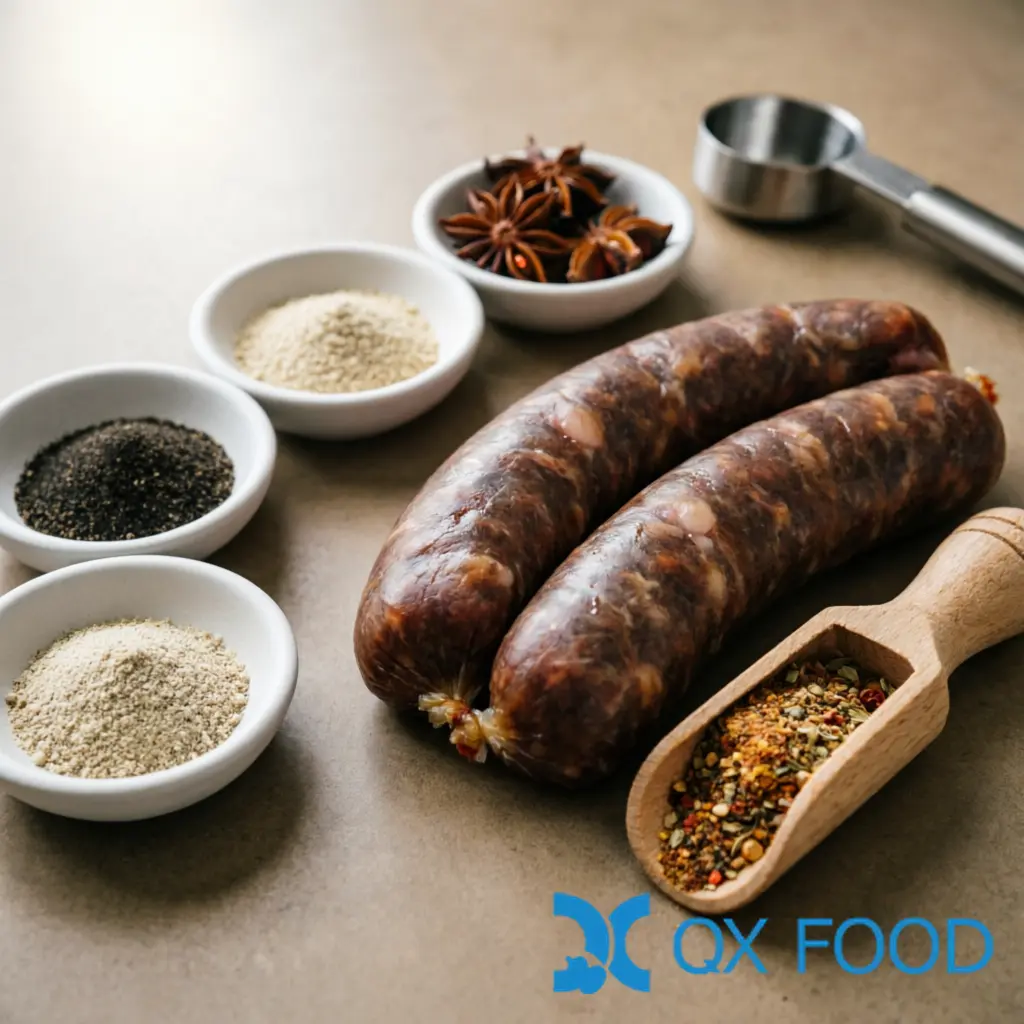
Meat Seasoning for Sausage and Processed Meat: A Manufacturer’s Formulation Guide
Meat seasoning is the primary differentiator in a processed meat market valued at USD 707.98 billion in 2025 and projected to reach USD 1.25 trillion by 2034 (Fortune Business Insights, 2025). The antimicrobial and quality role of natural marinade ingredients is documented in a 2023 review in Foods (MDPI); the meat seasonings category itself is growing from USD 5.6 billion in 2025 toward USD 11.7 billion by 2036 at a 6.9% CAGR (Future Market Insights, 2025). For sausage plants, ham producers and meat-processing facilities, the seasoning system determines not just flavor but yield, color stability, shelf life and batch consistency. This guide covers the functional roles of meat seasoning ingredients, formulation logic by product type, and the raw material parameters that matter at production scale.
The Four Functional Roles of Meat Seasoning
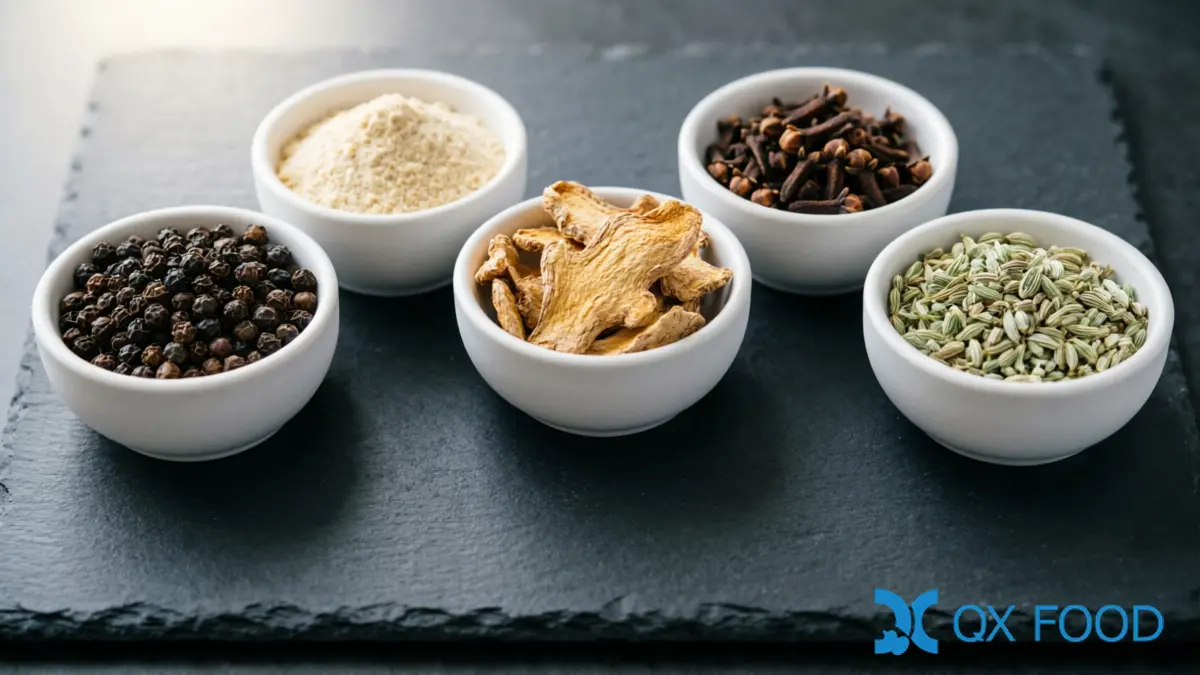
Industrial meat seasoning is not a single flavor layer — it is a system with four distinct jobs, and a balanced formula covers all four:
- Deodorizing — masking and transforming the raw meaty and fatty notes. Ginger, garlic and pepper are the workhorses; dried ginger DGR-27 and dehydrated garlic powder GP-W04 cover this role in most Western and Chinese formulas.
- Flavoring — the recognizable product identity. Black pepper defines breakfast sausage, fennel defines Italian, star anise and cassia define Chinese-style processed meat. pure black pepper powder BPP-K45 and pure white pepper powder WPP-K44 are the two most widely used meat seasoning anchors in the world.
- Preserving synergy — salt and spice systems work together to control water activity and microbial load. Clove’s eugenol content and pepper’s piperine contribute measurable antimicrobial activity, which is why traditional meat seasoning blends repeat the same spice core across cultures.
- Color and texture contribution — paprika and chili contribute red color to emulsion products, while spice fiber content influences bite and mouthfeel in cooked sausages.
Meat Seasoning Formulation by Product Type
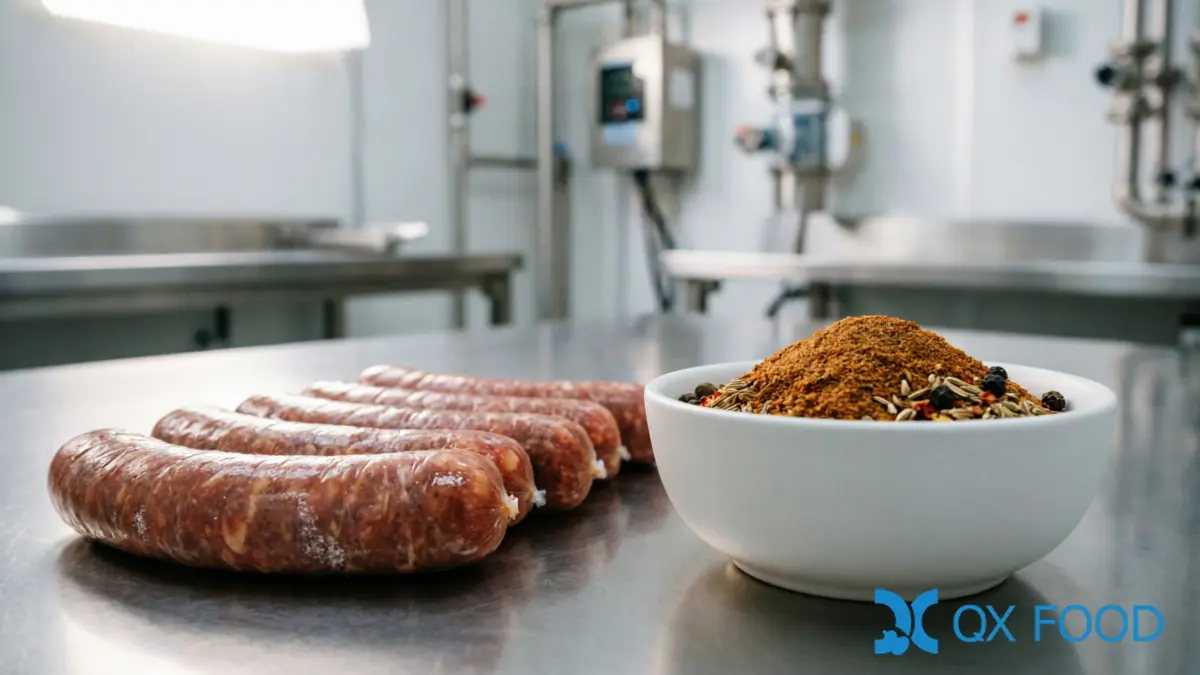
The same raw material library produces very different meat seasoning systems depending on the product. Formulation logic follows the processing step and the target flavor:
| Product | Seasoning Core | Processing Notes |
|---|---|---|
| Breakfast sausage | Black pepper, sage, garlic, sugar | Coarse grind, short cook, pepper-forward |
| Italian sausage | Fennel, black pepper, garlic, oregano | Fennel seed size visible in cut surface |
| Chinese lap cheong | Star anise, cassia, cloves, white pepper, ginger | Air-dried, low water activity, spice maceration in wine |
| Frankfurter/bologna | White pepper, nutmeg, garlic, onion | Fine emulsion, white pepper avoids dark specks |
| Ham injection | Garlic, onion, pepper, cure salts | Injection brine carries seasoning into muscle |
| Meatballs | White pepper, ginger, garlic, onion | Seasoning blended into mass, heat set during cooking |
Whole star anise STA-23, cassia powder CP-B04 and clove powder CLO-D11 anchor the Chinese processed-meat family, while white pepper WPP-K44 and black pepper BPP-K45 dominate Western emulsion lines. A meat seasoning supplier that carries both families lets one plant diversify without requalifying vendors.
Whole Spice vs. Ground Powder in Meat Processing
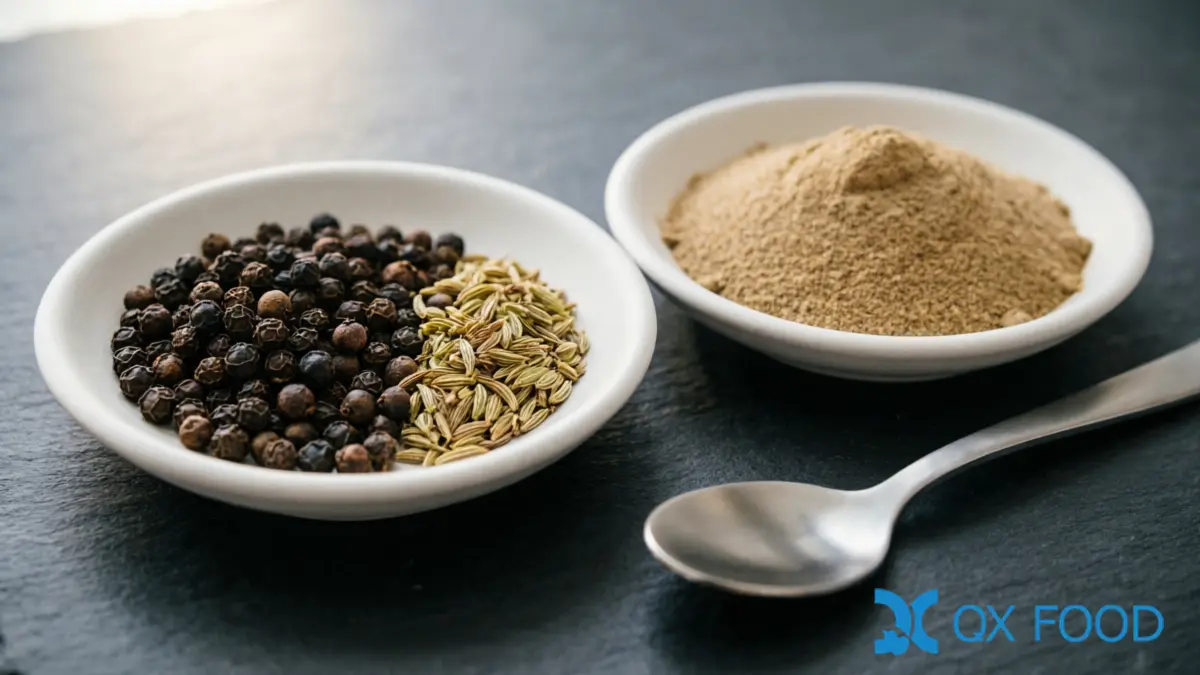
The format decision in meat seasoning has production consequences beyond flavor:
- Ground powders disperse evenly through emulsion and mass products, dose precisely on automated lines, and are the standard for bratwurst, bologna and meatball seasoning. Mesh matters: 40-60 mesh suits coarse-ground sausage, 80-120 mesh suits fine emulsions where specks would be visible.
- Whole spices appear in visible-ingredient positioning (fennel seed in Italian sausage, peppercorn in coarse sausage) and in long-maceration processes like lap cheong, where whole spice releases flavor during drying.
- Coarse cuts sit between — visible but evenly distributed, used in artisan-style lines.
For ground meat seasoning, grind freshness is the hidden quality parameter. Ground pepper and garlic lose volatile compounds from the moment of milling; a supplier that grinds to order and ships sealed lots protects the flavor budget that a warehouse-ground lot quietly destroys.
Yield, Cure and Salt Systems in Meat Seasoning
Meat seasoning works alongside the brine and cure system, not independently. Three interactions define the total formula:
- Salt and water activity — salt carries the seasoning flavor into the meat matrix and controls water activity; the seasoning blend must be balanced against the salt level or the product tastes flat or harsh.
- Cure color stability — nitrite-based cure systems set the pink color of ham and frankfurters; spices high in reducing compounds support color stability, while overcooked or stale spice lots can dull it.
- Injection and tumbling — in injected products, particle size must be fine enough to pass injector needles; oversized pepper or garlic granules clog nozzles and cause uneven seasoning distribution.
This is why meat seasoning specifications should state mesh range, moisture and microbial limits together — they interact with the processing line, not just the flavor profile.

Verifying Meat Seasoning Quality at Inbound Inspection
When a meat seasoning raw material arrives, four checks protect the production run:
- Moisture — above-spec moisture in garlic or onion powder introduces water into the blend and shortens shelf life; verify against the COA.
- Volatile oil — for pepper, ginger and clove, volatile oil content predicts aroma delivery in the cooked product; compare against the agreed floor.
- Microbiology — processed meat is a low-water-activity environment, but spices can carry spore-forming bacteria; review the COA microbiology section and re-test high-risk lots.
- Mesh verification — confirm the actual particle distribution matches the spec, especially for injection-grade seasoning.
QXFOOD’s meat seasoning line — black pepper BPP-K45, white pepper WPP-K44, garlic GP-W04, ginger DGR-27, clove CLO-D11, fennel FP-B01, star anise STA-23 and cassia CP-B04 — ships with COA data for all four checks, plus ISO9001, ISO22000, HACCP and HALAL certification, with 1 kg samples for formula evaluation.
For the full category view, visit the Raw Spices & Herbs category page.
Request meat seasoning samples through the contact form on this page and our application team will support formulation against your product line.
Buyers who dig deeper usually read two companion pieces: the standardized spice procurement guide for the five-checkpoint sourcing method, and the braised meat spice pack guide for how the same whole spices behave in long-simmer applications.
Frequently Asked Questions
What are the essential spices in meat seasoning?
The universal core is pepper (black or white), garlic and ginger. Product families then add their signature: fennel for Italian sausage, star anise and cassia for Chinese-style processed meat, clove and nutmeg for frankfurters. A balanced meat seasoning covers deodorizing, flavoring, preservation and color roles.
White pepper or black pepper for meat products?
White pepper is preferred in fine emulsions like frankfurters and bologna because it adds heat without dark specks in the cut surface. Black pepper suits coarse and pepper-forward products like breakfast sausage, where visible specks are expected and desired.
Why does meat seasoning lose flavor during processing?
Volatile compounds evaporate and oxidize during chopping, heating and smoking. Using fresh-ground spices with verified volatile oil content, adding a portion of the seasoning late in the process, and protecting powders from moisture all slow the loss.
What mesh size should meat seasoning powders be?
40-60 mesh suits coarse-ground and dry-cured sausage; 80-120 mesh suits fine emulsions and injection brines. Injection-grade seasoning must be fine enough to pass needles without clogging. Confirm mesh on the COA and at inbound inspection.
Can spices help preserve processed meat?
Spices support preservation through antimicrobial compounds — clove eugenol and pepper piperine contribute measurable activity — but they work in synergy with salt, nitrite and water-activity control. Spice quality supports the preservation system; it does not replace it.
What certifications should a meat seasoning supplier hold?
Baseline: ISO9001, ISO22000 and HACCP. Add HALAL or KOSHER where destination markets require. Each lot should carry a COA covering moisture, volatile oil, mesh and microbiology relevant to meat processing.
How do I keep seasoning flavor consistent across batches?
Compare COA values across consecutive lots — moisture, volatile oil and mesh drift predict flavor drift. Buy from suppliers who grind to order, store under controlled conditions and can trace each lot to harvest region and processing date.