
Spice Procurement for Food Manufacturers: A Standardized Quality and Supplier Guide
Spice procurement is a cost-protection function in a global spices and seasonings market worth around USD 24.0 billion in 2024 and projected to reach USD 39.5 billion by 2034 at a 5.1% CAGR (Market.us, 2024). For seasoning manufacturers, snack producers, meat processors and sauce plants, the raw spice purchase decides more than cost: it decides whether the finished product tastes the same in January as it did in June. This guide standardizes spice procurement into five checkpoints — specification, COA verification, supplier qualification, inbound inspection and batch continuity — with the parameters that matter at each step.
Checkpoint One: Write the Specification Before You Shop
Every successful spice procurement relationship starts with a written specification, not a price discussion. A proper spice spec covers six parameter groups:
- Identity — botanical name, product form (whole, cracked, ground), origin region, harvest season.
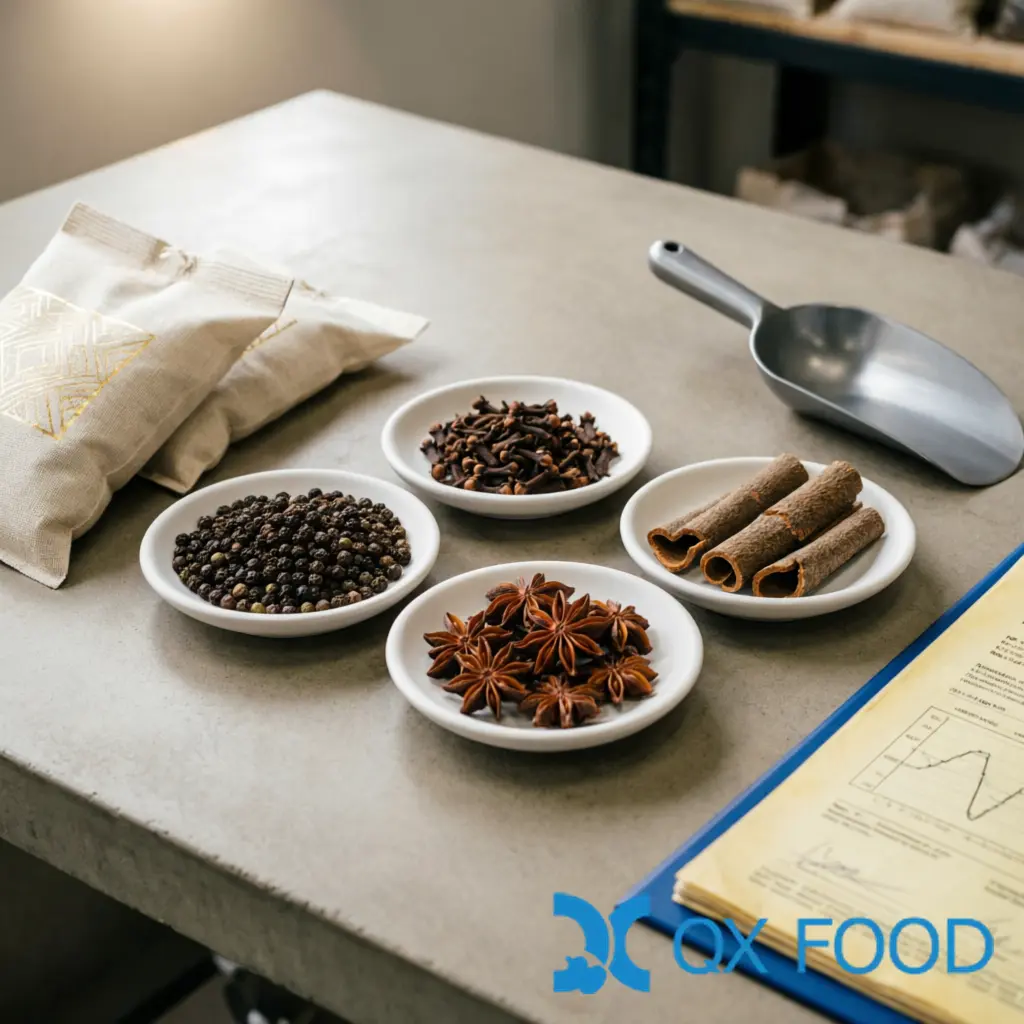
- Particle size — mesh range, maximum oversize fraction, test method (e.g. sieve analysis). Clove powder CLO-D11 at 80 mesh and black pepper powder BPP-K45 at 80-120 mesh are examples of mesh-defined spice procurement grades.
- Composition — volatile oil content, moisture, ash (total and acid-insoluble), and active compounds where relevant (piperine, eugenol, trans-anethole).
- Microbiology — total plate count, yeast and mold, coliforms, Salmonella, E. coli.
- Contaminants — heavy metals (lead, arsenic, cadmium), pesticide residues, aflatoxin for certain origins, coumarin for cassia-family lots.
- Certifications — ISO9001, ISO22000, HACCP, HALAL, KOSHER, organic where required.
Putting this in writing before contacting suppliers filters the market fast: a supplier who cannot commit to a specification in writing is not a candidate for production-scale spice procurement.

Checkpoint Two: Read the COA Like a Formulator
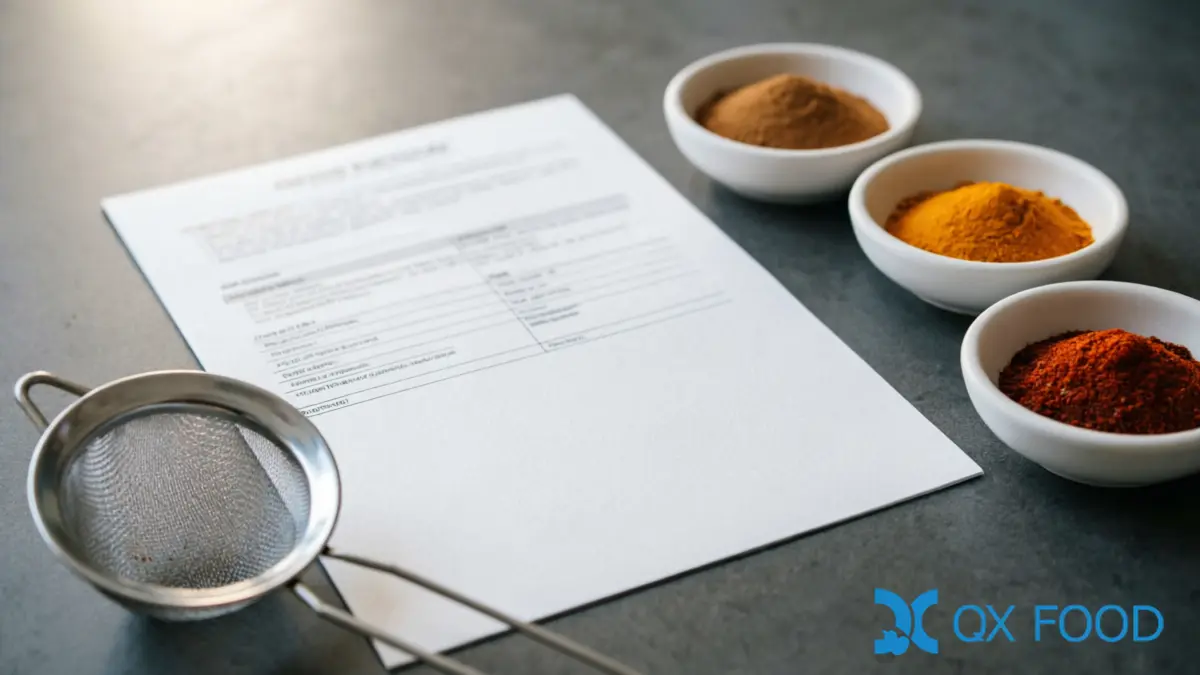
The certificate of analysis is the bridge between spice procurement and formulation. The three values that predict finished-product performance are volatile oil, moisture and mesh — and they should be read together, not in isolation:
| Parameter | Why It Matters | Warning Sign |
|---|---|---|
| Volatile oil | Correlates with aroma delivery in the cooked product | Below agreed floor, or drifting down across lots |
| Moisture | Drives caking, microbial risk and flavor loss | Above 12% for dried herbs, above spec for powders |
| Mesh/particle size | Determines adhesion, dispersion and line behavior | Oversize fraction outside the agreed range |
For a practical buyer’s checklist covering these parameters, see the B2B wholesale spice quality checklist from BF Spices. The COA should state the test method for each value — two suppliers can quote the same volatile oil number using different methods.
Cumin is a textbook case for oil-content verification, and our cumin powder sourcing guide shows the spec table.
Checkpoint Three: Qualify the Supplier, Not the Price List
Supplier qualification is where spice procurement separates professional programs from spot buys. The qualification file should contain:
- Certificates — food safety certifications with the certification body’s IAF accreditation visible and the scope covering the product you buy.
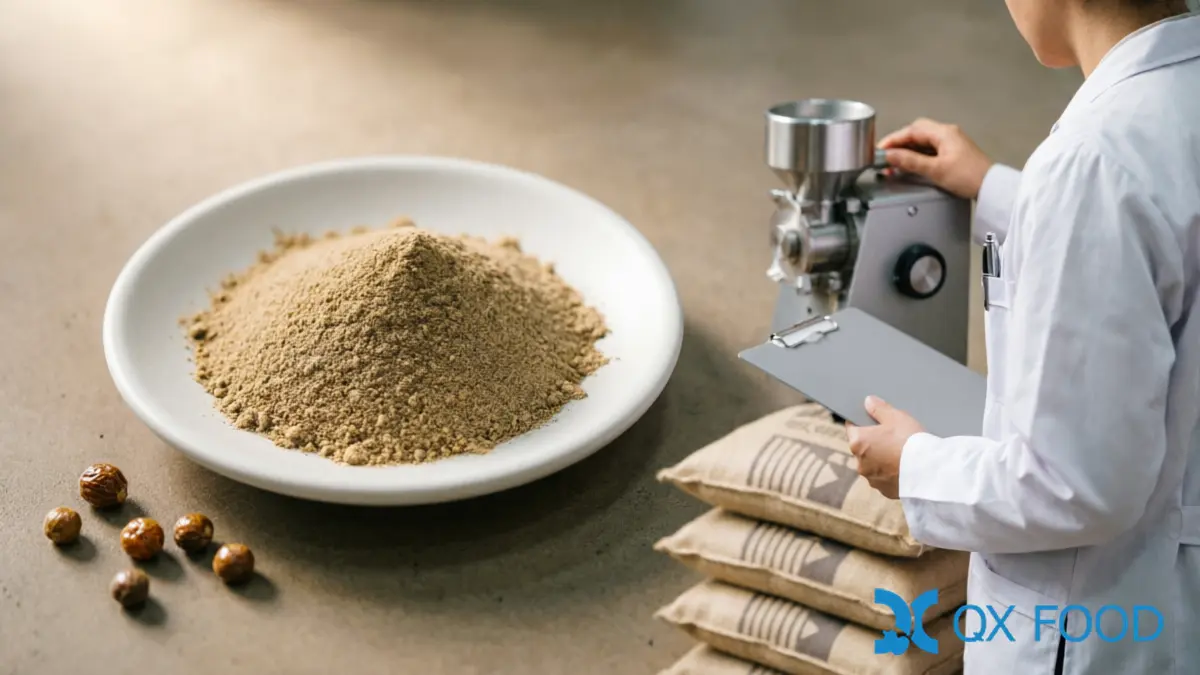
- Facility audit — cleaning, sorting, grinding, metal detection and storage practices; grinding-to-order capability is a strong signal for freshness control.
- Traceability — lot-level traceability from growing region and harvest season to shipped lot number.
- Allergen and contamination declarations — written allergen statement and contamination monitoring program.
- Financial and capacity stability — production capacity versus your forecast, and a track record of on-time delivery.
The FDA’s FSMA supplier verification guidance and the foreign supplier verification research published in Applied Sciences (MDPI, 2023) describe the audit structure that importers can adapt to spice procurement at any scale.
A worked example on numbing-spice buying appears in our sichuan pepper variety and quality guide.

Checkpoint Four: Inbound Inspection Protects the Run
Even a qualified supplier ships the occasional off-spec lot. Inbound inspection is the last gate before the spice touches production:
- Document review — match the COA to the lot number on the packing list; reject mismatched documentation.
- Physical check — moisture spot test on arrival, visual check for insects, foreign matter and off-odor, mesh verification for critical grades.
- Microbial hold — for high-risk spice categories, hold the lot until microbial results clear.
- Archive samples — retain a sealed sample of every accepted lot for claim and investigation purposes.
Inspection records feed the supplier scorecard: a supplier with three clean quarters earns faster release; a supplier with repeated moisture flags earns extra testing or replacement.
Checkpoint Five: Batch Continuity Is the Real Deliverable
The goal of standardized spice procurement is not a single good batch — it is batch continuity across a production year. Three habits deliver it:
- Rolling COA database — log every lot’s volatile oil, moisture and mesh values; a trend line predicts flavor drift before the finished product does.
- Rotation purchasing — buy in rotation rather than deep inventory; ground spices lose volatile oil monthly, and the warehouse is the first place flavor goes to die.
- Specified re-qualification — re-verify the supplier annually or on any material change (new grinding line, new origin, new ownership).
QXFOOD’s spice line — black pepper BPP-K45, white pepper WPP-K44, clove CLO-D11, cassia CP-B04, star anise STA-23, fennel FP-B01, garlic GP-W04 and ginger DGR-27 — is built for this workflow: mesh-defined grades, COA on every lot, grinding-to-order and lot-level traceability, with 1 kg samples for qualification trials.
For the full category view, visit the Raw Spices & Herbs category page.
Request spice procurement samples through the contact form on this page and our team will support your specification and qualification process.
These checkpoints come alive in two real-world buying situations: hot pot base spice procurement for blend-driven sourcing, and the global chili sourcing guide for origin and trade-quality questions.
Frequently Asked Questions
What is the most important parameter in spice procurement?
Volatile oil content is the strongest predictor of aroma in the finished product, but it must be read with moisture and mesh. The specification should define all three with test methods, and the COA should report them on every lot.
What should a spice COA include?
Identity, volatile oil, moisture, ash, particle size/mesh, microbiology, heavy metals and relevant contaminants (aflatoxin, coumarin for cassia). Each value should state its test method so numbers are comparable across suppliers.
What certifications should a spice supplier hold?
ISO9001, ISO22000 and HACCP as a baseline; HALAL, KOSHER or organic where destination markets require. Verify the certification body’s IAF accreditation and that the certificate scope covers the product you are buying.
Whole spice or ground powder for procurement?
Whole spices hold volatile oil longer and suit visible formats; ground powders dose precisely but degrade faster. Many plants buy both. For ground, specify mesh range and prefer grinding-to-order suppliers to control freshness.
How do I verify a supplier’s food safety program?
Request certificates with IAF-accredited bodies, conduct a facility audit covering cleaning, sorting, grinding, metal detection and storage, and require lot-level traceability. FDA FSMA supplier verification guidance provides a ready audit structure.
How often should I re-qualify a spice supplier?
Annually, or on any material change — new grinding line, new growing region, new ownership. Between re-qualifications, track COA trends across lots; drifting volatile oil or moisture is an early warning that justifies an earlier audit.
How can I keep spice flavor consistent across batches?
Maintain a rolling COA database, buy in rotation instead of deep inventory, verify inbound lots, and archive samples of every accepted batch. Consistency is a procurement outcome, not a formulation accident.