
HVP amino nitrogen and total nitrogen are the two numbers quoted most often when a hydrolyzed vegetable protein supplier changes, and they are also the two numbers read fastest. Buyers ask whether the amino nitrogen is high enough and whether the total nitrogen matches the previous COA.
Both fair questions, but both skip one step: nitrogen figures only mean something when the sample, the basis and the analytical method behind them are understood. This guide explains what amino nitrogen and total nitrogen actually measure, what the AN/TN ratio can and cannot show, and how to compare two HVP COA documents without comparing the wrong things.
Quick Answer
- Total nitrogen = overall nitrogen measurement under the stated method.
- Amino nitrogen = method-dependent amino-group measurement.
- AN/TN = comparable hydrolysis indicator only under defined conditions (same sample, basis and method).
- Not a flavor-intensity score.
What Amino Nitrogen Actually Measures
Amino nitrogen (AN) is reported on HVP specifications and COA documents as the nitrogen associated with amino groups in the hydrolysate. The practical definition is method-dependent. Formol (Sørensen) titration, the classical approach for HVP and related savory ingredients, estimates titratable amino groups generated during hydrolysis; it is not specific to free, flavor-active amino acids. Different analytical methods can produce values that are not directly interchangeable.
Why does that distinction matter to an HVP buyer? Because “amino nitrogen equals the flavor-active free amino acids” is an oversimplification. The measured figure includes more than free amino acids, and finished savory perception depends on which amino acids are present, not only on how much amino-group nitrogen the titration detects. HVP amino nitrogen remains a legitimate specification row for characterizing hydrolysis. It just does not describe a single compound class, and it is not a potency score.
What Total Nitrogen Tells You
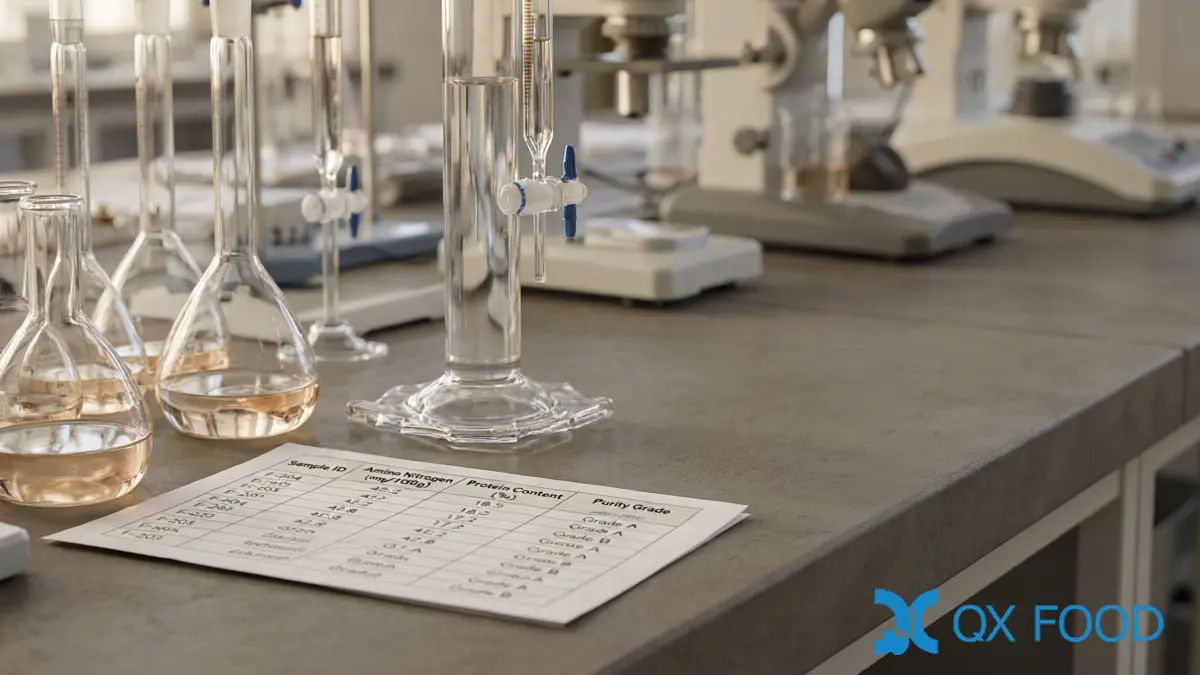
Total nitrogen (TN) is the overall nitrogen content of the ingredient as measured by the stated analytical method, most commonly Kjeldahl digestion in food-ingredient trade, with Dumas combustion as an alternative. The measurement does not decide where the nitrogen came from. In an HVP, most of the nitrogen is protein-derived because the raw material is plant protein, but the figure itself is a compositional measurement rather than a protein-quality score or a flavor score. Converting TN into “crude protein” with a factor such as 6.25 is a separate accounting step used for nutrition declarations, not a step in COA comparison.
The formulation-relevant reading of total nitrogen is more modest: it indicates how much protein-derived material the powder or liquid carries, which feeds dose economics. Two powders with the same total nitrogen can still differ in every sensory property, because amino-acid composition, peptide profile, salt, aroma chemistry and processing sit outside the nitrogen figure.
AN/TN Ratio: A Hydrolysis Indicator, Not a Flavor Score
The AN/TN ratio divides measured amino nitrogen by measured total nitrogen and is often quoted as the degree of hydrolysis. Used carefully, it has real value: within one product system, one analytical method and a comparable raw material, a higher AN/TN points to deeper hydrolysis. Used carelessly, it becomes a fake universal scale. A review of protein-hydrolysate methodology notes that degree of hydrolysis can be estimated by several different principles, including pH-stat, TNBS, OPA and formol titration, and that no single method works best across all protein hydrolysates: methodology for determining degree of hydrolysis, a review (PubMed). What formol titration measures is not identical to what OPA or TNBS measures, so an AN/TN figure from one laboratory cannot be assumed equivalent to one from another.
The practical rule: treat AN/TN as a characterization value for comparing like with like, and nothing more. It is not a universal hydrolysis percentage, and it does not rank finished flavor.
Buyer Warning: Do Not Calculate AN/TN From Specification Minimums
Here is a mistake that shows up in real sourcing conversations. A supplier quotes total nitrogen at a minimum of 3.0 and amino nitrogen at a minimum of 2.0, and the buyer divides 2.0 by 3.0 to conclude the AN/TN is 66%. That ratio is meaningless, because both figures are independent minimum specifications, not a matched pair of measured values from one batch. One batch may run total nitrogen 3.4 and amino nitrogen 2.1. Another may run 4.2 and 2.3. The ratio of the actual batch values differs from the ratio of the minimums every time.
A ratio is meaningful only when amino nitrogen and total nitrogen are measured on the same sample, on the same basis, with the defined analytical methods. Minimum specification values describe acceptance limits. They do not describe a batch, and they cannot be combined into a ratio.
AN/TN Ratio Calculator
Enter matched measured values from the same batch COA. Do not use specification minimums.
AN/TN = —
Use only matched measured values from the same batch, basis and compatible analytical methods. AN/TN is a hydrolysis-characterization value, not a flavor score.
Why Higher Amino Nitrogen Does Not Automatically Mean Stronger Flavor
The most common HVP amino nitrogen question in procurement is the direct one: does a higher number mean the ingredient tastes stronger? Not necessarily. Amino nitrogen characterizes the extent and composition of hydrolysis, while finished savory impact depends on the amino-acid profile (glutamate against bitter or neutral amino acids), peptide composition, salt level, aroma chemistry and the food matrix it lands in. Two grades with different amino nitrogen values can reverse order in a finished-product tasting. Two lots of the same grade can differ on paper and still sit inside the same sensory window in application. Research on HVP model systems confirms the point: HVPs with different free amino-acid compositions generated qualitatively different volatile compounds when reacted under identical conditions, so composition rather than one nitrogen row drives the finished result.
That is why application testing exists. If a supplier argues that a higher amino nitrogen figure means stronger flavor, the professional response is to run both candidates in the actual finished product at an equivalent use basis, not to compare two numbers on two COA documents. Nitrogen figures describe the grade; they do not score finished flavor.
Analytical Method Matters
HVP amino nitrogen values, like total nitrogen values, become comparable across suppliers only when the methods behind them are comparable. Codex CXS 117-1981, the international standard for bouillons and consommés, references total nitrogen by AIIBP Method 2/6 or AOAC 928.08 and amino nitrogen by AIIBP Method 2/7: Codex Standard for Bouillons and Consommés (FAO). In broader protein-hydrolysate work you will also meet formol titration, OPA, TNBS and Dumas-based total nitrogen. Each method has its own response and its own error structure.
The buying consequence: ask which method a supplier used before comparing their amino nitrogen with another supplier's. The method can live in the product specification or the test-method document rather than on every COA page; what matters is that it is defined and disclosed. If a supplier cannot say which method produced the number, the number cannot be evaluated.
Do Not Compare HVP Specifications Without Checking the Basis
Before any cross-supplier comparison, check the seven items below. Missing one of them produces the classic false conclusion: for example, deciding that a powder with a "lower" nitrogen figure than a liquid is weaker, when one document quotes g/100g on an as-is powder basis and the other quotes g/100ml or a dry-matter basis.
| Check | Why it matters |
|---|---|
| Product form | Powder and liquid figures are not directly comparable; the two formats dose and dilute differently |
| Unit | g/100g, g/100ml, % and mg/kg must be normalized before any comparison |
| Basis | As-is and dry-matter figures cannot be mixed; a liquid expressed on 40% dry matter is not on the same basis as an as-is powder |
| Test method | Different amino nitrogen or total nitrogen methods change what is measured; confirm before comparing |
| Batch vs specification | A minimum specification is an acceptance limit, not a batch result; the COA carries the measured values |
| Salt and moisture | Salt and moisture dilute or concentrate the nitrogen; the rows must be read together |
| Source and process | Soy, corn, acid and enzymatic grades differ in chemistry beyond their nitrogen rows |
The same basis discipline applies to market data. Published HVP market figures are built on different scopes, regions and base years; our hydrolyzed vegetable protein market outlook explains why the numbers do not line up — and what a buyer can still use them for.
Salt, Moisture and pH: Read the Whole Grade
Amino nitrogen and total nitrogen do not sit alone on a COA, and the rows around them decide whether a grade works in the formula. Salt is the classic example: many acid-hydrolyzed HVP grades carry substantial salt, particularly hydrochloric-acid systems neutralized with a sodium base. The actual salt contribution is grade-specific and should be confirmed from the selected specification and batch documentation, then counted in the total sodium of the finished product. Moisture behaves differently by format. A powder specification typically quotes moisture, so a powder at 7% moisture carries roughly 93% solids, while a liquid specification quotes solids directly. Mixing the two vocabularies is how buyers end up with nonsense such as expecting a powder to quote solids the way a liquid does. pH is most relevant for liquid grades, where it affects compatibility in a sauce or brine.
How to Compare Two HVP COAs Correctly
Comparison is a sequence, not a glance. Seven steps, in order:
- Confirm the same product form and the actual SKU or grade you intend to buy. A "hydrolyzed vegetable protein" label can hide different sources, processes and formulations.
- Normalize units and basis so both documents speak the same language.
- Confirm method compatibility for amino nitrogen and total nitrogen before comparing the two nitrogen rows.
- If you calculate AN/TN, use matched measured batch values, never two minimum specifications.
- Read salt and moisture or solids together with the nitrogen rows. A higher nitrogen number does not by itself determine the required dose or finished-product performance once salt, solids and formulation constraints are normalized.
- Separate the batch COA from process and allergen documentation. Hydrolysis route, raw-material source and allergen declaration are answered by technical documents, not by nitrogen rows on a COA.
- Validate the shortlisted grade in the finished product, at the use level and process of your line, before approving it.
Qualitative rows are normal on a real COA. Appearance may read "conforms", and microbiology rows read "absent" or "negative". A COA that reports measured values for quantitative parameters and clear results for qualitative ones is doing its job; a numeric value is not required on every row, and a test method does not have to be reprinted on every page when the specification or test-method document states it.
3-MCPD Is a Separate Compliance Question
For acid-hydrolyzed HVP, 3-MCPD is a contaminant-control question that nitrogen specifications do not answer. The contaminant can form during acid hydrolysis under process conditions, and it is controlled by the manufacturing process rather than by a nitrogen target. For EU-bound product, Commission Regulation (EU) 2023/915 sets a maximum level for 3-MCPD in hydrolyzed vegetable protein of 20 µg/kg expressed on the liquid product at 40% dry matter, equivalent to 50 µg/kg on a dry-matter basis and adjusted proportionally for other dry-matter levels: Regulation (EU) 2023/915 (EUR-Lex). Buyers should verify the applicable category and dry-matter basis for the selected grade rather than assuming one calculation transfers across products.
The same discipline runs through the rest of the document stack: hvp amino nitrogen and total nitrogen characterize the grade, while contaminant results plus process documentation answer the compliance question. The process difference behind the 3-MCPD story is covered in our acid vs enzymatic HVP guide.
Example: How QXFOOD HVP Grades Differ on Paper
To show what a paper-level comparison looks like, the table below reproduces representative specifications from the published QXFOOD HVP powder series comparison. Total nitrogen and amino nitrogen are quoted as minimums or ranges in g/100g on the powder as-is, with moisture at 7% or below.
| Grade | Source | Total N (g/100g) | Amino N (g/100g) | Format |
|---|---|---|---|---|
| HVP-FSA | Soy | ≥3.0 | ≥2.0 | Spray-dried powder |
| HVP-FSAH | Soy | ≥4.0 | ≥3.0 | Spray-dried powder |
| HVP-FYA | Corn | ≥4.0 | ≥3.6 | Spray-dried powder |
| HVP-FYC | Corn | ≥4.5 | ≥3.5 | Spray-dried powder |
| MF-01 | Soy | 1.8-2.3 | 1.3-1.5 | Spray-dried powder |
These values describe specification position, nothing more. The series table is a summary: the individual product page and the current batch COA remain the reference for a specific purchase. Note the range on MF-01: a specification range defines the acceptable window for the grade, while the batch COA reports the actual measured result for a specific lot. That is another reason to compare the current batch COA rather than treating the specification table as batch data. And no row here ranks flavor. The grade that fits your formula still has to be confirmed in application testing.
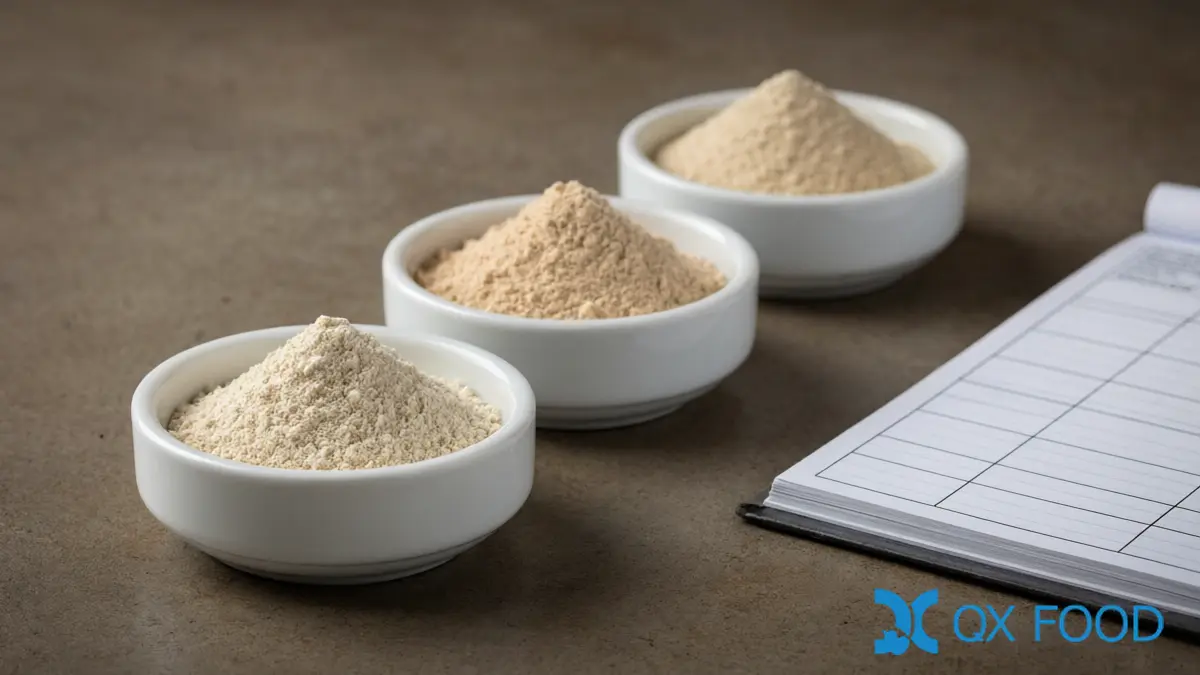
One practical note from this example: if you ever see a discrepancy between a series table and the product page for the same SKU, ask the supplier which document is the purchase reference before comparing anything. That question, not the numbers themselves, is the point of this guide. The same source-level comparison logic for soy and corn candidates is covered in our soy HVP vs corn HVP guide, and the form decision in our HVP liquid vs powder guide.
Specification, COA and Technical Documentation Are Different Records
Three documents answer three different questions, and none substitutes for another:
- Product specification — the agreed control targets for the grade: nitrogen minimums, salt and moisture ranges, method references.
- Batch COA — the measured results for one specific lot, reported against the specification.
- Technical documentation — process description, raw-material source, and compliance evidence such as 3-MCPD process control.
Do not ask the COA to prove process history, and do not ask the specification to prove a batch. Buyers who keep the three records apart avoid most of the confusion this guide describes.
Using This Guide When You Source HVP
Concrete use: line up the candidate COA documents from two or three suppliers in the structure above, checking form, unit, basis, method, salt, moisture and matched batch values, then shortlist one or two grades for finished-product trials. The full supplier screening process, including documentation review, is covered in our HVP supplier guide.
QXFOOD publishes the HVP powder series comparison and the HVP liquid series with the same table structure, and each SKU page carries the product specification. Download the HVP COA Comparison Worksheet (PDF): a one-page table built around the seven checks above, with columns for Supplier A, Supplier B and QXFOOD, so the batch data lines up before the tasting starts. You can also request the worksheet with your next sample request through the contact form. Contact us through the form on this page and the application team will support the comparison and grade selection.
Frequently Asked Questions
What does amino nitrogen mean in HVP?
Amino nitrogen reflects amino groups associated with protein hydrolysis. Depending on the analytical method, the measured value can include free amino acids, peptide terminal amino groups and ammonium-related contributions, so it should not be described simply as the amount of flavor-active free amino acids. It characterizes hydrolysis; it does not score finished flavor.
Does higher amino nitrogen mean stronger HVP?
Not necessarily. Finished savory impact depends on the amino-acid profile, peptides, salt, aroma chemistry and the food matrix, so two grades with different amino nitrogen values can reverse order in finished-product sensory performance. Compare candidates in the actual application at an equivalent use basis instead of ranking COA numbers.
What does the AN/TN ratio tell you?
Divided as amino nitrogen over total nitrogen from the same sample, basis and method, AN/TN can serve as a practical hydrolysis indicator within a comparable product system. It is not a universal degree-of-hydrolysis value, and it cannot be compared blindly across suppliers, methods and product families.
Can I calculate AN/TN from specification minimums?
No. Specification minimums are independent acceptance limits, not a matched analytical pair. A ratio is meaningful only when amino nitrogen and total nitrogen are measured on the same batch sample, on the same basis, with the defined methods.
Which test methods measure HVP amino nitrogen and total nitrogen?
Total nitrogen is commonly measured by Kjeldahl, with Dumas available as an alternative. Amino nitrogen may be measured by formol titration or another defined amino-nitrogen method; Codex CXS 117 references AIIBP Method 2/7 for amino nitrogen and AIIBP Method 2/6 or AOAC 928.08 for total nitrogen. OPA, TNBS and other approaches also appear in broader protein-hydrolysate work. Compare the analytical method before comparing results across suppliers.
What else should I check besides nitrogen on an HVP COA?
Read the whole grade: salt, moisture or solids, pH for liquids, unit and basis of every figure, batch linkage, microbiology, and the 3-MCPD result for acid-processed material where the destination market requires it. Keep the batch COA separate from the product specification and the technical documentation, and validate the shortlisted grade in your finished product.