
Brewed soy sauce powder quality cannot be read off the powder. Process identity can be documented, but sensory quality still has to be evaluated grade by grade, because amino nitrogen, color or aroma alone cannot prove that a soy sauce powder is genuinely brewed. Soy sauce powders sit on a real process spectrum: fully fermented, hydrolyzed, and blended products all reach the market under names that look similar on a specification sheet.
This guide provides an evaluation framework for brewed soy sauce powder that separates what can be documented (process route, composition, compliance) from what must be tested (sensory performance in the finished application), so buyers can compare grades rather than categories.
Brewed, Hydrolyzed and Blended Are Process Categories
The useful classification is by production route, not by a brewed-versus-synthetic label. Real products include naturally fermented or brewed soy sauce, acid-HVP-based sauces, enzymatically hydrolyzed sauces, brewed sauce blended with amino-acid liquid, and formulated soy-sauce seasonings. Japan’s MAFF formally distinguishes production methods along these lines: honjozo (straight brewed), mixed fermentation, and mixed method, the last two combining fermented soy sauce with amino-acid liquid or other hydrolyzed materials.
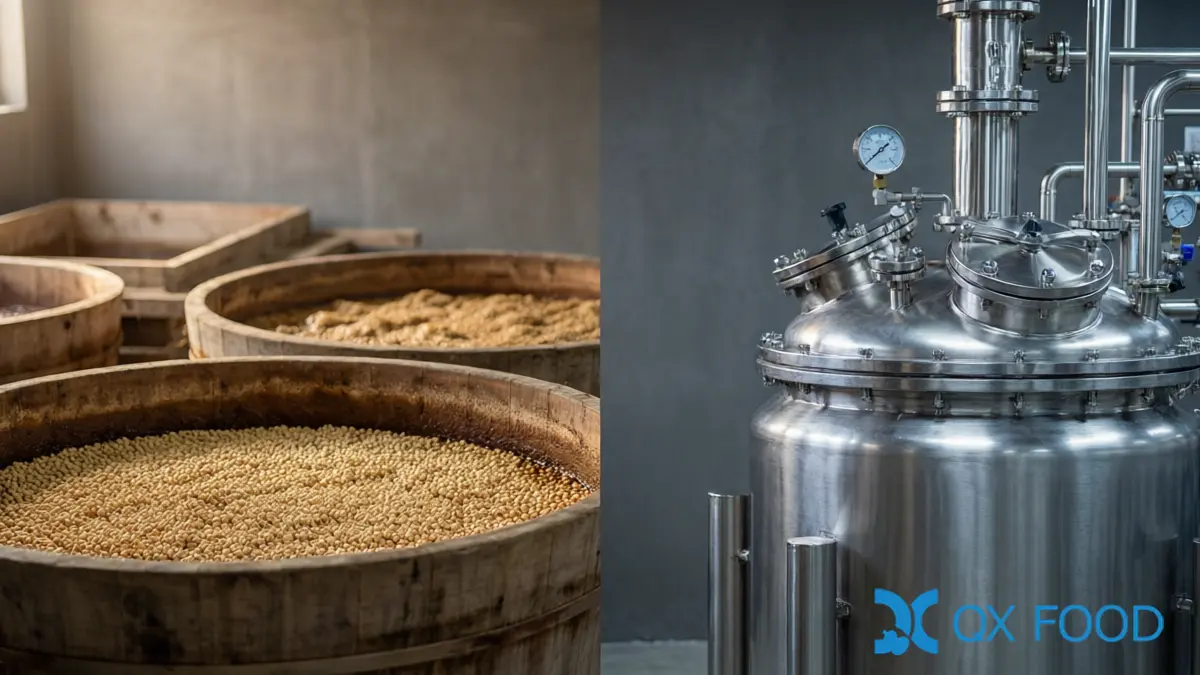
Blended does not mean synthetic. A blend built on a brewed base with a defined hydrolyzed addition is a legitimate product category with its own specification, and its performance has to be judged against the intended application like any other grade.
Process Identity Must Be Documented, Not Guessed From Taste
Brewing time varies by soy-sauce style and production method, so duration alone should not be used to prove authenticity. Japanese production practice illustrates the range: standard koikuchi brewing is commonly described as several months of moromi aging, while styles differ in raw materials, salt strategy and aging length, and some products age well beyond a year. Verify the declared production route, raw materials and applicable product specification or standard rather than treating fermented for months as a universal test.
Sensory evaluation can screen candidates, but it cannot prove process history. Two powders from different routes can be formulated to similar taste, and two brewed grades from different breweries can taste very different. Process identity belongs in the technical documentation: the declared route, raw-material statement and applicable product standard. Japan, for example, maintains a dedicated soy sauce standard under its JAS system, and claim terms such as naturally brewed should be checked against the destination market’s labeling rules rather than treated as one global definition.
Fermentation Changes Chemical and Aroma Profiles, but Not Into One Fixed Persona
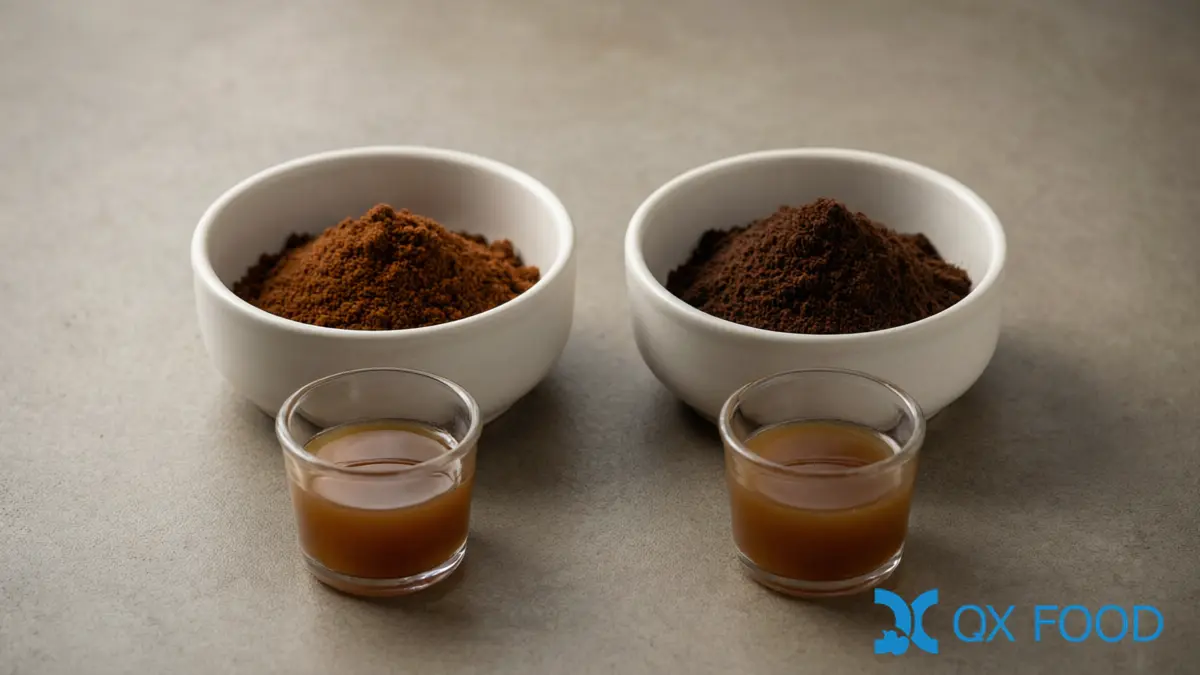
Production route influences composition and sensory character. A review of soy sauce chemistry notes that the aroma-active volatiles are chemically diverse and that their origin relates to the raw ingredients, starter cultures and parameters applied during production, and studies tracking fermentation over time find that volatile profiles develop and change across the fermentation cycle. None of this means every brewed powder is round and complex while every hydrolyzed powder is sharp and flat. Grades within each route vary with raw materials, fermentation or hydrolysis conditions, formulation and drying.
| Variable | Brewed / fermented | Hydrolyzed or blended |
|---|---|---|
| Production route | Microbial fermentation | Hydrolysis and/or blending route |
| Aroma composition | Fermentation-dependent volatile profile | Process-dependent volatile profile |
| Taste composition | Depends on raw materials, fermentation and grade | Depends on hydrolysis, formulation and grade |
| Color | Style- and process-specific | Formulation- and process-specific |
| Salt | Grade-specific | Grade-specific |
| 3-MCPD | Usually low in solely fermented systems, but market compliance still applies | Acid hydrolysis is a known formation pathway |
| Final sensory | Validate actual grade in application | Validate actual grade in application |
Color and salt level are not fixed personalities either. Traditional soy sauce styles range from dark to light to white, with different salt strategies, and a hydrolyzed sauce can be formulated to lower salt than a brewed one. The route does not write the label; the grade does.
Amino Nitrogen Is a Composition Indicator, Not an Authenticity Fingerprint
Total nitrogen and amino nitrogen can characterize composition or hydrolysis and fermentation performance under a defined method, but they are not authenticity fingerprints. Amino nitrogen rises as protein is broken into free amino acids, and that happens in both fermentation and acid or enzymatic hydrolysis. Amino nitrogen can also be high in acid- or enzyme-hydrolyzed protein systems, so the parameter cannot distinguish fermentation from hydrolysis on its own.
3-MCPD: Acid Hydrolysis Raises the Question, but Market Limits Decide Compliance
Acid hydrolysis is a recognized 3-MCPD formation pathway, while solely fermented soy sauce typically contains non-quantifiable or very low levels. However, destination-market contaminant limits may apply to soy sauce as a product category regardless of the declared production route. For EU-bound products, Regulation (EU) 2023/915 sets 3-MCPD maximum levels for hydrolysed vegetable protein and for soy sauce as separate entries, each expressed on the liquid product at 40% dry matter (20 µg/kg, corresponding to 50 µg/kg in dry matter and adjusted proportionally for other dry-matter levels). Buyers should verify the product category and dry-matter basis that applies to the selected grade rather than assuming that one calculation transfers between products.
Spray Drying Creates a Second Quality Layer
The quality of a soy sauce powder depends not only on the liquid soy sauce used as feed but also on the drying formulation and process. Carrier type and level, feed composition and spray-drying conditions can change aroma retention, powder stability, hygroscopicity and flavor release. A brewed liquid therefore does not guarantee that every powder made from it will perform the same way.
Spray drying is not simply removing water. A 2026 review of aroma encapsulation notes that wall-material selection governs flavor retention, stability and release, and that common operations such as heating, drying and storage can cause substantial losses of key aroma volatiles. Research on spray-dried soy sauce powder shows that maltodextrin dextrose-equivalent value and addition level significantly change hygroscopicity, glass-transition temperature, flowability and caking behavior. The carrier is not a neutral diluent: it changes the powder’s stability and the way the flavor is retained and released.
Compare Powder Grades on an Equivalent Application Basis
Powders with different carrier levels deliver different amounts of soy-derived solids per kilogram, so comparing them by rehydrating the same powder weight is not comparing the same thing. Compare candidates on a defined basis, such as equivalent finished-product use level, salt contribution or soy-sauce solids where that information is available, and then validate them in the actual application.
Specification, COA and Process Documentation Answer Different Questions
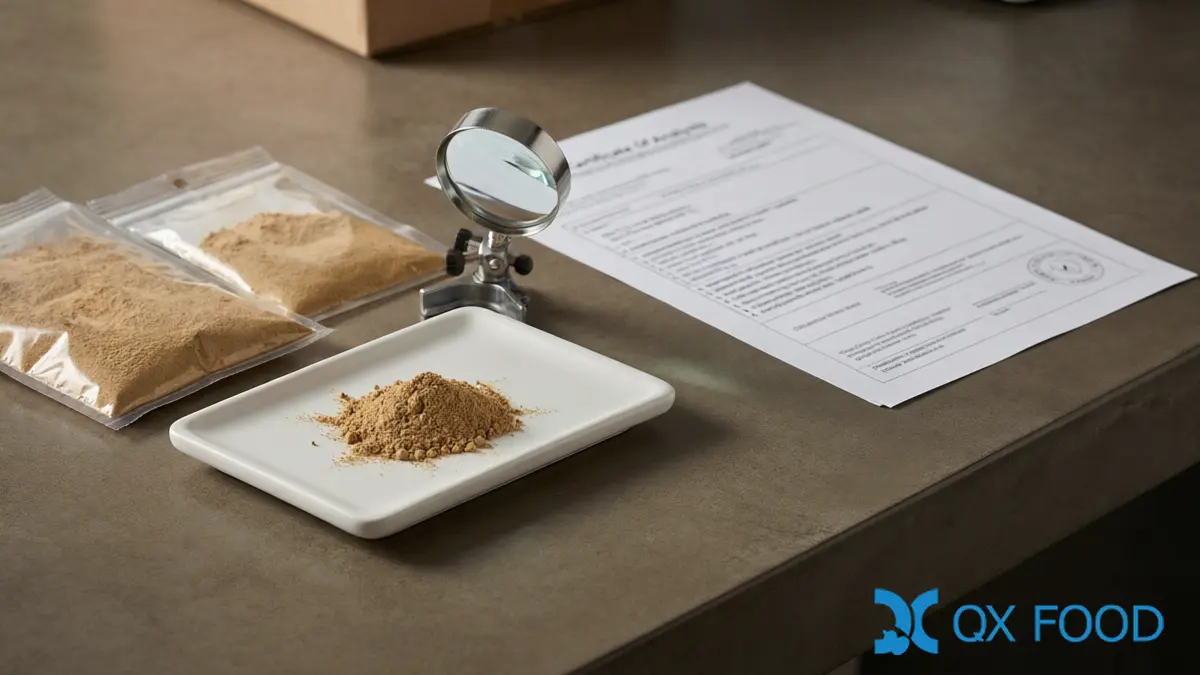
Three records answer three questions. The specification or technical documentation defines the grade: composition, declared process route (brewed, hydrolyzed or blended), analytical targets and applicable standards. The batch COA reports what was measured for the batch on the parameters the SKU controls. Allergen, process-identity and compliance evidence sits in the applicable declarations and technical files. Do not assume that process history or every analytical parameter appears on every batch COA.
Allergen declaration follows the actual raw materials and destination-market rules: soy and wheat are common in soy sauce, but styles and formulations differ, so wheat should not be assumed for every grade.
How QXFOOD Soy Sauce Powder Grades Differ
QXFOOD’s soy sauce powder portfolio includes straight brewed grades and formulated or protein-enhanced grades with different salt levels and profiles. Buyers should therefore confirm the selected SKU’s liquid base, added ingredients, process route and analytical specification rather than assuming that every product in the series has the same composition. Examples include Japanese-style brewed soy sauce powder FSP-BH, the ester-aroma grade and low-salt solid-state FSP-CD.
QXFOOD provides product-specific specifications and batch documentation for the selected soy sauce powder grade. The analytical parameters reported on the batch COA depend on the SKU and control plan, while process identity, ingredient composition, allergen information and other supporting documentation should be confirmed from the applicable technical file.
Related evaluation logic appears in our HVP soy sauce replacement guide and the brewed soy sauce powder supplier guide.
Frequently Asked Questions
Can amino nitrogen prove that soy sauce powder is brewed?
No. Amino nitrogen reflects protein breakdown into free amino acids, which happens in fermentation and in acid or enzymatic hydrolysis alike. It is a composition indicator under a defined method, not an authenticity fingerprint.
Can I identify brewed powder by taste alone?
No. Sensory evaluation can screen candidates against a reference, but taste cannot prove process history, and grades within each route vary. Verify the declared production route and applicable specification from the technical documentation.
Does brewed soy sauce eliminate 3-MCPD concern?
No universal exemption exists. Acid hydrolysis is a recognized formation pathway and solely fermented soy sauce is usually very low, but destination-market limits can apply to soy sauce as a product category. For EU-bound products, check compliance against Regulation (EU) 2023/915 on the applicable dry-matter basis.
Does spray drying preserve the original soy sauce flavor exactly?
No. Carrier selection and drying conditions change aroma retention, release and powder stability. The same liquid brewed soy sauce can yield powders with different performance depending on the drying formulation, so validate the actual powder grade.
What documents should a buyer compare?
The specification and technical documentation for process identity and composition, the batch COA for measured batch parameters, allergen and compliance declarations for the destination market, and application trial results for sensory performance.