
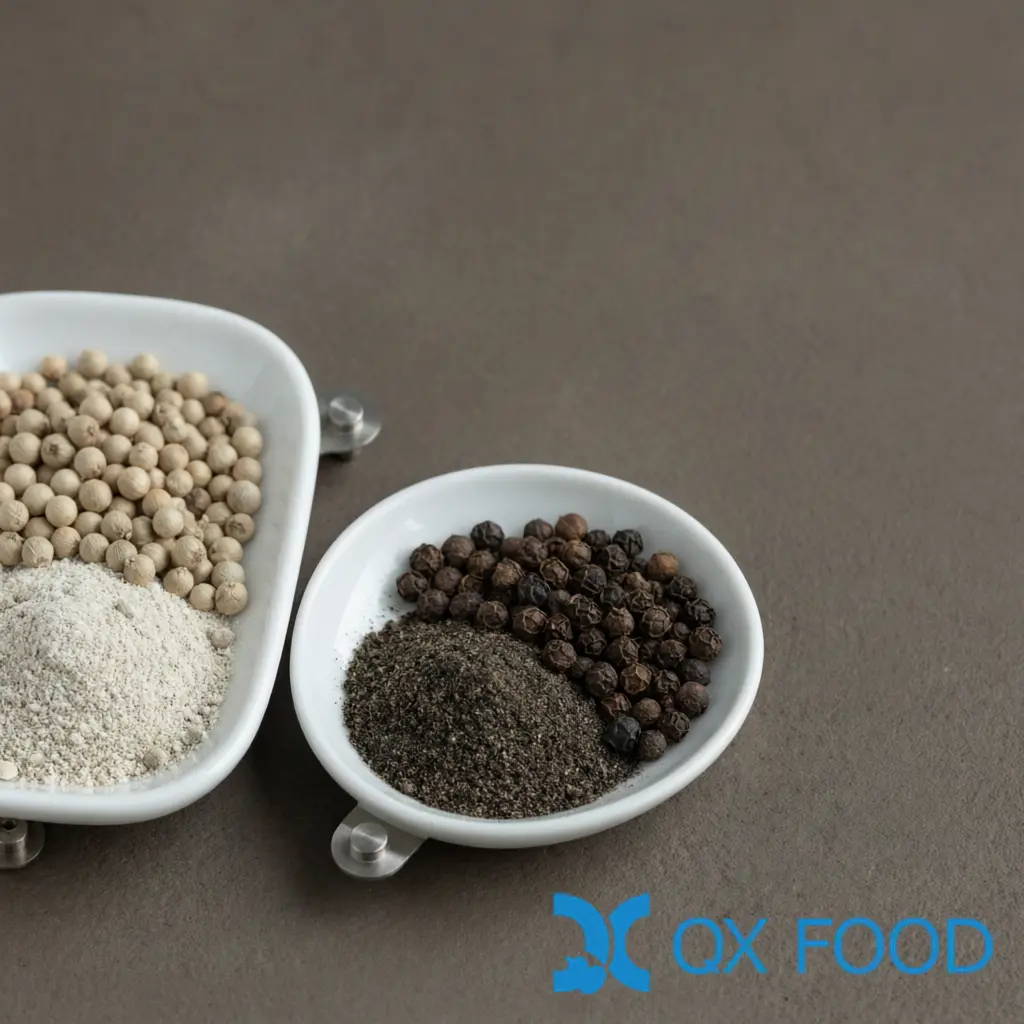
Black and white pepper come from the same species, Piper nigrum L., but differences in maturity and processing create distinct aroma and appearance, plus different formulation behavior. For food manufacturers, the white pepper vs black pepper decision depends on sensory targets, product color, processing conditions and the required purchasing specification, and getting the form right matters as much as the grade.
White pepper is produced from pepper berries after the outer pericarp is removed, commonly through retting and washing or mechanical decortication before final drying, which changes its aroma and appearance compared with black pepper. Black pepper is the whole berry dried with the pericarp intact, carrying the aromatic citrus and pine top notes of the hull.
This guide covers the white pepper vs black pepper processing difference, the flavor trade-offs, the application fit, the specification parameters to compare and the sourcing questions specific to each form.
The Processing Difference
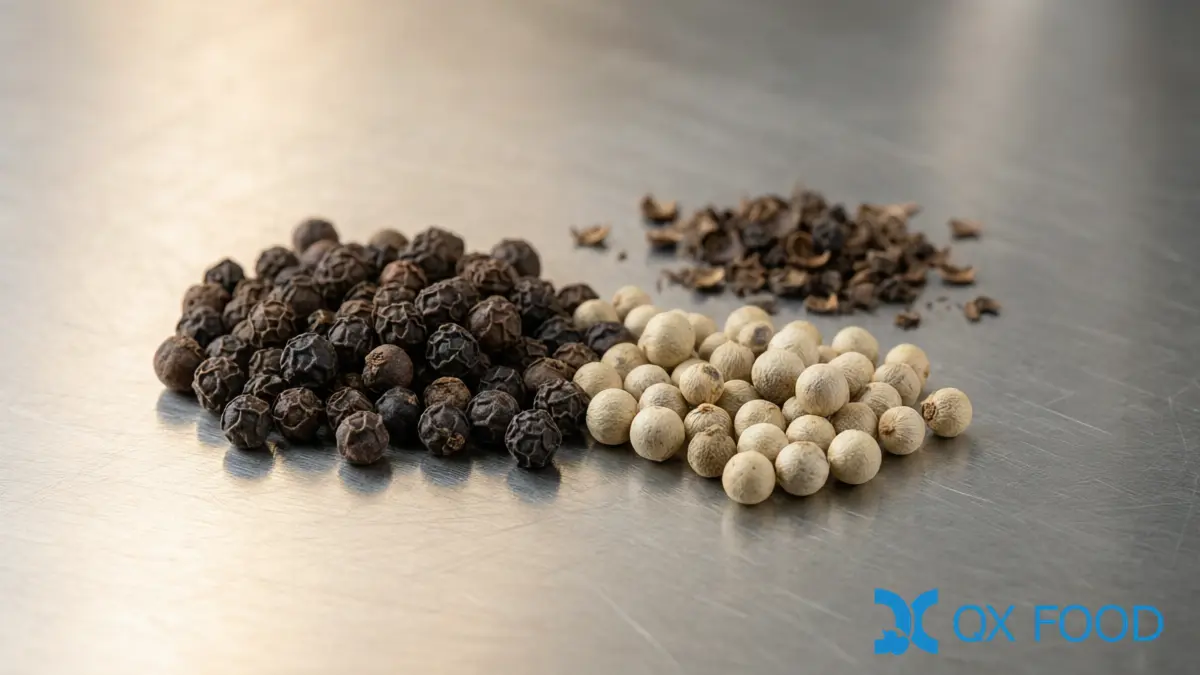
Black and white pepper come from the same species, Piper nigrum L., but differ mainly in maturity and post-harvest processing. Black pepper retains the pericarp during drying, while white pepper is produced by removing the pericarp, commonly through retting and washing or mechanical decortication, before final drying. For white pepper, retting conditions can materially affect aroma quality.
Poorly controlled or prolonged retting can promote off-odor formation, including compounds such as butanoic acid, 3-methylindole (skatole) and 4-methylphenol, which read as musty or fecal. Flowing-water retting is traditionally associated with high-quality Muntok white pepper processing, while modern white pepper production may also use controlled or mechanical decortication methods. For a manufacturer, the retting method belongs in the supplier questionnaire.
Flavor and Heat Profiles
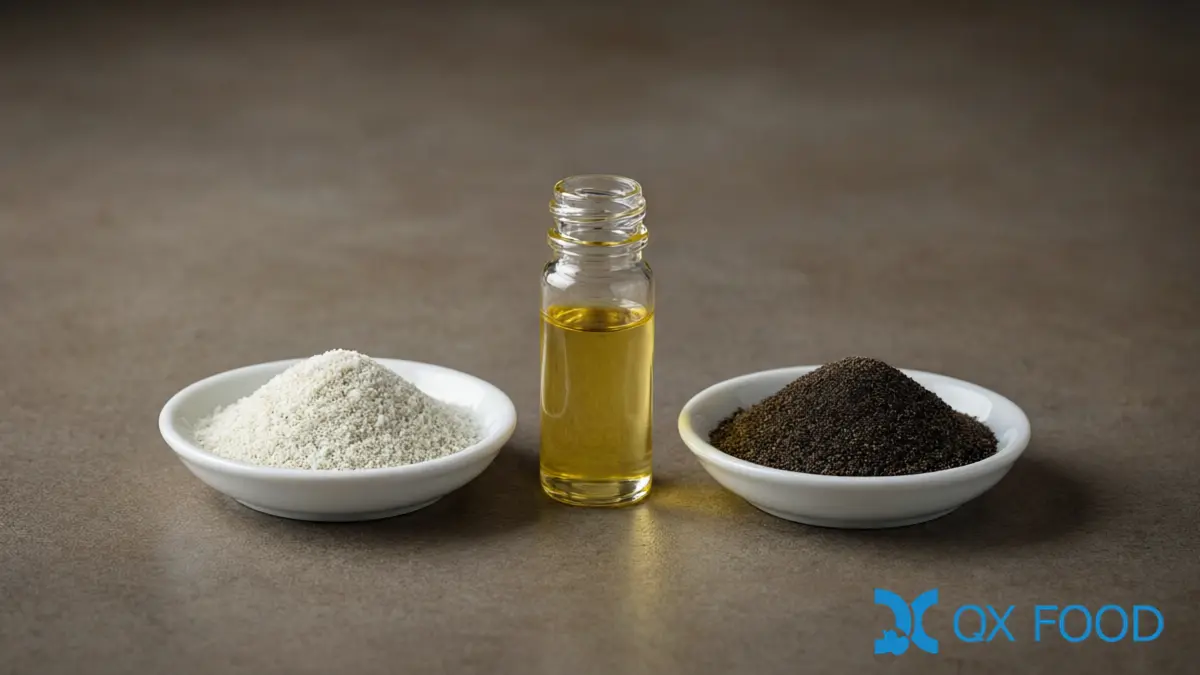
Black pepper retains more pericarp-associated aromatic compounds, contributing citrusy, woody or pine-like notes. Removing the pericarp changes the aroma profile of white pepper. Piperine contributes pungency in both forms, and actual levels vary with cultivar, maturity, origin or processing, so they should be verified by lot-specific analysis rather than inferred from pepper color alone.
Thermal processing can alter both pepper aroma and pungency. Volatile aroma compounds and piperine can change during prolonged or high-temperature processing, so pepper selection and dosage should be validated under actual production conditions.
Application Fit
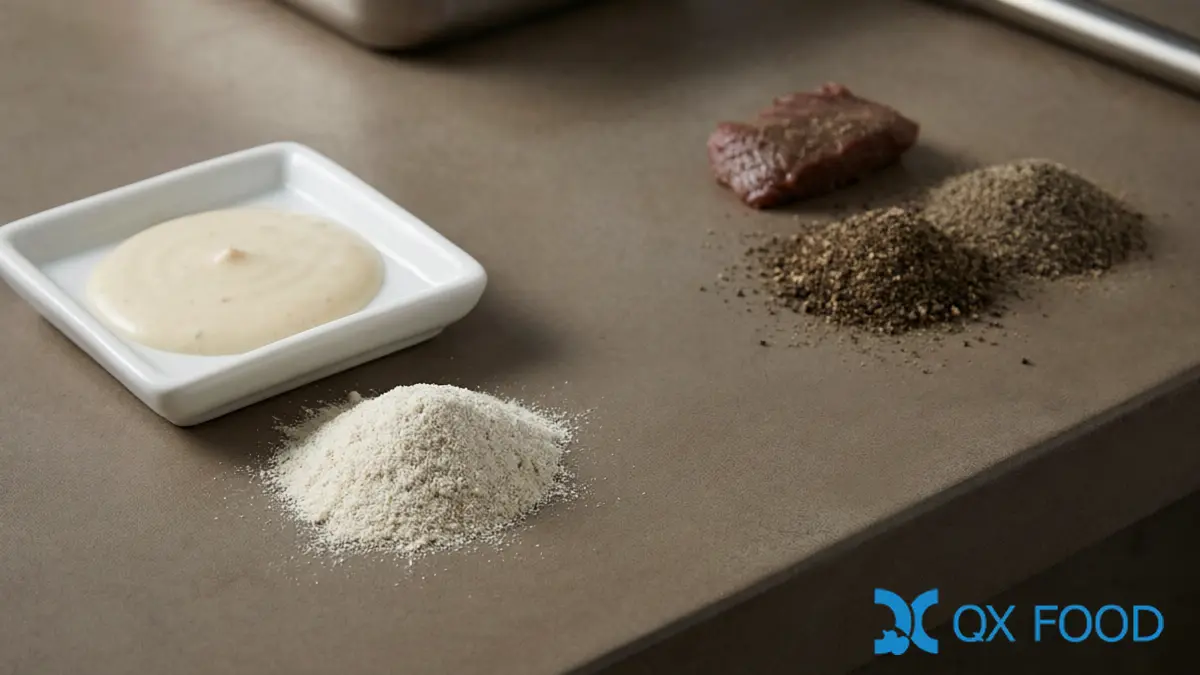
Appearance decides a large share of pepper form applications. White pepper is the default in light-colored systems where black specks are unacceptable: bechamel and cream sauces, mayonnaise, white gravies, mashed potato products, processed poultry and white sausages. Black pepper suits dark systems and visible-flake products: meat rubs, dark gravies, snack seasonings, pepper-forward blends and table shakers, where a fuller aromatic profile is desirable.
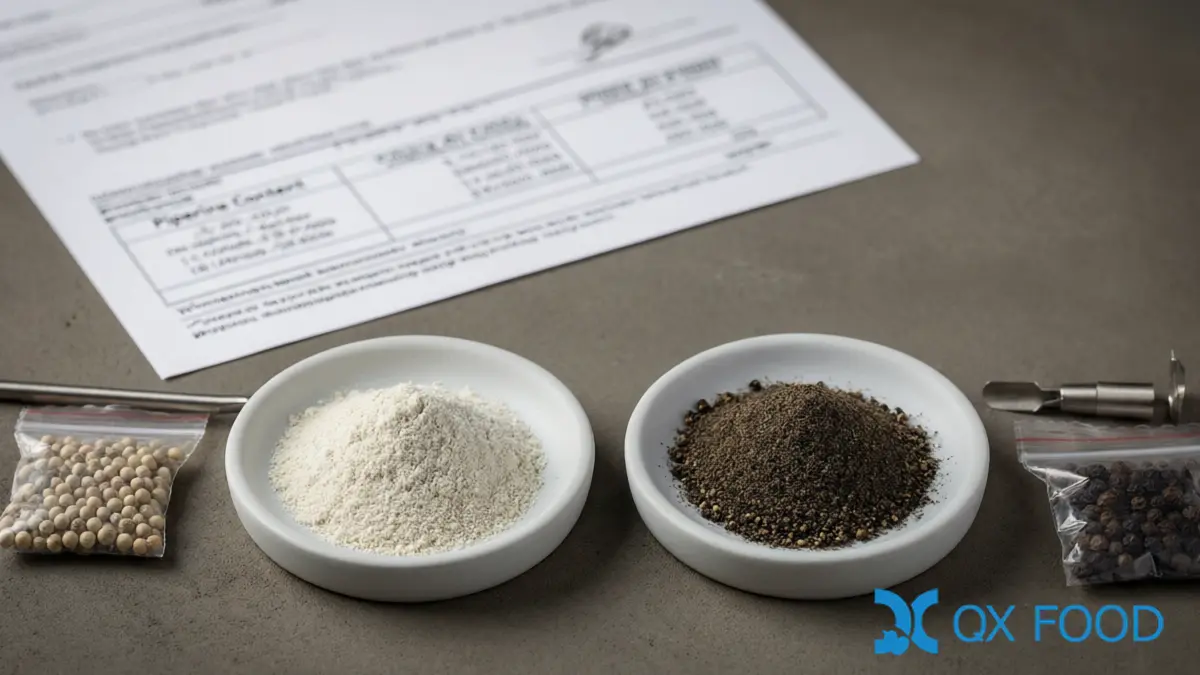
White Pepper vs Black Pepper: Specifications to Compare
| Parameter | Black Pepper | White Pepper |
|---|---|---|
| Moisture, max | 12.0% | 13.0% |
| Total ash, max | 6.0% | 3.5% |
| Volatile oil, min | 1.0 mL/100g | 0.7 mL/100g |
| Piperine, min | 3.5% | 4.0% |
| Acid-insoluble ash, max | 1.2% | 0.3% |
These values are reference requirements from Codex CXS 326-2017 for ground pepper within its stated scope. Codex CXS 326-2017 excludes pepper intended for industrial processing, so buyers should confirm whether the standard is applicable to their specific product and purchasing stage. Piperine and volatile oil are two important chemical indicators, but they should be evaluated alongside moisture, ash, cleanliness, microbiological criteria and destination-market compliance.
Quality Grades and Inspection
Pepper quality is graded on physical and chemical criteria that differ between the two white pepper vs black pepper forms. For black pepper, the key physical checks are berry size, bulk density, light-berry count and foreign matter, aligned with the grading approach in ISO 959-1:2026 for pepper. ISO 959-1:2026 and ISO 959-2:2026 replaced the previous 1998 editions for black and white pepper in May 2026. China’s GB/T 7901-2018 (black pepper) and GB/T 7900-2018 (white pepper) remain current and are identical adoptions of the 1998 ISO editions. Light berries (fruit that appears normally developed but contains no kernel) and pinheads (small, underdeveloped berries) are separate physical quality parameters and should be evaluated against the applicable grade or agreed contractual limits. For white pepper, the priorities are color uniformity, cleanliness or the absence of hull fragments, plus the retting method used.
Where pungency and aroma consistency are critical, piperine and volatile oil should be included in the agreed specification and supported by lot-specific test data where required. Moisture should remain within the agreed specification, with Codex referencing a maximum of 12.0% for ground black pepper and 13.0% for ground white pepper. Excess moisture can increase storage and mold risk, particularly during long container transit, so request readings at loading and on arrival.
Formulation and Blending Considerations
Black and white pepper can also be blended when a formulation requires both aromatic complexity and controlled visual appearance. Because piperine and volatile-aroma levels vary between lots, blend ratios should be validated through sensory trials rather than fixed solely by total pepper weight.
When the ratio changes, recheck pungency, aroma or visible specking against the approved product standard.
Sourcing Notes
Vietnam remains the world’s largest pepper exporter and accounts for roughly 35-40% of global output in recent industry estimates. Other major producing countries include Brazil, Indonesia and India. Black pepper quality is judged on berry size, density or volatile oil; white pepper on color, cleanliness or the retting method. The two forms also price differently, with white pepper historically carrying higher processing cost.
In the white pepper vs black pepper sourcing decision, the retting or decortication method is an important supplier-qualification question because poorly controlled processing can introduce persistent off-odors. For black pepper, lot-to-lot piperine and volatile-oil data can help buyers manage pungency and aroma consistency where those attributes are contractually important.
Supply Chain and Price Factors
Pepper prices vary with origin, crop conditions, grade, processing level and market availability. Buyers should compare quotations against the same specification and Incoterm rather than relying on nominal price alone.
Container economics also differ by form because density differs. Ground pepper packs more weight per volume than whole, which improves container utilization but accelerates flavor loss. For ground pepper, packaging should provide adequate moisture, oxygen and light protection. Nitrogen flushing may be considered where extended aroma retention is a specific requirement.
Certification and Documentation
Depending on product form and destination market, the white pepper vs black pepper documentation set may include a COA with piperine, volatile oil, moisture or microbiological results, phytosanitary documentation where applicable, and origin documentation. For EU and US markets, pesticide-residue compliance is particularly important because permitted limits vary by destination. Buyers should confirm the required testing panel, laboratory and reporting method before shipment.
Where Halal or organic certification is required, buyers should verify that the certificate is valid, covers the relevant product and manufacturing operation, and is accepted in the destination market. Lot- or shipment-specific supporting documentation should be requested where applicable.
Buying from QXFOOD
QXFOOD supplies pure white pepper powder, pure black pepper powder and a Hainan black pepper powder grade. For the sourcing framework behind pepper and other spices, see our spice procurement guide.
Pepper Supplier Checklist
- Botanical and form: Piper nigrum, whole or ground, stated on the COA.
- Piperine: agreed minimum specification or lot-specific test result where pungency standardization is critical.
- Volatile oil: agreed minimum specification or lot-specific test result for aroma consistency.
- Retting / decortication method (white): document the method used and evaluate the lot for fermentation-related off-odors.
- Moisture: agreed contractual maximum; Codex references ≤12.0% for ground black pepper and ≤13.0% for ground white pepper.
- Decontamination: where required, specify the treatment method and target microbiological limits.
- Pesticide residue: tested against your destination’s limits.
- Sample program: sealed reference sample retained for incoming lot comparison.
FAQ
Is white pepper stronger than black pepper?
White pepper and black pepper differ in aroma, appearance or lot-specific pungency. Piperine contributes pungency in both forms; actual intensity varies with cultivar, maturity, origin or processing, so sensory validation is recommended.
Can I substitute white pepper for black pepper?
Yes, but substitution should be validated by sensory testing because white and black pepper differ in aroma, appearance or lot-specific pungency.
Why do Asian recipes use white pepper?
White pepper keeps light-colored soups, sauces or dishes visually clean while delivering heat, and its earthy character suits the flavor systems of many Asian cuisines.
What is Muntok white pepper?
Muntok White Pepper is a geographical indication from Bangka Belitung, Indonesia. It is produced from ripe Piper nigrum fruit through controlled soaking, pericarp removal, washing and drying, using traditional or modern processing methods.
How is white pepper made?
White pepper is made by removing the outer pericarp of ripe pepper berries through soaking (retting) or mechanical decortication, then drying the decorticated pepper berry.
What is the shelf life of pepper powder?
Shelf life depends on product form, grinding level, packaging barrier properties and storage conditions. Ground pepper generally loses volatile aroma faster than whole peppercorns, so buyers should follow the supplier’s validated shelf-life specification.
Can pepper powder be customized?
Yes, mesh size, piperine level and blending ratios can be developed for your application, subject to technical feasibility review, sample validation, agreed specifications and batch verification.
References and Industry Standards
Industry and Regulatory Standards
- ISO 959-1:2026 – Pepper (Piper nigrum L.), whole or ground – Specification – Part 1: Black pepper.
- ISO 959-2:2026 – Pepper (Piper nigrum L.), whole or ground – Specification – Part 2: White pepper.
- GB/T 7901-2018 – Black Pepper, Standardization Administration of China.
- GB/T 7900-2018 – White Pepper, Standardization Administration of China.
- Codex CXS 326-2017 – Standard for Black, White and Green Peppers.
- ASEAN Geographical Indications – Muntok White Pepper, Indonesia (registration IDG 000000004).
Scientific References
- Steinhaus, M., and Schieberle, P. (2005). Role of the fermentation process in off-odorant formation in white pepper: on-site trial in Thailand. Journal of Agricultural and Food Chemistry.
- Piperine from black pepper (Piper nigrum L.): a comprehensive review (2024). Preparation, pungency and bioactivity transduction of piperine. Food Chemistry.
- Nisha, P., Singhal, R. S., and Pandit, A. B. (2009). The degradation kinetics of flavor in black pepper (Piper nigrum L.). Journal of Food Engineering, 92(1), 44-49. DOI: 10.1016/j.jfoodeng.2008.10.018.