
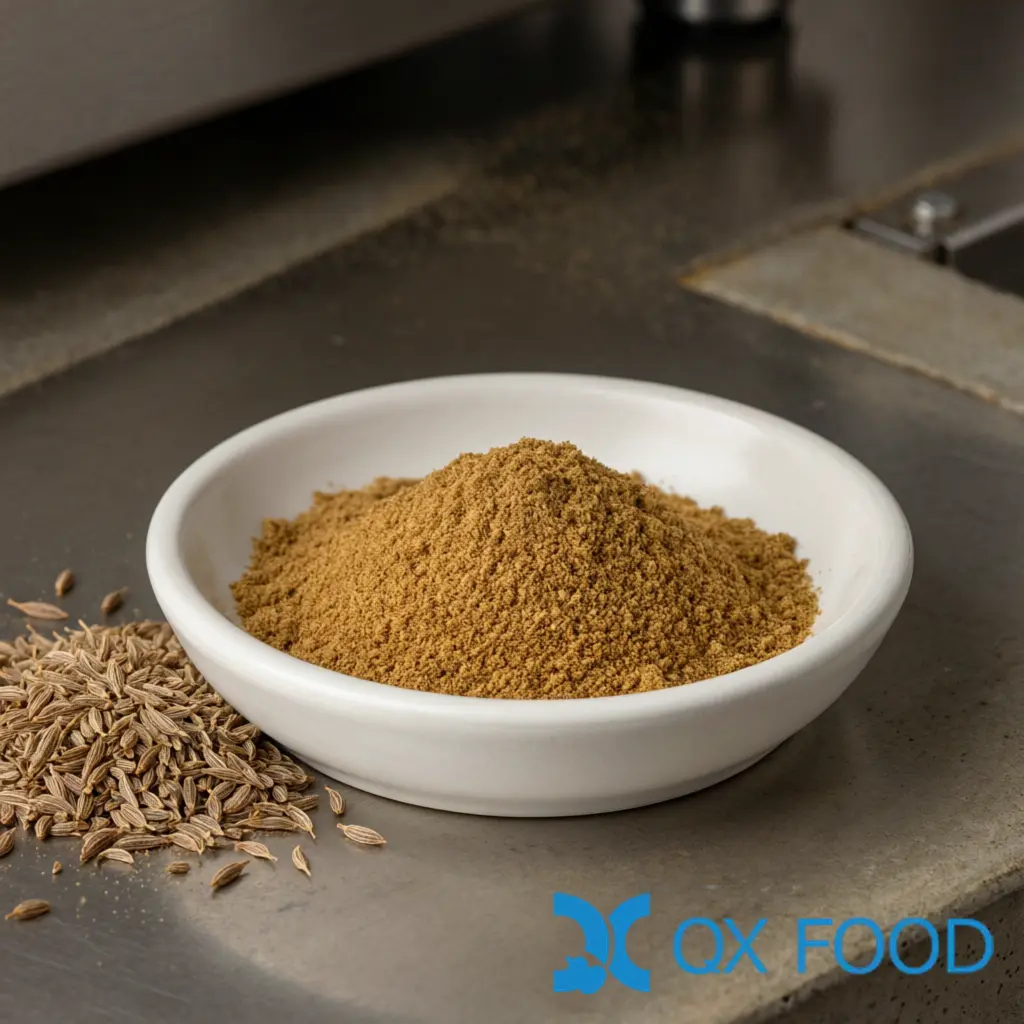
Cumin powder is widely used across curry blends, meat seasonings, snack coatings and Middle Eastern and North African food systems, and cumin powder sourcing decisions affect flavor consistency from batch to batch. India is the leader in cumin production and export, according to the Indian Council of Agricultural Research (ICAR), with Gujarat and Rajasthan forming its main production belt. Unjha in Gujarat is a major cumin trading and processing centre and a key price-setting market.
Quality can vary between lots, and volatile oil content is an important aroma-related indicator. Actual sensory performance also depends on variety, origin, storage and processing.
This guide covers the quality grades, the adulteration risks specific to cumin, the specifications to write into your contract and the supplier checks that protect batch consistency.
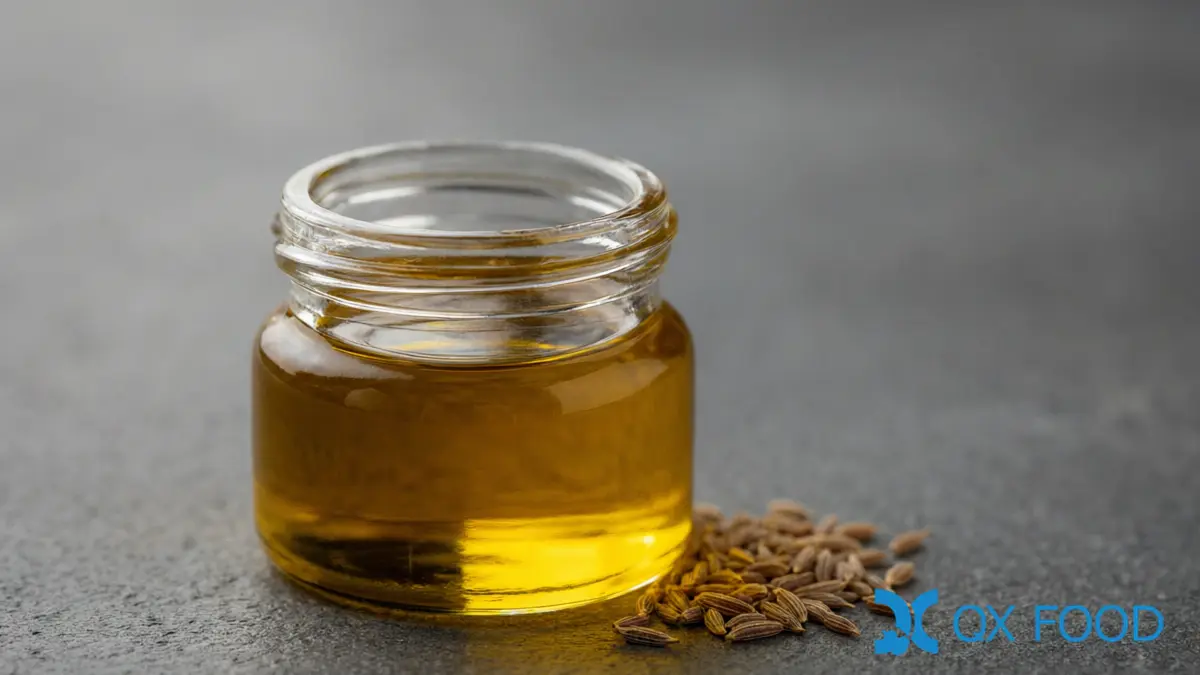
Varieties and the Black Cumin Confusion
True cumin is Cuminum cyminum, a small yellowish-brown dried fruit commercially referred to as cumin seed, from the parsley family. It is often confused with two different spices sold as black cumin: Nigella sativa, the kalonji used across Indian and Middle Eastern cooking, and Bunium persicum, the wild black cumin of Central Asia. All three are legitimate spices, but they are not interchangeable. Stating the botanical name in the specification reduces the risk of misidentification or substitution.
Write Cuminum cyminum into your purchase contract and verify the COA botanical description. The substitution risk is higher for ground product, where the seed shape cannot be inspected.
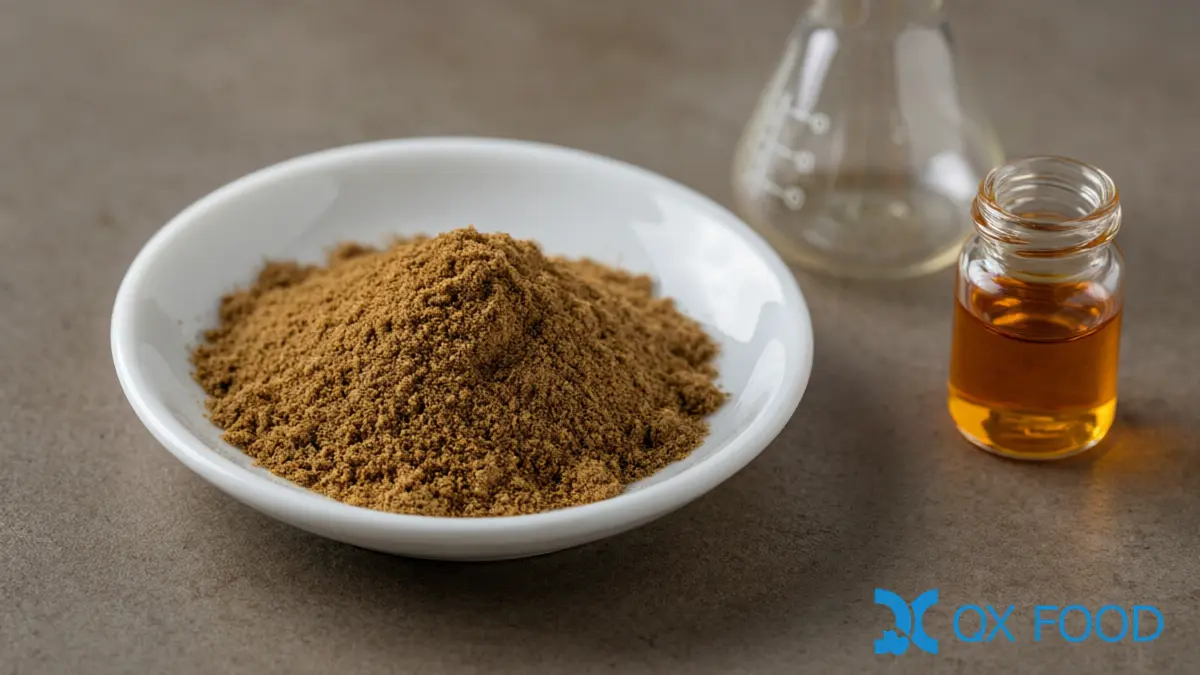
Why Volatile Oil Matters in Cumin Procurement
The flavor of cumin comes mainly from cuminaldehyde in the volatile oil. Codex CXS 327-2017 and ISO 6465:2009 both specify a minimum of 1.3 mL/100 g on a dry basis for ground cumin. Where aroma consistency is critical, buyers may specify a contractual minimum and request lot-specific volatile-oil results.
Higher volatile-oil content can indicate stronger aromatic potential, but sensory evaluation under the intended application conditions remains important.
Adulteration Risks Specific to Cumin
Ground cumin has a documented history of adulteration. In the EU-wide herbs and spices authenticity survey (2019-2021), around 14% of cumin samples were considered at risk of adulteration. In the US, undeclared peanut in cumin led to recalls of more than 675 products between 2014 and 2015, with almond and other botanical material also detected in some lots. In addition, FDA CPG 525.325 uses an average total ash level of 9.5% or more and/or acid-insoluble ash of 1.5% or more as regulatory-action guidance for cumin seed adulteration involving sand and grit.
A risk-based verification program may include allergen or botanical-authenticity testing, ash analysis and volatile-oil testing depending on supplier history, destination requirements and the agreed specification. Spent or previously extracted cumin has a substantially altered flavor profile and lower commercial value than untreated cumin, and undeclared blending would constitute an authenticity concern.
Specifications to Write Into Your Contract
| Parameter | Codex CXS 327-2017 (Ground) | ISO 6465:2009 (Ground) | Buyer-Defined Spec |
|---|---|---|---|
| Moisture | ≤10.0% | ≤12.0% | Contract-defined |
| Total ash | ≤9.5% | ≤9.5% | May be tightened |
| Acid-insoluble ash | ≤1.5% | ≤1.5% | May be tightened |
| Volatile oil | ≥1.3 mL/100g | ≥1.3 mL/100g | Application-specific |
| Mesh (powder) | Not a universal fixed value | Not a universal fixed value | e.g. 40-80 mesh |
| Microbiology | Destination / buyer requirements | Destination / buyer requirements | Contract-defined |
| Pesticide residues | Destination regulations | Destination regulations | Market-specific panel |
These values are reference requirements from Codex CXS 327-2017 and ISO 6465:2009. Codex excludes cumin intended for industrial processing, so buyers should confirm whether the standard applies to their purchasing stage and use these values as references rather than universal contractual specifications.
Harvest and Supply Planning
Cumin is planted in winter and harvested in spring, with the main Indian harvest around February to April. The crop is sensitive to rainfall and temperature during the growing season, and harvest reports from Gujarat and Rajasthan influence global prices. For annual purchasing programs, the post-harvest period is one point at which buyers can evaluate new-crop quality, availability and pricing before deciding on contract structure.
Ask your supplier how they manage origin mixing. Buyers should understand whether lots are single-origin or blended and evaluate batch-to-batch sensory consistency against an approved reference sample.
Whole Seed vs Ground Cumin Procurement
Buying whole cumin can provide greater control over grinding time and particle size where suitable milling equipment is available. Buying pre-ground cumin reduces processing requirements but places greater importance on supplier control of particle size, volatile oil, packaging and storage. The appropriate format depends on the buyer’s manufacturing capabilities and quality-control system rather than purchase volume alone.
Contract structure matters as much as price. A fixed-price contract, a formula-based contract tied to published market indicators, or spot purchasing each has a place depending on volume and risk tolerance. Ask whether freight, sterilization and documentation are included in the quoted unit price.
Storage and Shelf Life
Ground cumin generally loses volatile aroma faster than whole cumin, particularly with exposure to heat, light and oxygen. Store it in sealed, moisture- and light-protective packaging under cool, dry conditions, and follow the supplier’s validated shelf-life specification.
Excess moisture increases storage risk, particularly during long-distance transport. Moisture should remain within the agreed specification throughout shipment. Confirm the supplier’s moisture result before shipment and, where required by the contract or risk profile, re-test moisture during incoming inspection.
Application Fit by Product Category
Cumin performs differently across seasoning, meat, snack and sauce applications. For a broader comparison of spice behavior across snack, meat and other food systems, see our seasoning formulation by application guide. In curry blends, cumin provides a characteristic warm, earthy aroma. In meat seasonings, particularly for lamb and beef, it is often used as a dominant spice note. In snack coatings, it is commonly combined with chili, garlic and other spices. Inclusion rate depends on the desired flavor profile, cumin oil strength, particle size and the other components in the seasoning system; pilot or bench trials are more reliable than a universal dosage range. For buyers developing finished flavor systems rather than pure ground cumin, QXFOOD also offers cumin seasoning powder and cumin lamb seasoning powder as compound seasoning options.
For beverage and sauce applications, consider whether ground seed or an oleoresin fits better. Ground cumin delivers the full particulate character but can leave sediment in clear liquids. Cumin oleoresin provides concentrated flavor without seed particles, but solubility depends on the specific grade and carrier system: standard oil-soluble and specially formulated water-dispersible grades are available.
Where multiple destinations are involved, keep a compliance matrix per market: residue limits, labeling requirements and certificate needs differ between the EU, the United States and individual destination countries in the Middle East and Southeast Asia, and a product cleared for one market is not automatically cleared for another. Reviewing destination requirements before contracting can reduce documentation and compliance mismatches.
What Drives Cumin Prices
Cumin prices are influenced by planted area, crop conditions in Gujarat and Rajasthan, carryover stocks and domestic and export demand. Price movements tend to follow the Indian harvest cycle, since India is the dominant producer.
Buyers should compare quotations using the same grade, test requirements, treatment method, packaging and Incoterm. Contract structure can be fixed-price, formula-based or spot depending on purchasing strategy and market conditions.
Documentation and Certification
Commonly requested documentation may include a COA covering agreed quality parameters, a botanical declaration, microbiological or pesticide-residue test reports where required, and a decontamination record when treatment has been applied. Depending on product form and destination market, required documentation may include phytosanitary documentation where applicable. Where Halal or organic certification is required, verify that the certification is valid, covers the relevant product and manufacturing operation, and is accepted in the destination market. Shipment-specific supporting documentation should be requested where applicable.
Pesticide residue documentation is worth particular attention for cumin because cultivation practices vary widely by origin. EU MRLs and applicable U.S. EPA pesticide tolerances or exemptions differ, so buyers should define the required residue panel according to the destination market. Ask the supplier to state the test method, the limits applied and the laboratory used, and keep the results on file. Review the required documentation before shipment release or final acceptance according to the agreed commercial terms.
Supplier Checks
- Botanical declaration: Cuminum cyminum stated on the COA.
- Volatile oil: agreed minimum specification, with lot-specific results where aroma standardization is important.
- Ash limits: total ash and acid-insoluble ash for purity control and detection of excessive mineral contamination.
- Decontamination: where required, specify the treatment method and target microbiological limits.
- Pesticide residue: test method and limits for your destination.
- Sample program: ground samples checked against your reference for aroma and color.
For the full supplier-qualification workflow, see our spice procurement guide.
Sourcing from QXFOOD
QXFOOD’s cumin-based compound seasoning powders cover cumin, cumin lamb and related profiles as formulated seasoning systems, distinct from the pure ground cumin specifications discussed above. Mesh size, heat level and blending ratios can be developed for your application.
During supplier qualification or specification approval, request a sealed reference sample and retain it under controlled storage conditions. Compare incoming lots against that reference using the same evaluation procedure.
FAQ
What is cumin powder used for?
Cumin powder is used in curry blends, meat seasonings, snack coatings, marinades, chili con carne and the spice systems of Middle Eastern, North African, Indian and Latin American cuisines.
What is the difference between cumin and black cumin?
True cumin is Cuminum cyminum. Black cumin usually refers to Nigella sativa (kalonji) or Bunium persicum, which are different spices with different flavors and should not be substituted.
How can I tell if cumin powder is adulterated?
There is no single test for all cumin adulteration. Total ash and acid-insoluble ash help identify excessive mineral contamination such as sand or grit. Suspected allergenic or botanical adulteration may require ELISA, PCR, mass spectrometry or other authenticity methods. Volatile-oil testing can support flavor and extraction-quality assessment but does not by itself prove authenticity.
Why does my cumin powder taste weak?
Weak cumin flavor may result from low volatile-oil content, prolonged storage, poor packaging or processing losses. Buyers can specify a minimum volatile-oil level and confirm sensory performance against an approved reference sample.
What mesh size should cumin powder be?
Mesh size is buyer-defined and depends on the application. Commercial cumin powders may be supplied in ranges such as 40-80 mesh, but the required particle size should be specified in the purchase contract.
How should cumin powder be stored?
Store in sealed, moisture- and light-protective packaging under cool, dry conditions. Ground cumin generally loses volatile aroma faster than whole cumin, so follow the supplier’s validated shelf-life specification.
Is cumin powder halal certified?
Cumin itself is a plant spice and generally halal. Where Halal certification is required, verify that the certificate is valid, covers the relevant product and manufacturing operation, and is accepted in the destination market.
References and Industry Standards
Industry and Regulatory Standards
- ISO 6465:2009 – Spices – Cumin (Cuminum cyminum L.) – Specification.
- Codex CXS 327-2017 – Standard for Cumin.
- ISO 6571:2008 – Spices, condiments and herbs – Determination of volatile oil content (hydrodistillation method).
- ISO 939:2021 – Spices and condiments – Determination of moisture content.
- ISO 928:1997 – Spices and condiments – Determination of total ash.
- ISO 930:1997 – Spices and condiments – Determination of acid-insoluble ash.
Authenticity and Scientific References
- Garber, E. A. et al. (2016). Presence of undeclared food allergens in cumin: the need for multiplex methods. Journal of Agricultural and Food Chemistry, 64(5), 1202-1211.
- FDA CPG Sec 525.325 – Cumin Seed – Adulteration with Sand and Grit.
- European Commission (2019-2021) – EU coordinated control plan on herbs and spices authenticity (14% of cumin samples at risk of adulteration).
- Spices Board India (Ministry of Commerce and Industry) – Seed-spices Buyer-Seller Meet, Unjha 2026 (Gujarat as a major seed-spice producer; Unjha APMC as one of Asia’s largest seed-spice markets).
- Sowbhagya, H. B. (2013). Chemistry, technology, and nutraceutical functions of cumin (Cuminum cyminum L.): an overview. Critical Reviews in Food Science and Nutrition, 53(1), 1-10.