
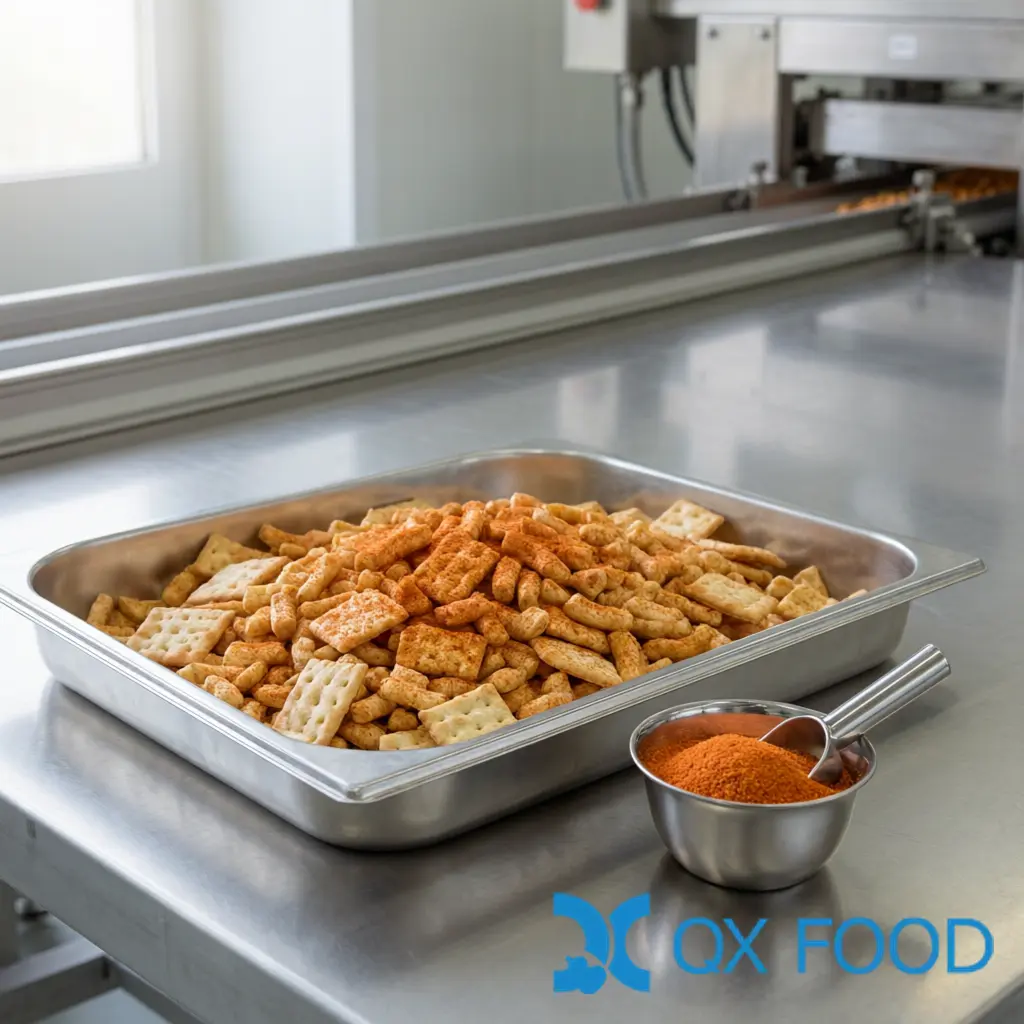
Quick answer. Seasoning pickup and retention are measurements, not settings. Pickup is the amount of seasoning carried by the product at a defined sampling point, expressed on a stated basis such as grams per kilogram. Retention is the fraction of that pickup still present after a defined handling or packing step. Both need a stated basis, a sampling plan and a test method; without them, two measurements that are each valid may not be comparable.
Most seasoning discussions inside a factory start with the blend. This one starts with the measurement, because seasoning pickup and retention are two of the most useful physical measurements for showing whether a coating system is performing consistently on your line. A snack can leave the drum looking right and still arrive at the packer short of flavor. It can also test well at the drum and lose a visible share of powder by the time a bag is sealed. Those are different failures, and they need different tests.
This guide covers how to measure seasoning pickup and retention with equipment most plants already have: a balance, a timer, sample trays, and a written procedure. It also covers what those numbers can and cannot tell you, which matters the moment a supplier claims a performance figure that was generated on someone else’s line.
Applied Dose Is a Setpoint; Pickup and Retention Are Measurements
Several quantities get mixed together in daily conversation, and they are not interchangeable. It is worth separating them on paper before the first trial, because a supplier and a buyer can use the same word for two different measurements.
The target dose, or setpoint, is what the feeder is set to deliver, usually expressed as a percentage of product mass. It says what you intended, not what landed.
The actual feed ratio is what the feeder really delivered against what the line really produced: seasoning mass fed into the application system divided by the product mass that passed through it during the same window. Many feeders totalize consumption and many checkweighers totalize product, so this is often the easiest number to obtain.
Pickup is the mass of seasoning the product is actually carrying at a defined sampling point. A pickup figure is meaningless without its denominator: grams of seasoning per kilogram of unseasoned base and grams per kilogram of finished seasoned product are different numbers with different uses. Choose one basis, state it, and keep it for every sample in the trial.
Transfer efficiency is a separate ratio: seasoning deposited on the product divided by the seasoning fed into the application system, expressed as a percentage. The term comes from the powder coating literature, where it is used to compare application methods and powder properties on a like-for-like basis (Barringer and Sumonsiri, 2015, Annual Review of Food Science and Technology). Pickup and transfer efficiency answer different questions. A line can show a healthy pickup while wasting a large share of what the feeder delivered, and the two figures will not tell the same story.
Retention is a ratio as well, and this is the one most often reported as a bare number. Retention is the pickup measured after a defined handling or packing step, divided by the reference pickup measured at the earlier sampling point, expressed as a percentage. Fallout is the remainder: 100 percent minus retention. A single post-handling figure cannot tell you whether retention was good or poor, because you cannot see how much was there to begin with. In this article, retention means powder that physically stays on the surface. It is not the same as flavor that survives an oven, which is a different question covered in our guide to seasoning systems for baked snacks.
The number without a basis is the problem. “We get 4 percent pickup” can mean 4 grams of seasoning per 100 grams of product, 4 grams per square meter of surface, or 4 grams per 100 pieces. Those are three different measurements, and a supplier who quotes one of them while your line needs another is not lying. They are answering a question you did not ask. Write the basis down first, then measure.
The five quantities in one place
- Actual feed ratio = seasoning fed ÷ product throughput
- Pickup = seasoning carried by the product ÷ stated product basis
- Transfer efficiency = seasoning deposited on the product ÷ seasoning fed to the applicator × 100%
- Retention = post-handling pickup ÷ reference pickup × 100%
- Fallout = 100% − retention
These five only compare when the basis, the pickup method and the sampling window are the same. Changing any one of them mid-trial produces numbers that look like data and are not comparable to anything.
Why the Target Addition Rate Cannot Predict the Bag
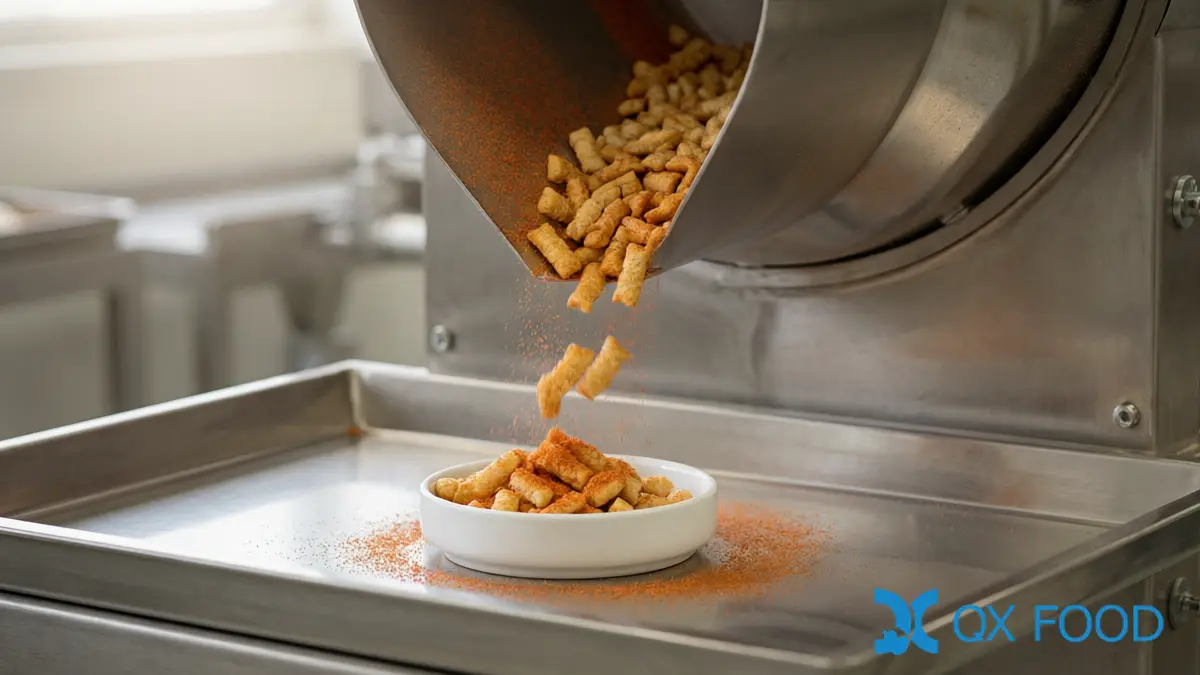
A feeder set to deliver a fixed percentage of seasoning gives you a fixed input. Everything downstream then decides how much of that input ends up where the consumer finds it. The short version: the feeder controls the input, and the rest of the line decides the outcome.
There are three broad places where seasoning goes missing. The first is the application itself: powder that never contacts the product, powder that bounces off a smooth or cold surface, powder that is pulled away by extraction air or static. The second is mechanical handling between the drum and the packer: transfers, drops, vibration, screening and other handling steps between the drum and packer. The third is packing and distribution: the fill step, the seal, vibration in a case, and the long ride to a distribution center.
Seasoning system suppliers describe the same list of suspects. KMG Systems, an equipment manufacturer, attributes seasoning fall-off to oil application and temperature, particle size relative to the snack surface, product temperature entering the drum, insufficient tumble time, static charge, airflow, over-dried surfaces, uneven seasoning delivery, and inconsistent product geometry (KMG Systems, What Causes Seasoning to Fall Off Snacks). That list is useful as a diagnostic menu. It is not a ranking, and the ranking is what matters on your line.
This is where most buyers trip up. Two plants can run the same blend at the same setpoint and report pickup numbers that differ by a wide margin, because the oil film, the product temperature, the dwell time and the surface roughness are not the same. The setpoint travels. The result does not.
Need a starting point for a trial? Send us the product geometry, the application method and the target dose. We can shortlist which seasoning specifications are worth testing first, and which powder properties to record during the run. Request application samples.
A Line-Side Protocol for Measuring Seasoning Pickup and Retention
The protocol below is written to run during normal production, using a balance and a small set of trays. It has five steps, and the order matters. The first run takes longer, because the method has to be established. Repeat trials become much faster once the sampling and handling procedure is standardized.
Step 1: Fix the basis and the units before anything is weighed
Decide whether the trial will report seasoning on a product-mass basis, a surface-area basis, or a per-piece basis, and keep it for the whole trial. A product-mass basis is the easiest to run and is the number that connects directly to your cost per kilogram. A surface-area basis is more informative when piece geometry changes, because a curled chip and a flat chip carry the same mass differently. A per-piece basis can be useful where piece mass and geometry are reasonably controlled and piece count is operationally meaningful. It becomes less comparable when breakage or size variation is high.
Do not skip this step. Record the basis, the target and the tolerance in the trial document, not on a whiteboard. A pickup result that cannot be compared with the next run is data you have to throw away.
Step 2: Run a weigh-in and weigh-out check at the seasoning system
The simplest measurement is a mass balance around the seasoning system: seasoning consumed versus product produced, over a defined window. Many feeders already totalize consumption, and a checkweigher totalizes product. Divide one by the other and you have the actual feed ratio for that period.
Read that number for what it is. It ignores powder that left the drum as dust, powder that recirculated, and powder that landed on the equipment rather than the product. It is an input check, and it belongs in the trial record as one. It is not pickup.
Step 3: Estimate pickup on sampled product with a validated removal method
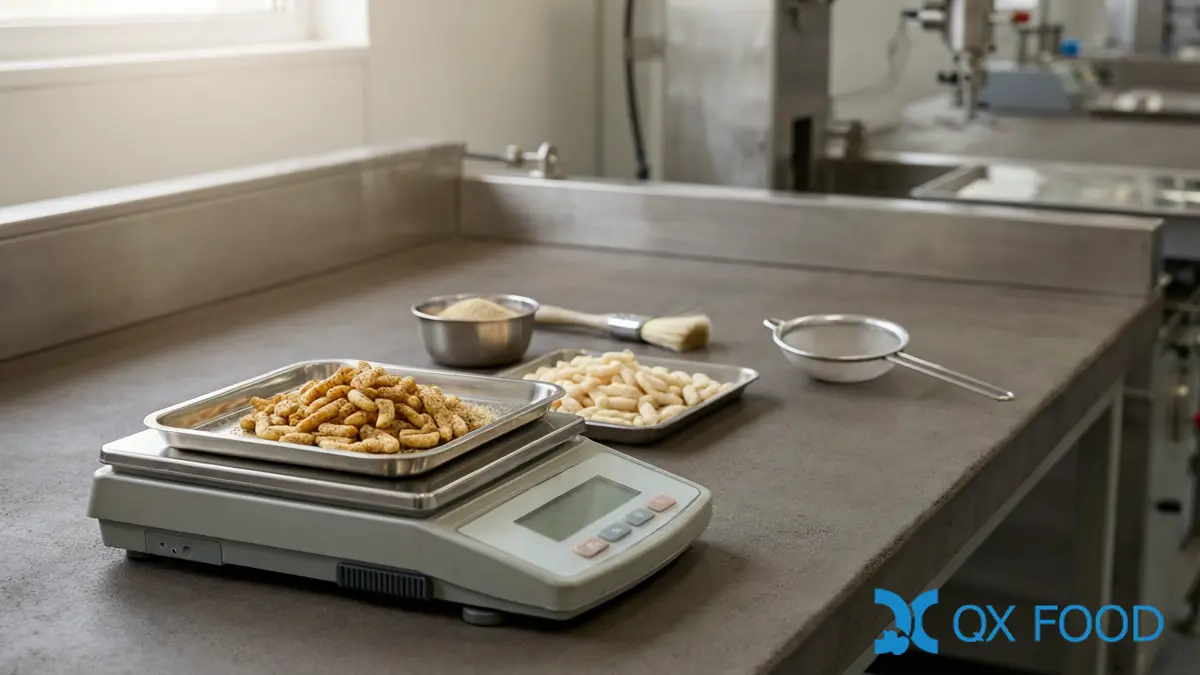
This is the step most plants start with, and it needs a removal method that is defined and repeatable. The principle is straightforward: weigh the sampled portion, remove the surface seasoning by a defined method, weigh again, and treat the difference as an estimate of the powder that was sitting on the surface. Estimate is the right word here. A gravimetric removal step is a line-side method, not an absolute measurement.
Removal methods in use include controlled brushing, a defined rinse or dissolution step, and careful scraping with a tool of fixed width. Each method has a bias, and the bias is why the method has to be written down and used consistently. A rinse that dissolves part of the base, or a brush that removes only the loose outer layer, will give a number. It will not give a number you can compare across two suppliers unless every sample is treated the same way.
Validate the method before you use it for a supplier comparison. Run the same procedure on unseasoned product first to see how much mass the brushing, rinsing or scraping step removes from the base itself. Then run a known-addition recovery check: add a weighed quantity of the same seasoning to unseasoned product and see how much of it the method recovers. Where practical, prepare the recovery sample with the same carrier, or with a defined application step that approximates production coating conditions. A simple dry spike tests the removal procedure, but it does not reproduce actual line adhesion. If the blank shows substantial base loss, or the recovery check recovers only part of a known addition, treat the result as an internal comparative number rather than an absolute pickup value. A method that dislodges crumbs, carries off some carrier oil or leaves embedded powder is still useful for ranking suppliers, as long as everyone knows what it is measuring.
Where the visual aspect matters as much as the mass, coverage can be assessed by image analysis or by a trained panel against reference photographs. Those methods describe distribution, not quantity, and they are useful precisely because a mass number can hide an uneven coat. A run with good average pickup and a patchy distribution is a different problem from a run with low pickup, and the test should be able to separate them.
One published research approach used controlled airflow in a wind tunnel: on fried tortilla chips, the amount of seasoning retained was measured as the chip was exposed to air at different flow rates, which isolates how much powder the surface can hold against a defined removal force (Enggalhardjo and Narsimhan, 2005, Journal of Food Science). You do not need a wind tunnel. You do need the same discipline: one defined force, applied the same way to every sample.
Step 4: Add a defined handling step to measure retention
Pickup measured at the first sampling point is the reference value. Retention is measured after the product has been through something. Pick one or two handling steps that represent your worst cases and make them repeatable: a fixed drop height onto a defined surface, a set number of minutes on a vibratory tray, a transfer that mirrors the real conveyor layout, or a filled and sealed bag that is shaken in a fixed pattern for a fixed time.
Because a gravimetric pickup method is destructive, the same physical pieces cannot be measured twice. Use matched sample groups instead. Collect a reference group at the first sampling point, and a matched group from the same production window after the defined handling step. Measure both groups with the same removal method and on the same basis. Retention is the post-handling pickup divided by the reference pickup, expressed as a percentage, and the pair of values is the deliverable. A single post-handling number tells you very little, because you cannot tell whether it is low because pickup was low or because retention was poor.
Step 5: Write a sampling plan for time and position, with repeats
Sampling is where most line trials lose their credibility. A sample taken at one moment from one place on the belt describes that moment and that place. Seasoning pickup and retention vary across the width of a conveyor, at the start and end of a run, between the first bag and the last bag of a packing cycle, and after any change in product temperature or throughput.
A workable plan stratifies the sample. Take samples at the start, through the middle and at the end of the run. Take them from more than one position across the product flow. Take bags from the start of a packing cycle, from the middle and from the end of it. Keep the sample size fixed within the trial so the pieces can be compared, and treat the spread of the results as a result in its own right. When a plant reports one pickup figure, the more useful question is usually how far the individual samples sat from that average.
Repeat the whole exercise on more than one production day before accepting a value as normal for the line. One run establishes a method; several runs establish a baseline. Buyers who evaluate a seasoning change on a single run are measuring that day as much as the powder.
The Variables That Move the Number
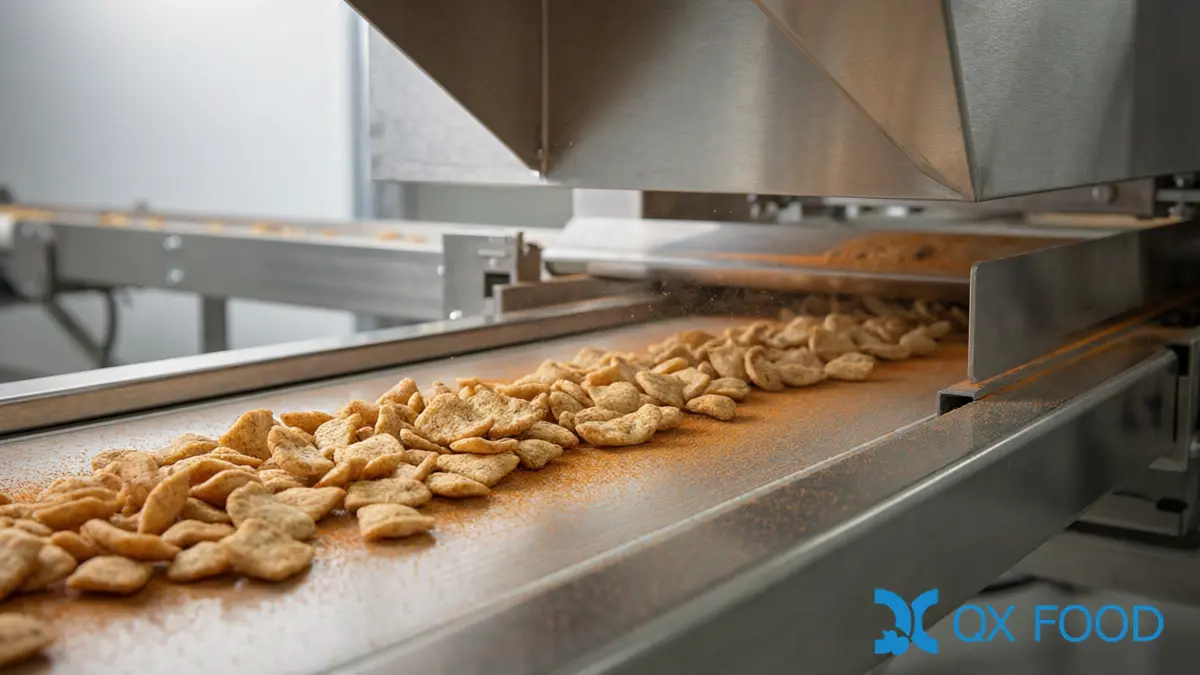
Once the method is fixed, the variables that shift seasoning pickup and retention fall into four groups.
The substrate carries the whole result: surface oil or moisture, roughness, porosity, piece temperature and geometry. A surface that has cooled during transfer is a different surface. Curls and rings present a different surface from flat pieces at the same mass.
The powder brings its own behaviour. Particle size distribution and density influence how a powder deposits, as do flowability and dustiness and how it is retained against a mechanical force, and the same properties decide how it behaves under electrostatic application (Barringer, 2013, Handbook of Food Powders). A blend that is milled finer is not automatically better on every line: finer powder can improve coverage on a rough surface and increase dust losses on a smooth one.
The application system sets the contact conditions: how the powder is delivered, whether a liquid carrier is applied first, how long the product is exposed to the seasoning, and how evenly the feeder meters at the actual throughput. Carrier systems differ in kind, from dry application onto residual surface oil through to water-based binding solutions, and the choice interacts with the label and the finished texture as well as with adhesion.
The environment changes deposition and retention conditions. Extraction and cooling airflow can physically remove powder, while static charge and plant humidity can alter how particles flow, deposit and stay attached. These are easy to overlook because they are not part of the blend or the recipe, and they can change when a line is reconfigured or a new extraction hood is installed.
The four groups do not rank the same way in every plant. That is the entire argument for measuring on your own line rather than adopting a figure from a supplier presentation. A supplier’s application data can tell you what a powder did under defined conditions. It cannot tell you what it will do under yours.
| Variable group | Where it acts | What to record in the trial |
|---|---|---|
| Substrate | Sets how much powder the surface can hold at the drum, and how firmly it holds it | Surface oil or moisture, piece temperature at the drum, geometry and surface texture |
| Powder | Decides how the powder deposits and how it resists a mechanical force later | Particle size distribution, moisture, density and flow-related values from the specification |
| Application system | Sets the contact conditions between powder and product | Application method and carrier, feed rate against actual throughput, exposure time in the applicator |
| Environment | Changes deposition and loss conditions at the drum and after it | Extraction and cooling airflow settings, static control, plant humidity |
Comparing Two Seasoning Suppliers on Performance
A taste test answers a sensory question. It does not answer the throughput question a procurement team is actually managing, which is whether a given powder delivers a target pickup on a specific base with an acceptable spread and an acceptable retention through packing.
A fair comparison needs the same discipline as any other controlled trial. Same base and same base lots, same target dose, same application method, same product temperature window, same handling step, same sampling plan, same endpoint. Run the two powders back to back in one session where the line permits it. Back-to-back trials reduce the risk that day-to-day line variation is mistaken for a supplier difference.
An equal dose isolates physical coating behaviour, which is what you want when the question is which powder deposits and holds better. It is not the right comparison for a procurement decision, because two seasoning systems at the same addition rate do not deliver the same finished flavour, the same salt level or the same colour. When the question is which system is better for the product, repeat the comparison at the use levels that deliver an equivalent finished sensory target. Otherwise a lower-potency seasoning can look physically efficient while still needing a higher commercial dose to reach the same flavour.
Ask each supplier for the specification values that describe the powder itself, and for application notes with the conditions stated. The particle size and moisture of a powder, and its flow-related values, are part of its identity; the conditions belong to the application note. When you compare, compare seasoning pickup and retention results computed on the same basis, and treat any figure without a stated basis as a marketing number rather than data.
This is the same framework we describe for qualifying a seasoning powder supplier, where line performance sits alongside documentation, traceability and change control rather than replacing them.
Why a Use Rate Does Not Transfer Between Bases
A use rate validated on one product is a result, not a property of the blend. Change the base from a fried corn pellet to a baked wheat cracker and you have changed the surface, the residual oil, the moisture and the geometry. Change the seasoning position from a post-bake dusting to an in-dough addition and the powder is now inside the matrix rather than on it.
The practical consequence for a buyer is that a supplier’s recommended use rate from a different application is a screening value. It is a reasonable place to start the first trial, and a poor place to end the discussion. Our breakdown of formulation by application covers how the required questions change when the application changes; the measurement protocol is what converts those questions into numbers.
Fallout After Packing: Reading the Bottom of the Bag
Powder at the bottom of a finished bag is a common complaint a snack plant hears from its own sales team, and it is also the easiest signal to misread. It can come from a weak initial pickup, from losses during conveying, from vibration during transport, or from a fill and seal step that shakes the product more than expected. The distinction matters because each cause is fixed in a different place.
The way to separate them is to measure seasoning pickup and retention at more than one point: after the drum, after the transfer to packing, and after a defined pack-and-vibrate step. If the number collapses between the drum and the packer, the handling path is the suspect. If it holds until the pack step, look at the filler and the seal. If it is already low at the drum, the issue sits in the application conditions, the carrier or the powder itself.
Retention through packing is also the number that governs how a claim travels. A seasoning system that performs on the line but loses its coating in a shipping case will produce inconsistent flavor at the point of consumption, which is exactly where the brand is judged. If the finished-product attribute matters after distribution, the trial has to include a simulated distribution step rather than ending at the packer.
What to Document After the Trial
Keep three documents separate, because they answer three different questions. The specification describes the grade and what it is intended for. A certificate of analysis reports the results for a specific lot against the parameters in the control plan. A trial report describes what a particular powder did on a particular line on particular days, with the method attached.
A trial result is not a specification value, and it is not a promise about the next batch. What it does do is record seasoning pickup and retention for your line under stated conditions, and give you a reference point: a line baseline, a method, and a record of the conditions. When a blend is reformulated, when a raw material source changes, or when the line speed is increased, that baseline is what tells you whether the change mattered.
Record at minimum: the base and its lot, the seasoning and its lot, the target dose and its basis, the application method and carrier, the product temperature window, the drum or applicator settings, the sampling plan, the handling step, the removal method for the pickup measurement, the endpoint used for sensory or color, and the raw results with the spread. Fifteen lines of notes will save a day of argument later.
Where QXFOOD Fits
QXFOOD supplies seasoning powders and savory ingredient systems for snack producers, including blends designed around surface application. Product-specific specifications and applicable batch documentation are available for the selected SKU. Particle characteristics, moisture, bulk properties and application guidance are provided where they are controlled or relevant to that grade and project. We do not publish a universal pickup figure, because a pickup figure belongs to a line.
For surface-seasoned snacks, the relevant lines include spicy chicken seasoning powder (WK9802) and spicy chili chicken seasoning powder (XLJ-002), which are used on chips, extruded snacks and coated nuts. Tomato-based systems such as sweet sour tomato seasoning powder (TMP-H15), tomato flavor seasoning powder (TMP-H17) and ketchup style seasoning powder (TMP-H18) cover the sweet-savory side of the same application. Where color carries part of the claim, paprika (PP-C13) and hot chili powder (HCP-C14) are the ingredient-side options, and chicken extract powder (CFP-H24) covers the savory base in a coating blend. Aromatic components such as onion powder (OP-B03) are often present at low levels in a coating blend, which is one reason a gravimetric trial reports total surface powder rather than individual components.
If the trial is designed around particle behaviour, the background reading in our guides to spice grinding and particle size, powder caking and flowability and seasoning granules versus powder explains how form and size are chosen before a line trial starts. For the blend architecture itself, compound seasoning production covers how batch consistency is held, and our HVP in snack seasonings guide covers the savory base side of a dry coating system.
If you are setting up the first trial, send the product geometry, the application method and the target dose. We will tell you which specifications are worth recording and which of our seasoning systems is worth testing first. Contact QXFOOD or ask for a specification sheet and a sample of the grade you are evaluating.
Frequently Asked Questions
What is the difference between seasoning pickup and retention?
Pickup is the amount of seasoning the product is carrying at a defined sampling point, stated on a defined basis. Retention is a ratio: the pickup measured after a defined handling or packing step divided by the reference pickup measured earlier, expressed as a percentage. A product can show good pickup and poor retention, which usually points at the transfer path or the packing step, or poor pickup and good retention, which points at the application conditions or the powder.
How do you measure seasoning pickup on a snack line?
Fix a basis first, then weigh a sampled portion, remove the surface seasoning by a defined method such as controlled brushing or a fixed rinse step, and weigh again. That calculation gives pickup at the sampling point. To calculate retention, repeat the same pickup method on matched samples after a defined handling step and divide the post-handling pickup by the reference pickup. Validate the removal method with a blank and a known-addition recovery check before you use it to compare suppliers.
What pickup rate should we target?
There is no universal target. A target has to come from the finished snack: the intended seasoning level at consumption, the losses your own line produces between the drum and the packer, and the cost you accept per kilogram of finished product. Set a tolerance band on your own line, verify it over several runs, and treat any external figure as a starting hypothesis.
Why does seasoning collect at the bottom of the bag?
Because powder that is not bound to the surface moves to the lowest point available once the product is agitated. The cause can be low initial pickup, losses during conveying, the fill and seal step, or vibration in transit. Measuring retention after the drum, after the transfer and after a defined pack-and-vibrate step tells you which of those is responsible.
Can we use the same use rate on a different snack base?
Only as a starting point. A use rate carries the surface it was measured on: the oil film, the temperature, the roughness and the geometry. Change the base and you change all four, so the pickup and retention have to be re-measured on the new product before the rate is treated as validated.
How do we compare two seasoning suppliers without a full sensory panel?
Run both powders on the same base, in the same session, at the same target dose, with the same sampling plan and the same handling step, and compare pickup and retention on one stated basis. Add a small trained panel or color measurement at the end if the claim depends on appearance or flavor, but keep the physical measurements as the primary comparison.
Does more oil always improve adhesion?
No. Oil applied as a carrier can help powder adhere, but application that is uneven or excessive creates its own problems, including powder that slides rather than binds, and it changes the fat content and mouthfeel of the finished snack. Equipment suppliers list oil application among the main causes of fallout for exactly this reason. The working level is a line result, not a fixed number.
What should a seasoning trial report contain?
The base and its lot, the seasoning and its lot, the target dose with its basis, the application method and carrier, the product temperature window, the main equipment settings, the sampling plan, the reference sampling point, the handling step used for the retention ratio, the removal method used for pickup, the endpoint for sensory or color, and the results with their spread. Attach the raw data. A trial report describes what happened on a line; it does not replace a specification or a certificate of analysis.