
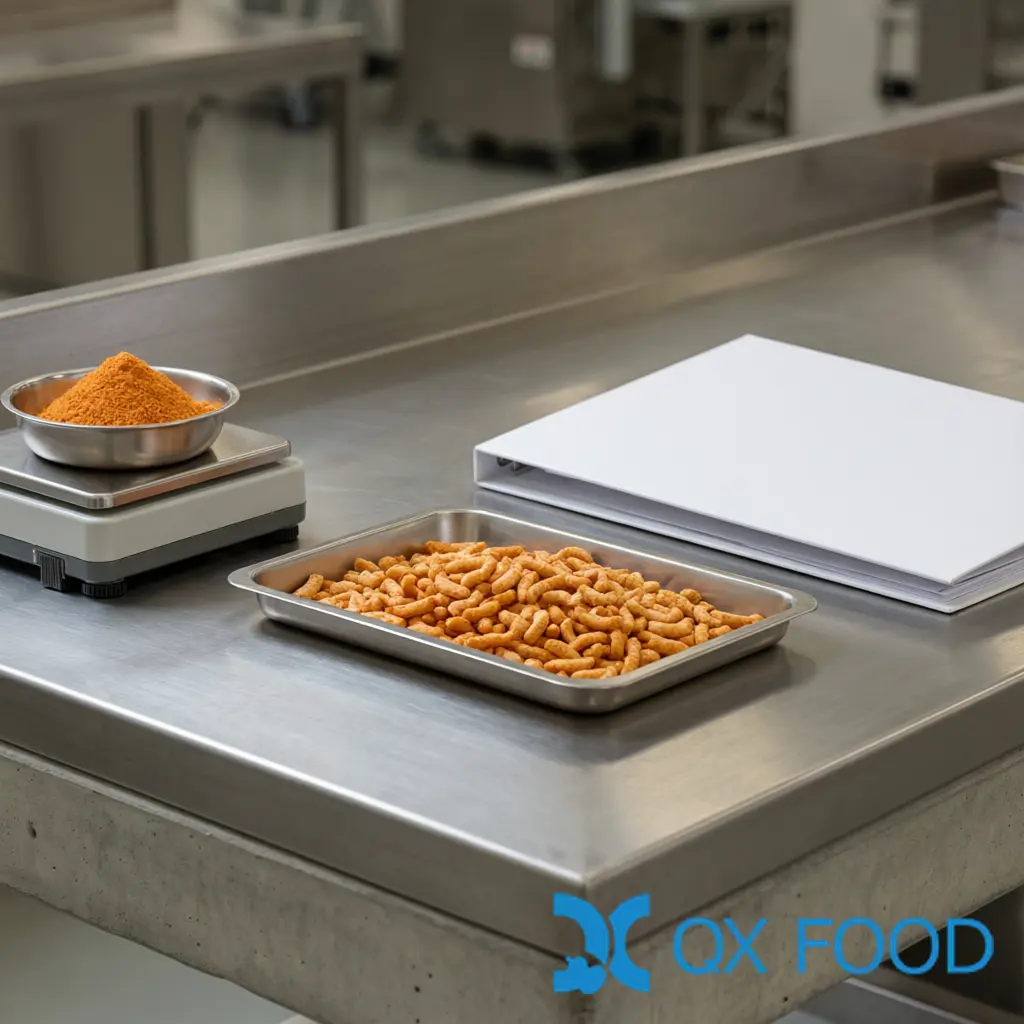
Quick answer. Seasoning cost per finished snack is not the price per kilogram. Three layers decide it: what the ingredient costs to land, how much the line consumes per unit of saleable output, and what process failure costs around it. The first two multiply into a direct material cost that already contains the powder that never lands; the third is added only where it is real.
A purchase order records a price per kilogram. The finished snack, the one that carries the brand, carries a cost per unit, and the two numbers are related only through the process. Everything in this article follows from that gap: what the gap contains, how to measure it, and which levers close it.
This is the last piece in a series that starts with where seasoning enters a baked snack process, moves through how much of it actually stays on the product and why powder leaves the piece, and ends with how to move the system from a trial to production. Cost is where all of it shows up in the accounts.
The Identity That Decides Everything
Start with the arithmetic, because it is not controversial and it removes most of the confusion. Four definitions cover the whole model, and the third one is where most cost models go wrong.
- Landed seasoning cost, per kilogram: the purchase price plus attributable freight; insurance; duty and import charges; taxes; handling. Supply-chain references define landed cost as the total cost of acquiring goods at a location rather than the invoice price alone (Oracle, what are landed costs).
- Direct seasoning material cost, per kilogram of saleable finished snack: total seasoning consumed multiplied by the landed cost, divided by saleable finished output. This is the number the rest of the article is about.
- Seasoning loss cost: seasoning consumed but not retained, multiplied by the landed cost. This is a diagnostic subset of the direct material cost, not a second cost to add on top of it.
- Total seasoning-system cost: the direct material cost, plus any carrier purchased and applied separately, plus attributable clean-up, downtime, rework, disposal, customer complaints, and returns.
The third definition is the one that keeps a cost model honest. Suppose a run consumes 100 kg of seasoning and 20 kg of that never ends up on saleable product. The direct material cost is calculated on the full 100 kg; the 20 kg is a diagnostic slice of that same spend, a fifth of it, and it belongs in the report to engineering rather than as an extra term in the sum. Adding it again charges the same powder twice.
To build the number for one product, pull four items from records that already exist:
- What the feeder consumed per finished unit over a defined production window, measured rather than assumed from the setpoint.
- The landed cost per kilogram of the powder actually used, on the same basis as the consumption figure.
- The split between what stayed on saleable product and what was lost, so the loss can be attacked as a diagnostic number inside the first item.
- The failure cost per unit: start-up purge and changeover waste, plus any batch that fails its sensory check and any credits from the last comparable period.
The first two multiply together, and the third tells you how much of that same spend never reached the bag. The fourth is the one plants most often leave out of the calculation, and it is the one that decides whether a cheaper blend is actually cheaper. If any of the four is missing, that is where the costing work starts, and on most lines the two that are missing are consumption measured against saleable output and the loss split.
Teams that manage seasoning cost well usually treat the price negotiation as the last step rather than the first. A blend that costs a little more per kilogram but delivers at a lower dose, or with less loss, can reduce seasoning cost per finished snack; a blend that costs less per kilogram and needs more of itself to reach the same taste does the opposite. The only way to know which one you have is to compare both systems at the same finished sensory target.
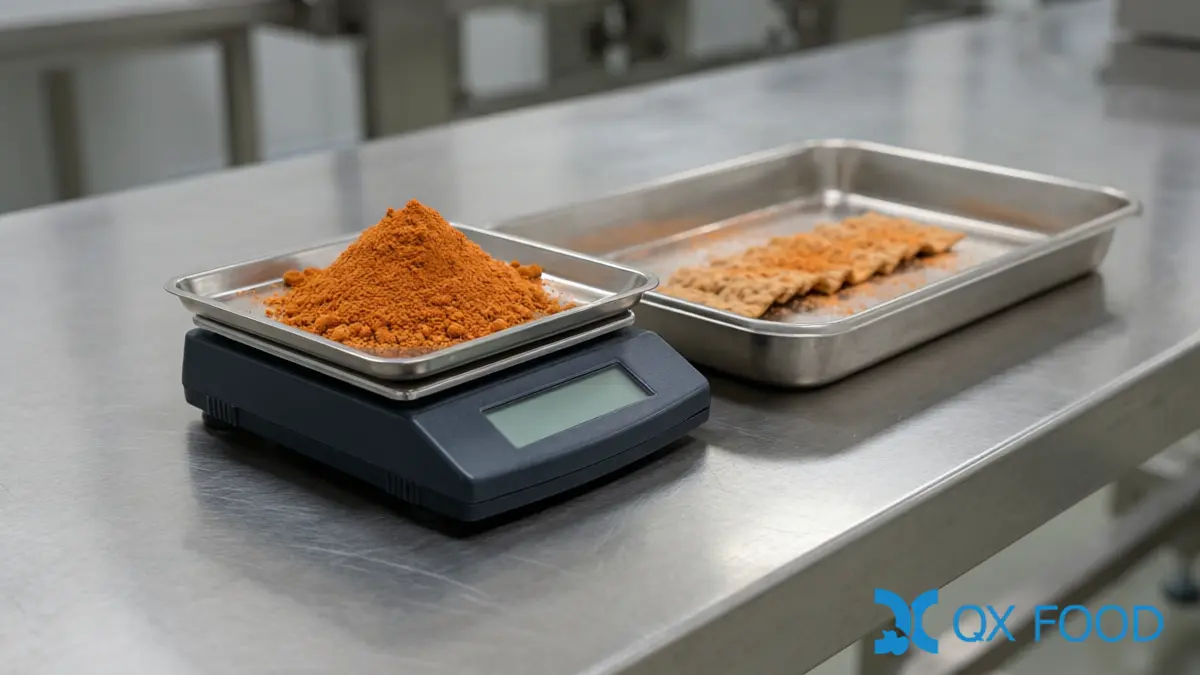
Layer One: What the Ingredient Costs to Land
The first layer is the only one a supplier controls directly, and it is the one that gets the most attention in negotiations and the least scrutiny in accounting. Purchase price is the visible part; freight, insurance, duty, import charges and taxes, plus attributable handling, complete the landed number, and they move with the Incoterm, the routing and the order size rather than with the formulation.
Two quotations are only comparable at this layer when both are stated on the same basis: the same unit of measure, the same currency and terms, and the same definition of what is included. A price that looks lower before freight and duty can arrive higher afterwards, and a supplier quoting delivered terms is offering a different product from one quoting ex works.
Layer Two: How Much the Line Actually Consumes
The second layer is where the arithmetic stops being a purchasing question. Seasoning cost per finished snack depends on the mass the line consumes to deliver the target per unit of saleable output, and that mass is a process result rather than a setting. It contains five things at once: the dose the finished sensory target requires, any over-application above that dose, powder lost before it reaches the product, powder lost after it has reached the product, and seasoning consumed on product that is never sold.
The required dose is set by how concentrated the flavour system is, how evenly it distributes, and how much of the target flavour comes from the seasoning rather than from the base. A system built on more carrier and less active material needs more of itself per finished unit, which multiplies directly into seasoning cost per finished snack. Where the powder is added on the line decides which of those factors dominates, as set out in where the powder meets the product.
Production rarely runs exactly at the number written on the line sheet. If a product reaches the flavour target only when the feeder is set above the nominal dose, the excess is not a rounding error; it is part of the consumption figure for as long as the line runs that way. Measuring it means separating the intent from the outcome: the setpoint, the actual feed ratio, what the product carries at a defined point, and the share of that which survives handling. Our guide to measuring pickup and retention sets out the four quantities and the sampling discipline behind them; the cost question is simply which of them the line has been letting drift.
One material question sits on the boundary between this layer and the next. If the carrier is part of the purchased seasoning blend, its cost is already embedded in the seasoning price. If oil, a binder or another carrier is purchased and applied separately on the line, cost it as a separate material line in the coating system, because the consumption figure for the blend will not contain it.
Where Seasoning Consumption Becomes Loss
Some loss happens before the powder ever reaches the product, and some happens after it has landed. Both consume seasoning and both are paid for, but they need different fixes, and lumping them together is how a plant ends up attacking the wrong end of the line. Application loss covers extraction and overspray, powder that deposits on equipment, and targeting loss where the applicator misses the product stream. Post-application fallout covers what was picked up and then left the surface: transfer points, vibration, filling and transport. The distinction is the same one the measurement guide draws between pickup and retention, and it is the difference between a dosing problem and an adhesion problem.
Whichever category the loss falls into, it stays inside the direct material cost rather than beside it. The economic argument for reducing it has been made in the coating literature for years: transfer efficiency is the ratio of powder deposited to powder fed, and improving it saves material without changing the formulation (Barringer and Sumonsiri, 2015, Annual Review of Food Science and Technology). What the loss costs is the lost mass multiplied by the landed cost, and what it earns is nothing; the diagnostic value is that it tells you where to work. The mechanisms behind it are set out in what makes the powder separate from the surface.
There is a second-order cost that rarely makes it into the calculation. Powder that fails to land does not simply disappear; it settles somewhere, and what settles on seals, film and product contact surfaces becomes a hygiene and foreign-material concern as well as a yield loss. Reducing loss therefore tends to reduce cleaning time, product holds and the risk of a rejected batch, none of which are visible in the price per kilogram.
Layer Three: What Process Failure Costs Around It
Here is the catch: the third layer is usually absent from the cost comparison entirely, and quality management has a framework for exactly this problem. The cost of quality is divided into prevention, appraisal, internal failure and external failure, and the purpose of the framework is not to assume that failure costs are always larger, but to make the trade-off visible: prevention and appraisal are intentional investments, while internal and external failures reveal what poor control actually costs in the plant and in the market (ASQ, cost of quality). Translated into a snack plant:
- Prevention: the sample trial, the carrier and feasibility work, the specification review, the line validation described in transferring a recipe from lab to line, and the measurement exercise that tells you where the loss is.
- Appraisal: incoming checks, batch documentation, retained samples, and the routine sampling that confirms a run is on target.
- Internal failure: start-up and changeover purge, product that fails its sensory check, rework, and the seasoning in the dust collection system.
- External failure: customer complaints about inconsistent flavour, credits and returns, and the cost of a flavour drift that reaches the market before it reaches your attention.
A lower ingredient quote can be economically attractive, but its value should be tested against any change it creates in dose, process stability, validation burden and failure cost. That is an argument for measuring before reformulating, not an argument against reformulating.
Build the Comparison in Three Cost Blocks
A quotation is a starting point, and the seasoning cost per finished snack depends on more than the number printed on it. Three blocks keep the comparison honest, because they behave differently: the first is negotiated, the second is engineered, and the third is managed.
- Landed ingredient cost: supplier unit price and its basis; freight; insurance; duty and import fees; attributable handling. Everything in this block is a purchasing variable, and the basis has to match on both sides of the comparison.
- Usage economics: the dose the finished target needs; the consumption the line actually achieves per unit of saleable output; transfer and retention performance; any carrier purchased and applied separately.
- Commercial and operational exposure: minimum order quantity; inventory and carrying cost; lead time; shelf life against your consumption rate; changeover losses; documentation and testing burden; failure and rework costs, plus complaints.
Batch variability belongs in the third block, and it deserves a caution. Variation between batches can create operating margin, additional testing, adjustment, rework or rejection depending on how the plant chooses to control it. Quantify the actual response on your line rather than assuming that variability always appears as extra dose.
| What looks cheaper | What it can hide | What to compare instead |
|---|---|---|
| A lower price per kilogram | A higher required dose to reach the same finished taste | Cost per finished unit at the dose each system actually needs |
| A blend with more carrier and less active material | More mass applied per unit, and more powder available to be lost | Delivery per unit of product at the same sensory target |
| A supplier who can hit a lower price by widening the specification | Batch variation that the plant has to absorb as margin, testing or rework | Batch data, and the cost of whatever control the variation forces |
| Cutting the trial short to save time | Failure costs booked later as complaints, rework or a failed launch | The validation evidence, priced against the cost of a failed run |
| A cheaper carrier or a lower carrier dose | Transfer loss and handling, plus label consequences if the carrier changes | Retention through a defined handling step, and the label review |

Where Seasoning Cost Reductions Usually Come From
The order below is a diagnostic sequence rather than a claim about implementation cost: it starts with measurement because measurement tells you which of the other levers is worth pulling, and where the loss sits decides which lever that is.
- Confirm what the line actually delivers. Verify the feeder at the operating rate, and separate setpoint from delivered dose. A control problem that is solved by adding dose stays solved only until the next price increase.
- Measure the loss before attacking it. Sampling at two points with a defined handling step turns a general complaint about dust into a number and shows whether the loss happens at the drum, on the way to the packer, or in the bag.
- Where measurement identifies a mechanical loss, investigate extraction, transfer heights, drop points and line settings before assuming a formulation change is required. Equipment work does not touch the label, but it is not automatically the cheaper option, so price it against the alternatives before committing.
- Manage changeovers and start-up purge. Every changeover generates non-representative product; where allergen, sanitation and carryover controls allow it, campaigning compatible flavour families reduces the amount of seasoning applied to product that will not be sold.
- Match the powder to the applicator and the substrate, then verify on the line. A particle-size distribution chosen for the application is a hypothesis about transfer efficiency, pickup, retention and coverage; it earns its place only when the line confirms the improvement.
- Test any reformulation at finished-product level. When a blend does change, the comparison has to be at the same sensory target and the same handling step, or the saving is an artefact of the test.
How QXFOOD Talks About Cost
We quote per kilogram and we can quote per project, but we cannot tell you what a given blend will cost per finished snack on a line we have never seen, because the answer depends on dose, transfer loss and validation rather than on our price list alone. What we can do is supply production-representative samples at the agreed specification, document the parameters that affect how the powder behaves in an applicator, and work through a trial with you so that the cost comparison is made on measured delivery rather than on assumptions.
Where a project starts from a formulation question rather than a price question, our guides to seasoning formulation by application and spice procurement and supplier qualification cover the selection side; our guide to seasoning granules and powders covers how form affects delivery.
Product routes for the applications discussed here: pepper salt seasoning powder, spicy chicken seasoning powder and tomato seasoning powder.
Frequently Asked Questions
How do you calculate seasoning cost per finished snack?
Multiply the seasoning the line consumes per unit of saleable finished output by the landed cost per kilogram, then add the failure costs that consumption drags with it. The mass is the measured one, not the setpoint, and the loss is a diagnostic part of that figure rather than an additional cost: the powder that never landed is already inside what the line consumed.
Why is price per kilogram a poor basis for comparing blends?
Because dose sits between the price and the finished unit. A blend that is cheaper per kilogram but needs a higher dose can cost more per snack, and a blend that is dearer per kilogram but delivers at a lower dose can cost less. The comparison only becomes meaningful when both systems are evaluated at the same finished sensory target.
Does a cheaper seasoning always reduce cost?
No. A lower price can come from many legitimate commercial or manufacturing factors, including scale, local raw material advantages, freight economics, contract terms and supplier efficiency. The relevant question is whether the lower-priced system still meets the same finished sensory target, specification, documentation, process performance and handling requirements at a lower total cost per finished product.
How much does over-application cost?
It scales with two things: the size of the excess and the price of the material. A line running a fraction above its target dose spends that fraction on every unit it produces, all year, without any of it appearing as a separate line in the accounts. The way to quantify it is to measure delivered dose against setpoint over a production window, not to estimate it from a spot check.
Do transfer losses really matter financially?
They are material paid for and never delivered, and the coating literature has treated transfer efficiency as an economic parameter for years. The financial size of the loss is the lost mass multiplied by the landed cost, read as a slice of the consumption figure rather than a charge on top of it, together with the clean-up and hygiene consequences of powder that settles where it should not. Before spending on a reformulation, it is worth measuring how much of the fed powder actually reaches the piece.
What belongs in the landed cost of a seasoning?
Strictly, the unit price plus freight, insurance, duty, import fees and taxes, plus attributable handling. The dose the system needs, packaging format, lead time, minimum order quantity, shelf life and documentation belong to the wider sourcing and usage comparison rather than to landed cost itself, and they still have to be counted somewhere, because a long lead time or an oversized minimum order becomes inventory cost whether or not it appears on the invoice.
How should two suppliers be compared on cost?
On the same base, the same application system and the same finished sensory target, with the same handling step in the retention test and the same documentation standard. Where a direct comparison is impossible, compare the delivered dose each system needs, the consumption per unit of saleable output and the loss each one shows, and let those numbers plus the landed price decide.
Can a supplier guarantee a cost reduction?
A supplier can hold the powder side of the system constant and can supply samples and documentation that make a trial possible, but seasoning cost per finished snack depends on your dose, your losses and your validation. Treat any guaranteed saving offered without a trial on your own line as a sales position rather than an engineering one.
The Short Version
Price per kilogram matters, but only after it is combined with what the line actually consumes per unit of saleable finished product. Measure the consumption, separate what stayed on the product from the diagnostic loss without charging for the same powder twice, add separately purchased carrier and failure costs where they are real, and compare suppliers at an equivalent finished sensory and quality target.