
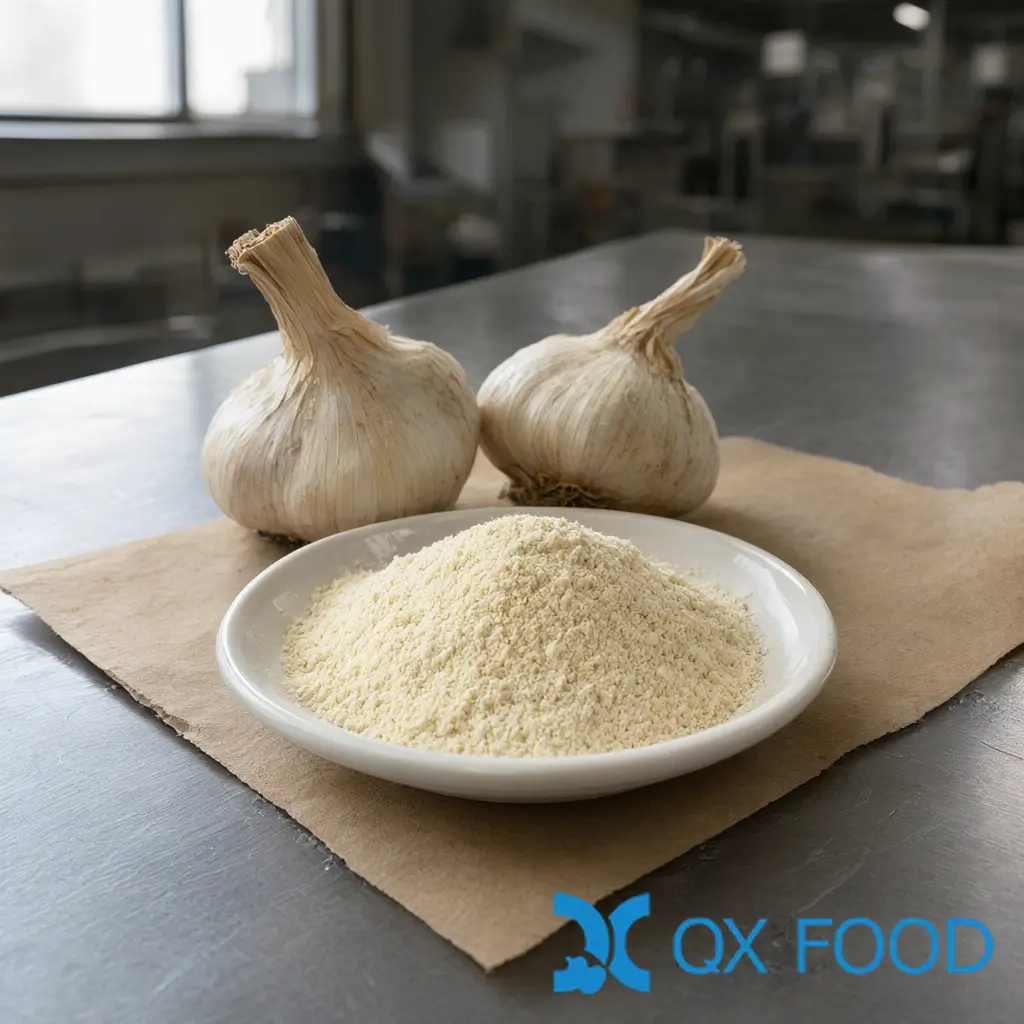
Two garlic powders can meet the same listed moisture, particle-size and microbiological limits yet perform differently in a sauce. One reads fresh and sharp, the other cooked and flat, and the certificate alone does not explain the gap. Garlic powder flavor processing is one reason: how the tissue is broken, heated, dried, and rehydrated changes which sulfur compounds survive. This guide explains those steps and what to ask suppliers when comparing grades.
How Garlic Powder Flavor Processing Changes the Clove
Garlic aroma is not stored in the clove as a finished molecule. It is built when cells are damaged, and it changes again when heat or water arrives. A review of sulfur-containing garlic flavours describes the compounds as chemically unstable and sensitive to thermal processing, fermentation, curing, and storage (Wu et al., 2026). That instability is why garlic powder flavor processing can send the same raw material out of two dryers as two different products.
| Stage | What can change | What it means in the powder |
|---|---|---|
| Intact clove | Precursors are kept apart in the cell | Little aroma until the tissue is damaged |
| Wet crushing (fresh tissue) | Enzymes meet their substrates in a watery matrix | Pungent thiosulfinates begin to form |
| Heating or blanching | Enzyme activity falls; some volatiles are lost | Fresh pungency drops; cooked notes can move forward |
| Drying | Water leaves and carries volatiles; some reactions continue | Dryer type and temperature leave a fingerprint |
| Dry milling (after drying) | Particle size falls and the matrix is no longer a fresh mash | Release rate and perceived intensity can change |
| Rehydration in the recipe | Residual enzyme and substrate meet again | Flavour can keep moving after mixing |
These are processing stages that can affect garlic flavor, not a universal production sequence. The order and intensity of slicing, crushing, heat treatment, drying, and milling vary by product. Review the route used for the selected grade before comparing its flavor performance.
The Intact Clove Has Almost No Garlic Aroma
A whole bulb smells mild because its flavour chemistry is compartmentalised. The odourless precursor alliin sits in the cell, and the enzyme alliinase is held separately. A second enzyme, gamma-glutamyl transpeptidase, acts on related precursors in the same system, and the blanching study measured its inactivation alongside alliinase. Damage to the tissue is what starts the sequence, and the review above treats that enzymatic route as the core of garlic flavour formation.
This matters for procurement because it explains why “100% garlic” says nothing about aroma, and why the flavour story starts before the dryer. Two powders can be pure garlic and still differ, because the raw material carries different precursor levels and because the process that follows is different. Genetics, growing conditions and storage before processing all shift the starting point (Wu et al., 2026).
Crushing Starts the Reaction, and Timing Sets the Character
When cells break, alliinase converts alliin into allicin and related thiosulfinates. Those sulfur compounds are the pungent, fresh part of garlic character (Lanzotti, 2006). Allicin is unstable, so the pungency rises quickly and then changes into other sulfur compounds as the material stands.
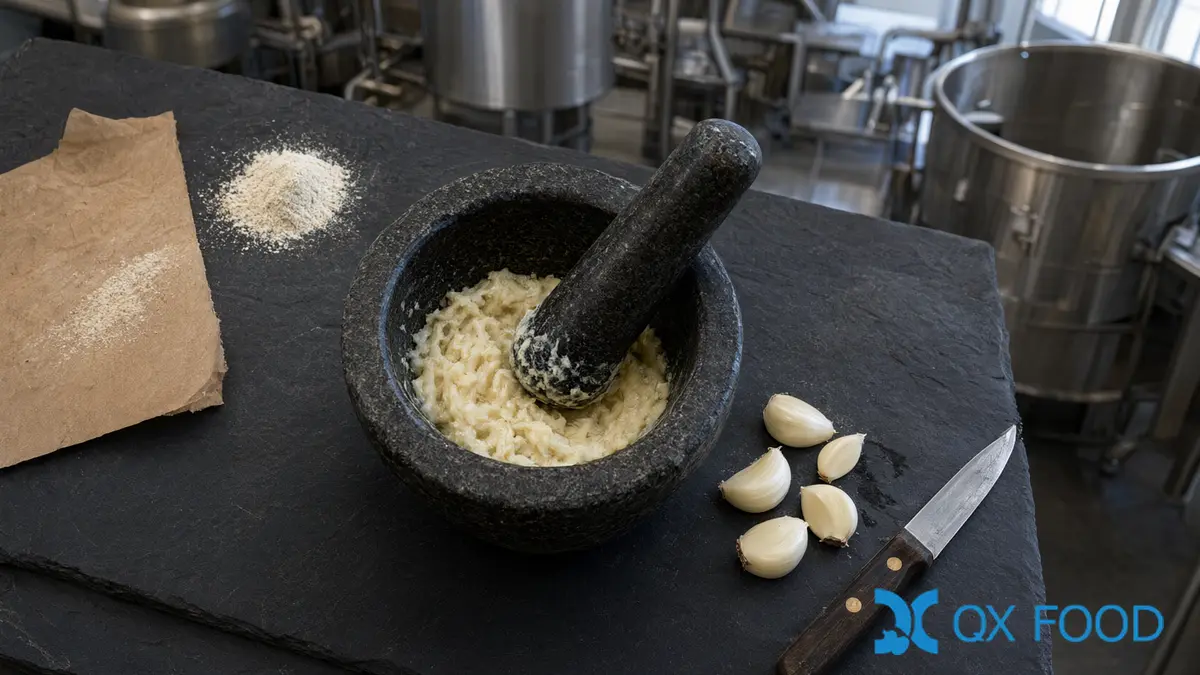
The practical variable is not whether the clove is broken, because it must be. The variable is when, and in what state. Crush fresh tissue and let the mash stand, and the fresh note develops before drying. Heat the tissue before disruption, and the alliinase activity available for later flavour formation can be lower. The extent depends on the actual treatment, so a blanched route is not automatically enzyme-free. Neither order is better on its own. A snack coating may want a sharp top note, while a retort sauce may want a stable cooked base that does not drift during processing.
Ask the supplier where crushing sits relative to heat. It is a single question that separates two products with otherwise identical certificates. Put simply, the dryer cannot undo the crushing decision.
Heat Decides Whether You Get Fresh or Cooked Garlic
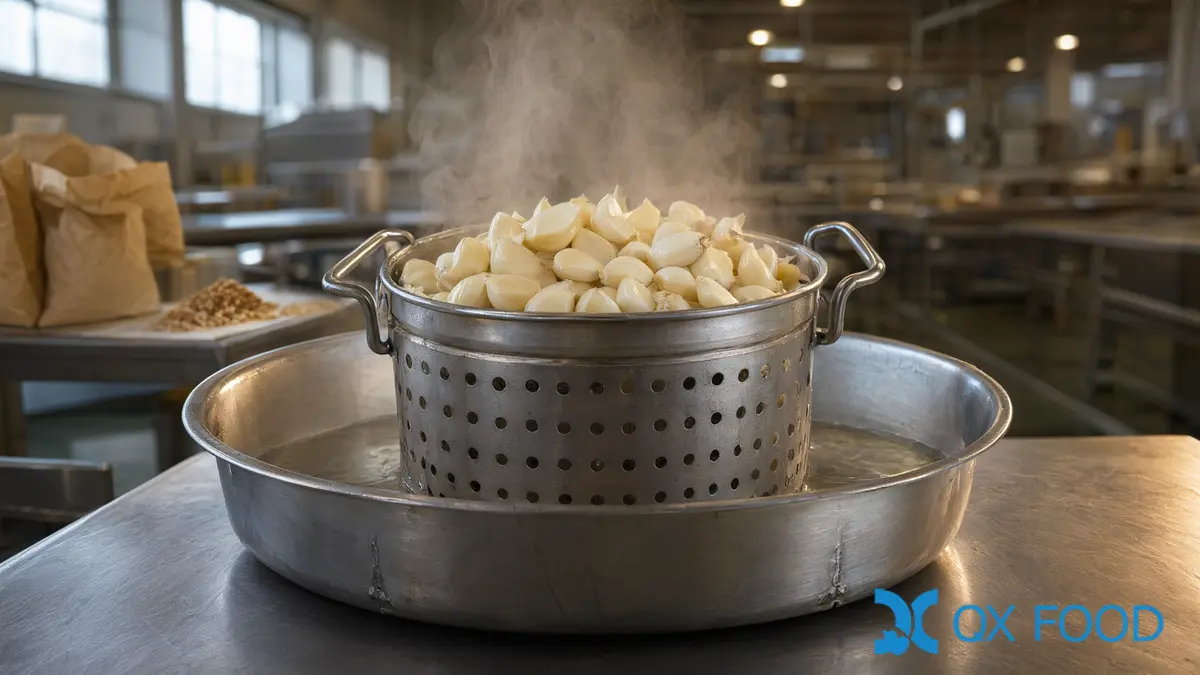
When blanching is used before drying, it can help control colour changes and reduce the enzyme activity associated with fresh pungency. The effect depends on the treatment conditions. A kinetic study on garlic puree found that alliinase and gamma-glutamyl transpeptidase were inactivated in a temperature- and time-dependent way, following first-order behaviour, and that allicin content fell by about 71% at 70 C, 80% at 80 C and 85% at 90 C after five minutes (Huang et al., 2019). These values describe the hot-water blanching conditions in that study. They are not loss rates for commercial garlic powder or for spray drying, and they do not measure an equivalent percentage decrease in perceived garlic flavor.
The same study reported that the puree turned white after blanching at 80 C for five minutes or 90 C for four minutes. That is a colour result, not a flavour result, but it shows how the two outcomes travel together: the step that protects appearance can also remove much of the enzyme potential behind fresh garlic notes.
Heat treatment can reduce fresh pungency and alter the sulfur-compound profile. The final balance between cooked and sweet notes, sulfury notes, and mild notes should be confirmed by sensory testing, because it depends on the actual treatment and the matrix. Roasted notes come from additional thermal chemistry and browning, which is a different route again. If a buyer expects fresh garlic from a blanched powder, the specification alone will not explain the disappointment.
The Dryer Removes Water and Moves the Volatiles
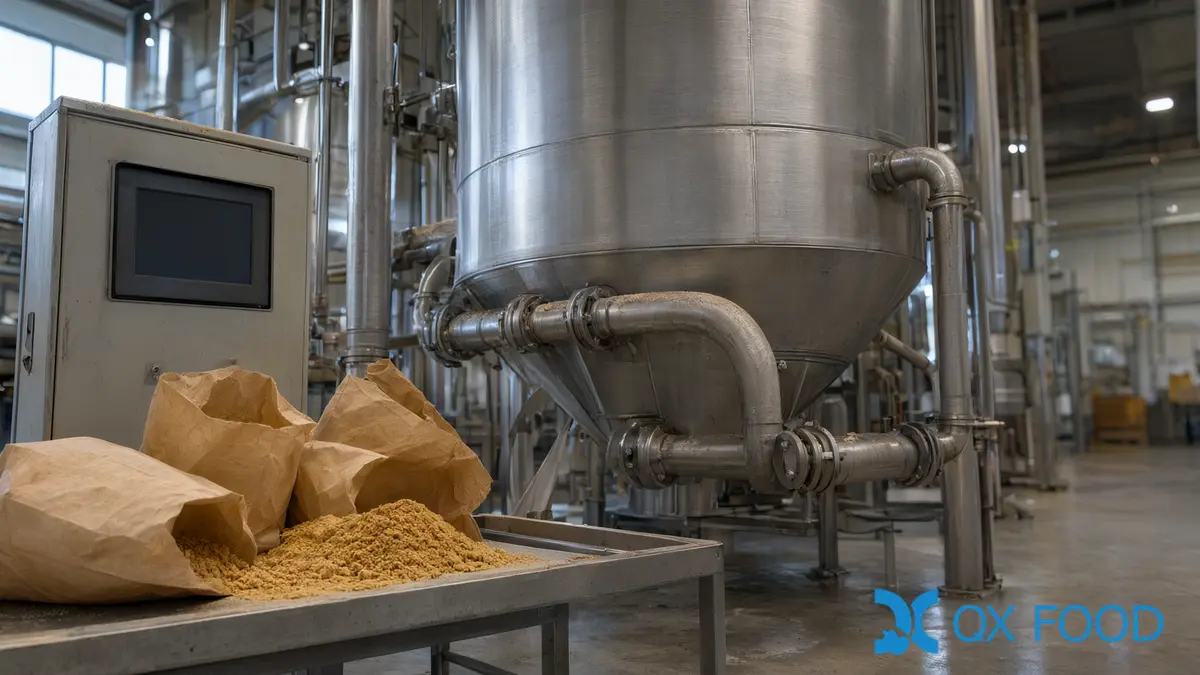
Drying is a separation process, and the water that leaves carries volatile compounds with it. It is the part of garlic powder flavor processing that buyers most often reduce to a single temperature number, yet temperature and time decide how much survives. In an infrared-drying study of garlic slices, measured thiosulfinate levels showed no significant change during drying at 50 C, 60 C or 70 C, while degradation was observed at 80 C (Zhou et al., 2017). Those findings apply to the tested conditions and do not establish a universal temperature limit for other drying methods or for spray-dryer inlet and outlet temperatures.
Dryer type also leaves its own signature. A comparison of five drying methods for garlic slices, vacuum freeze drying, hot air drying, infrared hot air drying, relative humidity drying and pulsed vacuum drying, found different flavour fingerprints and different rehydration capacities for the same raw material (Feng et al., 2021). The study did not include spray drying, so it compares those routes among themselves rather than against a spray-dried powder. Two suppliers can therefore both be honest about “dehydrated garlic” and still ship powders that behave differently in a roux or a marinade.
Spray drying sits inside this picture as a fast dehydration route: the feed is atomised into small droplets, hot air removes water quickly, and a carrier can be used to support the powder and limit losses. Speed helps, but it does not make the heat history irrelevant. Inlet and outlet temperatures, residence time in the chamber, feed concentration and carrier level all shape what survives. Ask for the route and the conditions, then confirm the result in your own matrix rather than assuming a dryer type guarantees a flavour. A spray-dried garlic ingredient is also a different product form from a dehydrated, milled powder, and the two should be compared as such.
Rehydration Restarts Part of the Chemistry
Rehydration is one stage of garlic powder flavor processing that buyers can control during application testing, and it is where a dry powder stops being a paused system. Subsequent cooking, holding, and storage can also change the aroma profile, so compare samples after the processing steps relevant to the finished food. Water activity is low, so enzyme activity and many reactions are limited. Add water in a sauce or a marinade and the system can move again: if any alliinase survived the heat step, it can convert residual alliin and generate new pungency over time. If the powder received a thorough heat treatment, little enzyme activity may remain and the flavour stays closer to the dried profile.
How far it moves depends on the product, not on a rule of thumb. The relevant conditions are the residual enzyme activity, the amount of substrate left, the water activity after mixing, the pH and temperature of the matrix, and the time between mixing and tasting. That is why a sauce sampled immediately can taste flatter than the same sauce sampled after thirty minutes, and why two powders can rank differently depending on the test.
The practical consequence is that rehydration belongs in the comparison. Fix the matrix, the dose, the temperature and the holding time, then taste. A sensory plan for that comparison is set out in the garlic powder sensory evaluation guide.
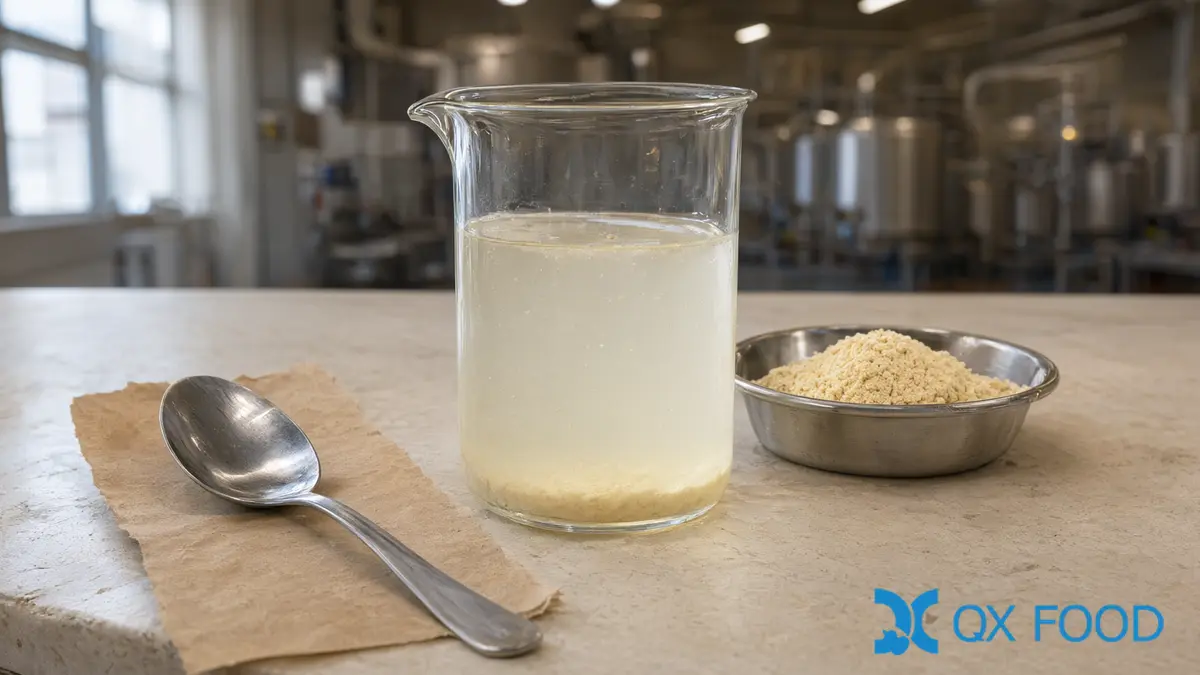
Two Powders, Same Specification, Different Flavor
The variables below explain most flavour gaps between powders that pass the same certificate, and they are garlic powder flavor processing choices that trip up a price comparison. They are process choices, not quality grades. Each one offers something and creates something to verify.
| Process choice | Potential benefit | What needs verification |
|---|---|---|
| Blanch before drying | More stable colour and lower enzyme activity | Fresh pungency and the final balance of cooked notes; actual residual enzyme |
| Crush before heat | Fresh, sharp top notes from thiosulfinates | Volatile losses in the dryer; flavour drift during holding |
| Lower drying temperature | May limit some thermal changes | Drying time, energy use and flavour retention depend on the method and endpoint |
| Higher-temperature drying | May shorten drying time and improve throughput | Flavour changes and microbial reduction require assessment under the actual operating conditions |
| Carrier in a spray-dried system | Flow and dispersion, plus some volatile retention | Dilution of garlic intensity; declaration changes |
| Long holding before packing | Simpler scheduling | Continued sulfur chemistry; aroma moves away from the reference |
What to Ask a Supplier Before You Compare Price
Routine specification and COA results do not necessarily predict flavour performance in a specific finished food. These questions map the garlic powder flavor processing route, and each one answers a decision you can act on.
| Question | Why it matters |
|---|---|
| Is the garlic blanched before drying, and at what stage? | Helps explain residual enzyme activity and the potential for fresh pungency after rehydration |
| Where does crushing sit relative to the heat step? | Sets how much allicin can form before enzyme activity falls |
| Which dryer type, and what is the heat history? | Explains volatile retention and the flavour fingerprint |
| Is a carrier used, and what does the declaration say? | Changes intensity and the label, not only the price |
| How should the powder be rehydrated for a fair sample? | Without a fixed matrix and hold time, tasting is not comparable |
| Can you supply an evaluation sample, and is a same-lot sample available? | Lets you compare flavour and specification on one material when a lot-specific comparison is needed |
These questions ask for the grade information a supplier can share, such as the declared ingredients, the processing route and the conditions that matter for flavour. They turn a flavour complaint into a specification conversation.
Selecting a Garlic Powder Grade from QX Food Ingredients
Evaluate each QX Food Ingredients garlic grade by its declared ingredients, processing route and intended application. The linked GP-W04 product is described on its page as sliced garlic that is dehydrated and then finely ground, so it is not a spray-dried powder and should not be judged as one. Confirm the current specification and the supporting documents available for the selected grade before comparing samples. Where a project needs a different granule size or a granulated rather than fine powder form, that is a specification conversation we can have, subject to sample approval and the current route for the grade.
Three existing guides cover the neighbouring questions. The garlic powder specification guide explains how to read moisture and mesh, plus the microbiology lines, before a purchase. The spray drying process guide covers the equipment and powder formation side. The spice grinding process guide covers particle size and milling, which interact with how quickly flavour is released.
If you are comparing a current supply against a sample, send the application, the processing conditions and the target garlic profile with the request. We can share the current specification, the ingredient declaration and an evaluation sample for the grade, and confirm what supporting information is available. If you need to compare a specific supply lot, ask about same-lot sample availability. The dehydrated garlic powder page lists the current product route.
Garlic Powder Flavor: Common Questions
Does drying temperature change garlic powder flavor?
Yes. Temperature and time decide how much of the sulfur volatile fraction survives drying in garlic powder flavor processing. In an infrared-drying study of garlic slices, thiosulfinates showed no significant change at 50 C, 60 C or 70 C, and degradation was observed at 80 C. Those results apply to the tested conditions and should not be read as a universal limit for other dryers or for spray-dryer air temperatures. Ask for the heat history and taste the result in your own matrix.
Why does one garlic powder smell stronger than another at the same mesh?
Mesh describes particle size, not the complete aroma profile. Differences in aroma-active compounds and their release can make one powder smell stronger than another. Raw materials and processing can contribute, and so can formulation and storage, so smell intensity alone does not establish how much of the original garlic aroma has been retained. Compare both powders under the same preparation conditions and in the intended food.
Is allicin listed on a garlic powder specification?
Check the grade rather than assuming. Allicin is unstable and is not a routine release line in every specification. Ask whether the grade reports it and which method and sample preparation are used. Routine specification and COA results do not necessarily predict flavour performance in a specific finished food.
Does blanching remove garlic flavor?
It reduces the enzyme activity behind fresh pungency rather than removing all flavour. Blanching inactivates alliinase and gamma-glutamyl transpeptidase, and allicin content falls with temperature and time. The final balance of cooked, sulfury, and sharp notes should be confirmed by sensory testing. A more cooked profile can be the right one for a retort or bakery application.
Does spray drying destroy garlic flavor?
No blanket answer is honest. Spray drying is a fast dehydration step, and fast drying helps limit losses, but inlet and outlet temperature, residence time, feed solids and carrier level all matter. A spray-dried ingredient is also a different product form from a dehydrated, milled powder. Ask for the conditions and compare the finished powder in the application instead of judging the dryer type by itself.
Can adding water bring back fresh garlic character?
Only partly, and only if enzyme survived the heat step. Rehydration can restart allicin formation from residual alliin, but the extent depends on residual activity and substrate, plus water activity, pH, temperature, and time. No fixed restoration percentage should be expected from a dried powder.
What is the difference between fresh, cooked, and roasted garlic notes?
Fresh notes come from the enzymatic route that produces thiosulfinates. Cooked notes reflect heat-inactivated enzyme plus thermal changes to the sulfur compounds. Roasted notes add browning and further thermal chemistry, which is a different route again. The same powder can sit anywhere on that map depending on how it was made.
How do I compare two garlic powders fairly?
Fix the matrix, the dose, the water activity, the temperature and the hold time, then taste blind and record the attributes. Compare against the same reference and repeat the test with a second lot. The sensory evaluation guide covers panel setup, the coding, and the difference between aroma screening and tasting in the finished food.
The Short Version
Garlic powder flavor processing is not one fixed order. The clove may be sliced, crushed or milled at different points, and heat treatment, drying, and rehydration each change the sulfur chemistry in ways that depend on the actual conditions. Crushing builds pungent thiosulfinates. Heat treatment can lower the enzyme activity behind fresh notes and shift the profile toward cooked character. The dryer removes water and some volatiles, with temperature and technique leaving a fingerprint. Rehydration can move the flavour again if enzyme activity remains. Ask for the route used for the grade and the conditions that matter, then confirm them in your own matrix, because routine specification results alone will not settle how the powder performs.