
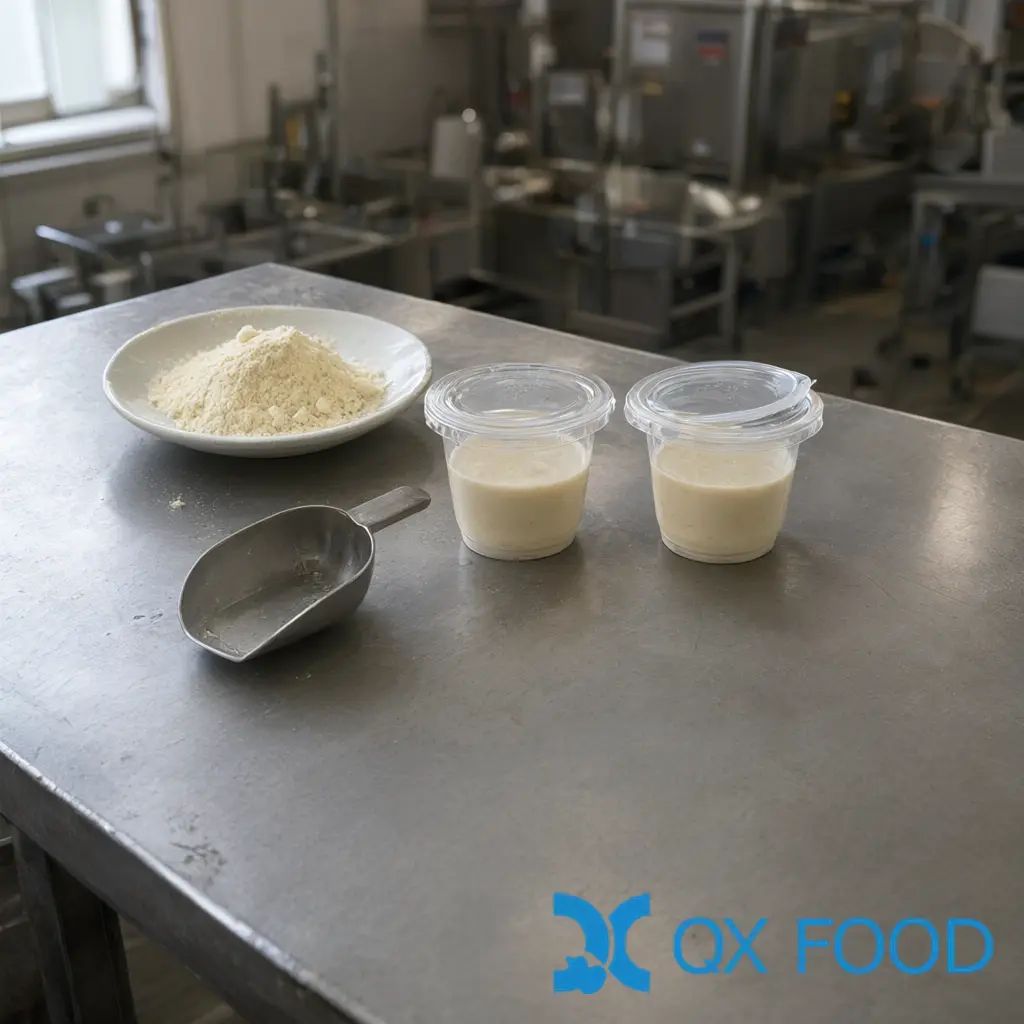
Garlic powder sensory evaluation answers a question a certificate cannot: what this powder does inside your food. The specification confirms identity and sets limits for moisture, ash, microbiology and other parameters. It does not tell you whether a sample reads as fresh-cut garlic or as cooked garlic after your sauce has been cooked and then held or cooled. This guide sets out a coded comparison you can run on your own bench or pilot line.
The comparison is not a taste-off between suppliers. It is a small process trial with fixed conditions, blind codes and a record that explains why one sample moved forward. Run it before commercial terms, not after.
The existing garlic powder specification guide covers the document side: moisture and sieve residue, ash content, sulfite declaration and micro counts. This article starts after those lines are acceptable and asks what happens in the finished food.
What a Garlic Powder Sensory Evaluation Has to Answer
Three questions, in this order. First, can anyone in the room tell the samples apart at the dose you actually use? Second, if they can, what character separates them: fresh-cut pungency, cooked or roasted sweetness, sulfury weight, green notes, bitterness or an off-note? Third, does that ranking survive your heat history, your hold time and a second lot?
A single overall score collapses these into one number and hides the reason behind it. The short version: a specification is a document test, and a sensory comparison is a process trial. Keep the three answers separate on the record, even when the same panel runs all of them in one session.
This is where most buyers trip up. A buyer asks for the strongest garlic aroma, receives a sample built for intensity, and later finds that the note dominates a delicate cream sauce or disappears after retorting. Intensity is one attribute, not the target.
Read the Declaration Before You Code the Samples
Hwang and Kim (2022) bought eight commercial garlic powders in Korea and analysed them by instrumental and descriptive methods. Two of the eight were not pure garlic: one declared 70% garlic with 30% corn flour, and another declared 33.4% garlic with bread powder and corn flour. The remaining six declared garlic only.
That detail changes the design of any comparison. If you weigh a 70% garlic blend against a 100% garlic powder at the same dose, part of the difference you measure is carrier. The first decision in garlic powder sensory evaluation is therefore what you are comparing, and on what basis.
Record the declared garlic content, the carrier, the allergen statement and the lot number before coding. Do not skip this step. Then write the comparison basis on the record. Each basis answers a different question, and a result without a stated basis cannot be repeated by anyone else.
| Comparison purpose | Basis to use | What the result supports |
|---|---|---|
| In-place substitution check | Same added weight of the commercial ingredient | What changes when the current addition level is held |
| Comparable garlic source | Comparable declaration and solids basis | A comparison of declared garlic content, not only the percentage on the label |
| Commercial selection | Amount of each candidate needed to reach the same finished-product target | Actual usage, cost and formulation impact |
A declared percentage is only comparable if it is calculated the same way, at comparable moisture, for the same type of starting material.
The specification and the lot COA tell you what the supplier controlled. They do not tell you what your panel will perceive. Keep both documents next to the record, but do not let a compliant sheet stand in for a tasting result.
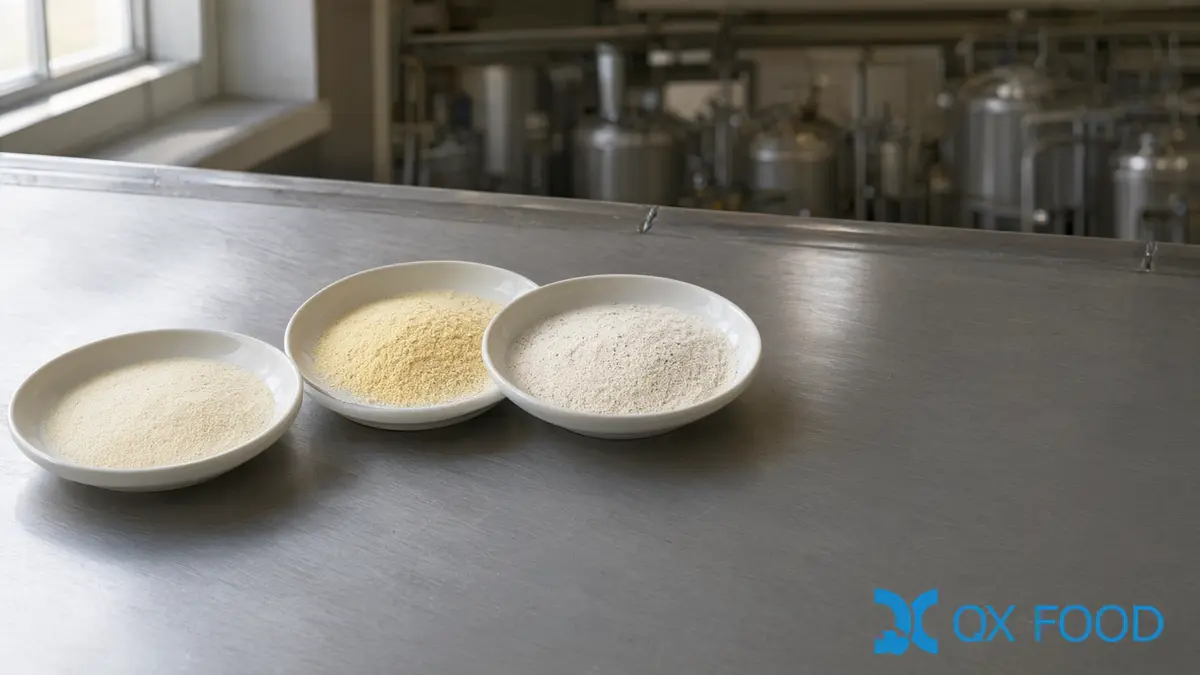
Fix the Finished-Food Conditions First
Choose one base that represents the product under development, and change nothing else between samples. The base composition changes how sulfur volatiles are released and how much aroma reaches the panel. A comparison across two different bases measures the bases, not the powders.
| Condition | Why it changes the answer | What to record |
|---|---|---|
| Base recipe and batch size | Base composition changes aroma release and mouth coating | Full base formula, batch weight, preparation date |
| Dose basis | Equal weight is not equal garlic when one sample contains a carrier | Grams per kilogram of finished food plus declared garlic content |
| Water and pH | Dilution and acidity shift the balance between sharp and cooked notes | Added water; final pH and, where relevant, titratable acidity, each with method and units |
| Fat and emulsifiers | Fat can carry and hold aroma, and it changes how the sample coats the mouth | Fat type and percentage in the base |
| Heat history | The same powder can read differently before and after cooking | Time, temperature, equipment and addition point |
| Holding and cooling | A sauce held hot or cooled overnight is a different sample | Hold time and temperature, cooling method, reheat cycle |
| Serving temperature and standing time | Serving temperature and standing time can change aroma release and perceived intensity | Temperature at tasting, minutes after preparation, minutes on the table before tasting |
| Panel and session | Fatigue and serving order change scores | Panel size, training, order design and rest between samples |
The application defines the questions; the selected SKU defines the specification values. That sentence comes from the seasoning formulation by application guide, and it applies here. There is no universal garlic sensory protocol that fits a dry rub, a retorted sauce and a chilled dip at the same time.
A garlic powder sensory evaluation without a fixed base is a preference poll. Fix the base, write the batch, and keep a reference sample of the base with no garlic added. The blank base tells you what the matrix contributes before any powder arrives.
Separate a Model-System Screen from the Finished-Food Test
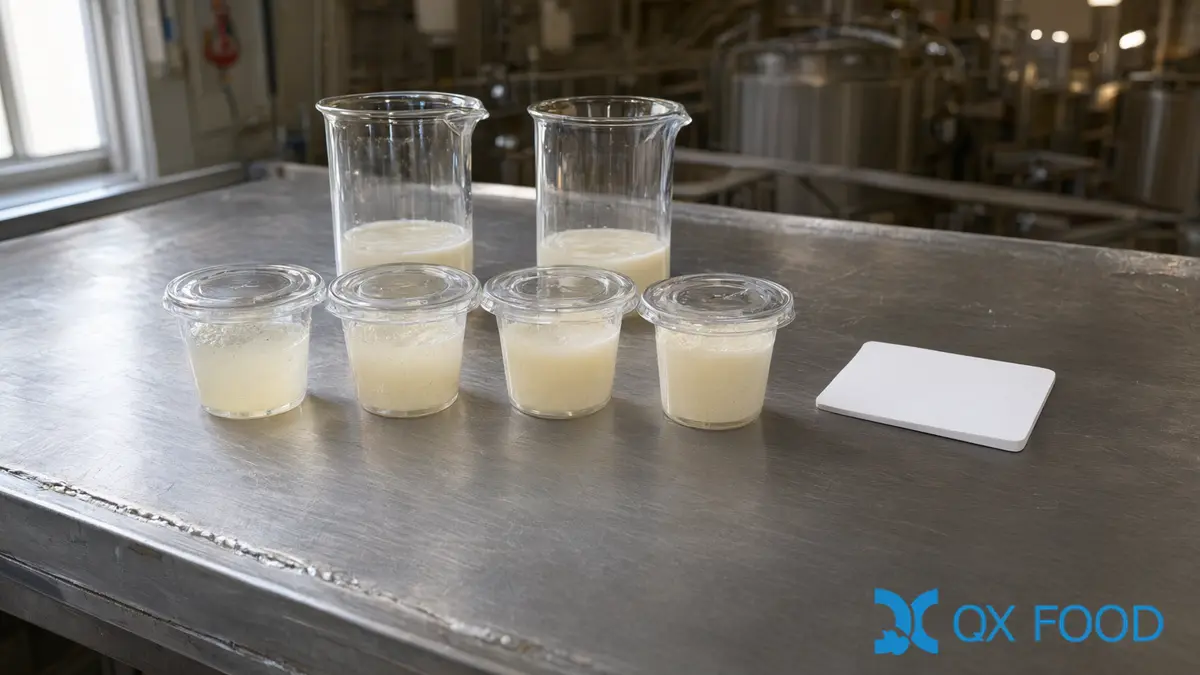
Hwang and Kim diluted each powder to 10% weight by volume in deodorized water, served 20 mL in 56 mL plastic cups with lids, prepared the samples one hour before evaluation and coded them with random three-digit numbers. That design isolates orthonasal aroma and is sensitive to small differences. It was a water-based aroma screen, not a cooked finished-food matrix. Ingredients already present in the commercial powders, including carriers such as corn flour or bread powder, remained part of the comparison. The finished-food tasting procedure proposed in this article is a separate application test and needs its own attributes, preparation conditions and food-safety clearance.
Use a dilution screen to shortlist samples, then confirm the shortlist in the real base. Report both stages. A sample that wins in water and disappears in a retorted sauce has told you something useful, but it has not told you that it is the better ingredient.
Lidded cups matter more than they look. The sulfur compounds you are judging are volatile, and an open cup on a bench loses them while the panel waits. The same logic applies in the finished-food test: cover the sample, note the time it was plated, and taste within the window you wrote down.
The dilution step in garlic powder sensory evaluation is a screen, not an approval. Keep the two stages on separate lines of the record so nobody later reads a screening score as a plant result.
Choose Attributes That Separate Fresh from Cooked
Hwang and Kim developed a 13-attribute orthonasal aroma lexicon for dried garlic powder. It covered fresh garlic, roasted garlic, steamed garlic, sweet aromatics, green onion, lemon peel, brothy, soy sauce, pasta water, oxidized oil, beef extract powder, plastic and menthol. Their fresh-garlic reference was freshly minced garlic. Their roasted-garlic reference was minced garlic heated at 200 °C for 30 minutes in a convection oven.
The chemistry behind the split is worth keeping in mind. Intact garlic contains odourless alliin. When cells are crushed, the enzyme alliinase converts alliin to allicin, the thiosulfinate most associated with fresh garlic odour. Thiosulfinates are unstable and break down into other sulfur compounds, and heat adds reactions of its own. Fresh and cooked are therefore separate attributes, not two ends of one strength scale.
The practical consequence is visible in their data. Two samples scored 1.67 and 1.80 for fresh-garlic aroma on a 15-point scale, while four other samples scored between 1.60 and 2.20 for roasted garlic. Same product category, different character. A buyer who asks only which sample is stronger will miss the difference that decides the application.
For a plant panel, a shorter list is easier to use consistently. Keep aroma apart from in-mouth assessment: fresh-cut pungency, cooked or sweet garlic, roasted or browned, sulfury weight, green or vegetal and one off-note row belong to aroma. Brothy or savory and bitter belong to the in-mouth assessment, together with any lingering heat or irritation. The in-mouth terms are an extension proposed here for finished-food tasting, not part of the published aroma lexicon. Define each attribute with a physical reference before the session, and agree the scale direction in advance. A panel that argues about what fresh means halfway through the session is measuring its own vocabulary.
A useful garlic powder sensory evaluation lexicon also names what you do not want. Oxidized oil and plastic appeared in the Korean samples, and the samples with carriers scored higher on pasta water and oxidized oil notes. An off-note row gives the panel permission to report those characters instead of forcing every sample into a garlic-only vocabulary.
Coded Samples and an Order You Can Defend
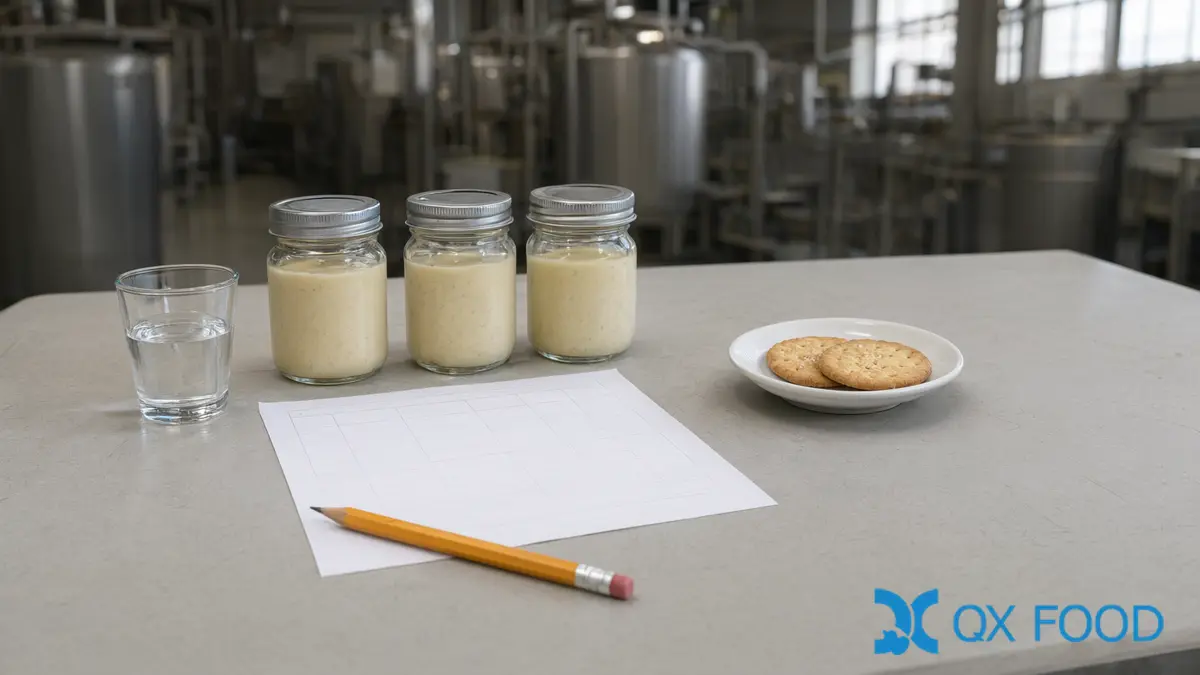
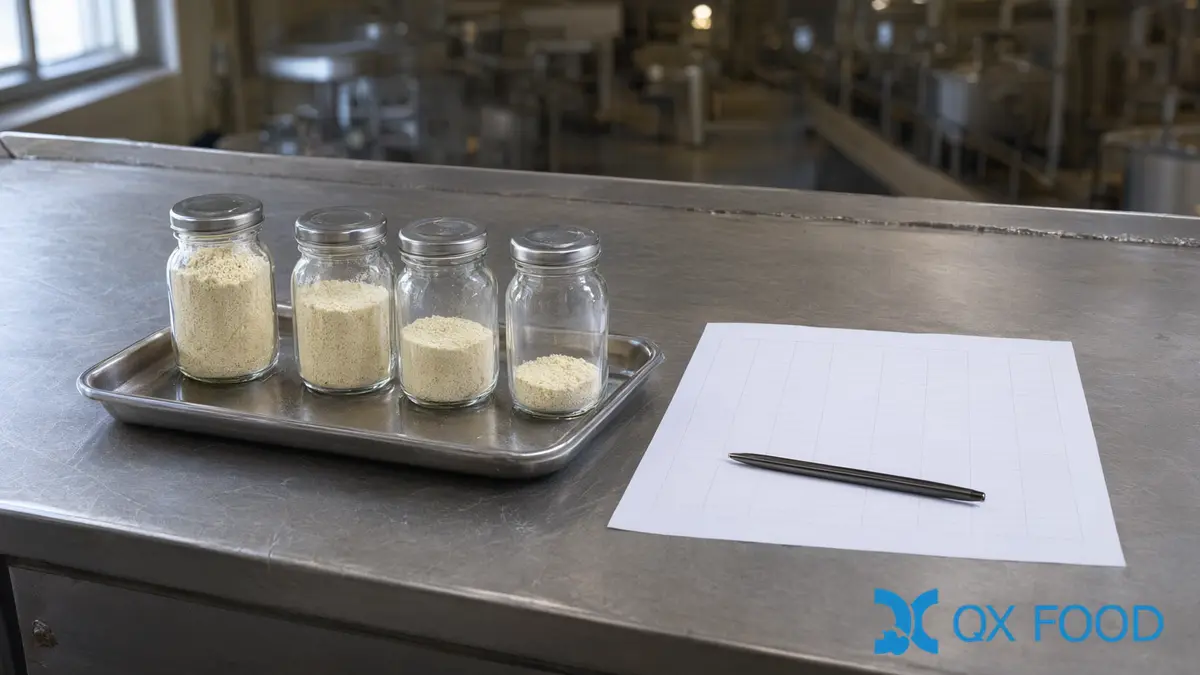
Code every sample with a random three-digit number, and re-code in each session. The person who prepares the samples should not taste them. The panel should not see the code map until the scores are locked. Serve in random or Latin-square order, ask panelists to rest between samples, and keep the set small enough that fatigue does not decide the result.
Hwang and Kim used six highly trained panelists, three evaluations per sample and at least five minutes between samples. That is a research design, and it is a useful benchmark for what a defensible descriptive panel looks like. A small internal panel can support screening, but the strength of any statistical conclusion depends on the test design and effective sample size, the independence of observations, and a pre-specified analysis, not on the number of people alone.
Match the test to the question before the session starts. ISO 4120:2021 sets out the triangle test for determining whether a perceptible difference or similarity exists between two samples. ISO 8587:2006 covers ranking, which places samples in order by an attribute but, as the standard states, does not establish the size of the difference. ISO 13299:2016 gives guidance on establishing a sensory profile, which is the tool for direction and intensity. ISO 8586:2023 covers the selection and training of assessors.
Triangle testing is one option, not a mandatory first step. It works well when samples can be presented homogeneously; a strong lingering garlic aftertaste can carry over between samples, so check that condition before choosing the test. Write the chosen method on the record. If the result later travels to a customer, the method is what makes it readable. A score without a method is an opinion with a decimal point.
| What is repeated | What it checks | What it cannot replace |
|---|---|---|
| Repeated evaluation of the same prepared sample | Assessor consistency and session effects | Repeatability of independent sample preparation |
| Independently prepared food samples | Whether the formula and preparation can be reproduced | Different production lots of the ingredient |
| Ingredient from different production lots | Whether lot variation changes the finished food | Validation of other processes and markets |
Heat History Is Part of the Sample
A garlic powder does not carry one fixed flavour. Drying conditions change the aroma profile: a study of drying time in garlic seasoning powder reported changes in the aroma and in descriptive attributes that included toasted, pungent, cooked garlic, burnt and herbal notes (Li et al., 2021). A comparison of drying techniques also found differences in rehydration and flavour characteristics (Feng et al., 2021). Your process adds another layer on top.
Evaluate the ingredient under the intended manufacturing and serving conditions. An alternative addition point can be included as a development control where useful, but it is not automatically an approved production route. Taste only samples cleared under the site’s food-safety procedures, including appropriate controls for any ingredient added after the heat step; FDA risk profile for pathogens and filth in spices sets out the microbiological hazards that those procedures have to address. Where the product is held hot, cooled overnight or reheated, include those conditions in the trial. Record the time and temperature of each condition, and do not borrow another plant’s numbers.
Do not assume that heat always flattens garlic. The direction depends on the powder, the matrix and the time-temperature history. That is exactly what the comparison is for. The heat step belongs inside the garlic powder sensory evaluation, not after it.
The mechanism behind those changes is a separate question, and it is not needed to run a good comparison. What matters here is whether the ranking you measured survives the conditions you actually run.
Record Enough to Explain the Result
| Field | What to enter | Why it matters |
|---|---|---|
| Sample code | Random three-digit code, re-coded each session | Separates the sample from the supplier name during scoring |
| Supplier and lot | Supplier, production lot, receipt date | Ties the result to a lot, not to a brand |
| Declared garlic content | Percentage of garlic and any carrier | Prevents weight-for-weight comparisons of unlike products |
| Documents checked | Specification and COA reference | Shows what was known before tasting |
| Dose basis | Grams per kilogram of finished food | Makes the comparison repeatable |
| Base and batch | Base formula, batch weight, preparation date | Confirms that only the powder changed |
| Heat history | Time, temperature, equipment, addition point | Defines the sample that was actually tasted |
| Time point | Minutes after preparation, serving temperature | Captures the decay that changes conclusions |
| Aroma attributes | Orthonasal terms, scale, reference anchors, replicate number | Keeps odour separate from taste and irritation |
| In-mouth attributes | Taste and irritation terms, plus aftertaste | Captures what the aroma score cannot show |
| Sample release status | Aroma only, or cleared for tasting under site food-safety procedures | Prevents tasting a sample that was not released |
| Preparation ID | Independent preparation number, rather than a cup number | Separates a repeated tasting from a repeated preparation |
| Free comment | Panelist’s own words | Explains a score that looks odd in the table |
| Decision | Advance, hold or reject, with reason | Prevents a later rewrite of the outcome |
| People | Who prepared, who tasted, who unblinded | Makes the record auditable |
A blank record is more useful than a filled example. Fill your own numbers. Do not copy a supplier’s trial sheet, and do not let a sales presentation become the record of your own comparison.
Turn the Comparison into a Sourcing Decision
Run the decision in four steps. First, test for a difference at the dose you use. A non-significant difference test means that the study did not detect a difference under its stated conditions; it does not by itself establish sensory similarity. If the purchasing decision requires evidence of similarity, define that objective, the acceptable difference and the statistical power and sample size before testing. Second, test for direction. Write the must-have attributes and the tolerable trade-offs before the codes are broken, so the target is not invented after the scores arrive.
Third, test robustness. Supplier approval should follow the agreed qualification plan. Where sensory consistency matters, evaluate multiple production lots and the relevant processing conditions; the number of lots and repetitions should reflect the decision and its risk. A ranking that reverses between lots is not a sourcing result. Fourth, compare commercial terms against an equivalent finished-product sensory target rather than equal weight. The supplier evaluation framework covers the document and qualification side of that decision.
Garlic powder sensory evaluation ends in a decision, not a score sheet. One session is a screening result. Lot-to-lot consistency is a trend across lots, and it is not something a single panel day can establish.
The measurement discipline is the same one used for coating performance: define the basis, define the handling, and report the variability rather than a single number. The pickup and retention measurement guide makes the same argument for a different measurement problem.
Errors That Make the Result Meaningless
- Treating equal ingredient weight as equal garlic content without checking the declaration and reporting basis.
- Reporting a non-significant difference test as proof that two samples are similar.
- Tasting dry powder from the palm, where the dose is not the dose in the food and the panel burns out.
- Letting supplier names or prices show on the cups.
- Using one time point for a product that is held, cooled or reheated.
- Changing the base, the water or the salt between samples.
- Running too many samples in one session and calling the last scores data.
- Treating a stronger garlic note as better quality.
- Approving a supplier from one lot and one session.
What QXFOOD Can and Cannot Provide
QXFOOD offers GP-W04 and GP-B06 as separately specified garlic powder grades. Both are published products with their own specification pages. Confirm the current ingredient declaration and production route, and the applicable batch documentation, for the sample being evaluated.
We can send samples and the documents that accompany them: the specification, the lot COA, and the allergen and carrier information for the grade under consideration. We cannot hand you a sensory score we did not measure, and we will not tell you that a grade will perform in your sauce without your own trial. The comparison belongs in your plant, on your base, with your heat history.
If the standard grade does not fit the development brief, QXFOOD can discuss formulation and flavour directions. Any change remains subject to technical feasibility, sample validation, agreed specifications and batch verification.
FAQ: Garlic Powder Sensory Evaluation
What can a garlic powder sensory evaluation tell me that a specification cannot?
It tells you how a sample behaves in a defined food system: whether a difference is perceptible at your dose, which character dominates, and whether that character survives your heat history. A non-significant difference test does not prove similarity; it means the test did not detect a difference under its stated conditions. A specification describes identity and controlled parameters. It cannot predict perception in your matrix.
Should garlic powder be tasted dry?
No. Dry tasting does not represent the dose in the finished food, it rapidly fatigues the panel, and it gives no information about heat or matrix effects. Use a dilution screen to shortlist, then confirm in the base you actually produce.
How many samples should one session compare?
Keep the set small enough that fatigue and carry-over do not decide the result. The exact number depends on the method, the attribute list and the panel. Hwang and Kim used eight samples with six trained panelists and three evaluations per sample, with rest between samples. A bench panel should use fewer samples and should not claim more than it tested.
What is the difference between fresh-garlic and roasted-garlic notes in a powder?
They are separate aroma attributes with different reference standards. Hwang and Kim linked fresh-garlic aroma to dimethyl disulfide and allyl methyl trisulfide, and roasted-garlic aroma to allyl dimethyl trisulfide. In their samples, some powders scored high for fresh garlic while others scored high for roasted garlic, so the two characters are not a single strength scale.
Do I need a trained panel to run a garlic powder sensory evaluation?
It depends on the claim you want to make. A triangle test or a ranking test can be run with screened assessors under a defined method. A descriptive profile that reports direction and intensity needs trained assessors and a defined lexicon. A small internal bench panel is useful for screening, but it is not a trained descriptive panel and should not be reported as one.
How do I compare a 100% garlic powder with a blend that contains a carrier?
Choose the basis first. Compare at equal garlic content, at equal delivered aroma, or at equal cost in the finished formula, and record which basis you used. Weight-for-weight comparison of a 70% garlic blend against a 100% garlic powder measures the carrier as much as the garlic.
Can one tasting session approve a supplier?
No. One session is a screening result. Supplier approval should follow an agreed qualification plan that includes multiple production lots where sensory consistency matters, a look at lot-to-lot COA trends and a line trial in your own process. The sensory comparison is one input to that decision, not a substitute for it.
Does a stronger garlic note mean better quality?
No. The target is the profile your product needs at the dose you use. A powder built for maximum intensity can dominate a delicate sauce or collapse after heat. Match the character to the application and confirm it in the finished food.
Discuss the Sample With QXFOOD
Share the finished food, the base recipe, the heat history, the samples you are comparing and the destination market. Our global trade division will respond within 1 business day.
Send the application, the reference ingredient, the process conditions and the annual volume. We will reply with the documents and sample options that fit that brief.