
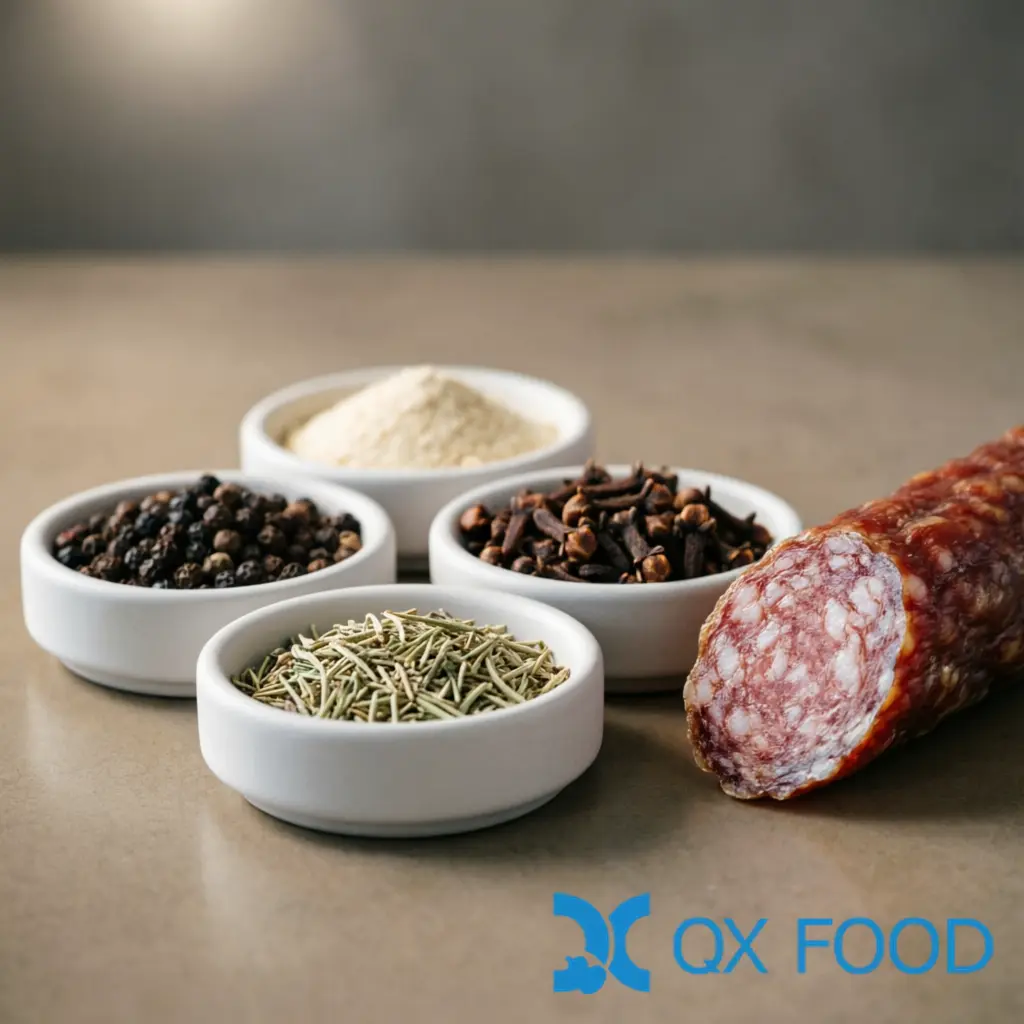
Meat processing spice procurement starts from the intended function of the selected ingredient and the hazard analysis of the finished product. Spices used in meat products can affect flavor, appearance, process performance, microbiological risk and labeling, but not every spice performs all of those functions. Procurement should therefore be built from product risk, ingredient specification, supplier evidence, process validation and traceability, rather than from one universal “meat-grade” specification.
Quick answer. Meat processing does not create one universal “meat-grade spice specification.” The meat product, its process, the hazard analysis and the intended spice function determine what has to be specified and verified. The application defines the questions; the selected SKU defines the specification values.
Checkpoint 1: Build a Product-Specific Specification
For meat processing spice procurement, the application determines which parameters matter; the selected SKU determines the numerical limits. A dry rub, an injected system, a sausage batter and a visible surface seasoning may need different particle profiles, but no universal mesh range defines those applications. Particle characteristics should be specified where they affect dosing, dispersion, appearance, mouthfeel or process performance. The same application-first logic is laid out in our seasoning formulation by application guide.
Analytical markers such as volatile oil, piperine, color or pungency may be appropriate for selected spice grades where they correlate with a controlled raw-material characteristic. They should not be treated as universal flavor-potency scores or as mandatory rows on every meat-spice specification. Moisture or water-activity-related limits should be used where they are relevant to the selected grade, storage stability or powder handling. Moisture alone is not a microbiological safety score, and finished caking behavior depends on the complete powder system rather than on one component value; the mechanism is covered in our powder caking prevention guide.
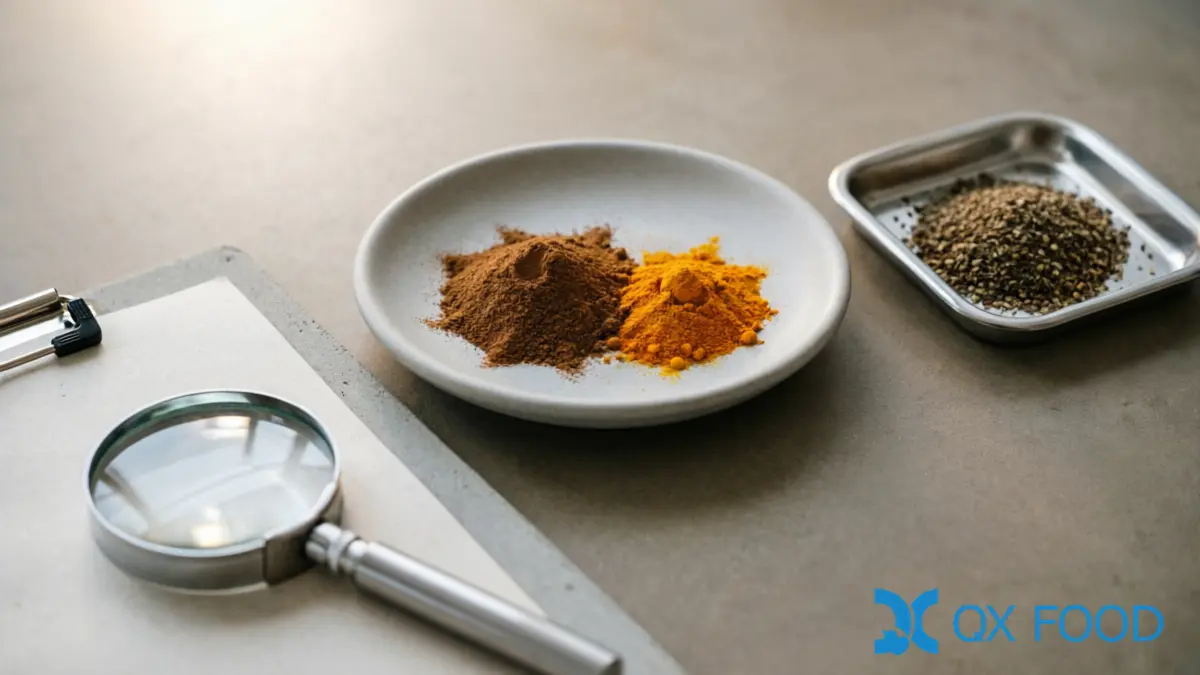
Which parameters appear on the specification is decided ingredient by ingredient. A surface-applied pepper for visible identity may need appearance and particle controls; a garlic powder entering a cooked sausage batter may need moisture-related limits and sensory references; a spice expected to carry color may need a color acceptance method. None of these parameters is mandatory for every meat processing spice.
Checkpoint 2: Separate Specification, COA and Technical Documentation
Three document layers answer different questions. The product specification defines the grade: controlled parameters, limits and the acceptance basis. The batch COA reports the measured results required by the specification for a specific lot. Technical documentation carries the analytical methods, application guidance and process information. Numerical results are useful where the controlled parameter itself is quantitative; qualitative parameters may legitimately be reported as “conforms”, “negative” or another defined result where the specification and method make the acceptance criterion clear.
Where method dependence materially affects comparability, define the agreed analytical method in the specification, test-method document or quality agreement; the method does not have to be repeated on every purchase order or COA line. Different methods can measure different things, so comparing results without comparing the method can be misleading.
On the US side, FSIS HACCP requirements oblige an establishment to support the decisions in its hazard analysis and verify that its controls work, using validation and supporting documentation appropriate to its system. Supplier COAs may be one form of supporting or verification evidence where appropriate, but 9 CFR Part 417 does not create a universal requirement that every spice lot carry the same COA panel. FSIS generic HACCP models, such as the raw ground beef model, illustrate one way to use a supplier COA; they are examples, not mandates for every ingredient.
Checkpoint 3: Food Safety, Allergen and Microbial Controls
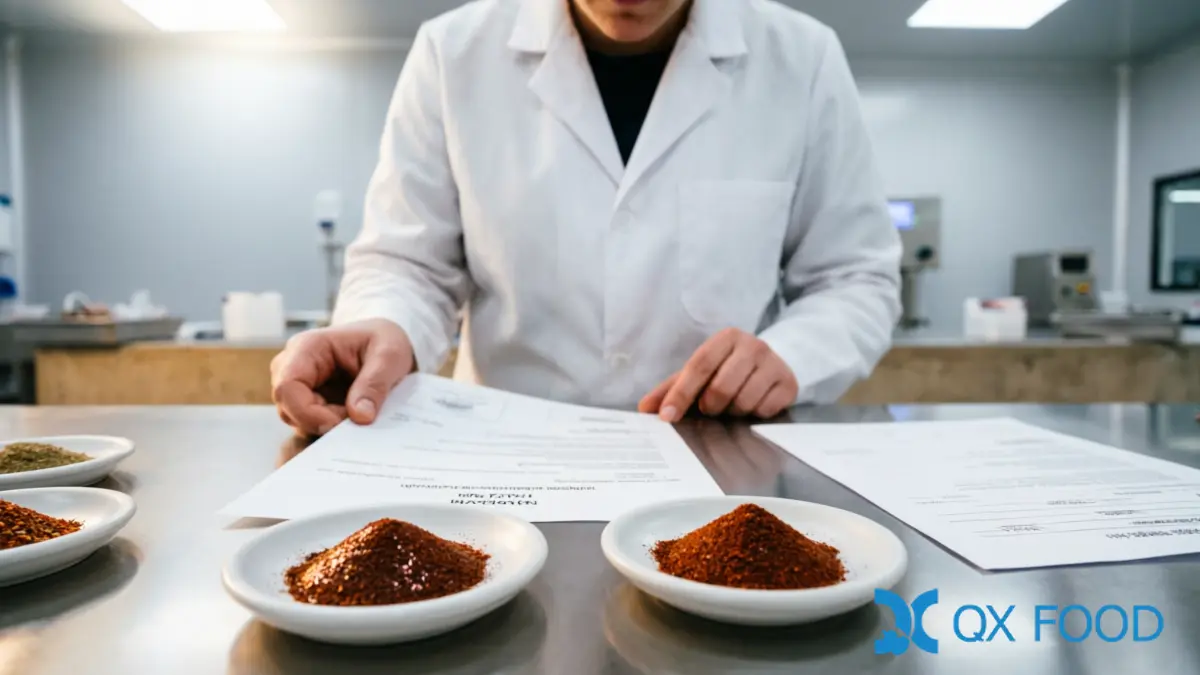
Microbiological criteria should be established from the ingredient risk, the supplier control plan, the buyer specification and destination-market requirements, not from a global ranking of which markets are strictest. Where the hazard analysis requires a reduced-microbial-load spice, verify the supplier’s validated microbial-control process, such as an applicable thermal, steam or irradiation treatment where permitted and appropriate, and the resulting microbiological specification. US authorities permit irradiation for spices among other foods, but permission is not a universal requirement for every meat application, so do not prescribe one decontamination method universally.
Allergen and cross-contact information should identify allergenic ingredients intentionally present and document relevant cross-contact controls. In the United States, FSIS requires all ingredients to be declared in the ingredient statement, while “may contain” and similar statements remain voluntary labeling and cannot replace effective sanitation controls. Precautionary statements are therefore market- and jurisdiction-specific and should not be treated as a universal trace-level declaration requirement.
Checkpoint 4: Do Not Treat Spice Chemistry as Preservative Proof
Essential oils and spice-derived compounds have shown antimicrobial or antioxidant effects in specific meat systems, but those results are form-, dose-, matrix-, organism- and storage-specific. A 2025 systematic review of clove essential oil in meat and meat products found the effect heavily dependent on application form and concentration, with limited comparability across studies and sensory penalties at higher levels. In meat processing spice qualification, a ground-spice volatile-oil result does not establish preservative performance in a finished meat product. If a spice is expected to contribute to shelf life or oxidation control, validate that function in the actual product and do not reduce an established preservative or lethality system without appropriate safety review.
Checkpoint 5: Validate Cure, Texture, Aroma and Oxidation in the Finished Meat Product
Four product-level questions close the qualification:
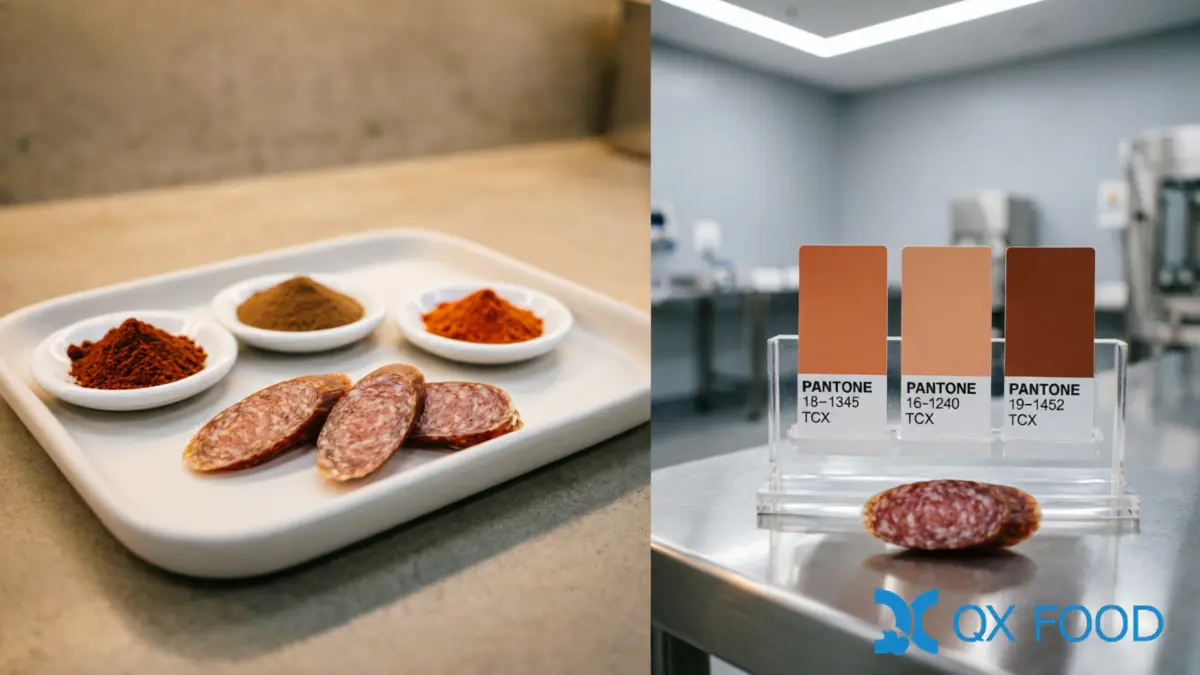
- Cure color. Where cured color is a critical quality attribute, verify the complete seasoning system in the actual cure and thermal process rather than assuming a single mechanism such as polyphenol interference.
- Texture and appearance. Where particle characteristics could affect texture, visible appearance or processing, validate the selected spice in the actual chopping, mixing, stuffing and cook system.
- Aroma. Evaluate aroma retention under the actual time and temperature history; any dose adjustment is formulation-specific rather than a fixed over-formulation headroom.
- Oxidation. If oxidation control is an intended function, validate it through finished-product oxidation and shelf-life testing. Contaminant controls such as heavy metals are a separate food-safety and compliance question and should follow the applicable ingredient specification and market requirements.
Meat processing spice suppliers can contribute application data for screening where available, but final cure, emulsion, thermal and shelf-life validation belongs in the buyer’s formulation and process.
Checkpoint 6: Supplier Traceability and Change Control
The traceability test is whether the supplier can accurately link a finished spice lot backward to the controlled incoming lots and forward to affected shipments within the response time defined by the buyer’s recall program and applicable law. There is no universal “one shift” requirement; under the US Food Traceability Rule, persons subject to the rule must maintain specified records for foods on the Food Traceability List and, when the rule is enforceable, make required information available to FDA within 24 hours of a request or another reasonable time agreed by FDA. The original January 20, 2026 compliance date has effectively been deferred for enforcement until July 20, 2028 under a 2026 Congressional directive, so buyers should distinguish the rule’s recordkeeping requirements from its current enforcement timetable. For spice supplier qualification, the more general test is whether lot linkage can support the buyer’s recall procedure and applicable law. For blends, the supplier should maintain internal linkage between incoming material lots and finished blend batches, and buyers should verify that the linkage works without assuming that proprietary supplier and formulation data must always be disclosed in full. Supplier records should retain the source, supplier lot, processing or batch identity and other origin or harvest information where required by the product specification, risk assessment or destination market, plus a written change-notification commitment.
Change control completes the picture: the supplier should commit in writing to notifying buyers of changes to source, process, specification or packaging that could affect the approved lot profile, so that qualification stays valid between audits.
A Meat-Processing Supplier Qualification Checklist
| Check | What to verify |
|---|---|
| Intended ingredient function | Flavor, color, process, preservation only if validated |
| Product-specific specification | Relevant SKU parameters and limits |
| Food-safety controls | Micro hazards, allergen, contaminants as applicable |
| Batch evidence | COA or results required by the selected SKU |
| Process compatibility | Actual meat formulation and process |
| Supplier system | Traceability, change control, capacity |
| Application validation | Sensory, color, texture, shelf life where relevant |
| Destination market | Labeling, permitted treatments, compliance |
The same gate-plus-evidence structure is explained in full in our snack seasoning supplier evaluation guide, which applies to meat programs with the same logic.
How QXFOOD Supports Meat-Processing Qualification
QXFOOD can support meat-processing ingredient qualification with product-specific specifications, applicable batch documentation, samples and technical or certification documentation for the selected SKU. Analytical parameters, microbial controls, certification scope and available traceability evidence depend on the selected product and buyer requirements and should be confirmed during qualification. Representative entry points include black pepper powder and garlic powder, with the full published range and its own specifications in the raw spices and herbs category.
Request meat processing spice samples and COA examples through the contact form on this page, and the team will support your supplier qualification file.
Frequently Asked Questions
Is there one “meat-grade” spice specification?
No. Meat processing spice specifications are set by the meat product, its process, the hazard analysis and the intended spice function, not by a category template. The application defines the questions; the selected SKU defines the values.
Does a meat spice need one specific mesh?
No. A dry rub, an injected system, a sausage batter and a visible surface seasoning may need different particle profiles, and there is no universal mesh range for meat applications. Specify particle characteristics where they affect dosing, dispersion, appearance, mouthfeel or process performance.
Can volatile oil predict preservative performance?
No. Volatile oil may characterize selected grades, but antimicrobial and antioxidant effects are form-, dose-, matrix- and storage-specific and require validation in the finished product. A volatile-oil result on a spice COA is not preservative proof.
Should every COA value be numeric?
No. Quantitative items need numbers where the specification defines them; qualitative tests can legitimately report “conforms”, “negative” or another defined result where the specification and method make the acceptance criterion clear.
Does USDA FSIS require a COA for every spice lot?
No. 9 CFR Part 417 requires establishments to support their hazard-analysis decisions and verify their controls, and supplier COAs may be one form of supporting evidence where appropriate. There is no universal rule that every spice lot must carry the same COA panel.
What traceability should a spice supplier demonstrate?
Internal lot linkage backward to controlled incoming lots and forward to affected shipments, tested against the response time defined by the buyer’s recall program and applicable law. For blends, verify that the internal linkage works without assuming full disclosure of proprietary formulation data.