
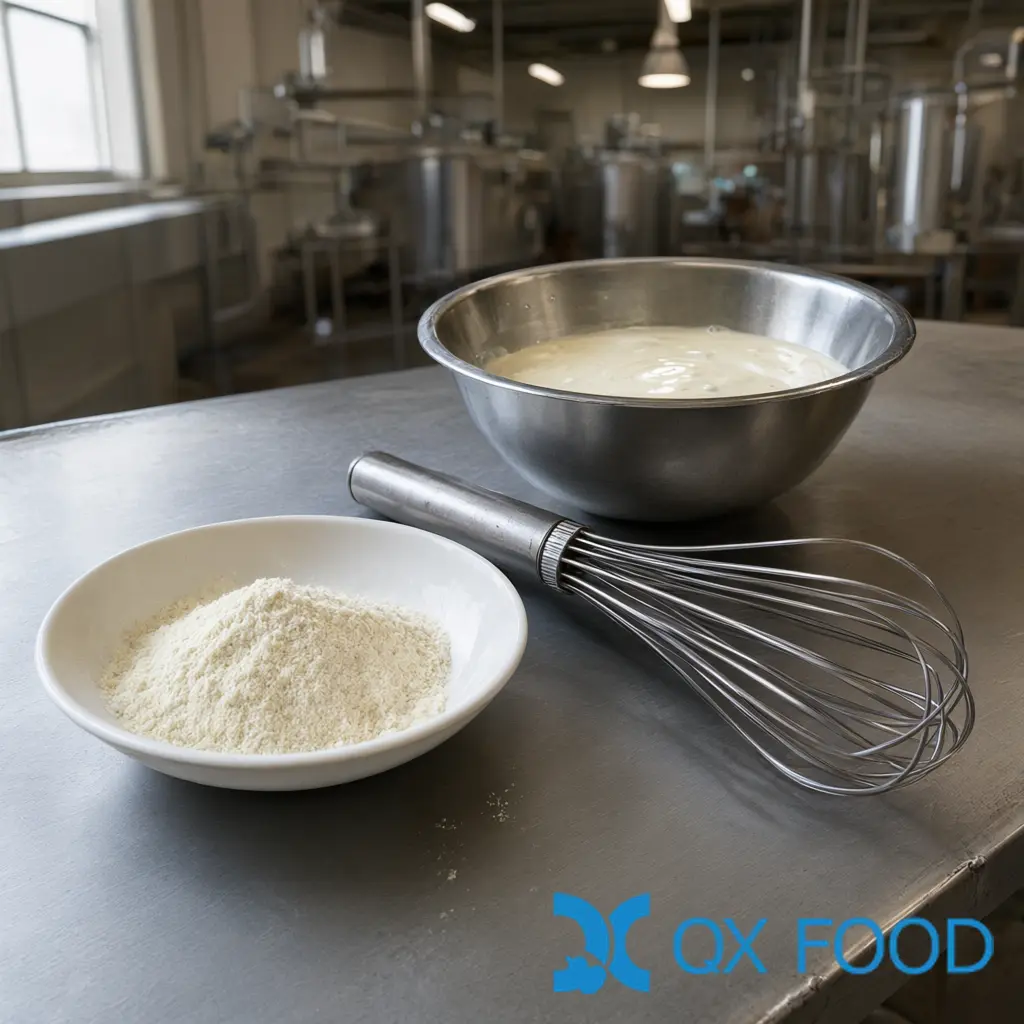
A sauce can carry the right amount of garlic and still taste uneven. Garlic powder dispersion in sauces fails in four ways that are often confused: the powder floats instead of wetting, it wets but will not break apart, it disperses but settles before packing, or it forms lumps that never hydrate. Each failure has a different cause and a different fix, so name the failure first.
How Garlic Powder Dispersion in Sauces Fails
Dehydrated, milled garlic powder is a dispersion problem, not a solubility problem. It contains soluble material and insoluble plant particles, and no grade will disappear into a clear liquid the way salt does. The realistic goal is a uniform suspension with no dry pockets and no hard lumps, held for the time your process actually needs.
The table below separates the symptoms buyers describe from the causes worth checking. It is a diagnostic order for a plant trial, not a list of defects in the powder.
| Symptom | Possible causes | First checks |
|---|---|---|
| Powder sits on the surface in a dry raft | Limited wetting, interfacial forces, air held in particle clusters | How the powder enters the liquid, and the addition rate |
| Cloudy liquid with hard centres | Particles wetted on the outside while the core stays dry | Agitation during the first seconds of contact |
| Fine sediment within minutes | Particles dispersed, but the base cannot hold them in suspension | Suspension stability, plus agitation during holding and filling |
| Sharp garlic hits in some bites | Poor distribution, or a few intact agglomerates, or both | Dosing point, mixing time after addition, and a sieve check |
| Lumps that survive cooking | Persistent agglomerates with dry cores, or gelled material from the base | Lump structure under a sieve, and the base ingredients around them |
Wetting, Dispersion and Dissolution Are Different Problems
The food-powder literature separates rehydration into wetting, dispersion, and solubilisation, and the three do not improve together (Selomulya and Fang, 2013). Wetting is the liquid replacing air at the particle surface. Dispersion is the breakdown of clusters into individual particles. Solubilisation is the dissolving of the soluble fraction. A review of food-powder rehydration built largely on dairy powders makes the same three-way distinction, which is why the terms are worth keeping apart even when the powder is a spice rather than a dairy solid.
For dehydrated garlic powder, the third step is partial and that is normal. The soluble fraction goes into the water phase; the insoluble plant particles stay dispersed, or settle, depending on the sauce and the holding conditions. A buyer who tests for complete dissolution will reject usable material, and a supplier who promises a clear solution is describing a different product. What happens to flavour after the powder is in the sauce is a separate question, covered in the garlic powder flavor processing guide.
Why Fine Powder Can Be Harder to Wet
It is tempting to assume that a finer grind disperses faster. The opposite is often true at the first contact with water, which is where most garlic powder dispersion in sauces is decided. Fine particles pack into clusters that hold air, and clusters holding air tend to stay at the surface. Work on fine-powder mixing describes exactly this: micron-scale powders form macroscale clusters holding air and dry powder, and the process has to be split into incorporation and deagglomeration (Ozcan-Taskin, 2015).
A pouring study shows how far this can go. Grains added to a liquid surface can float as a granular stack, and as more grains arrive the stack either disperses or breaks free and sinks as a dry powder lump. The maximum number of grains that can float increases as grain size decreases (Ong et al., 2019). That model experiment used glass beads and controlled interfacial conditions rather than a sauce, so treat it as a mechanism, not a recipe. A fine powder dusted onto a sauce can still build a floating raft that later collapses into a wet-skinned lump, which is the worst of both worlds: it looks mixed and it is not.
Particle size and structure change this balance, and milling is where those properties are set. The spice grinding process guide covers what a mill does to particle size and surface. For dairy powders, agglomeration changed wettability, dispersibility, and solubility together (Ji et al., 2016), which is the reason instant powders are built as porous agglomerates rather than fine dust.
One caution follows from that same study. Changes in particle size and structure can alter wetting and dispersion. Evaluate flavour performance separately when changing the particle form or processing route, because the cited dairy-powder study did not assess flavour retention in garlic.
Where Lumps Come From in a Sauce Base
A lump is usually a wetting failure that has been sealed in. Some food powders can form a hydrated surface layer that slows water penetration into a dry core. Agitation can improve incorporation without fully breaking persistent lumps. For garlic powder, assess the formulation, addition rate and local mixing conditions before deciding whether longer mixing will help. That judgement sits at the centre of garlic powder dispersion in sauces.
Sauce bases add three complications. Viscosity slows liquid penetration into the powder, so the same powder that wets instantly in water can float for minutes in a thick base. Starch and protein compete for water and can gel around the particles during heating. Salt and sugar change the ionic and osmotic environment at the particle surface, which shifts how quickly the soluble fraction hydrates.
Composition matters as well: a study of cheese powders found that composition and ingredient mix changed wettability, dispersibility, and solubility (Felix da Silva et al., 2020). A garlic powder with a carrier is a different wetting problem from pure ground garlic, even when the two are dosed to the same garlic solids.
Storage caking is a separate failure. A powder that flowed freely in the bag can still form lumps in the kettle, and a powder that clumped in storage may disperse normally once wetted. The powder caking prevention guide deals with the dry side of that question.
How Addition Order and Agitation Affect Wetting
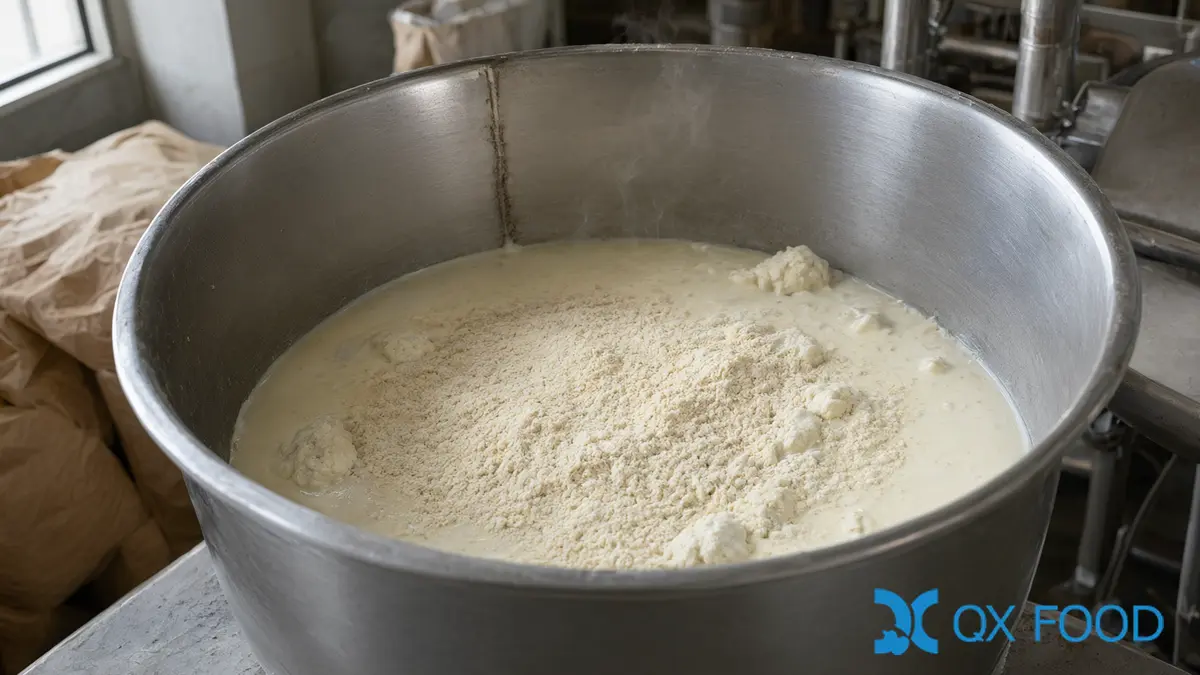
Most failures are decided in the first seconds of contact, before the mixer has done any real work, and addition order is the cheapest variable in garlic powder dispersion in sauces. The following addition methods behave differently, and none of them is useless in advance: whether surface addition works depends on the addition rate, the spread of powder and the circulation in the vessel.
| Addition method | What it tends to favour | What to check |
|---|---|---|
| Dust powder onto the liquid surface | Simple dosing with no extra equipment | Whether the powder is drawn under, and how fast it is added |
| Add powder into a high-shear zone | Fast incorporation of fine powders | Air entrainment and foam, especially in a thick base |
| Make a slurry with water first | Controlled wetting before the sauce base | That the slurry water comes from the recipe allowance |
| Add water to powder | Small batches and paste-like intermediates | Dry pockets at the bottom of the vessel |
Shear helps incorporation but not always dispersion. A high-shear head can wet a cluster without breaking it, and then the cluster survives the rest of the process. If lumps are the problem, the useful question is whether the mixer can deagglomerate, not whether it can stir faster. Drawing powder below the surface is a good sign, but it does not by itself confirm that the clusters have opened.
Lump behaviour can be measured rather than judged by eye. A study of milk powder rehydration used in-line particle measurement and video to follow sinking, lump formation and dispersion under controlled conditions (Mitchell et al., 2020). A plant without that instrument can still use a fixed sieve, a fixed sample mass and a fixed holding time to get a comparable number.
A Controlled Comparison Test
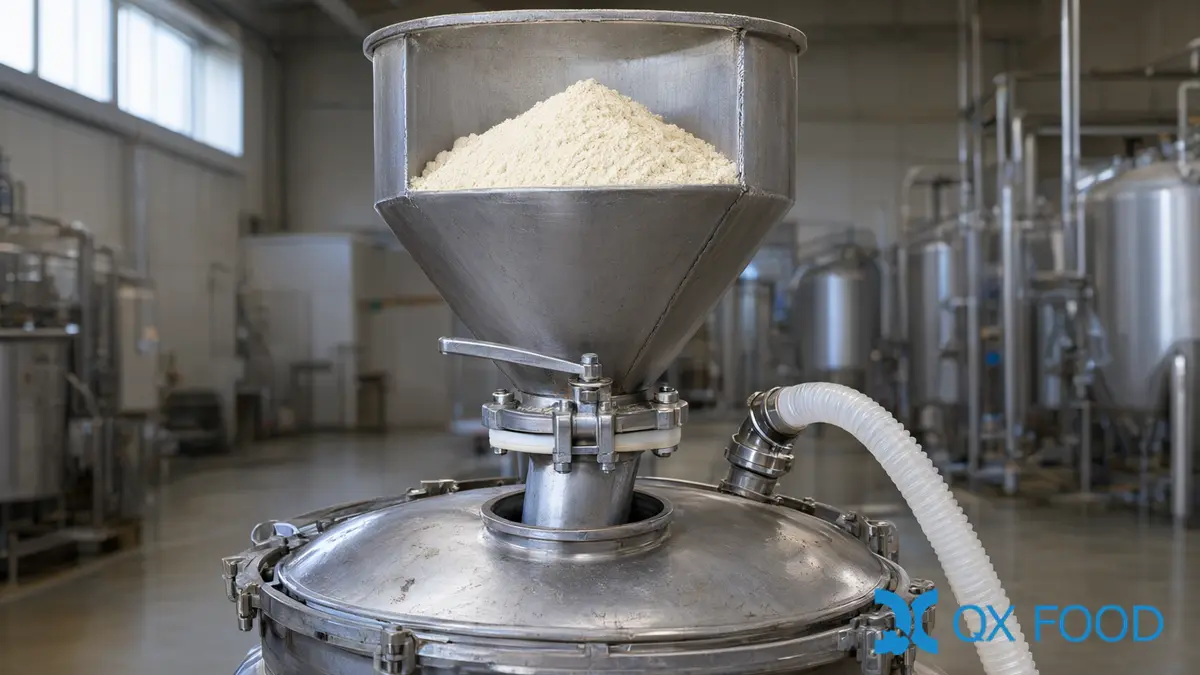
A controlled comparison test does not require specialist analytical equipment, and the protocol below is a screening method rather than a standard. Its value comes from holding everything constant except the variable under test, so the result tells you which change helped instead of producing a number nobody can repeat. That discipline is also the only reason garlic powder dispersion in sauces can be compared between suppliers.
Use the same final formulation, batch mass and garlic dose for each addition-method trial. Take slurry water from the recipe’s existing water allowance and record the addition sequence. Record the vessel, mixer setup, speed, addition rate and mixing time, keeping them consistent unless one is the variable under test. Measure final viscosity under the same conditions without adjusting individual batches to force the same reading.
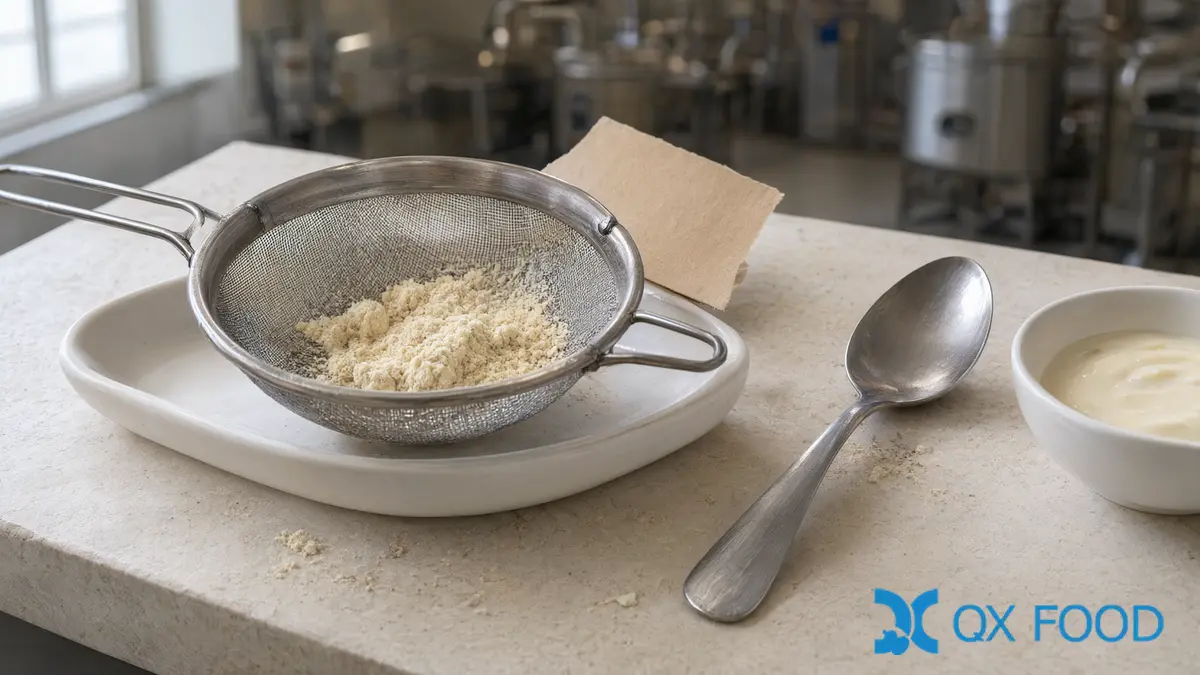
Record the time until no dry powder remains on the surface. For sieve checks, use a fixed sample mass, sieve aperture and drainage procedure. Report retained residue and inspect it to distinguish agglomerates or dry cores from normal garlic particles and solids already present in the sauce. Assess sedimentation separately as a suspension-stability result, and use fixed sampling locations and timing for sensory comparison.
Repeat each condition. Here is the catch: if repeat runs give inconsistent rankings, treat the comparison as inconclusive, check preparation and measurement conditions, and use additional runs before selecting a preferred powder or method. Record your own line values for addition temperature, sieve aperture and holding time; those three numbers, rather than a generic protocol, are what make the result repeatable in your plant.
| Variable to test | Hold constant | What a difference tells you |
|---|---|---|
| Addition method: surface, high-shear or slurry | Final formulation, dose, temperature, mixing time | Whether the problem sits in wetting or in deagglomeration |
| Agitation type and speed | Formulation, dose, addition method | Whether the mixer can break clusters rather than only move liquid |
| Base temperature at addition | Formulation, dose, shear | Wetting gain against starch or protein side effects |
| Powder grade or supplier sample | Formulation, dose, method, shear, temperature | How the samples perform under the conditions you tested |
Tasting is the other half of the comparison. Take samples from the same locations at the same time and score them with the method in the sensory evaluation guide, so that a difference in flavour is separated from a difference in lumps.
What to Ask a Supplier Before You Reformulate
Supplier questions should separate the powder from the process. The answers you need are about the grade and the conditions, not about a claim that the powder mixes easily.
| Question | Why it matters |
|---|---|
| What is the declared particle size or mesh, and how is it measured? | Particle size sets a starting point for wetting and suspension behaviour |
| Is the powder pure garlic or does it carry a carrier? | The carrier changes wetting and the ingredient declaration |
| What addition method did the supplier use in its own trials? | Gives you a baseline to reproduce or challenge |
| Can you supply a sample from the same lot for a side-by-side test? | Lets you compare powder and process on one material |
| Does the grade change between lots, and how is that controlled? | Explains why a validated process can drift |
Two clarifications prevent a false comparison in garlic powder dispersion in sauces. First, state whether you are matching the powder dose or the garlic solids dose, because a powder with a carrier delivers less garlic per kilogram. Second, count the carrier in the final formulation, not as an extra. The garlic powder specification guide shows how mesh, moisture and carrier lines are declared.
Where QX Food Ingredients Fits
The listed QX Food Ingredients GP-W04 grade is dehydrated and milled. For the selected grade, confirm the particle size, ingredient declaration and current specification before testing. Coarsely milled garlic and porous agglomerated powders are different particle structures, so discuss the required format and application conditions when requesting a sample.
Tell us the sauce type, garlic dosage, addition method, processing temperature and the problem you are seeing in your garlic powder dispersion in sauces trial. We can provide the current grade specification and an evaluation sample, then discuss what additional information is needed for a useful comparison. The dehydrated garlic powder page lists the product route.
Garlic Powder Dispersion: Common Questions
Does a finer garlic powder disperse better in sauces?
Not automatically. Finer particles suspend longer once they are in the liquid, but they also hold more air and can stay at the surface before they wet. Dispersion depends on how the powder enters the liquid and on the shear available, not on mesh alone.
Why does garlic powder float on water?
Fine powder can remain at the liquid surface because of limited wetting, interfacial forces and air trapped within particle clusters. Drawing the powder below the surface can improve incorporation, but does not by itself confirm that the clusters have dispersed. Check the addition method in the intended sauce.
Should garlic powder go into the water or into the sauce?
It depends on what you are testing. A slurry in water gives controlled wetting before the powder meets starch or protein, and the slurry water has to come from the recipe allowance. Adding directly to the sauce is faster but removes the chance to check the powder on its own. Run each method more than once with everything else fixed, and keep the version that gives fewer persistent lumps.
Why do I get lumps even when I stir constantly?
Stirring moves liquid past the cluster but does not necessarily wet the dry core. A hydrated outer layer can slow water ingress, and the result depends on the powder, the addition rate and the local mixing conditions. Slower addition into higher shear, or a pre-slurry, is worth testing before you extend the mixing time.
Does hot water help garlic powder disperse?
Warmer water wets many powders faster because viscosity falls and surface tension changes, but heat also drives flavour changes and can gel starch in the base. Test it at the temperature you will actually use, and taste the result rather than judging only the lumps.
Is garlic powder soluble in water?
Dehydrated, milled garlic powder is only partly soluble in water. Its soluble components dissolve, while insoluble plant particles remain dispersed or settle, depending on the sauce and holding conditions. Evaluate uniformity, persistent lumps and settling over the required holding time rather than expecting a clear solution.
Is a higher mesh better for sauce applications?
A higher mesh gives more particles per gram and a smoother mouthfeel, and it also changes wetting and dusting behaviour. It does not guarantee better flavour or fewer lumps. Choose the mesh for the texture and suspension you need, then validate the addition method for that grade.
How do I compare two garlic powders in a sauce?
Fix the final formulation, the dose basis, the temperature, the shear and the addition method, then compare the time to wet, the retained residue on a fixed sieve, the suspension stability over the holding time, and the flavour at fixed sampling points. Repeat each run and keep the samples coded.
The Short Version
Garlic powder dispersion in sauces is a sequence of separate problems. Wetting is the first: fine powder holds air, can stay at the surface, and may collapse into a dry lump. Dispersion is the second: clusters must be broken, and shear that only moves liquid will not do it. Solubilisation is partial by nature, because dehydrated garlic powder is not a soluble ingredient. Fix the formulation, the dose basis and the temperature, change one variable at a time, and measure retained residue and suspension stability instead of judging by eye. The powder can only do so much; the addition method decides the rest.