
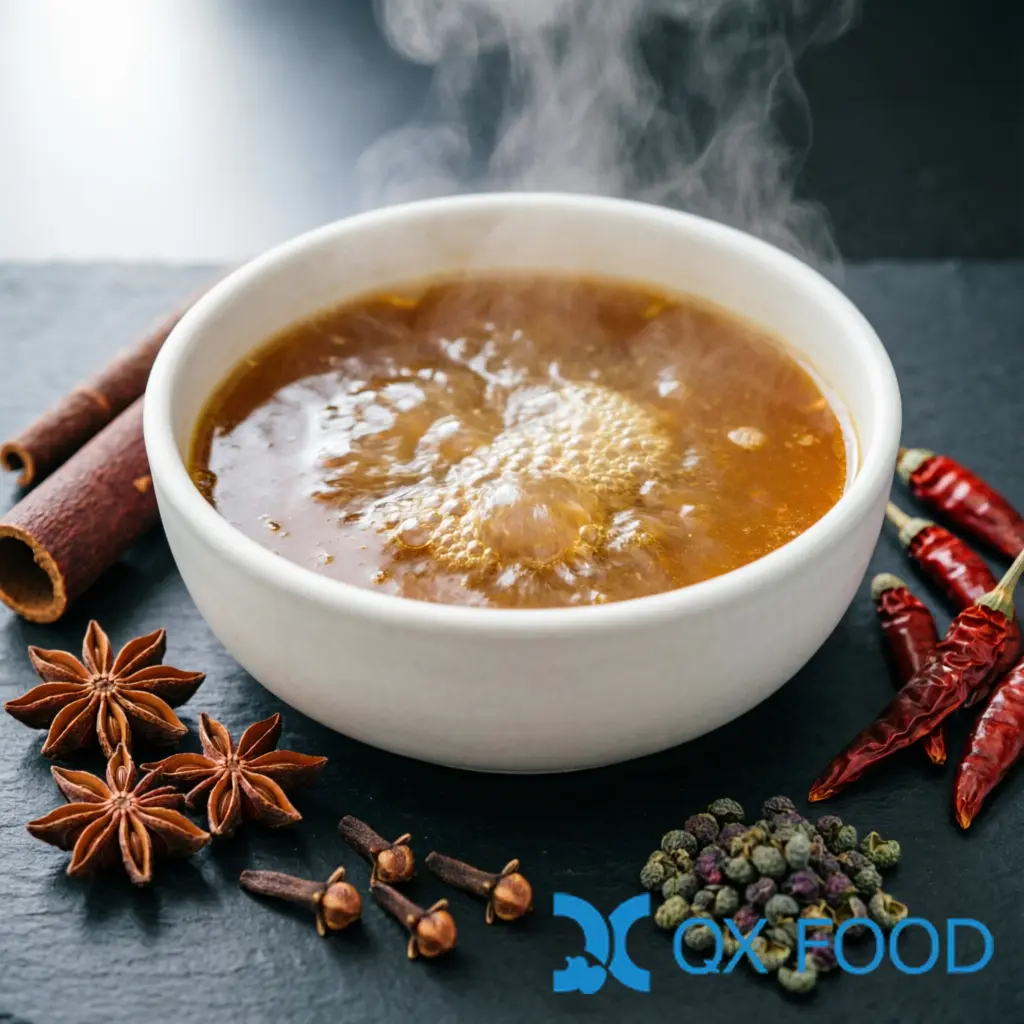
Hot Pot Base Spice Procurement: A Sourcing Guide for Seasoning Manufacturers
Hot pot base spices are the flavor backbone of a category projected to grow from USD 8.12 billion in 2025 to USD 13.1 billion by 2035 (Spherical Insights, 2025). Every major growth market — China, Southeast Asia, North America and Europe — is served by seasoning manufacturers who must buy whole and ground spices at scale. Hot pot base spices are spice-intensive: a single mala formula can carry eight to twelve botanical components, and the flavor of the finished base depends on the quality of every one. This guide covers the spice architecture of hot pot bases, whole versus ground sourcing decisions, and the procurement checklist that protects batch consistency.
Hot Pot Base Spices: The Architecture of a Mala or Savory Broth
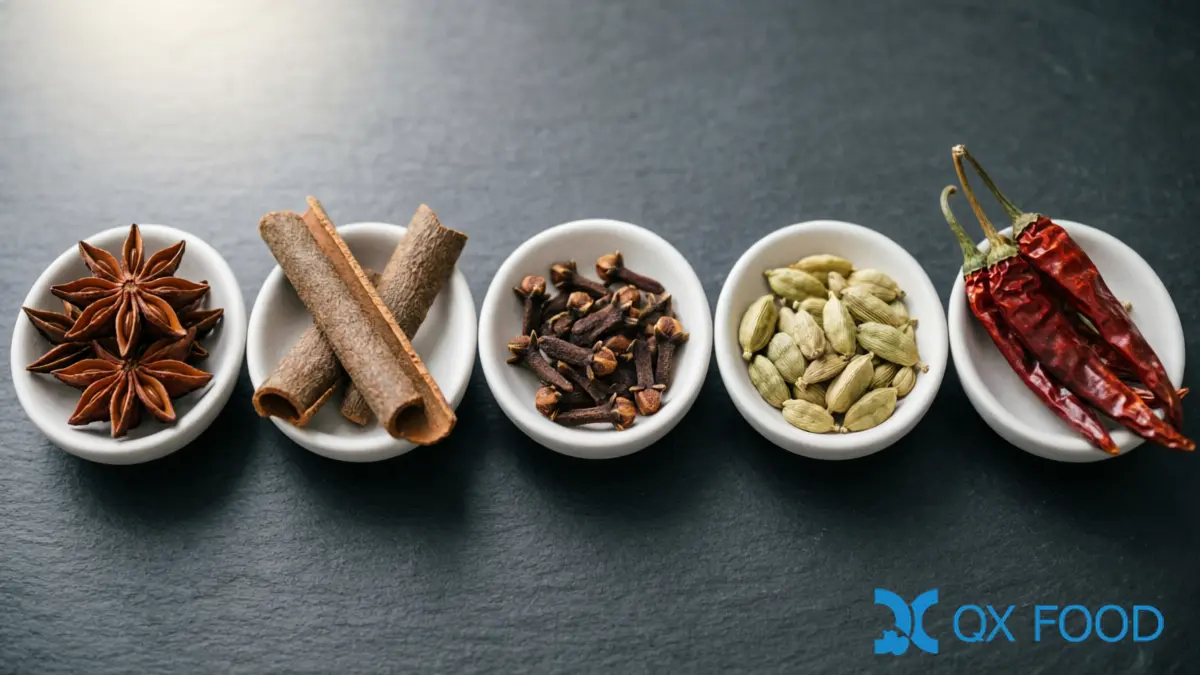
Hot pot base spices divide into two dominant families — spicy mala (Sichuan) and savory broth (tomato, mushroom, bone and herbal styles) — and each has a recognizable spice core. Understanding the role of each component is the first procurement skill, because it tells you which parameters matter on the specification sheet.
- Star anise — the licorice-sweet aromatic that anchors both mala and braised-style bases. Quality parameters: whole-pod integrity, trans-anethole content, absence of stem fragments and insect damage.
- Cassia bark — the warm, sweet-bark depth behind Sichuan and Cantonese broths. Quality parameters: bark thickness, volatile oil content, coumarin levels for EU-bound formulas.
- Cloves — a low-dose high-impact note that rounds out spice blends and suppresses greasy mouthfeel. Quality parameters: clove stem content, eugenol level, moisture.
- Fennel seed — the cooling, anise-adjacent note that balances chili heat. Quality parameters: seed size uniformity, volatile oil, cleanliness.
- Sichuan peppercorn — the numbing (ma) sensation unique to mala bases. Quality parameters: husk-to-seed ratio, hydroxy-alpha-sanshool content, freshness (the numbing compounds degrade quickly).
- Dried chili — heat and red color. Quality parameters: Scoville range, ASTA color value, capsanthin content, moisture.
- Ginger and garlic — the savory pungent base layer shared by nearly every hot pot formula.
Whole star anise STA-23, cassia powder CP-B04 and clove powder CLO-D11 are examples of spec-documented spice raw materials for this category: each ships with a certificate of analysis covering the parameters above, which is exactly the data a hot pot base formulator needs before blending.
Sourcing the numbing component properly matters, and our sichuan pepper sourcing guide covers red versus green varieties and sanshool verification.
Whole Spice vs. Ground Powder: Sourcing Decisions
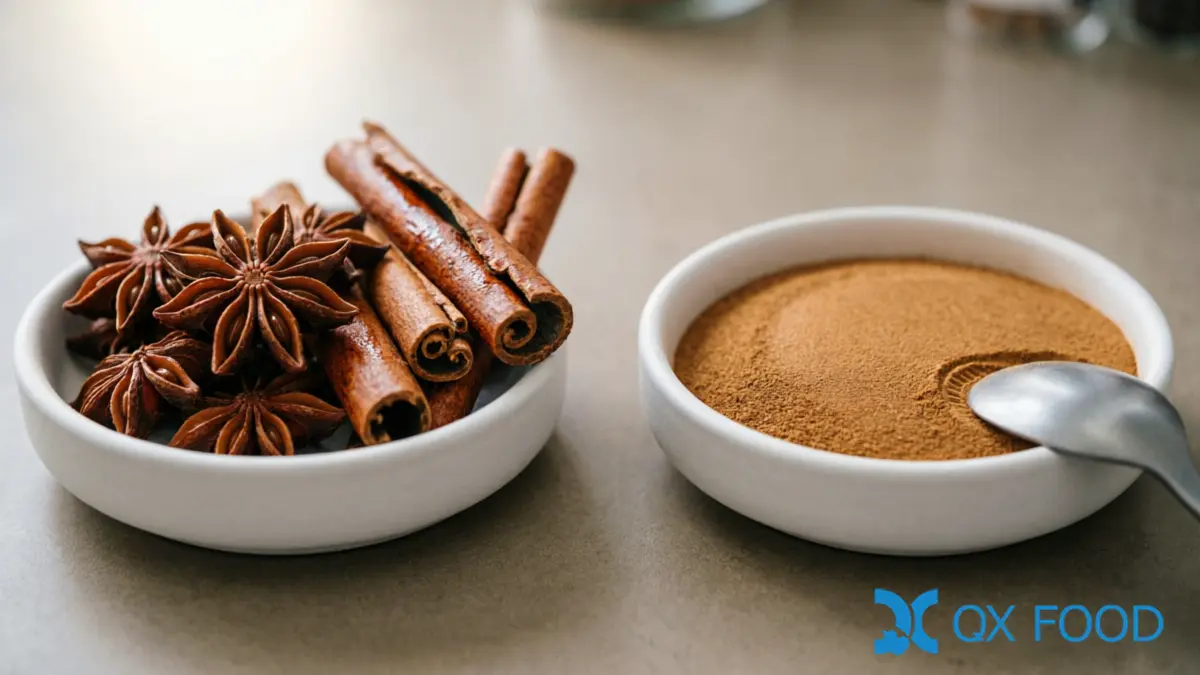
The whole-versus-ground decision shapes cost, flavor and shelf life. Hot pot base spice buyers typically run both formats in one formula: whole spices in the visible soup bag, ground powders in the seasoning sachet or blended paste.
| Format | Strengths | Trade-offs |
|---|---|---|
| Whole spice | Longer volatile oil retention, visible authenticity, slower flavor release in simmering broth | Higher freight volume, requires inspection per lot, larger storage footprint |
| Ground powder | Precise dosing, faster flavor release, compact logistics | Faster volatile loss, requires tight grind freshness, mesh consistency matters |
| Coarse cut | Middle ground for sachet formats | Must match filling equipment particle limits |
For ground hot pot base spices, mesh size is a procurement contract item, not a detail: clove powder CLO-D11 at 80 mesh and pure black pepper powder BPP-K45 at 80-120 mesh are typical hot pot seasoning grades, and the spec should state the mesh range, the maximum oversize fraction and the test method. A powder that clumps at the filler or dusts on the line costs more than the price difference between suppliers.
Whole star anise is a classic spec-driven buy, and the star anise grade guide covers the pod size and breakage criteria.

Volatile Oil: The Parameter That Predicts Flavor
Volatile oil content is the single most informative number, a parameter the Eurofins spice shelf-life analysis also flags as central to quality on a hot pot spice COA, because it correlates directly with aroma intensity in the finished broth. A cassia bark lot at 1.5% volatile oil and one at 2.5% will produce measurably different bases at the same inclusion rate.
Clove powder CLO-D11, with a volatile oil level typical of fresh-ground clove, and cassia powder CP-B04 with its documented bark profile, are examples of how a supplier’s COA converts a purchasing decision into a formulation decision. Buyers should request volatile oil values on every lot, verify them at inbound inspection, and reserve the right to renegotiate when a lot arrives below the agreed floor.
Volatile oil also decays with age. Ground spices lose aroma fastest, whole spices more slowly. Buy in rotation rather than deep inventory: a 12-month stock of ground cassia bought at a good price is rarely a bargain by month nine.
Regional Compliance: Coumarin and the EU Market
Hot pot base spice manufacturers exporting to the European Union must manage coumarin limits in cassia-family spices. Coumarin is a natural constituent of cassia bark and is regulated in food in the EU; formulas bound for European retail need either a low-coumarin cinnamon source or a coumarin-budgeted inclusion level.
This is a destination-market compliance question, not a quality question, and it belongs in the procurement brief before the first sample order. Ask the supplier for coumarin data on cassia lots, and document the formula-level calculation if the destination requires it. For domestic Chinese and most Asian markets this is not a constraint, which is why the same raw material is procured differently depending on the plant’s export mix.
Batch Consistency and the Supplier Audit
Hot pot base spice flavor is a blend-level property, and blend-level consistency depends on component-level consistency. Three procurement practices protect it:
- COA review on every lot — verify volatile oil, moisture, mesh and microbiology against the agreed spec, not against the sales sample.
- Cross-batch comparison — keep a rolling record of incoming COA values; drift in any parameter predicts flavor drift in the finished base.
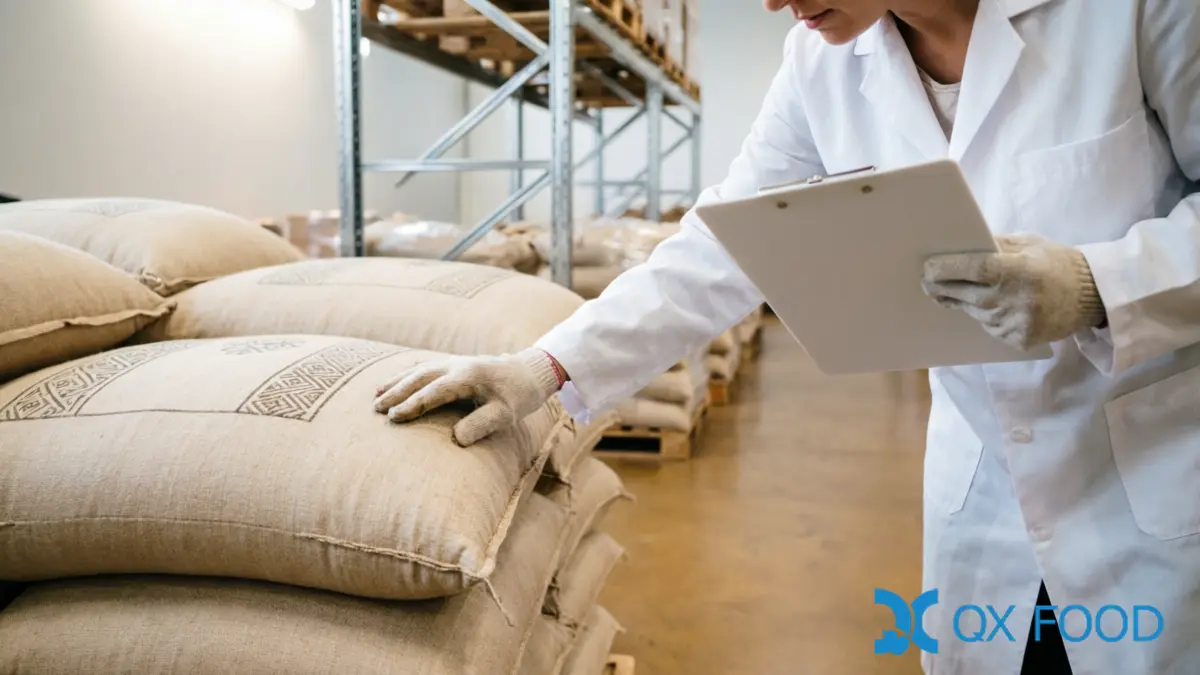
- Supplier capability audit — visit or document the supplier’s cleaning, sorting, grinding and storage lines, and confirm traceability from harvest region to shipped lot.
Suppliers who grind to order, maintain low-moisture storage and can name their growing regions — like QXFOOD’s spice line including whole star anise STA-23, dried ginger DGR-27 and fennel powder FP-B01 — fit the audit profile that hot pot base spice buyers should demand.
Building Your Hot Pot Spice Procurement Checklist
Before your next hot pot base spices sourcing round, use this checklist as the conversation starter with every spice supplier:
- Certificate of analysis per lot: volatile oil, moisture, ash, mesh, microbiology
- Regional origin and harvest season declaration
- Coumarin data for cassia-family lots (EU-bound formulas)
- Storage conditions and age of stock at shipping
- Sample policy: blend-scale samples, not just retail packs
- Batch traceability from farm region to container
- Certifications: ISO9001, ISO22000, HACCP, HALAL where required
For the full category view, visit the Raw Spices & Herbs category page.
Request hot pot base spices samples through the contact form on this page and our team will support your hot pot base formulation with spec-documented spice raw materials.
Buyers who dig deeper usually read two companion pieces: the standardized spice procurement guide for the five-checkpoint sourcing method, and the braised meat spice pack guide for how the same whole spices behave in long-simmer applications.
Frequently Asked Questions
What hot pot base spices are essential?
The core hot pot base spices for a spicy formula include star anise, cassia, cloves, fennel, Sichuan peppercorn, dried chili, ginger and garlic. Savory broths use a lighter set centered on star anise, cassia, ginger and mushrooms. Each component has a defined flavor job and a defined quality parameter on the COA.
Whole spice or ground powder for hot pot bases?
Both. Whole spices suit visible soup-bag formats and hold volatile oil longer; ground powders give precise dosing in sachets and pastes. Specify mesh range and grind freshness for every ground component.
What is the most important quality parameter for hot pot spices?
Volatile oil content — it correlates directly with aroma in the finished broth. Verify it on every lot, alongside moisture and mesh, rather than relying on the sales sample.
Why do some cassia lots need coumarin data?
Cassia bark naturally contains coumarin, which is regulated in food in the EU. Exporters to European markets must budget coumarin at the formula level or choose a low-coumarin source. Domestic and most Asian markets do not have this constraint.
How do I keep ground spice aroma fresh in production?
Buy in rotation instead of deep inventory, store below 25°C in sealed packaging, and grind-to-order where the supplier offers it. Volatile oil testing at inbound inspection and at 90 days tracks the decay you cannot see.
What should a hot pot spice COA include?
Volatile oil, moisture, ash, mesh/particle size, microbiology and — for cassia-family lots — coumarin data. Cross-batch comparison of these values is the best predictor of finished-base flavor consistency.
How much does spice quality affect finished hot pot base cost?
Spices are a small share of formula cost but a large share of flavor risk. A batch of low-volatile-oil cassia or aged Sichuan peppercorn can force rework — which is why hot pot base spices deserve procurement discipline can force full rework of a production run, so spice procurement discipline is a cost-protection measure, not a cost item.