
Last updated 11 September 2026: the validation, specification and documentation sections were revised.
Seasoning Systems for Baked Snacks: Where Flavor Enters the Process
Quick answer. Baked-snack seasoning should be designed around where the flavor enters the process: inside the dough, on the surface before baking or after baking. Each position changes thermal exposure, adhesion and finished-product delivery. There is no universal compensation percentage, particle size or carrier; validate aroma retention, pickup and finished sensory performance under the actual bake and application conditions.
A baked snack can receive seasoning at several points in the process: inside the dough or batter, on the surface before baking, or on the surface after baking. Each position exposes the seasoning to a different combination of heat, moisture, surface conditions and mechanical handling, and some products use more than one of them. Seasoning systems for baked snacks succeed or fail on which position carries the flavor load, because the oven sits between them and treats each one differently. The formulation question is therefore not simply how much seasoning to add, but where the flavor function should enter the process and what has to be validated at that position.
Three Entry Points: Dough, Pre-Bake Surface, Post-Bake Surface
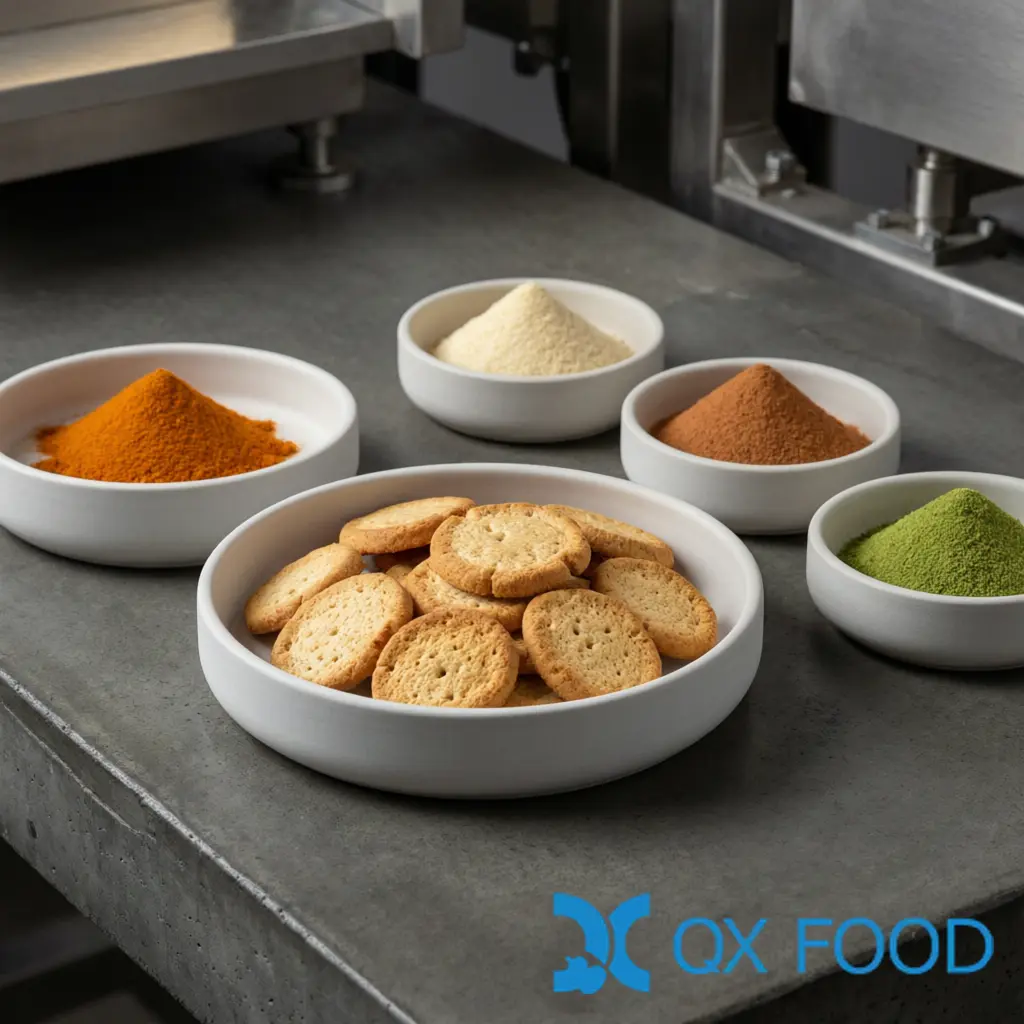
Crackers, biscuits, puffed rice cakes, baked lentil chips, pretzels, breadsticks and baked pellets all share one constraint: the heat that builds texture is rarely neutral to aroma. Most baked snack seasoning problems trace back to a mismatch between where the flavor sits in the process and what was asked of it. Pick the position that matches what the flavor has to survive, then validate that position on your own line. A poor choice of entry point is rarely solved efficiently by increasing the dose alone. Seasoning systems for baked snacks take one of three positions in the process, and each position imposes a different set of requirements on the same powder.
Dough-incorporated seasoning
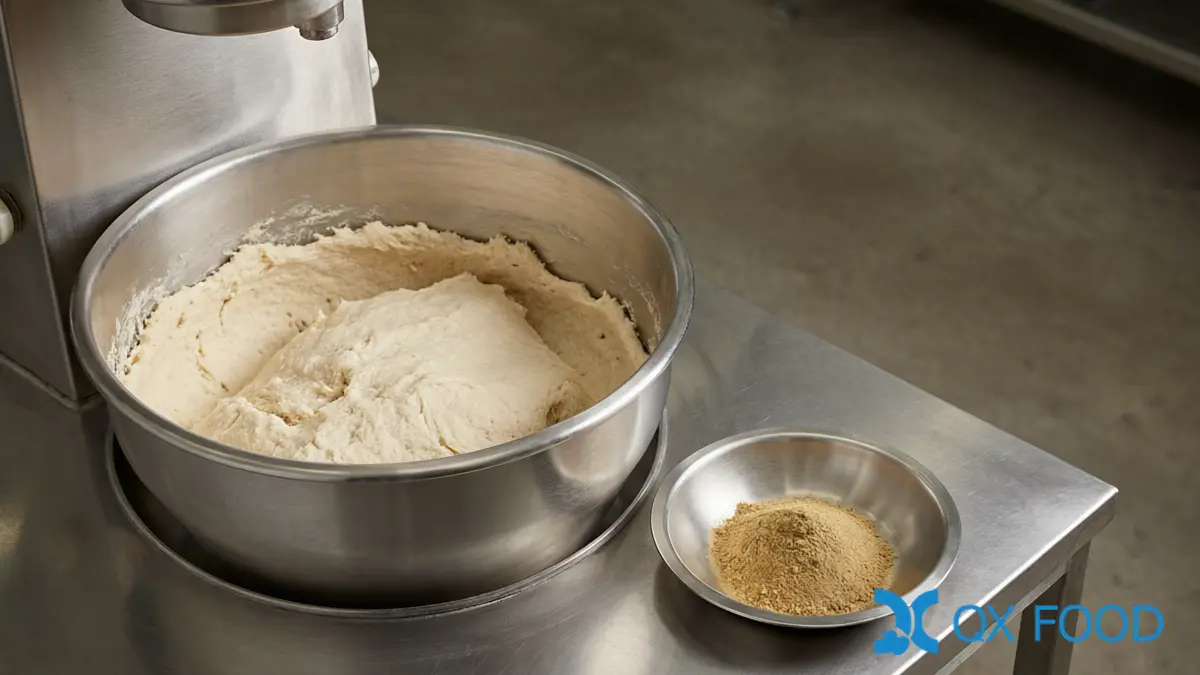
Here the seasoning is mixed into the dough or batter and travels with the matrix through sheeting, forming and the full bake. Nothing can fall off, because there is no surface bond to fail, and the flavor ends up distributed through the piece rather than sitting on it. The cost is heat exposure: an ingredient that enters at the mixer sees the entire thermal history, including the moisture-rich phase where volatiles partition into water and fat, plus any pH shift from chemical leavening or fermentation.
Dough incorporation may suit ingredients whose intended function tolerates full-process exposure or whose components can participate in heat-driven flavor development. Spice powders, yeast-derived ingredients, hydrolyzed vegetable proteins, soy sauce powders and cheese-type powders can all be screened in this position, but their post-bake sensory contribution is formulation- and process-specific. A spice powder brings its own volatile oil and will lose part of it, while amino compounds and reducing sugars may participate in Maillard chemistry where local moisture, pH, temperature and time permit it. That reactivity is a process effect to validate, not a guaranteed benefit of adding a hydrolyzed vegetable protein.
In seasoning systems for baked snacks that carry the flavor load inside the dough, retention is one of the key variables in setting the dose, alongside sensory potency, distribution through the piece, sodium contribution, color and cost. The final use level should be established from post-bake sensory and analytical performance in the complete formula: measure the flavor profile after mixing and again after the bake, on the buyer’s own profile. A seasoning that scores well in dough and disappears in the oven was never a dosing problem.
Pre-bake topical seasoning
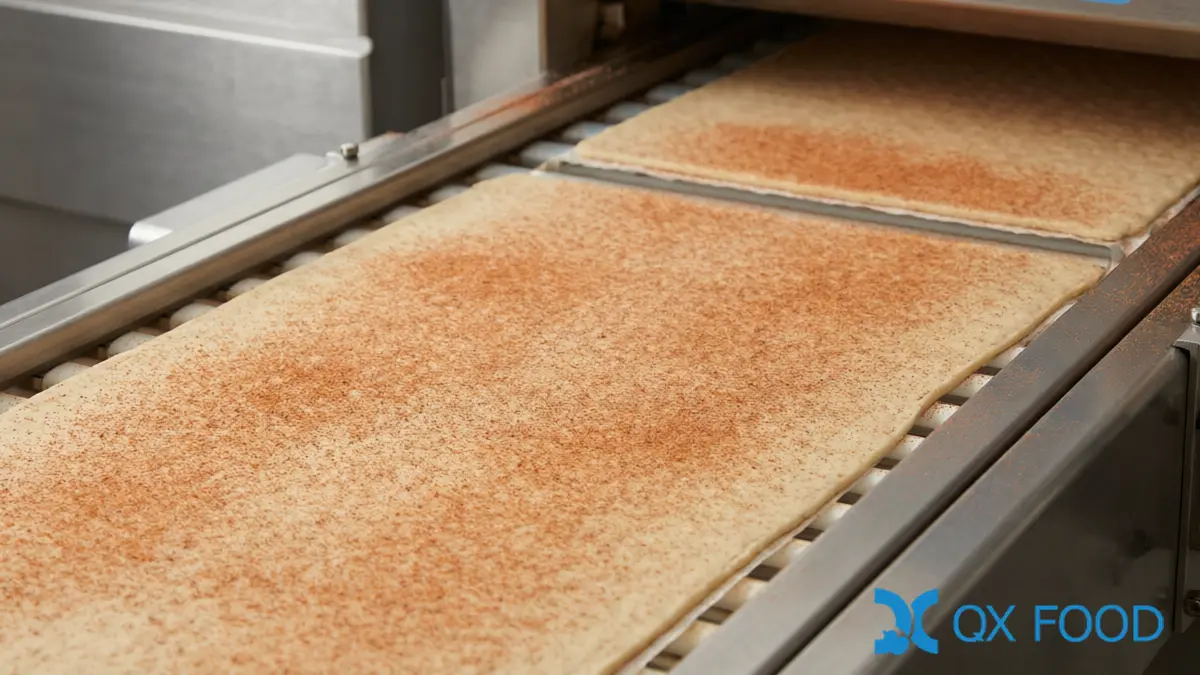
Powder or slurry is applied to the formed piece before it enters the oven, typically over a light water, oil or syrup film that acts as the carrier. The exposure is short but intense, because the surface dries fast and its temperature climbs above the interior. Surface solids concentrate as water leaves, which makes the pre-bake position the natural home for ingredients meant to participate in browning and color development rather than simply survive it.
The failure modes are mechanical as often as chemical. Pickup can vary across the belt, dust can be pulled into the extraction hood, powder can build up on oven bands and wire mesh, and a discontinuous carrier film leaves streaks. Pre-bake application also changes the surface before the Maillard reaction and caramelization do their work, so color and texture develop along with flavor, and they cannot be tuned separately.
Post-bake topical seasoning
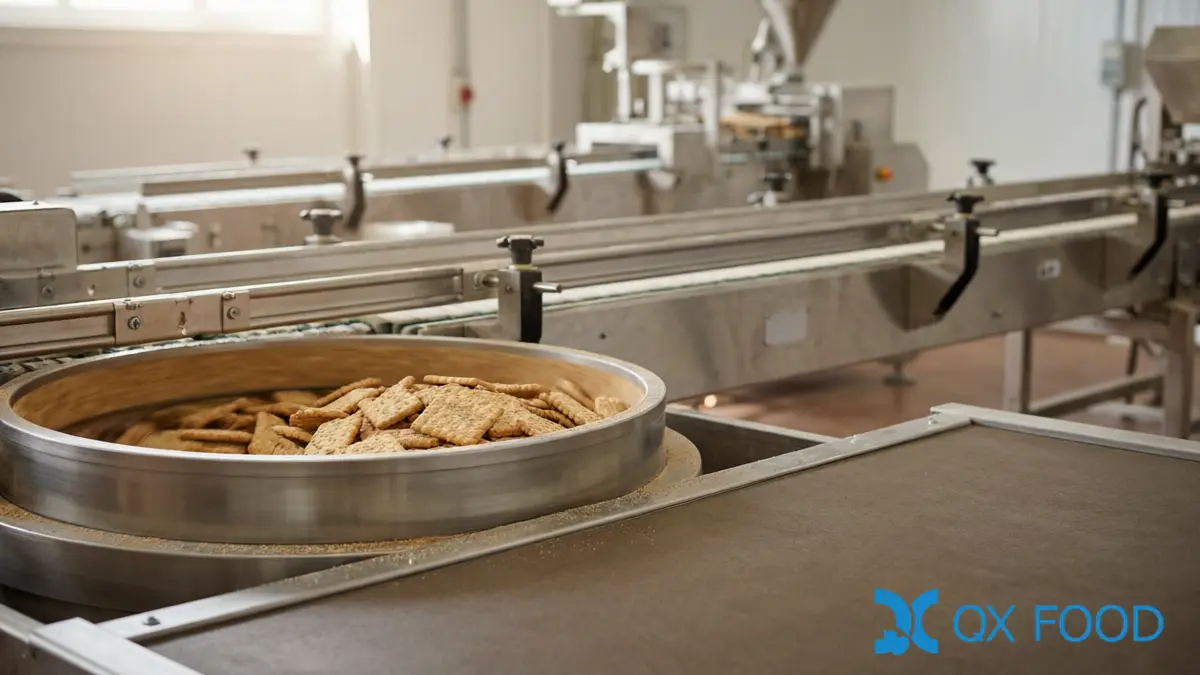
This is the position most snack producers picture first, and the one that most closely resembles fried snack seasoning. It is also where seasoning systems for baked snacks most often under-deliver, because the substrate gives the powder little to hold on to. The difference is the substrate. A baked cracker or pellet has a dry, low-fat surface with either a tight, closed structure or a highly porous puffed one, and neither holds powder the way an oiled fried chip does.
Carrier choice therefore becomes a formulation decision with measurable consequences. In cracker studies, carrier composition had a measurable effect on powder adhesion, and the best carrier depended on the seasoning itself: Armstrong and Barringer found that hydrophobicity, hydrocolloid structure, concentration and the related thickening behavior all influenced adhesion, so no single property such as molecular weight can be read as the rule (Armstrong and Barringer, 2013, Journal of Food Science). The useful takeaway is not “use gellan gum”; it is that the carrier is an application variable. When pickup falls short, diagnose the carrier, the substrate, the powder properties and the application conditions separately before reformulating the blend. Adhesion is a system response rather than a property of the seasoning powder or the carrier alone. Measure the effect on your own base, at your own line speed.
| Entry point | Heat exposure | Attachment risk | What to validate first |
|---|---|---|---|
| Dough-incorporated | Full bake profile, plus mixing and proofing | None at the surface; losses and precursor reactions instead | Aroma retention across the bake; interaction with leavening and pH |
| Pre-bake topical | Short but hot; surface dries and concentrates | Pickup uniformity, dust loss, band build-up | Color and flavor development together; pickup consistency run to run |
| Post-bake topical | Minimal thermal load | Carrier adhesion on a dry or porous surface | Unit-area pickup before and after handling; carrier system fit |
Developing a baked-snack seasoning system? Send the bake profile, the seasoning entry point and the target pickup, and we can shortlist which ingredient forms and which validation tests to run first. Request application samples or ask for the specification sheet of the grade you are evaluating.
What the Oven Does to a Seasoning
Baking losses are frequently treated as a fixed percentage to be topped up. The research points the other way. Real-time monitoring of volatile release during baking and toasting shows that losses are compound-specific and stage-specific rather than uniform across the process (Pico et al., 2020, Foods). A cookie study found that baking conditions and the initial flavor load interact to shape how the flavor profile evolves, so that adding more of the same flavor at the start does not simply scale the result (Abedi et al., 2024, Flavour and Fragrance Journal).
Three consequences matter for a seasoning system. First, top-up dosing without a retention test is guesswork. Second, the compounds that survive best are not always the ones the marketing brief names; the profile the consumer tastes is the profile after the oven, not the one in the batch sheet. Third, some ingredients gain during baking: reducing sugars and free amino acids react through the Maillard reaction and generate roasted, toasted and caramel notes, so the finished profile is not simply the added flavor minus what was lost.
Cooling matters too. As water migrates from the interior to the surface and then to the environment, dissolved solids at the surface can crystallize, and fine powders can take on moisture in the first hours after the oven. That is a shelf-life question as much as a flavor question, and it is covered in more detail in our guide to powder caking prevention.
Why a Baked Surface Is Not a Fried Surface
Buyers moving seasoning systems for baked snacks from a fried line to a baked one hit one of the most common causes of a product that reads as under-seasoned even when the recipe sheet shows the same inclusion level. Baked and fried substrates often present different surface-oil levels, porosity and texture, but neither category has one universal surface condition: the oil load on a fried product varies with the line, and a baked product may be dusted dry, sprayed with oil after the oven, or coated with an emulsion, hydrocolloid, syrup or glaze.
Particle size still matters, but not through one universal rule. A given cut can change coverage, cavity penetration, segregation and sensory delivery, while the carrier determines how much powder remains attached, and the effect of that cut shifts with the carrier system and the powder itself. A blend transferred from a fried product to a baked product should therefore be revalidated against the actual substrate and carrier rather than adjusted from a fixed “fine versus coarse” rule, which is why our guide to snack seasoning for chips and extruded snacks treats particle size as an application decision rather than a catalogue default.
The same logic applies to the equipment. Tumbling, slurry coating and electrostatic application each place different demands on the powder, and a system validated on a fried base will usually need revalidation on a baked one, at least on pickup uniformity and post-handling retention. Where the baked snack carries a coating rather than a dusting, including sugar-loaded and matcha-type systems, the considerations shift again toward color, dispersion, adhesion and surface appearance, which is the territory of our guide to seasoned nuts and bakery snack coating systems.
Salt, Sugar and Structure in a Baked Snack
Salt and sugar are usually discussed as taste, but in a baked snack they are process variables. In wheat-based doughs, salt can influence gluten hydration, dough rheology and water relations, while sugar can affect browning, spread, texture and moisture behavior. The magnitude and direction of those effects depend on the formula and the process rather than following one fixed rule. If salt or sugar is changed during seasoning reformulation, revalidate dough handling and finished-product shelf-life attributes rather than assuming that only the taste has changed.
For sweet-savory baked snacks, the practical requirement is often an ingredient that delivers color and flavor at once. Cocoa brings brown tones and depth, cinnamon and cassia bring warmth, and matcha or fruit powders carry color that has to survive baking without turning dull. Reviewing how such ingredients behave is a matter of asking for the right values per lot, not of assuming a category behaves uniformly.
Validating a Baked Snack Seasoning on the Line
Because the answers depend on the buyer’s process, validation has to be defined by the buyer’s process. A workable protocol for seasoning systems for baked snacks states the bake profile as a temperature curve over time with humidity where relevant, the application method and carrier, the target pickup, the storage conditions and duration, and the endpoint that decides pass or fail: sensory panel, chemical marker, color measurement, or all three.
Three tests carry most of the diagnostic value. A process-retention trial on the buyer’s own base (dosing a known addition, running the full bake and measuring what remains) shows what fraction of that addition survives the oven. A unit-area pickup test measured before and after handling shows how much of a topical seasoning actually stays on the product through the line and the pack. For color-critical products, use a defined finished-product color method appropriate to the application, such as instrumental L*a*b* measurement or another validated visual or instrumental reference. Ingredient-specific methods such as ASTA extractable color may characterize selected paprika or capsicum grades, but they do not replace finished-product color measurement. Shelf-life color acceptance should be evaluated on the finished snack over the intended storage period.
Specifications should then be written around what the process needs. No single value in a specification is meaningful on its own. Seasoning systems for baked snacks are specified the same way: every value is tied to the process step it has to survive. Moisture, particle size distribution, microbiological limits, color values where relevant, and lot-to-lot consistency of each of those belong in the specification discussion. The specification defines the parameters that control the approved grade and application; the batch certificate of analysis reports the lot-specific results the SKU control plan requires, and not every specification attribute has to be retested or repeated on every certificate. Application references, analytical methods and process guidance may sit in supporting technical documentation instead. The evaluation framework we use for screening suppliers, including which certificate values are gates rather than scores, is set out in our snack seasoning supplier evaluation guide. Where a line needs free-flowing behavior at high dosing rates, the choice between powder and granulated form is treated separately in our guide to seasoning granules. That check belongs in the trial protocol, not in a post-launch investigation. Because seasoning materials vary in how they respond to process conditions, and because seasoning systems for baked snacks rarely rely on a single ingredient, the broader comparison of parameters by application sits in our application-by-application formulation guide.
Sourcing Seasoning Systems for Baked Snacks
Procurement for a baked snack line is rarely a search for one ingredient, and seasoning systems for baked snacks rarely rest on a single material. It is a search for a supplier who can document several materials that have to behave together under one bake profile: savory bases such as chicken extract powder and acid hydrolyzed vegetable protein, fermented notes from brewed soy sauce powder, spice and vegetable powders such as paprika, garlic and scallion, and color-carrying sweet ingredients such as cocoa, matcha and fruit powders.
QXFOOD supplies selected spray-dried savory ingredients and ground spice or plant-powder grades for baked-snack trials, with specifications set per SKU and applicable batch documentation available for the selected SKU; the production route, analytical parameters and documentation depend on the selected SKU. Deep customization across parameters, flavor direction and formulation is possible for relevant product lines, subject to technical feasibility, sample validation, agreed specifications and batch verification. We do not treat “baked snack grade” as one universal specification: candidate selection is based on the bake profile, the seasoning entry point, the finished-product target and the specification of the selected SKU.
If you are building or revising a baked snack seasoning system, send the process detail rather than only the flavor brief. Contact QXFOOD with your bake profile, application method and target pickup, and we will tell you which materials are technically suitable and which questions need a trial before either side commits to a specification.
Frequently Asked Questions
Should a baked snack be seasoned in the dough or on the surface?
It depends on what the flavor has to survive. Dough-incorporated seasoning has no adhesion risk but sees the whole bake; post-bake topical seasoning avoids the heat but must bond to a dry or porous surface. Many baked snacks use both, with stable bases in the dough and aroma-sensitive components applied later.
Why does the same seasoning taste weaker on a baked snack than on a fried one?
Several reasons can apply at once, and they depend on the entry point. A seasoning applied inside the dough or before the oven experiences the bake profile, so more volatile compounds can be lost; a post-bake seasoning avoids the oven itself, although it may still experience heat from the product or from downstream handling. Its weakness is therefore more likely to involve pickup, the carrier, the surface structure or that downstream handling. Measure thermal retention and topical pickup separately before increasing the dose.
How much extra seasoning should I add to compensate for baking losses?
There is no transferable percentage, because losses depend on the compound, the matrix, the entry point and the bake profile. The reliable approach is a process-retention trial on your own base and bake curve: dose a known addition, run the full process, and set the dosage from the measured retention at the end of the line.
How can I improve seasoning adhesion on baked crackers?
Treat the carrier, the surface and the powder as one system. Published work on crackers shows that the carrier solution significantly affects how much seasoning stays on the piece, and that adhesion varies with carrier properties. Screen carriers on your own base at line speed rather than adopting a carrier from another product.
Can I use one seasoning blend for both baked and fried snacks?
Occasionally, but it needs revalidation. The substrate differs, the oil film differs, and so does the thermal load, so pickup, retention and color development will not transfer unchanged. Run a trial on the baked base before committing the blend to both lines.
What should a certificate of analysis include for a baked snack seasoning?
A certificate of analysis should report the lot-specific parameters required by the selected SKU specification and control plan. Those may include moisture, particle characteristics, microbiological results, color or other analytical markers where relevant, Lot-to-lot consistency is evaluated by comparing results across multiple production lots; it is not a result that one batch COA can establish. Do not impose one universal certificate panel on every seasoning system.