
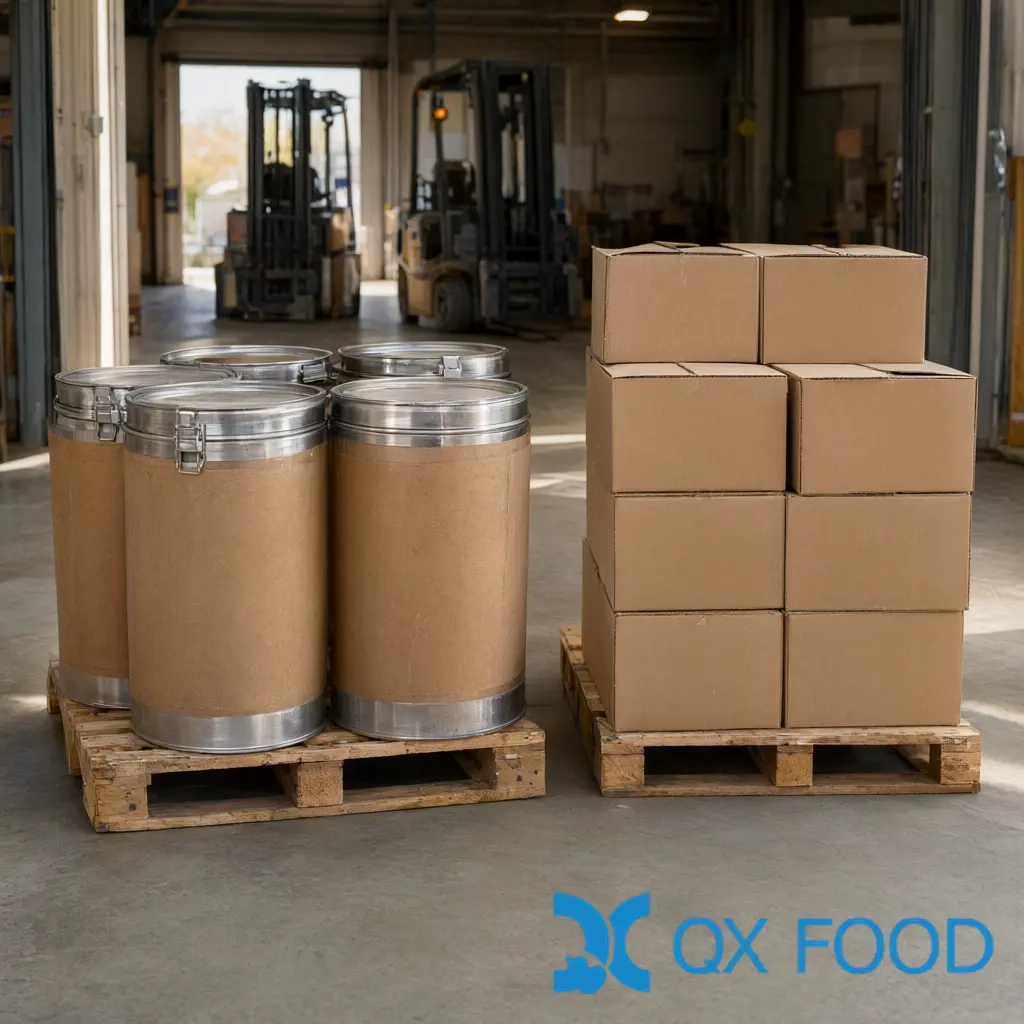
Tomato powder may cut the weight of a validated formulation, but that does not automatically make the delivered cost lower. Compare the quantities needed for the same finished-product target, at the same delivery point and over the same period. Price freight from the pallets you actually ship, and report landed cost separately from storage and inventory carrying cost. This guide builds a tomato ingredient freight and storage cost comparison in five steps.
What to Keep Constant Before Comparing Costs
Start with four fixed conditions. The finished product requirement stays the same. The delivery point and the Incoterm stay the same. The comparison period stays the same. The cost boundary stays the same. Change any one of them and the two columns stop being comparable, even if every individual number is correct.
Codex CXS 57-1981 defines processed tomato concentrates and excludes dry powders and flakes. It gives the paste specification context, but it does not establish a paste-to-powder conversion ratio. Codex CXS 57-1981 defines tomato paste as a concentrate with at least 24% natural total soluble solids, and it explicitly excludes product dehydrated to a dry powder or flake form. A powder therefore sits under a different specification and a different ingredient declaration. That matters for the cost model because the solids fraction, the packaging and the shelf-life statement all come from those documents, not from the product name.
If the question is how much paste replaces how much powder in a formula, that is a conversion question and it belongs with the tomato powder versus paste comparison. This article starts after the formula requirement is known and asks what it costs to move and hold each format.
Why Price per Kilogram Fails Before Freight Is Even Quoted
Start with the measure, not the number. A paste specification usually states natural tomato soluble solids, or NTSS, which counts soluble solids only. A powder specification usually states moisture, from which total dry matter is calculated, and that total includes insoluble solids and any carrier. NTSS and total dry matter are different measures, so they cannot be subtracted from each other or treated as the same solids figure. A paste at 28% NTSS does not automatically contain 28% total tomato solids.
For a solids-based comparison, use a tomato-derived solids figure stated on the same basis for both products, with non-tomato solids excluded. If neither supplier can provide one, compare validated usage quantities for the same finished-product target instead. Do not carry a fixed paste-to-powder ratio into the calculation: the ratio depends on the specific products, and a formulator may also adjust water, acidity or seasoning. A declaration identifies carriers but does not always give their share, so the tomato-derived fraction has to come from the supplier rather than from arithmetic on the label.
Step 1: Fix the Comparison Basis
There are two defensible bases. The stronger one is a validated usage pair: the quantities of paste and powder that trials show deliver the same finished-product result. The other is a solids basis, and it only works when both products state tomato-derived solids on the same definition. Equal product mass is not a basis, because it compares a wet ingredient with a dry one and treats the difference as a result. A tomato ingredient freight and storage cost comparison that skips this decision is answering two different questions.
On the solids basis, write the requirement in kilograms of tomato-derived solids, then convert to product mass with the solids fraction, the process loss and the package net weight. Product mass equals solids required divided by the solids fraction, divided again by one minus the process loss. Keep the loss assumption visible, because two points of loss can move the result more than a small freight difference.
| Input | Unit | Where to get it |
|---|---|---|
| Comparison basis | validated usage or tomato-derived solids | Trial result, or supplier figures on one definition |
| Tomato-derived solids required | kg | Finished formula and batch size |
| Paste tomato-derived solids | % | Supplier specification or COA, not NTSS unless it is stated on the same basis |
| Powder tomato-derived solids | % | Supplier specification or COA, excluding carrier |
| Process loss | % | Line trial or agreed allowance |
| Package net weight | kg | Packaging declaration |
| Units per pallet | units | Loading plan |
| Pallet envelope | m3 per pallet | Measured footprint and loaded height |
| Container payload | kg | Carrier quotation, not the ISO rating alone |
| Incoterm and delivery point | text | Signed quotation |
Two warnings. A specification window is not a batch result, so use the COA for the lot you would actually receive when the difference matters. And a formulated tomato seasoning may contain carriers; the ingredient declaration identifies them without always giving their share, so ask the supplier for the tomato-derived solids figure rather than inferring it from moisture.
Step 2: Turn Product Mass into Pallets and Containers
Weight is only one of the two freight inputs. ISO 668:2020 classifies series 1 containers and specifies their ratings, but the payload you can use is set by the carrier and the route. The pallet pattern is the second input, and it follows the footprint family described in ISO 6780:2003. A 1200 by 1000 mm pallet and a 1200 by 800 mm pallet hold different numbers of drums or cartons, and an overhang that saves one pallet position can be rejected at the load port.
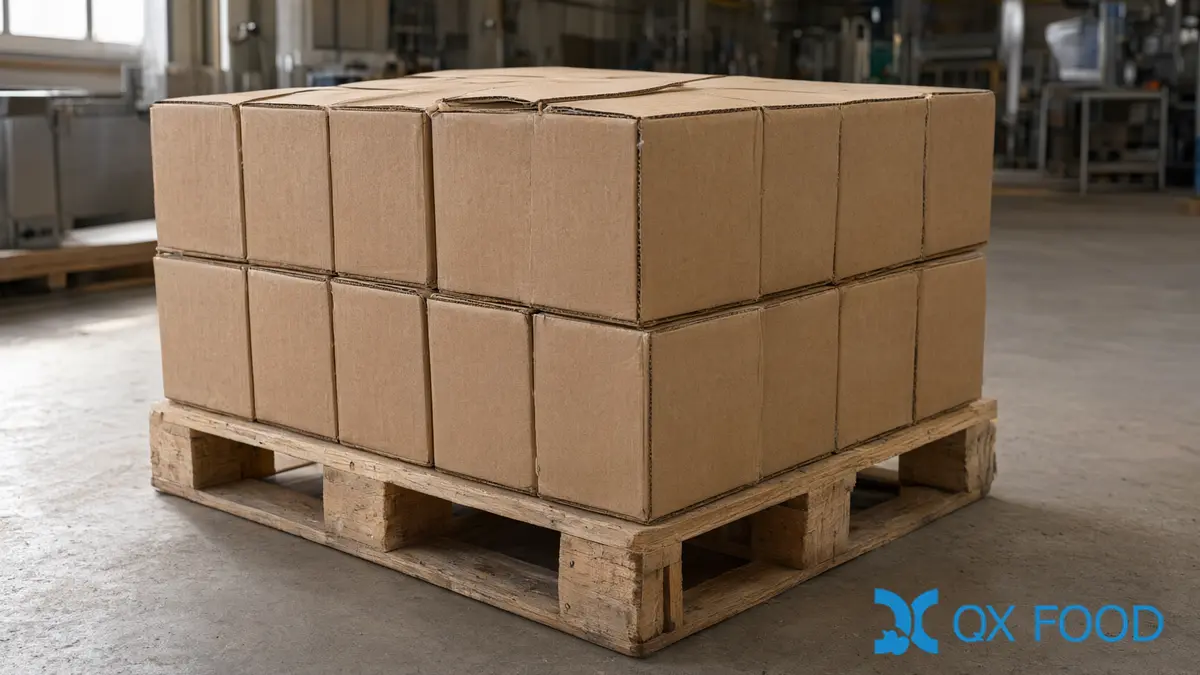
Packaging declarations are where the two columns diverge fastest. TMP-H20 organic tomato powder is packed as two 10 kg aluminium foil inner bags in a double-corrugated carton, so a 20 kg carton is the handling unit. A paste may arrive in aseptic drums or bag-in-box, and the net weight per drum is a supplier-specific number. Model the actual package, not a generic bag or drum.
Then calculate three quantities for each format: packages, the pallet count and the cargo volume. Packages equal product mass divided by net weight per package, rounded up. Pallets equal packages divided by the pallet pattern, rounded up. Volume equals the pallet count multiplied by the measured pallet envelope, footprint times loaded height, including the pallet itself. Those three numbers decide the cost more than the rate alone, because they fix whether the shipment is limited by weight, by volume, or by the container count.
The pallet count is also the storage unit. A format that needs five pallets rather than two does not merely freight differently; it occupies more warehouse space for the same comparison basis, and that cost continues every month the stock sits. Both lines belong in the tomato ingredient freight and storage cost comparison, because the warehouse line repeats while the freight line is paid once.
Step 3: Price the Movement on the Same Incoterm
Incoterms 2020 allocate cost and risk between buyer and seller, and set the obligations behind each term. A quotation on FOB terms and a quotation on DAP terms do not contain the same cost, so comparing them directly is one of the most common errors in a tomato ingredient freight and storage cost model. Convert every quote to the same delivery point before the numbers go into the same table.
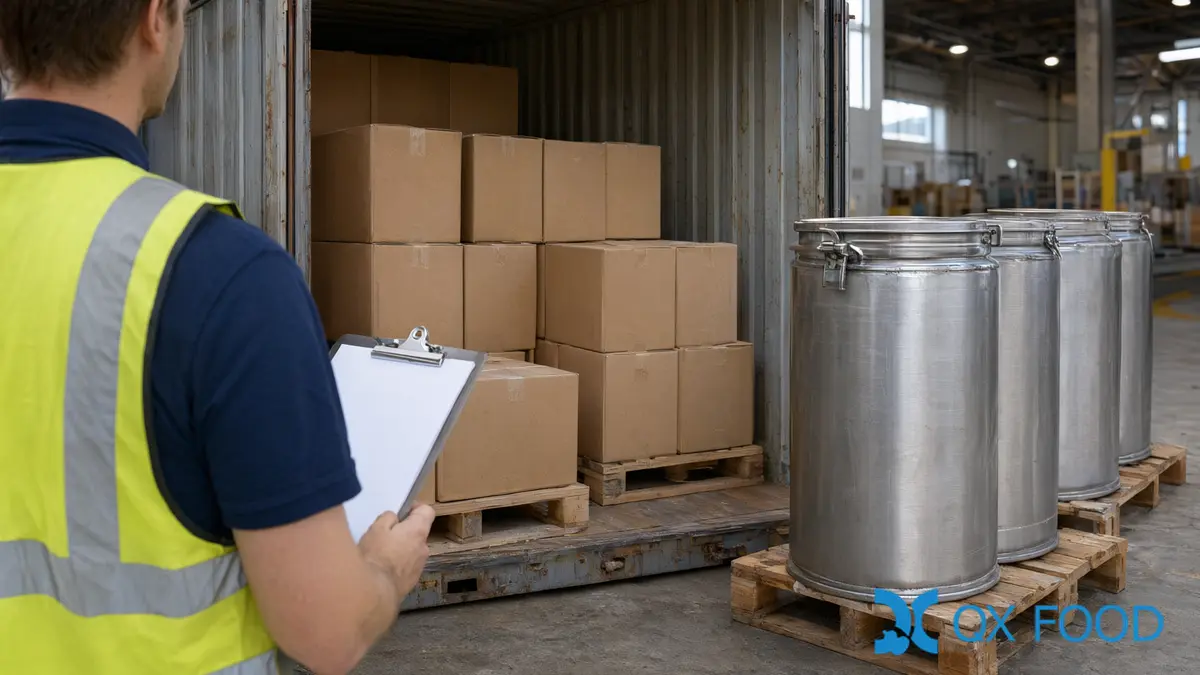
For full-container loads, the container count and the carrier rate decide the freight. For less-than-container loads, the carrier prices weight or measure, whichever produces the higher charge, and the measure comes from the shipping unit: the pallet envelope, not the individual pack. That is why a light powder can still hit a volume floor. Confirm the chargeable rule on the quotation. Mode matters as much as rate: in the worked example, LCL puts the powder ahead because two pallets of cartons are charged on cubic metres, while one FCL on each side removes that advantage and the paste edges ahead.
Include the charges that sit around the ocean freight: origin handling, documentation, destination terminal charges, customs brokerage and inland delivery. A low ocean rate with a high destination charge is not a low delivered cost. If the comparison involves repeated shipments, also record demurrage and detention exposure, because a late container is a cost that never appears in the rate table.
Step 4: Price Storage and the Capital Behind It
Storage has three components: the pallet position, the time and the conditions. The pallet position comes from Step 2. The time is your average months from receipt to use, not the shelf life. The conditions come from the product declaration. An ambient aseptic paste and a moisture-sensitive powder do not carry the same warehouse requirement, and neither format should be assumed to be the easier one without reading the specification.
Record the holding period next to the rent, then add the capital behind the stock. Inventory ties up cash from receipt, so carrying cost equals average inventory value multiplied by the annual capital rate and the period in years. Under even consumption with no closing stock, average inventory is half of the purchased value; state that assumption rather than calling it a measured average. Insurance and shrinkage belong here too. Keep these lines separate from landed cost, because landed cost answers what it costs to get the goods to your gate, while storage and capital answer what it costs to hold them. The holding period is the line most often missing from a tomato ingredient freight and storage cost model.
Minimum order quantity and shelf life change this line more than the warehouse rate does. A paste with a shorter remaining shelf life may need faster turnover, and a powder with a long shelf life may justify a larger order, but only if the capital cost and the storage space are in the model. Do not skip this step: a storage comparison without the holding period is just a rent quote.
Step 5: Put Both Formats on One Line
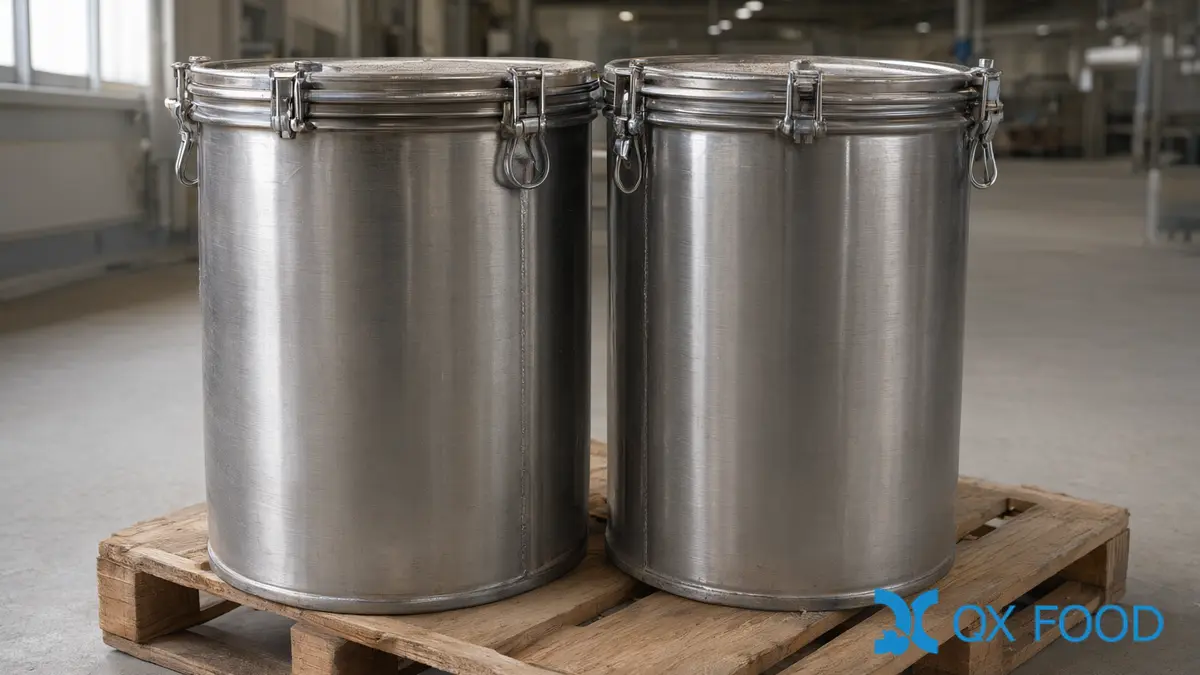
The worked example runs the tomato ingredient freight and storage cost comparison with illustrative values, not a QX Food Ingredients quotation and not a market price. The requirement is 1,000 kg of tomato-derived solids on a stated basis. Paste: 28% tomato-derived solids at 1.20 per kg, 220 kg drums, four per pallet, 2% process loss. Powder: 96% tomato-derived solids at 4.50 per kg, 20 kg cartons, 40 per pallet, 1% process loss. Both use a 1.2 by 1.0 by 1.5 m pallet envelope. Freight is LCL at 95 per W/M with 1,000 kg per cubic metre; insurance 0.5%, duty 10%, handling 0.03 per purchased kg, storage 18 per pallet per month for three months, capital 8% per year on half the purchased value.
| Line | Tomato paste | Tomato powder |
|---|---|---|
| Required product mass | 3,644 kg | 1,052 kg |
| Packages ordered | 17 drums | 53 cartons |
| Purchased net mass | 3,740 kg | 1,060 kg |
| Closing inventory | 96 kg | 8 kg |
| Pallets | 5 | 2 |
| Palletised volume | 9.0 m3 | 3.6 m3 |
| Chargeable weight | 9,000 kg | 3,600 kg |
| Freight, LCL | 855 | 342 |
| Goods | 4,488 | 4,770 |
| Landed cost | 5,926 | 5,645 |
| Storage, three months | 270 | 108 |
| Capital carrying cost | 45 | 48 |
| Total comparison cost | 6,241 | 5,800 |
| Cost per kg of tomato-derived solids | 6.24 | 5.80 |
Read the ratios before the totals. The paste shipment carries about 3.5 times the mass and occupies nine cubic metres against three point six, so under LCL it pays 855 in freight against 342 and 270 in storage against 108. The powder still wins on total, by about 441 per 1,000 kg of solids, or 7%. The freight line, not the goods line, decided that.
Change the mode and the ranking changes. If each format moves as one FCL at 2,800, freight becomes 2,800 on both sides, the volume advantage disappears, and the totals are 8,186 for the paste against 8,258 for the powder, so the paste is marginally cheaper. The sensitivity sheet reports the movement needed to tie in the current mode: here the paste freight would have to fall by about 52%, or the powder freight rise by about 129%. A decision that sits inside one quote is not a decision yet.
What Can Reverse the Answer
| Driver | What it changes | What to record |
|---|---|---|
| Freight rate and mode | Moves the total directly; LCL and FCL can rank the formats differently | Quoted rate, mode and validity date, plus the route |
| Distance and route | Changes both rate and transit time | Origin and destination, plus transit days |
| Storage months | Multiplies the pallet-position cost | Average months from receipt to use |
| Capital cost | Changes the holding cost of the higher-value stock | Internal rate or borrowing cost |
| MOQ and shelf life | Changes order size and write-off risk | Remaining shelf life at receipt |
| Process loss | Changes product mass for the same solids | Trial result, not a target |
| Packaging format | Changes units per pallet and cargo volume | Package drawing and pallet plan |
| Duty classification | Changes the landed cost of a formulated product | Declared composition and tariff line |
Here is the catch: the freight market moves more than most of these lines, and a quote is valid for a short window. Record the validity date next to the rate. A comparison that cannot be repeated next quarter is a snapshot, not a sourcing model.
Utilisation deserves its own line. A container that is limited by volume carries less product than its payload allows, and a container limited by payload leaves space unused. If the two formats have different limiting factors, compare them on the number of containers actually required, not on the nominal capacity printed on the booking.
The Worksheet
The companion workbook follows the tomato ingredient freight and storage cost sequence and keeps the assumptions visible. It opens with the illustrative values used above, so every yellow cell has to be replaced before the result means anything. The calculation sheet reports landed cost separately from holding costs, then converts the total to cost per kilogram of tomato-derived solids.
Download the comparison worksheet (XLSX) and enter your own quotation values.
The workbook also reports the freight-rate multiplier at which the two formats reach parity. That single number is often more useful in a sourcing meeting than the total, because it shows how much of the advantage depends on a freight rate that has not been booked yet. For the formula side of the same decision, the seasoning cost per finished snack article covers how a delivered dose becomes a cost per finished unit.
Tomato Powder Grades and What We Can Confirm
QX Food Ingredients supplies tomato powder grades, and the packaging and declaration differ by grade. The TMP-H20 grade specification is packed as two 10 kg foil bags in a double-corrugated carton, which is a useful example when you build the pallet pattern. For any grade, confirm the current specification, the lot COA, the ingredient declaration and the packaging information before the freight model is fixed, because a carrier’s volume calculation follows the package you actually ship.
Request a tomato powder specification and the packaging details for your comparison. Tell us the quantity and the delivery destination, and we will confirm the grade and the quotation basis. The tomato powder applications guide covers where the powder fits in a formulation, and the supplier evaluation framework covers how to qualify the supplier behind it.
If the project is moving from a bench sample to a production line, the process questions sit outside this cost model and are worth settling before the packaging is fixed.
Tomato Ingredient Freight and Storage Cost FAQ
Is there a fixed conversion from tomato paste to tomato powder?
No fixed ratio exists, and the two usual measures do not line up. A paste figure is normally NTSS, which counts soluble solids only; a powder figure is normally moisture, which gives total dry matter including insoluble solids and any carrier. Codex CXS 57-1981 defines paste at 24% NTSS or more and excludes dry powder from that standard, but it does not provide a conversion ratio. Use a tomato-derived solids figure stated on the same basis for both products, or compare validated usage quantities for the same finished-product target.
Should storage cost be included in landed cost?
Not by the usual definition. Landed cost covers price plus attributable freight and insurance, plus duty and handling to the delivery point. Storage and capital carrying cost are holding costs and should be reported separately, otherwise the same expense can be counted twice. In a tomato ingredient freight and storage cost comparison, the landed line and the holding line answer different questions.
Which Incoterm should I use for the comparison?
Use the same term for both quotations, and convert every quote to the same delivery point. Incoterms 2020 allocate cost and risk between buyer and seller, so an FOB quote and a DAP quote do not contain the same services.
Does a lighter shipment always mean a lower freight bill?
No. For LCL cargo the chargeable volume, minimum charges and the pallet envelope can decide the bill. In the worked example the powder is about a third of the paste mass but still pays 342 in freight, because two pallets occupy 3.6 cubic metres. Compare the chargeable quantity and the applicable charges on each quotation rather than the net weight.
How do pallet dimensions change the result?
The pallet footprint and stack height decide how many units fit per pallet and per container. ISO 6780 describes the principal footprint family, but your actual pallet plan and the carrier’s overhang rules decide the count you can load.
Does tomato paste always need temperature-controlled storage?
It depends on the product declaration. An unopened aseptic paste may be stored under specified ambient conditions, while other packs or opened product need tighter control. Read the supplier’s storage statement rather than assuming a category rule.
What is the biggest error in a tomato ingredient freight and storage cost comparison?
A tomato ingredient freight and storage cost comparison fails when it starts from price per kilogram of product, or from quotes on different Incoterms, before both formats are converted to cost per kilogram of tomato-derived solids. The second most common error is leaving out the holding period.
Can this worksheet be used for other tomato formats?
The logistics and storage structure carries over, but the comparison basis has to be re-established for each product. A formulated seasoning powder is not equivalent to paste on moisture or total dry matter alone, and a puree sits at a different solids level again. Enter validated usage or a comparable tomato-derived solids figure before reading the totals.
The Short Version
Five steps on one basis: fix the comparison basis, convert to product mass and whole packages, turn that into pallets and containers, price freight on one Incoterm and one delivery point, then add storage and carrying cost. Report landed cost separately, keep the assumptions visible, and test whether a realistic freight movement changes the ranking. The output is a tomato ingredient freight and storage cost figure per kilogram on one basis, plus a sensitivity check that tells you how fragile the ranking is.
{ “@context”: “https://schema.org”, “@type”: “FAQPage”, “mainEntity”: [ { “@type”: “Question”, “name”: “Is there a fixed conversion from tomato paste to tomato powder?”, “acceptedAnswer”: { “@type”: “Answer”, “text”: “No fixed ratio exists, and the two usual measures do not line up. A paste figure is normally NTSS, which counts soluble solids only; a powder figure is normally moisture, which gives total dry matter including insoluble solids and any carrier. Codex CXS 57-1981 defines paste at 24% NTSS or more and excludes dry powder from that standard, but it does not provide a conversion ratio. Use a tomato-derived solids figure stated on the same basis for both products, or compare validated usage quantities for the same finished-product target.” } }, { “@type”: “Question”, “name”: “Should storage cost be included in landed cost?”, “acceptedAnswer”: { “@type”: “Answer”, “text”: “Not by the usual definition. Landed cost covers price plus attributable freight and insurance, plus duty and handling to the delivery point. Storage and capital carrying cost are holding costs and should be reported separately, otherwise the same expense can be counted twice. In a tomato ingredient freight and storage cost comparison, the landed line and the holding line answer different questions.” } }, { “@type”: “Question”, “name”: “Which Incoterm should I use for the comparison?”, “acceptedAnswer”: { “@type”: “Answer”, “text”: “Use the same term for both quotations, and convert every quote to the same delivery point. Incoterms 2020 allocate cost and risk between buyer and seller, so an FOB quote and a DAP quote do not contain the same services.” } }, { “@type”: “Question”, “name”: “Does a lighter shipment always mean a lower freight bill?”, “acceptedAnswer”: { “@type”: “Answer”, “text”: “No. For LCL cargo the chargeable volume, minimum charges and the pallet envelope can decide the bill. In the worked example the powder is about a third of the paste mass but still pays 342 in freight, because two pallets occupy 3.6 cubic metres. Compare the chargeable quantity and the applicable charges on each quotation rather than the net weight.” } }, { “@type”: “Question”, “name”: “How do pallet dimensions change the result?”, “acceptedAnswer”: { “@type”: “Answer”, “text”: “The pallet footprint and stack height decide how many units fit per pallet and per container. ISO 6780 describes the principal footprint family, but your actual pallet plan and the carrier’s overhang rules decide the count you can load.” } }, { “@type”: “Question”, “name”: “Does tomato paste always need temperature-controlled storage?”, “acceptedAnswer”: { “@type”: “Answer”, “text”: “It depends on the product declaration. An unopened aseptic paste may be stored under specified ambient conditions, while other packs or opened product need tighter control. Read the supplier’s storage statement rather than assuming a category rule.” } }, { “@type”: “Question”, “name”: “What is the biggest error in a tomato ingredient freight and storage cost comparison?”, “acceptedAnswer”: { “@type”: “Answer”, “text”: “A tomato ingredient freight and storage cost comparison fails when it starts from price per kilogram of product, or from quotes on different Incoterms, before both formats are converted to cost per kilogram of tomato-derived solids. The second most common error is leaving out the holding period.” } }, { “@type”: “Question”, “name”: “Can this worksheet be used for other tomato formats?”, “acceptedAnswer”: { “@type”: “Answer”, “text”: “The logistics and storage structure carries over, but the comparison basis has to be re-established for each product. A formulated seasoning powder is not equivalent to paste on moisture or total dry matter alone, and a puree sits at a different solids level again. Enter validated usage or a comparable tomato-derived solids figure before reading the totals.” } } ] }