
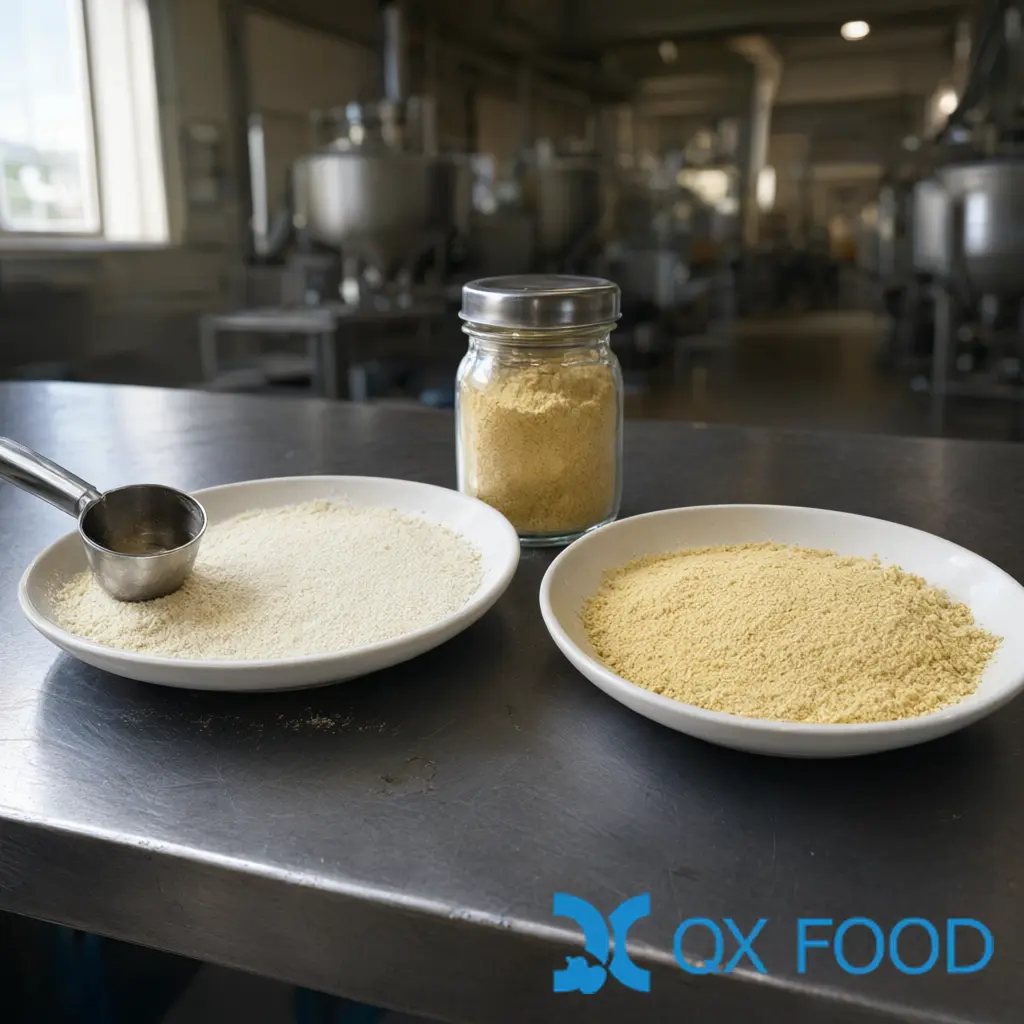
Quick answer. Onion powder color is a specification, not a quality ladder. The pale shade many buyers look for comes from the raw material and a controlled drying load, not from a higher grade on the sheet. This guide decodes the grade words suppliers mix together, explains how extractable color and surface color are actually measured, and shows how to write a color line you can accept or reject against.
The short version: a usable color requirement defines the acceptance target and links it to the applicable measurement and sampling methods, and to the disposition rules. Those details can sit in the specification itself or in controlled documents it references. Where that link is missing, what remains tends to be marketing language wearing a lab coat, and this is where most color disputes between a spice buyer and a supplier start.
Onion is a harder case than most powders. Its raw material spans three color families of onion, each with its own starting shade. It is blanched or not, dried by different routes, and traded under grade words that carry several unrelated meanings. This article stays on one attribute, color, and follows it from the field to the purchase contract. For the wider procurement sequence around it, the spice procurement guide covers standards, supplier qualification and batch continuity in full.
Where Onion Powder Color Comes From
Color is not a finish applied at the end of the process. It accumulates along the chain, and five stages decide what shade leaves the plant: the variety, the raw material’s history, the preparation step, the drying load, and everything that happens after the mill.
Variety sets the family
The three variety families are different raw materials, not different grades of one material. White varieties produce the lightest family, which is why they dominate the North American dehydration industry and why the published United States nomenclature is written around them. Yellow onions carry warmer, deeper tones, and powders milled from them sit in that warmer family. Red and purple varieties yield a distinctly deeper product with its own applications, not an inferior cut of the same thing.
This matters the first time you compare samples. A yellow onion powder sitting next to a white onion powder is not a darker grade of the same product; it is a different product family, and the two were never meant to match.
The drying load, and storage after it
Color can keep moving after the dryer, which is why post-drying storage belongs to color control rather than sitting outside it. Kinetic work on onion quality models browning through dehydration and the storage of dried onion under different temperature and water-activity conditions (Kaymak-Ertekin and Gedik, 2005), which is a formal way of saying a lot is not colour-frozen at the dryer exit.
The drying load then decides how far it moves. In one study of three onion varieties dried at temperatures from 50 to 90 degrees Celsius, total color change increased with temperature for two varieties but stayed essentially flat for the third (Food Science & Nutrition, 2018). Read that result carefully: the response to heat is a joint function of variety and process, not a coefficient you can copy from one supplier to another.
After the dryer: grinding and storage
Grinding opens fresh surfaces and adds a little heat of its own, which is one reason milling choices belong in the same conversation as drying choices (spice grinding process guide). From there the powder keeps aging in its package. Storage conditions affect both how the shade holds and how the powder handles, and the practical controls are the boring ones: a moisture barrier, a cool and dark store, and rotation (powder caking and flow).
What “Grade” Can Mean on an Onion Powder Offer
In supplier correspondence, the word grade carries several unrelated meanings, and they do not translate into each other. Before two sheets can be compared, someone has to say which meaning is on the table.
One clarification before the table. Fancy and Standard are grades inside a named framework; toasted describes a processing and product category, whose quality standards otherwise follow that same appendix with stated exceptions. These words are not positions on one quality scale.
| The “grade” describes | Words you will see | Where it is defined | What it does not tell you |
|---|---|---|---|
| Product grade inside a published standard | Fancy and Standard (for powdered onion) | The published association standards for dehydrated onion | Microbiology, particle size, flavor strength |
| Microbiological load target | Standard, low bacteria, extra low bacteria | The supplier’s own offer, or your control plan | Color, flavor, visual quality |
| Supplier letter grade | Letters such as A or B, or the word commercial | The supplying company itself | Any shared scale; letters differ by supplier |
| Particle-size cut | Names such as powdered, granulated or minced | Screen notation in the specification | Visual quality; a cut is not a ranking |
Only the first of these is a published grade system. The association standards for dehydrated onion state that all specifications are established for Fancy grade, except in the case of powdered onion, for which specifications are also established for Standard grade (ADOGA, 15th edition). Two consequences matter for anyone buying powder. First, Fancy against Standard is a real choice with published differences, and the visible one is a color ceiling, alongside differences such as hot-water insoluble solids. Second, in that document Standard exists only for powdered onion; every coarser cut is specified at Fancy alone.
One boundary belongs here, because it matters later. This framework describes a specific dehydrated-onion product family, and its nomenclature is written around dehydrated white onion products. It should not automatically be transferred to every onion-derived powder, particularly juice- or extract-based spray-dried products. A method or a limit can be adopted by agreement where it suits both sides, but that does not make the product conform to the complete grade standard. Read it as a published reference for interpreting certain trade grade terms, not as a universal export acceptance standard.
The letter grades and the bacteria suffixes are not errors in themselves. They are local vocabulary, and some of them describe genuinely important things. The problem is that they arrive in the same sentence as quality words and get read as if they belong to one scale. Read the letters twice before you compare two sheets, and ask what each one was measured against. A grade word you cannot measure is not yet part of your onion powder color or microbiology specification.
What the Standards Actually Measure
Two published documents anchor dehydrated onion. The international specification covers dehydrated onion in its commercial forms and adds microbiological recommendations (ISO 5559), while the association standards add the grade structure and the color ceilings this section works with. Two different measuring tools then sit behind the phrase it looks right, and they answer different questions.
Extractable color and the optical index
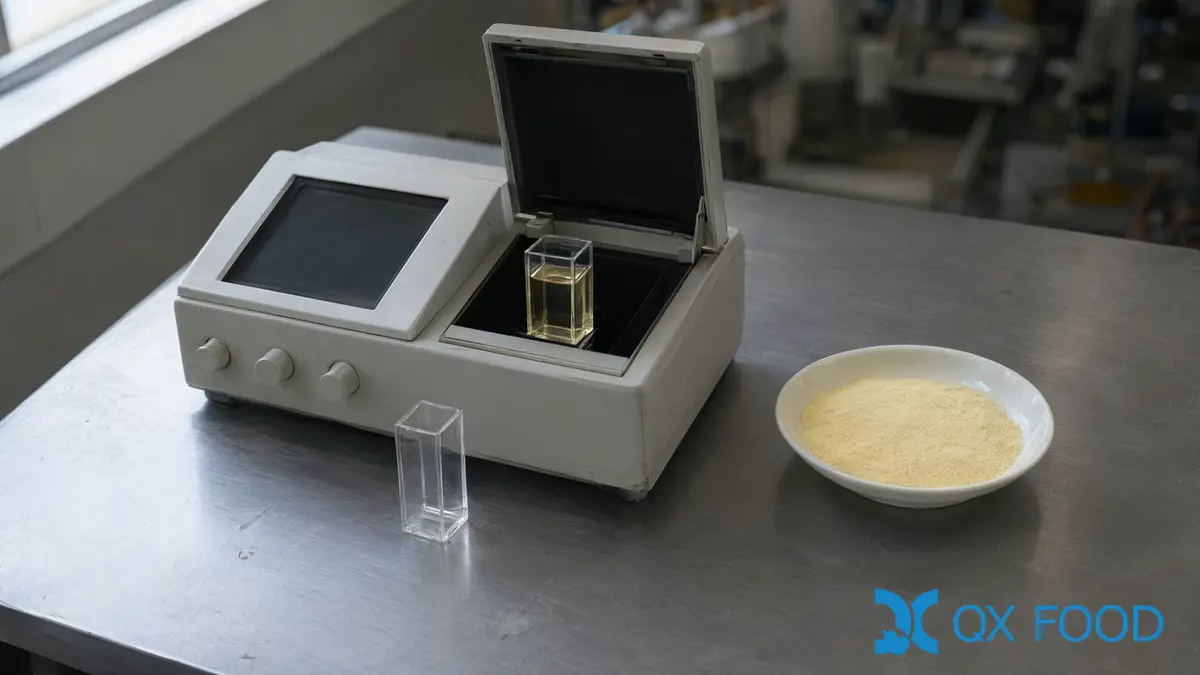
Extractable color is read from a liquid, not from a surface. A defined weight of powder is stirred into a 10 percent sodium chloride solution, left to stand for fifteen minutes, and filtered until the liquor is clear. The absorbance of that clear extract is read in a spectrophotometer at 420 nm, normalised to a one percent solution and a 5.0 centimetre cell path, and multiplied by 1,000 to give the Optical Index. The math is simple: a higher index means more color is extracted, which reads as a deeper shade in solution.
The published ceilings differ by product and grade: Fancy powdered onion and granulated onion are capped at 105, Standard powdered onion and the agglomerated products at 150, and all other dehydrated onion products at 90. The gap between the two powder grades is therefore 45 index points of allowable extractable color. That is how the trade says a deeper extract is acceptable in the Standard grade, without ever ranking it above or below Fancy.
Surface color and the blue score
Surface color is a reflectance reading. An Agtron instrument illuminates the powder and measures the light that comes back, and the standard assigns specific color channels to specific products: the blue score is used to evaluate onion products, while the yellow score evaluates garlic, toasted onion and roasted garlic. Powders and similar fine cuts are read as-is, without grinding, so the reading describes the surface a buyer actually sees, not a prepared extract.
For natural dehydrated onion, the published ceiling is the optical index; scan bands are published for the toasted products, which is one more reason to keep the two product families in separate columns. Sampling matters in both cases. The physical tests are read from a composite sample ground to pass a 20-mesh screen, and products already finer than that are tested as-is, so the value belongs to a defined composite rather than to a scoop from the top of the bag.
Why Whiter Does Not Automatically Mean Better
The instinct to rank powders by lightness runs into an awkward fact: lightness is largely a property of the raw material and the process, so it cannot serve as a universal score. Color can act as a grading criterion inside a named product standard. In the framework used here, Fancy powdered onion allows less extractable color than the Standard grade, and the two grades also differ in requirements such as hot-water insoluble solids. What a lighter sample cannot tell you is whether those other requirements are met.
So dry-powder lightness, extractable color and overall conformity are three different questions. A pale sample can satisfy one published requirement and miss another; a deeper sample can be entirely conforming to the grade it was sold under. No line in this framework rewards a whiter powder by itself, and none of them excuses drift: two lots that agree with the retained sample are worth more to a plant than one brilliant lot followed by one that moves.
Applications pull in different directions as well. A cream soup base, a snack seasoning and a toasted gravy system want different families, and the right onion powder color for one can be the wrong starting point for another. Write the shade your application uses into the specification, compare samples against the applicable grade requirements and that target, and let a supplier quote against them rather than against a beauty contest.
The Colors That Are Not a Shade
Some colors do not belong to any acceptable shade family: black specks and charred particles, grey or green-grey patches, anything that looks like growth or foreign matter. These are defect candidates rather than grade variation, and they deserve a hold and an investigation instead of a price conversation.
The published defect language works this way. Speck-count limits, expressed as a number of specks per sample weight, apply to the coarser cuts: coarse agglomerated at 10 per 0.1 g, granulated at 15 per 0.1 g, ground at 15 per 0.5 g and minced at 10 per 10 g. For powdered products the standard sets no speck count at all. That absence does not mean specks stop mattering in a powder; it means the visual check is left to the buyer and supplier to define, which is why an agreed reference sample and a written rejection criterion matter more for powders, not less.
Keep color in its lane, too. It is a fast, cheap, visual signal that sometimes moves ahead of other problems, and it is not a verdict on safety or flavor. Treat it as screening evidence and pair it with moisture, microbiology, defect counts and sensory before a lot’s fate is decided. When the underlying question turns out to be microbial load rather than shade, that is a treatment and control-plan discussion (spice sterilization methods), not a reason to accept a darker grade.
Toasted Onion Is a Different Product
The dark member of the onion powder family is not a darker batch of the same thing. The standards define toasted onion as functionally different, made in two steps: already dehydrated onion goes through a secondary heating stage that uses different equipment from the primary dehydration. It then carries its own numbers, including a moisture ceiling of 3.5 percent, an extractable color of 1,100 plus or minus 600 on the same optical index scale, and surface scan bands such as 69 to 90 for light onion powders and 60 to 65 for the dark ones.
Two smaller details show how deliberate the separation is. Speck counts are not conducted on toasted onion, and dark brown pieces are excluded from its defect count, because in this product family dark brown is the point rather than the fault.
The practical consequence is to write the product name precisely. Toasted belongs in the title line and in its own color window. Toasting is not a deeper onion powder color; it is a different product, and if the word only appears after a complaint, that is a conversation to have with the supplier rather than a specification to accept.
What a Very Light Shade Is Asking
When a powder arrives almost white, a fair question is how it got that way. Two legitimate answers sit at the front of the line: raw material selection, meaning white varieties, and process control, meaning prompt handling, enzyme inactivation and a controlled heat load. One historical shortcut sits beside them, and it is the reason this section exists: sulfiting agents, added during dehydration or storage to hold back browning.
The association takes a clear position, stating that it does not recommend added sulfites or sulfiting compounds in the preparation of dehydrated onion or garlic. Its manual then offers a method-specific reading of results, because onion and garlic bring their own sulfur chemistry to the lab: the classic Monier-Williams determination reports a share of naturally occurring sulfur as sulfite, and the manual cites reference values of up to 230 ppm by the optimized Monier-Williams method as naturally occurring, with a result above 230 ppm by that method but at or below 20 ppm by the specified HPLC method treated as natural material. Methods designed to find added sulfites reach down to 10 ppm. Treat those figures as interpretive references tied to that method pair, not as a general labeling exemption.
Labeling is a separate question, and it turns on the destination market and on what the sulfite is doing in the product. In the United States, FDA distinguishes naturally occurring sulfites from added sulfiting agents; whether an added agent has to be declared depends on its level, its technical or functional effect in the finished food and the applicable labeling provision, not on the color of the powder or an industry reference value alone (21 CFR 101.100). Under European rules, sulphites are declared when total sulfur dioxide exceeds 10 mg/kg or 10 mg/litre as consumed (Regulation (EU) No 1169/2011). In Singapore, sulphites that are added or carried over from ingredients are declared on prepacked food at a total concentration of 10 mg/kg or more, calculated as total sulfur dioxide (Singapore Food Agency labeling guide). Other destinations set their own triggers, so the rule to write into a contract is the one that applies where the product is sold.
Keep three statements apart, because suppliers merge them. No added sulfites is a process claim about what was used. Sulfites not detected is an analytical claim that needs a named method and a reporting limit. No labeling required is a regulatory conclusion that depends on the destination market and on the product. None of the three follows from a pale color, and the words sulfite-free do not belong beside an onion powder color claim unless the sheet names the test, the limit and the reporting basis. The same trap runs through dehydrated garlic (garlic powder specification), and the undeclared-sulfite import alert is where the enforcement stakes are set out (FDA Import Alert 99-21).
Writing the Color Clause
A workable color clause answers the questions from the beginning of this article, directly or by reference: what is measured, by which method, under which reading conditions, on which sample, and with what consequence if the answer is no. Sample-based and instrument-based acceptance can be used separately or together, and most disputes come from mixing them without saying which one governs.
| Approach | What it needs | Strength | Failure mode | Write it as |
|---|---|---|---|---|
| Sample-based approval | A sealed reference sample, defined viewing conditions, retained copies per lot | Fast, and it matches how the plant judges powder every day | Mixed lighting and untrained eyes; a sample that was never sealed or documented | Matches the retained sample within the agreed viewing conditions, with a stated retention period |
| Instrument-based approval | A named instrument or method, calibration checks, a numeric window with a tolerance | Reproducible between sites and between people; clean arbitration | Chasing a number that no longer matches the visual target the application actually needs | Optical Index at or below X, by method Y, on a composite sample defined as Z |
Used together, the two do different jobs: the reference sample defines the target appearance, while the instrument supplies a number you can trend and arbitrate. An instrument does not become comparable between sites just because it produces a value, so agree the measurement setup as well, meaning how the sample is presented and levelled for the reading, the measurement geometry, the calibration checks and the tolerance. Then write the tie-breaker: when the visual and the instrumental answers disagree, the specification should say which one decides, or how the two are weighed, before the argument happens.
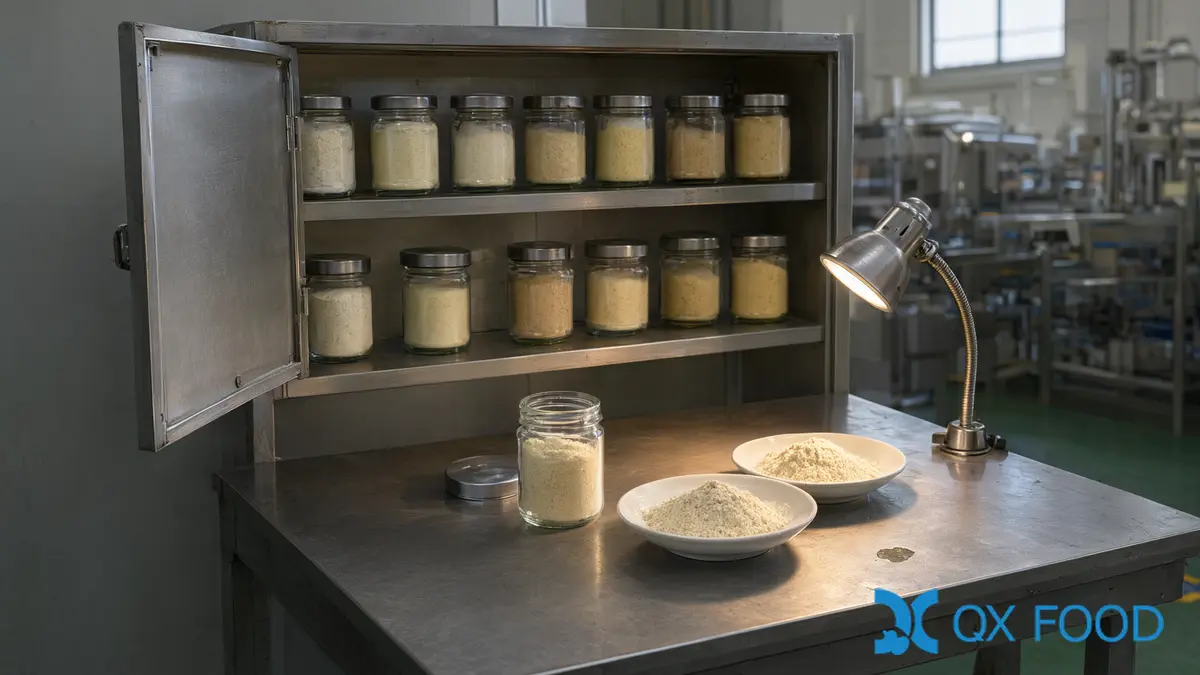
The mechanics around either approach, or both together, are unglamorous, and worth the extra effort. Retain a sealed sample for each accepted lot and keep the archive dark. Record who approved against what. Version the reference sample the moment the target changes, so a stale jar does not quietly become the standard. Then write the disposition: a retest on a second composite, a concession with a recorded deviation, or a rejection. An onion powder color clause without a disposition invites a negotiation every time it is tested.
If your clause is sample-based, put the viewing conditions in the document as well, meaning the same light source, the same background and the two samples side by side. Mixed light is where two honest people disagree most often. Done well, an onion powder color clause is boring to read and quick to enforce.
Two Drying Routes Behind the Powder
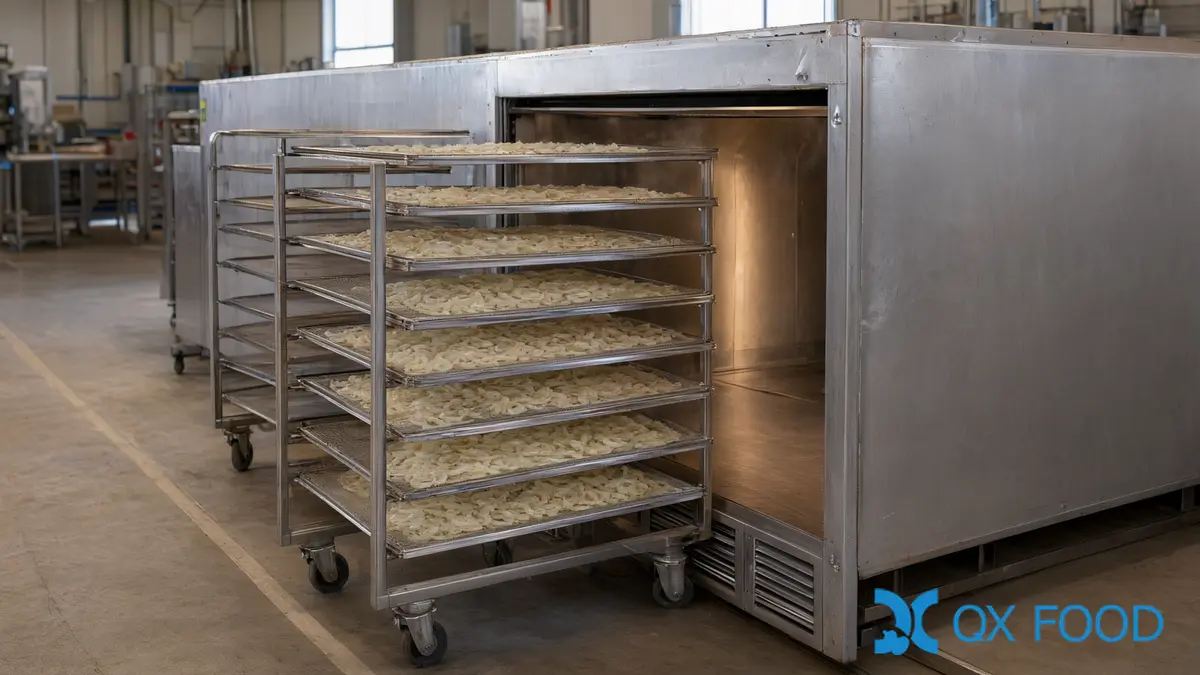
Most dehydrated onion in trade is dried as pieces, on a hot air or tunnel line, and then milled into powder. A smaller share is dried from juice in a spray tower, where the liquid is concentrated first and the powder forms directly in the tower. Both routes are legitimate, and color is one of the attributes their feed and heat histories can shape.
Milled pieces carry more of the raw material’s own shading, and the mill adds a little heat of its own before the powder ever reaches a package. On a spray line, the powder forms from a clarified and concentrated liquid feed, and what that powder does is decided by the feed composition, the clarification and formulation steps, and the drying conditions, not by the technology name. Whether a given spray-dried powder runs pale, flows freely or reconstitutes completely has to be established for that grade and confirmed on samples. Route also changes the questions your specification has to answer, since the same visual target means different process variables on each line (spray drying process variables).
QXFOOD supplies spray-dried onion powder as a standard grade. Onion powder OP-B03 is made from fresh yellow onions; the line runs through sorting, washing and peeling, a blanching step that inactivates enzymes, then pulping, filtration, concentration and spray drying. Its published color line is written the sample way, conforming to the standard sample under the enterprise standard Q/HKSP 0002S. Its moisture ceiling sits at 8.00 percent, above the 5.5 percent line carried by the dehydrated-onion framework discussed above, because it is a different product family governed by its own document; conformity to one specification is not conformity to the other. Hot-air dried dehydrated onion powder can also be arranged as a product-specific supply, with the grade, color window and specification agreed for the order.
One habit makes comparisons honest: ask which route a sample came from before comparing onion powder color between two suppliers. A route difference is a specification difference, and it belongs in the documents before it shows up in an intake check.
What QXFOOD Documents on Onion Powder
OP-B03 is offered against its product-specific specification under the enterprise standard Q/HKSP 0002S. Color acceptance is based on the agreed reference sample or instrumental requirement, and applicable batch documentation is provided according to the selected grade and control plan.
The product page publishes the working record behind that description: appearance as a uniform off-white to pale cream fine powder, a documented moisture value of 6.35 percent against an 8.00 percent ceiling, micro counts of coliforms below 0.3 MPN/g, Staphylococcus aureus below 10 CFU/g and Salmonella not detected in 25 g, certifications for ISO 9001, ISO 22000, HACCP and Halal, a single non-GMO ingredient with no additives, and an 18-month shelf life in sealed cool dry storage. Treat them as published example results rather than as current batch data or proof of lot-to-lot consistency, and confirm the current specification, the batch report and the applicable declarations for the order you place; each shipment is documented with a lot certificate against the agreed specification.
If your template needs a numeric color line, for example an optical index ceiling or an Agtron target, that is specification-stage work rather than a catalogue answer. Relevant parameters, including color, can be discussed for your application and destination market, subject to technical review, sample validation and an agreed specification before any batch claim is made.
Send the onion powder color clause you are working from, together with the application and the destination market. We will say which parts a retained sample can settle, which parts need an instrument, and what the batch documentation can carry. The contact page is the fastest way to start that conversation.
Frequently Asked Questions
What color should onion powder be?
There is no single correct shade. White varieties produce the lightest family, yellow varieties a warmer one, and red or purple varieties a deep product of their own; the drying route shifts the tone within each family. What the documents actually judge is fit: does the lot match the agreed sample, and is it free of the colors that signal defects. Both of those can be checked on any shade.
Is whiter onion powder better quality?
No, not automatically. Lightness follows the raw material and the process, so it is closer to a sourcing choice than a score, and the published color ceilings are maximums on extractable color rather than targets. Color can serve as a grading criterion inside a named standard, as with the Fancy and Standard ceilings for powdered onion, but that is one requirement among several. Dry-powder whiteness does not confirm overall quality on its own, and batch-to-batch consistency against your agreed sample is the signal that actually protects a production line.
Why does onion powder darken over time?
Powder keeps reacting after it is packed, and heat, moisture and light all push the shade. Sealed storage in a cool, dark place slows the drift. Before treating a shift as a supplier problem, compare the stored material with a reference kept under the same stated conditions, because a jar left open on a bench will lose that comparison on its own.
What does Fancy grade mean on a powdered onion specification?
Fancy is the association’s default grade for dehydrated onion products, and powdered onion is the one form that also has a published Standard grade. The two differ in several lines, and the visible one is the extractable color ceiling: 105 for Fancy powdered onion against 150 for Standard. Coarser cuts such as flakes, chopped and minced products are specified at Fancy alone, so a Standard grade offer on those cuts needs its own definition from the supplier.
What is the optical index on an onion powder sheet?
It is the extractable color reading: a defined extract is read at 420 nm and normalised to a one percent solution and a 5.0 centimetre cell path, then multiplied by 1,000. Higher values mean more color is extracted. The published ceilings run from 90 for the general dehydrated onion products to 105 for Fancy powdered onion and 150 for Standard powdered onion. It describes extractable color under the named method. It is not a direct measurement of dry-powder lightness, and it should not replace a surface-color or visual acceptance test when dry appearance is the purchasing requirement.
Is toasted onion powder a defect or a product of its own?
A product of its own. Toasted onion is made by a second heating step applied to already dehydrated onion, and the standards give it its own numbers, including a 3.5 percent moisture ceiling and an extractable color of 1,100 plus or minus 600. Dark brown pieces are excluded from its defect count, because in this family the color is deliberate. The mistake to avoid is treating a toasted lot and a natural lot as points on one scale.
How should an onion powder color specification be written?
Name what is measured, the method, the reading conditions, the sample and the consequence. A sealed reference sample with defined viewing conditions and a named instrument with a numeric window and tolerance can be used separately or together. Keep the retained samples, record who approved against what, and write the disposition for a failing lot. Where the visual and the instrumental answers disagree, the specification should already say which one decides. An onion powder color specification that cannot answer that is not finished yet.
Does onion powder contain sulfites?
Dehydrated onion contains sulfur compounds of its own, and the classic distillation test can report some of them as sulfite, which is a known reporting interference rather than an added ingredient. Industry references interpret results in method-specific terms: the association’s manual cites up to 230 ppm by optimized Monier-Williams as naturally occurring, with a result above that but at or below 20 ppm by the specified HPLC method treated as natural material, and added-sulfite methods reach down to 10 ppm. Those are interpretive references, not a blanket labeling exemption. Whether sulfites must be declared depends on the destination market and on what the agent does in the finished food, so treat no added sulfites, sulfites not detected and no labeling required as three different statements, each needing its own evidence.
Learn More
- Garlic powder specification: the same reading discipline applied to dehydrated garlic
- Spray drying for food powders: how process variables shape the powder
- Spray dried against freeze dried powders: what actually changes
- Spice grinding: how milling choices set particle size and heat
- Scallion powder SLP-B05: another spray-dried powder in the same family
- Discuss an onion powder color specification with QXFOOD