What Is Cassia Powder CP-B04?
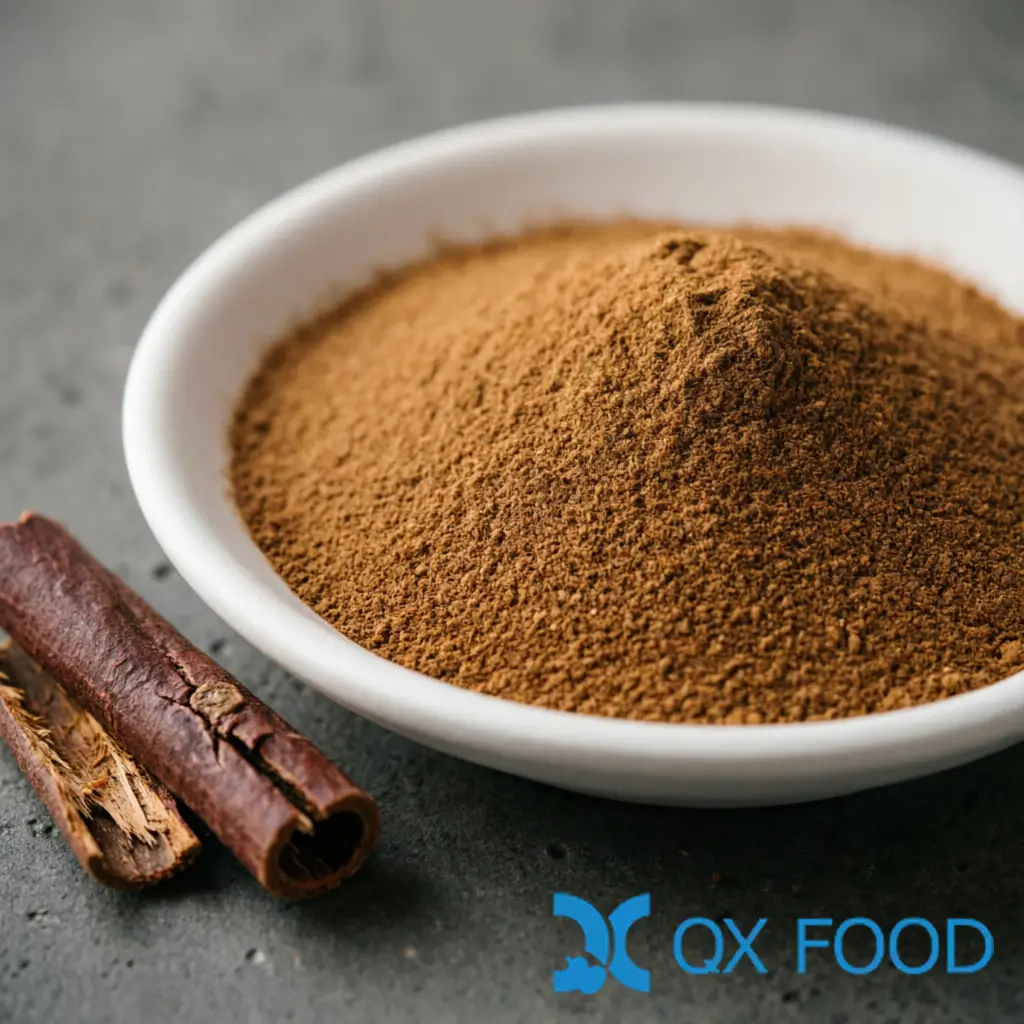
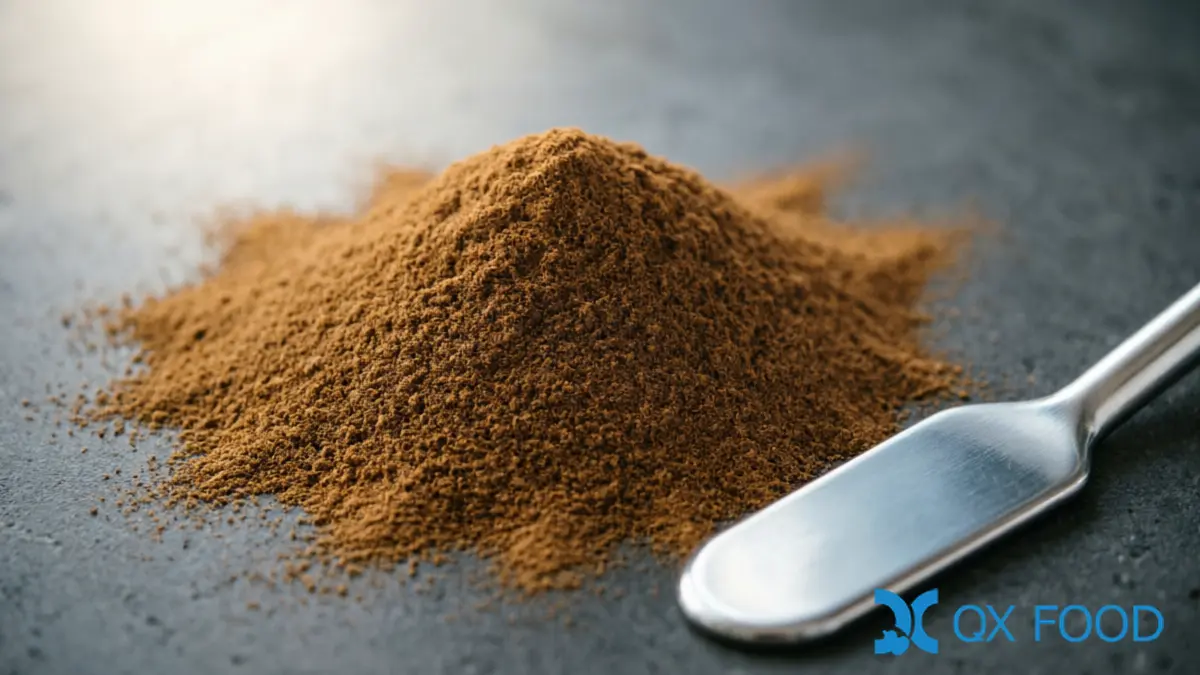
Cassia powder CP-B04 is made from the dried inner bark of Cinnamomum cassia — the species that commercial food manufacturers overwhelmingly mean when they specify cassia powder rather than Ceylon cinnamon. The bark is sourced from cassia-growing regions in Guangdong and Guangxi, China, where the warm, humid climate produces cassia bark with a characteristically thick cut and high volatile oil content. The bark is cleaned, cut into manageable pieces, low-temperature dried to preserve its volatile oil fraction, ground to a fine powder, sieved, and passed through metal detection before packaging.
Cassia powder is not the same product as cinnamon powder, though the two are often confused in English-language ingredient specifications. Cassia (Cinnamomum cassia) produces a thicker, darker bark with a stronger, more pungent flavor and a higher cinnamaldehyde content than Ceylon cinnamon (Cinnamomum verum), which has a thinner bark and a more delicate, floral aroma. In food manufacturing, cassia powder is the variety that delivers the warm, sweet, spicy character that consumers recognize as cinnamon in baked goods, spice blends and meat seasonings. When a buyer orders cassia powder rather than cinnamon powder, they are typically specifying the stronger, more heat-stable Chinese cassia variety — not the milder, more expensive Ceylon type.
The volatile oil content of cassia powder CP-B04 measures at 2.02 g/100g against a minimum standard of 1.50 g/100g. That is a solid margin above the floor. Volatile oil is the direct measure of aromatic intensity in cassia powder — the fraction of the bark’s weight made up of essential oil, of which 80–95% is cinnamaldehyde, the compound responsible for cassia’s characteristic warm, sweet-spicy flavor and for its documented antimicrobial and antioxidant activity. A cassia powder with higher volatile oil content delivers more flavor per gram, holds its aroma longer in storage, and performs more reliably in baked goods where the spice needs to survive the oven.
Heavy metal and mycotoxin screening is part of the standard COA: lead at 0.08 mg/kg (ceiling 2.0 mg/kg), aflatoxin B1 not detected at the 5 µg/kg limit. The microbiological profile is clean: aerobic plate count at 180 CFU/g (ceiling 10,000), coliforms below detection, Salmonella not detected, Staphylococcus aureus under 10 CFU/g (ceiling 100). For a cassia powder going into ready-to-eat bakery products, instant beverage mixes or export markets with strict contaminant limits, having lead, aflatoxin and microbiology data on the standard COA eliminates a round of third-party testing for the buyer.
Specification Data — Standard Grade
| Parameter | Unit | Standard | Measured | Method |
|---|---|---|---|---|
| Volatile Oil | g/100g | ≥1.50 | 2.02 | GB 31626 |
| Moisture | g/100g | ≤8.0 | 6.2 | GB 5009.3 |
| Total Ash | g/100g | ≤8.0 | 5.1 | GB 5009.4 |
| Acid-Insoluble Ash | g/100g | ≤1.5 | 0.8 | GB 5009.4 |
| Aerobic Plate Count | CFU/g | ≤10,000 | 180 | GB 4789.2 |
| Coliforms | MPN/g | ≤0.3 | <0.3 | GB 4789.3 |
| Salmonella | /25g | Not detectable | Not detected | GB 4789.4 |
| Staphylococcus aureus | CFU/g | ≤100 | <10 | GB 4789.10 |
| Aflatoxin B1 | μg/kg | ≤5.0 | Not Detected | GB 5009.22 |
| Lead (as Pb) | mg/kg | ≤2.0 | 0.08 | GB 5009.12 |
| Appearance | — | Fine brown powder, uniform | Compliant | Q/HKSP 0002S |
| Odor & Taste | — | Warm spicy-sweet, characteristic cassia | Compliant | Q/HKSP 0002S |
The product standard is GB/T 30381 — the Chinese national standard for cassia. The volatile oil reading of 2.02 g/100g is the number that tells a buyer what kind of cassia powder this is. A reading near the 1.50 minimum suggests bark from young trees, high-temperature drying that drove off volatiles, or grinding conditions that generated enough heat to degrade the oil. A reading of 2.02 — well above the floor — suggests mature bark, careful low-temperature processing, and a finished cassia powder that will perform in applications where the spice note needs to survive cooking, baking or extended storage. For a buyer who has tested cassia powder from other sources and found the aroma to be weak or inconsistent, the volatile oil number is the specification to compare side by side.
Cassia vs Cinnamon: Why the Distinction Matters for Buyers
In the B2B spice trade, cassia powder and cinnamon powder are not the same product, and the distinction matters for several practical reasons that go beyond botanical taxonomy.
Flavor intensity is the most immediate difference. Cassia powder contains a higher concentration of cinnamaldehyde — typically 1–3% of the bark by weight, compared to 0.5–1% for Ceylon cinnamon — which gives cassia its stronger, warmer, more pungent character. In a baked product, the cassia note registers more clearly and survives the oven better because there is simply more cinnamaldehyde available to volatilize. In a spice blend where cassia shares space with cumin, coriander, chili and other spices, the higher cinnamaldehyde content means cassia holds its own against the other aromatics rather than getting buried.
Heat stability is the second practical factor. Cinnamaldehyde has a boiling point of approximately 248°C — well above typical baking, frying and extrusion temperatures — so the compound itself is thermally stable. But the volatile oil fraction of cassia bark also contains lighter compounds like eugenol, linalool and caryophyllene, which can be driven off during high-heat processing. Cassia powder, with its higher total volatile oil content, has more aromatic material to lose before the flavor character degrades noticeably in the finished product. This is why cassia is the preferred choice for baked goods, fried snacks and extruded cereals, while Ceylon cinnamon is more commonly reserved for cold applications like beverage syrups, ice cream and no-bake desserts.
Cost is the third factor. Cassia bark is produced in far larger volumes than Ceylon cinnamon, primarily in China, Vietnam and Indonesia. The lower raw material cost per kilogram, combined with cassia’s higher flavor intensity per gram, means a buyer gets more flavor per dollar from cassia powder than from Ceylon cinnamon powder. For a food manufacturer producing tons of seasoned product per day, that cost difference is not trivial.
The coumarin question also arises with cassia powder. Cassia bark naturally contains coumarin at levels that can be a labeling consideration in certain EU markets. Ceylon cinnamon contains negligible coumarin. If a buyer’s product is destined for an EU market with coumarin labeling requirements, or if a customer specification includes a coumarin ceiling, the buyer should mention this during the inquiry stage. The QA team can provide lot-specific coumarin data.
How Cassia Powder Performs in Food Manufacturing
Bakery and Baked Goods
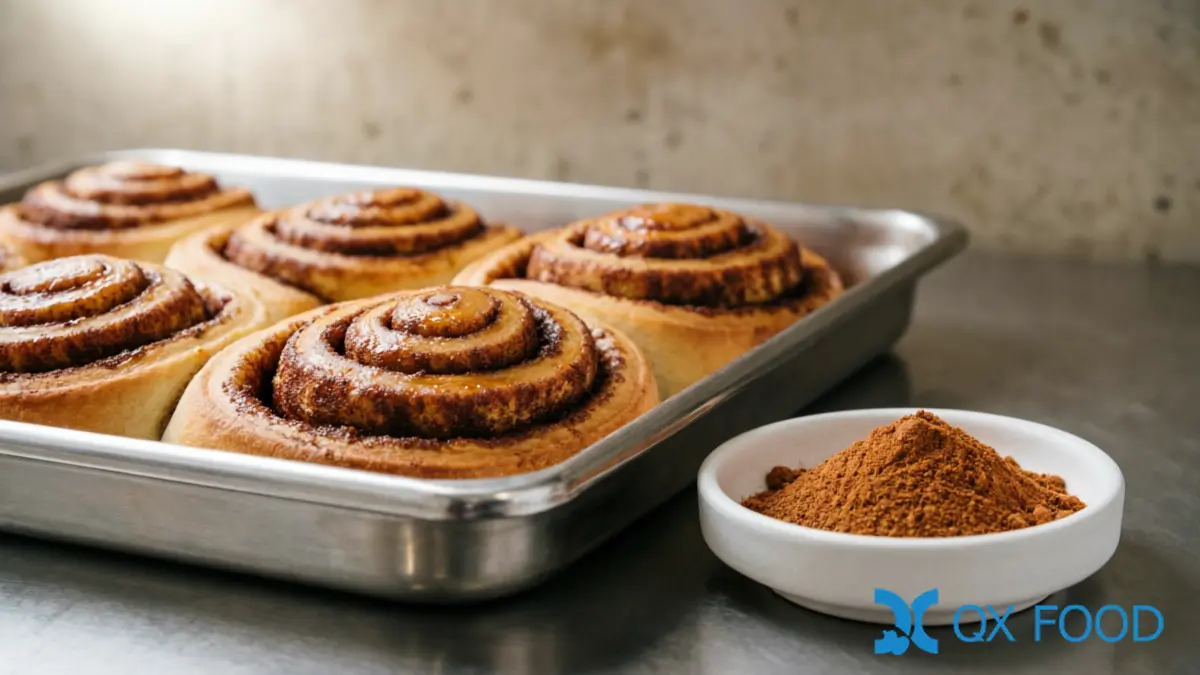
Cassia powder is the defining spice in commercial cinnamon rolls, coffee cakes, muffins, cookies, sweet breads and breakfast pastries. The typical inclusion rate for cassia powder in a bakery dry mix is 0.5–2% by weight — low enough not to dominate the product, high enough that the cassia character registers through the sweetness of the sugar and the richness of the fat. The volatile oil in cassia powder begins releasing at around 60°C and peaks during the bake, filling the production facility with the characteristic warm spicy aroma and depositing cinnamaldehyde onto the product surface and into the crumb.
For yeast-leavened products like cinnamon rolls, there is a practical caution: cinnamaldehyde has antimicrobial activity that can partially inhibit yeast fermentation at higher concentrations — roughly above 2% of flour weight. This is usually not a problem for cassia powder at typical bakery dosage levels, but formulators working with high-cassia specialty products should be aware of the interaction and adjust proofing time accordingly. Chemically leavened products like muffins and cookies are unaffected because the leavening comes from baking powder or baking soda, not from yeast metabolism.
Meat Processing and Savory Applications
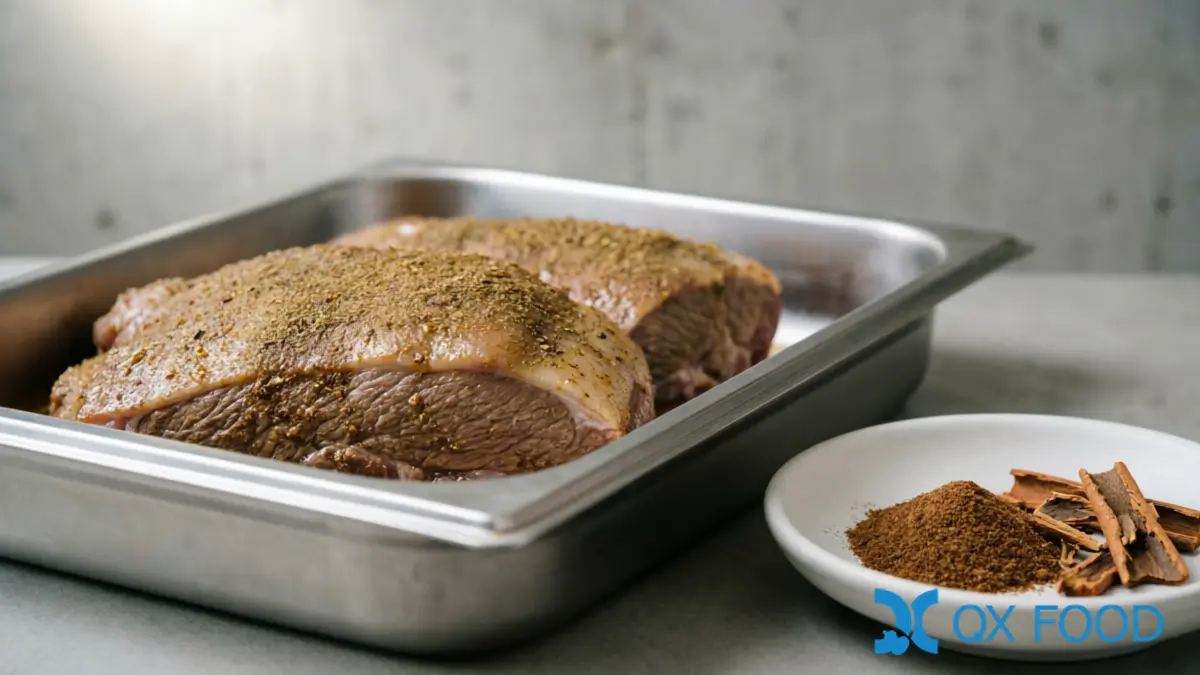
Cassia powder appears in meat processing across multiple culinary traditions — Chinese braised meat seasoning, Middle Eastern lamb marinades, North African tagine spice blends, and various European processed meat products. The typical dosage for cassia powder in a meat seasoning blend is 1–5% of the dry spice premix, which translates to roughly 0.02–0.1% of the finished meat product weight. At these levels, cassia powder contributes a warm, sweet-spicy background note that complements the salt, smoke and umami characters developed during curing and cooking.
Cassia powder also functions as an antioxidant in meat systems. Cinnamaldehyde and the polyphenols in cassia bark scavenge free radicals and slow lipid oxidation — the chemical process that produces rancidity, off-flavors and color degradation in stored meat products. The effect is measurable: seasoned meat products containing cassia powder at 0.05–0.1% typically show reduced thiobarbituric acid reactive substances (TBARS) — a standard measure of lipid oxidation — compared to unseasoned controls under the same storage conditions. Cassia powder is not a replacement for proper refrigeration or approved antioxidants, but it provides an additional preservation hurdle that formulators can factor into the product’s shelf-life calculation.
Beverage and Instant Drink Mixes
Cassia powder is used in hot beverage applications — chai latte mixes, spiced coffee blends, hot chocolate premixes, mulled cider seasoning — where the powder is reconstituted with hot water or milk at the point of consumption. The typical inclusion rate for cassia powder in a beverage dry mix is 0.2–1.0% by weight. At these levels, the cassia character provides the warm spicy note that consumers expect in a chai or spiced beverage without overwhelming the base flavor of the tea, coffee or cocoa.
The fine particle size of cassia powder CP-B04 ensures rapid dispersion in hot liquid without forming lumps or leaving a gritty sediment at the bottom of the cup. For ready-to-drink liquid beverages, cassia powder requires an emulsification system because the volatile oils are not water-soluble and will separate over time. In a dry powder that the consumer reconstitutes, the cassia powder disperses adequately as-is, and the brief contact time between the powder and the hot water — typically 10–30 seconds — is sufficient to release the volatile aroma without requiring pre-dissolution or a carrier system.
Seasoning Blends and Compound Spices
Cassia powder is a foundational component of Chinese five-spice powder — alongside star anise, cloves, fennel and Sichuan pepper — and appears in curry powders, garam masala, pumpkin pie spice, apple pie spice and various Middle Eastern baharat blends. In a commercial spice blend, cassia powder typically makes up 10–25% of the blend by weight, depending on whether cassia is a lead note (as in five-spice or pumpkin pie spice) or a supporting character (as in garam masala, where cumin and coriander dominate).
The fine grind of cassia powder CP-B04 ensures even distribution through the blend during mixing, and the high volatile oil content means the cassia note remains detectable in the finished blend even after the other spices have been added. In a multi-spice blend, a weak cassia component results in a blend that tastes flat and one-dimensional — the cassia provides the warm, sweet top note that rounds out the sharper, more pungent contributions from the cumin, chili and black pepper.
Packaging and Shelf Stability
Cassia powder CP-B04 is a natural single-ingredient product — 100% ground cassia bark with no additives, no anti-caking agents, no artificial flavors and no preservatives. The brown color is characteristic of properly dried and ground cassia. The volatile oil content (2.02 g/100g) is the primary quality indicator that buyers should monitor batch to batch.
For buyers who need a specific particle size, the standard fine grind can be adjusted — coarser for visible cassia particles in spice rubs, finer for instant beverage applications. This is a physical specification change, not a formulation change, and can normally be confirmed at the sample stage.
Standard packaging covers the usual volumes: 100 g and 1 kg aluminum foil bags for evaluation, 10 kg or 20 kg cartons for pilot production, and 25 kg fiber drums for full container loads. Custom packaging — private-label bags, specific dimensions, multi-layer barrier materials — is available for OEM orders.
Storage: sealed container, cool dry place, away from direct sunlight. The volatile oils are sensitive to oxygen and light; cinnamaldehyde oxidizes slowly to cinnamic acid under prolonged exposure, which reduces both the aroma intensity and the functional antioxidant activity of the cassia powder. Under proper conditions — sealed bag, below 25°C, humidity below 60% — the shelf life is 18 months from production. Opened bags should be re-sealed immediately; opened stock used within 60 days retains the best aromatic quality.
Quality Systems and Documentation
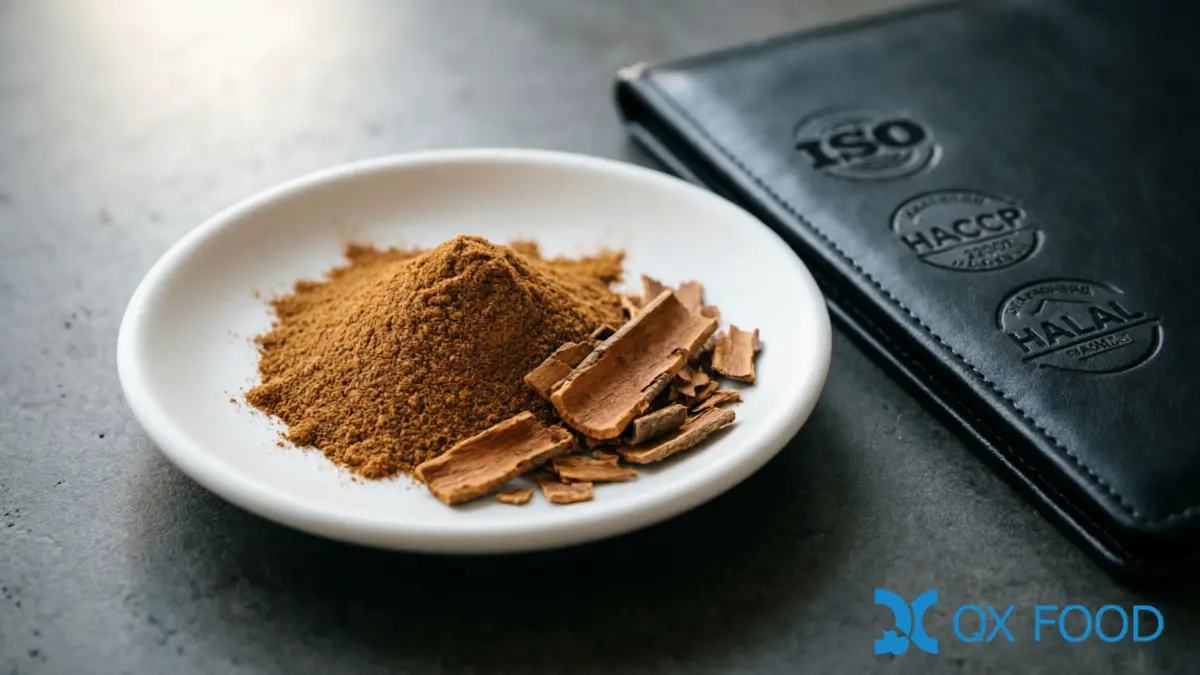
- ISO 9001:2015 — quality management system
- ISO 22000:2018 — food safety management system
- HACCP — hazard analysis and critical control points
- HALAL — certified by an accredited halal certification body
Each shipment comes with a batch-specific COA. Additional testing beyond the standard panel — coumarin by HPLC, pesticide residues, heavy metal panels beyond lead — can be arranged on request. Compliance with Codex Alimentarius guidelines is maintained.
Related reading: Cassia in hot pot base procurement and braised meat applications.
Cassia’s warm bark note rounds fruit systems such as matcha MP-K40 and mango MGO-15 in bakery.
Frequently Asked Questions
What is the difference between cassia powder and cinnamon powder?
Cassia powder comes from Cinnamomum cassia — a species with thicker bark, stronger flavor and higher cinnamaldehyde content (typically 1–3% of bark weight). Cinnamon powder usually refers to Ceylon cinnamon (Cinnamomum verum), which has thinner bark, a more delicate floral aroma and lower cinnamaldehyde (0.5–1%). In commercial food manufacturing, cassia powder is what most buyers actually want when they order cassia powder — it delivers more flavor per gram, survives high-heat processing better, and costs less per kilogram. The two are not interchangeable at the same dosage; substituting Ceylon cinnamon for cassia at equal weight will produce a weaker, less aromatic finished product.
What is the volatile oil content of cassia powder CP-B04?
The volatile oil content measures 2.02 g/100g by steam distillation, above the 1.50 g/100g minimum standard. The volatile oil is 80–95% cinnamaldehyde — the compound responsible for cassia’s warm, sweet-spicy flavor and for its antimicrobial and antioxidant properties in food systems. A higher volatile oil reading means the cassia powder delivers more flavor per gram, holds its aroma longer in storage, and provides stronger functional effects than a cassia powder with marginal oil content.
Does cassia powder contain coumarin, and is that a problem for my product?
Cassia bark naturally contains coumarin. This can be a labeling consideration in certain EU markets where food products containing cassia may be subject to coumarin limits. If your product is destined for an EU market or your customer specification includes a coumarin ceiling, mention this at the inquiry stage. The QA team can provide lot-specific coumarin data.
Is cassia powder CP-B04 tested for aflatoxin and heavy metals?
Yes. The standard COA includes aflatoxin B1 (not detected at 5 µg/kg) and lead (0.08 mg/kg against a 2.0 mg/kg limit). These parameters are part of the routine testing schedule. If your importing country requires broader screening — additional heavy metals, pesticide residues, or specific mycotoxin panels — communicate these requirements at the inquiry stage.
Can cassia powder inhibit yeast in my dough products?
Cinnamaldehyde — the main volatile compound in cassia powder — has antimicrobial properties that can partially inhibit yeast activity at concentrations above approximately 2% of flour weight. For yeast-leavened products like cinnamon rolls, keep the cassia dosage at or below 2% of flour weight or allow additional proofing time to compensate. Chemically leavened products like muffins and cookies are not affected.
Can I get cassia powder in a specific particle size?
Yes. The standard grade is a fine powder, but coarser grinds can be discussed at the sample stage — useful for visible cassia particles in dry rubs or spice blends. Finer grinds are available for instant beverage applications. This is a physical specification adjustment, not a formulation change.
How should I store cassia powder to maintain volatile oil quality?
Store cassia powder in a sealed container in a cool, dry place — below 25°C with humidity below 60%. The volatile oils are sensitive to oxygen and light; cinnamaldehyde oxidizes slowly under prolonged exposure. Re-seal opened bags immediately. Under proper storage, shelf life is 18 months; opened stock used within 60 days retains best quality.
Is cassia powder CP-B04 Halal-certified?
Yes. The manufacturing facility holds active Halal certification. Cassia powder is a single-ingredient plant product — dried, ground cassia bark — with no animal-derived materials, no ethanol and no fermentation steps. The certificate is included in the standard documentation package.
Explore Our Natural Spice Powder Range
Cassia powder CP-B04 is part of the Natural Plant Powders family. Buyers sourcing a full spice portfolio often evaluate these products alongside:
Turmeric Powder TP-K37 — curcumin 4.5 g/100g, natural color and seasoning base.
Garlic Powder GP-B06 — pure ground garlic for snack seasonings and savory blends.
Clove Powder CLO-D11 — 80 mesh, volatile oil 17.8g/100g, for meat curing and spice blends.
Pure Cinnamon Powder CP-K47 — pure ground cinnamon bark powder for spice blends and savory formulations.
For the full category view, visit the Natural Plant Powders category page.