
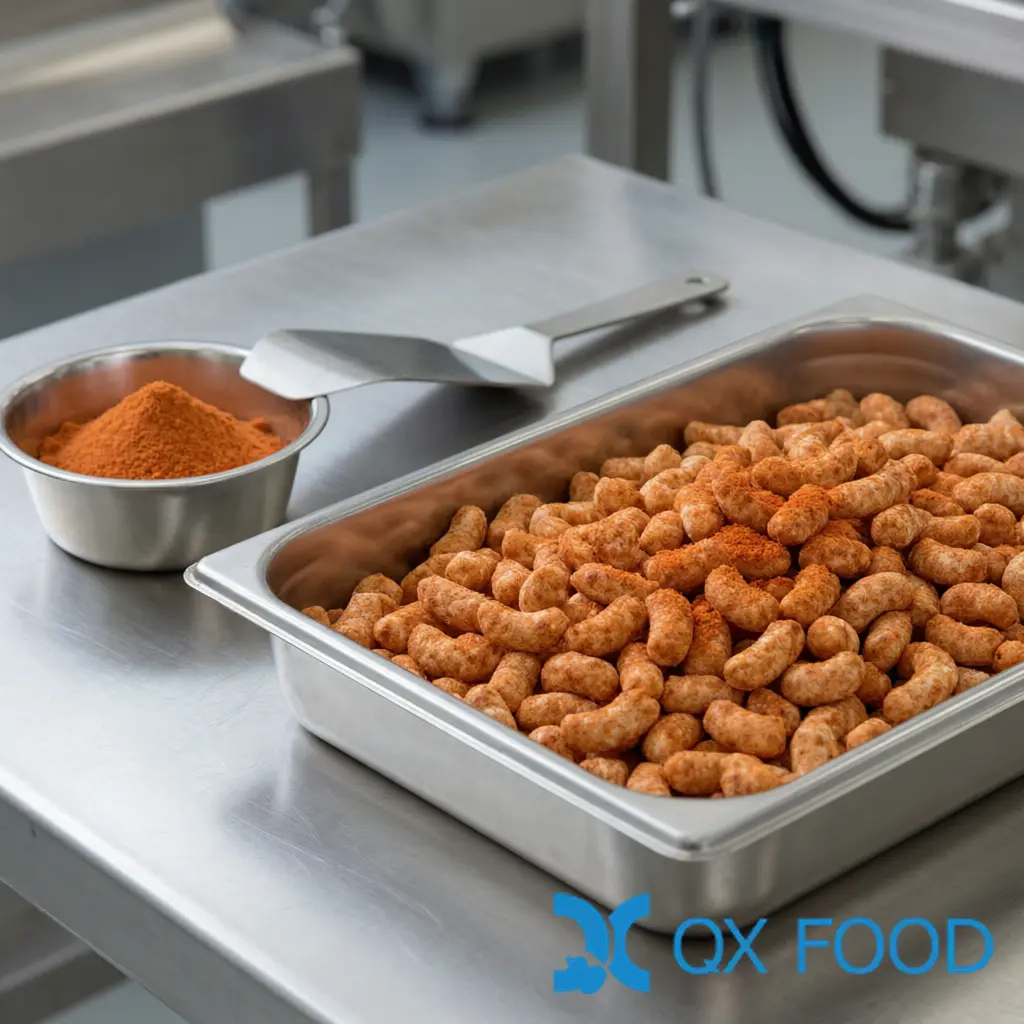
Quick answer. Seasoning adhesion can fail at the interface between powder and surface, inside the powder itself, and at every mechanical event after the drum. Carrier choice, surface oil and moisture, particle size distribution, static charge and handling all move the same result, so a change to any one of them has to be validated by re-measuring pickup after packing rather than by judging a sample at the drum.
Powder that leaves the drum and powder that reaches a consumer are not the same quantity. The gap between them is the subject of this article. Seasoning adhesion is not a property a blend carries in a bag; it is a property of a pair, the powder and the surface it meets at the moment it meets it, and everything that happens after that point works to break the bond.
Two other guides cover the neighbouring questions. How to measure what actually stays on the product, including sampling points and retention through packing, is set out in seasoning pickup and retention. Where seasoning should be added on a baked line, and what the oven does to flavour, belongs to seasoning systems for baked snacks. This page is about the mechanism: why powder comes off, and which of the possible causes deserves your attention first.
Adhesion and Cohesion Are Two Different Failures
The powder literature separates two forces that plant conversations usually merge into one word. Adhesion is an interfacial property: it measures the forces holding a particle to the surface of another material. Cohesion is an internal property of the powder: it measures the forces holding particles to each other. Particles stay put until a force larger than the relevant bond is applied to break it (Armstrong and Barringer, 2013, Journal of Food Science).
The distinction is not academic, because the two failures look different on the line and need different fixes. Adhesive failure means powder leaves the product: bare patches, uneven coverage, a piece that tastes weaker than the sample approved at the drum. Cohesive failure means powder stays with powder: agglomerates that never break up in the drum, bridges in a feeder, and deposits that build up on equipment instead of on product.
Both can end with the same complaint from a customer, and both can show up as a low retention figure. That is why a diagnosis has to start with what comes off. Powder collected under the drum that is fine, uniform and loosely packed points first toward a high fines fraction, targeting loss, static or mechanical removal. Agglomerates, feeder bridging, or powder that does not disperse cleanly point more directly toward excessive cohesion. Powder that leaves the surface as flakes, or as patches with clean edges on the piece, points at the interface. Treat any of these as a hypothesis rather than a diagnosis: the point is to narrow the search before you spend a shift changing a formula.
Carrier Choice Sets the Interface for Seasoning Adhesion
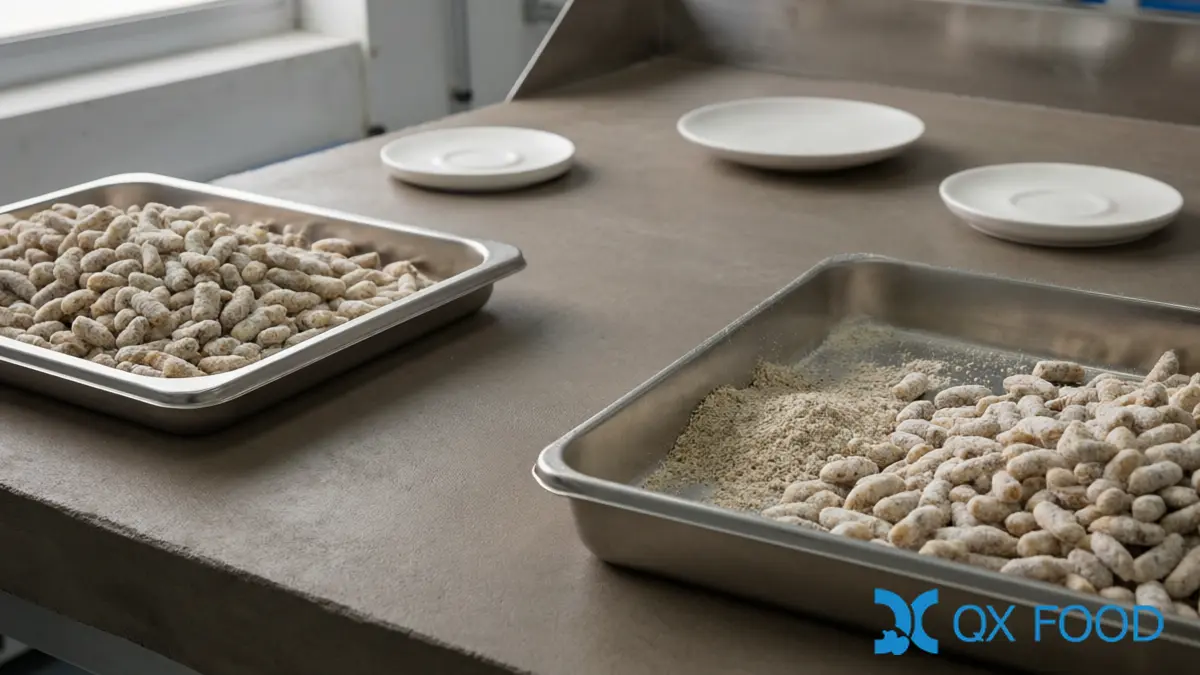
Oil is a common carrier in snack seasoning because it can create an adhesive liquid layer between the product surface and the powder. Its effectiveness depends on the surface, the powder, and the amount and distribution of oil; it is neither the only carrier nor automatically the strongest one. Work on cracker coating found that hydrocolloid solutions could improve seasoning adhesion, and in some cases entirely replace oil and sugar as the adhesive component. The same study reported that solutions with a hydrophobicity similar to that of the powder produced the greatest adhesion. Its sucrose result is worth reading in full: increasing sucrose concentration reduced adhesion of smaller particles but increased adhesion of larger ones, so that effect ran through particle size rather than moving in one direction. It also found that different seasonings preferred different carriers: salt, barbecue, ranch, and sour cream and onion adhered most strongly to a water-based coating, cheese powder to a dilute oil emulsion, and cocoa powder to oil (Armstrong and Barringer, 2013, Journal of Food Science).
That result is worth pausing on. The carrier that produced the greatest adhesion was the one whose surface chemistry matched the powder, not the one that was stickiest or most concentrated. Seasoning adhesion behaves like a compatibility problem more than a quantity problem. Here is the catch: the carrier that wins on adhesion can also be the one that adds the most to the label, so the choice is never purely technical.
Carrier families you can evaluate
- Oil and fat. The established route for fried snacks and for many nuts. Provides the liquid bridge, contributes fat to the nutrition panel, and can oxidise where the surface is exposed.
- Hydrocolloid solutions. Applied before powder, they can raise seasoning adhesion on dry or low-oil surfaces, and published work shows they can work alongside or instead of oil and sugar.
- Water-based film formers. Suppliers in the coating industry market fat-free, water-based systems positioned to reduce or remove the oil that usually acts as the primary carrier. Any such system is an added ingredient and belongs in the declaration review.
- Sugar or syrup glazes. Useful where a sweet profile is wanted, but note the direction reported in the cracker work: increasing sucrose concentration reduced adhesion in that system.
- No carrier. Dry application remains valid for some bases, and it makes the surface state and the powder properties carry the whole load.
What a carrier change triggers
Changing the carrier is a product change, not a line tweak, and it should be planned as one. The ingredient declaration changes when a film former or hydrocolloid is added. The fat and oil figures on the nutrition panel can move. Allergen review applies to any new component. The application hardware changes too, because a solution needs a different delivery method from dry oil, and the surface may need time to set before powder is applied.
Compare systems at an equivalent finished sensory target rather than at an equal carrier dose. Two routes can both deliver acceptable seasoning adhesion and still be very different products on the label, at different cost per finished tonne, so the commercial comparison belongs in the same trial as the technical one.
The Surface Decides as Much as the Powder
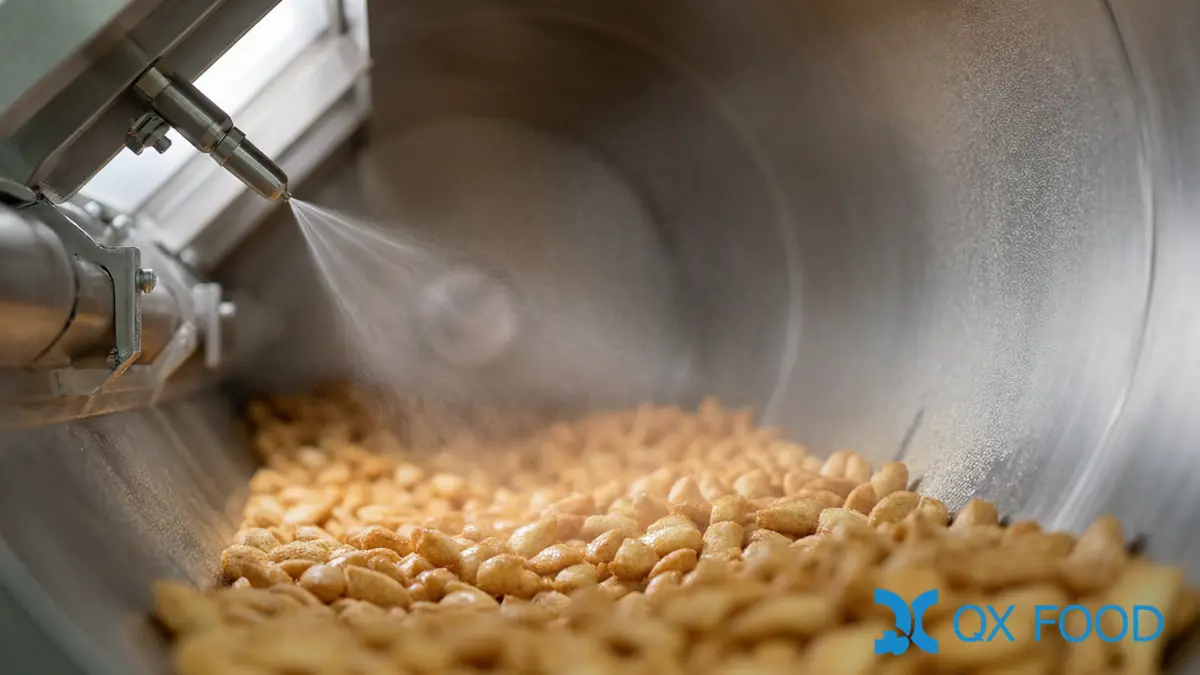
Powder does not bond to a product; it bonds to whatever is on the surface of that product at the moment of contact. The surface side of seasoning adhesion is therefore as important as the blend. Four surface properties are worth recording for every trial, and all four can be measured with routine laboratory work rather than specialist equipment.
Surface oil or free fat is the bridge the powder attaches to in oil-carried systems. Too little available surface oil can weaken the adhesive layer, while excessive or uneven oil creates its own pickup and sensory problems. Other carrier systems, and electrostatic application, rely on different interfacial mechanisms, so a dry surface is not automatically a liability. Surface moisture and water activity change how readily a particle is held. In electrostatic salt-coating studies, the target’s water activity, its electrical resistivity and its charge decay time all influenced transfer efficiency and adhesion, which is why the base counts as an active part of the system rather than a passive receiving surface. Treat that as a system-specific result, not as a rule that a wetter surface always holds more seasoning (Sumonsiri and Barringer, 2011, Journal of Electrostatics).
Piece temperature at the applicator is the third. Equipment suppliers describe the same pattern: a product that arrives too cold does not bond as readily, and a product that has been dried or fried so hard that its surface oil is stripped holds less powder until something is added back. Geometry and surface texture is the fourth. A blend that holds well on a rough, irregular nut can roll straight off a smooth flat chip, which is why the same recipe can pass on one SKU and fail on the next.
None of this can be settled by a data sheet. Water activity, surface oil, piece temperature and texture are properties of your base and your process, and they have to be recorded at the point where powder meets product. If a trial does not state them, the trial cannot be repeated or explained.
What the Powder Brings to the Interface
Particle size is the most quoted powder property in coating discussions and the most often over-simplified. Two effects pull in opposite directions. In several salt-coating studies adhesion increased as particle size decreased, from 388 to 25 µm on potato chips and from 332 to 119 µm on targets including cracker, bread and carrot (Buck and Barringer 2007; Sumonsiri and Barringer, 2011, Journal of Electrostatics). That relationship is system-specific and should not be read as a universal seasoning rule: the target’s own properties, the electrostatic conditions and the particle shape all shift the result. Smaller particles form more contact points for the same mass, which is the mechanism usually offered for the trend rather than a guarantee of it.
Transfer efficiency does not follow the same rule, and its direction depends on the applicator. A study comparing a gravity-fed tumble drum with a pneumatically fed conveyor found that the effect of particle size on transfer efficiency ran in opposite directions in the two systems, even though the other powder properties behaved consistently (Ratanatriwong and Barringer, 2007, Journal of Electrostatics). A powder that is fine enough to hold on the piece is also a powder that is easier to lose to airflow, and how much of it is lost depends on how it is fed. That trade is the reason a single mesh value cannot define a coating powder: you have to know the distribution, and you have to establish the delivery behaviour on your own applicator.
Why a single mesh number is not enough
Cohesiveness interacts with size. Some coating studies have found better adhesion with more cohesive powders under defined conditions, because the particles help hold each other in place once they land. Excessive cohesion runs the other way: it reduces flowability and dispersion and promotes agglomeration or feeder bridging. The useful range therefore depends on the powder and the applicator, and cohesion is a property to be managed rather than maximised.
Mixtures add a further complication. Studies of powder mixtures during coating found that the proportion of components reaching the target can change, because fine and coarse particles are not targeted equally and do not adhere equally. Particle size also affects separation and dustiness during coating (Somboonvechakarn and Barringer, 2011, Journal of Food Process Engineering; Likitwattanasade and Barringer, 2015, Journal of Electrostatics). In practical terms, what adheres to the piece may not be what was blended in the mixer, and a coating that tastes right at the drum can drift as components separate or as fines are lost.
Density belongs in the same conversation. Two powders with the same particle size but different bulk density behave differently in the applicator: one travels further in an air stream and a different share of it reaches the piece. When a supplier reports a specification for a coating powder, a particle size distribution, moisture, bulk density and flow-related values say more about seasoning adhesion than a mesh range on its own.
Static Charge and the Plant Environment
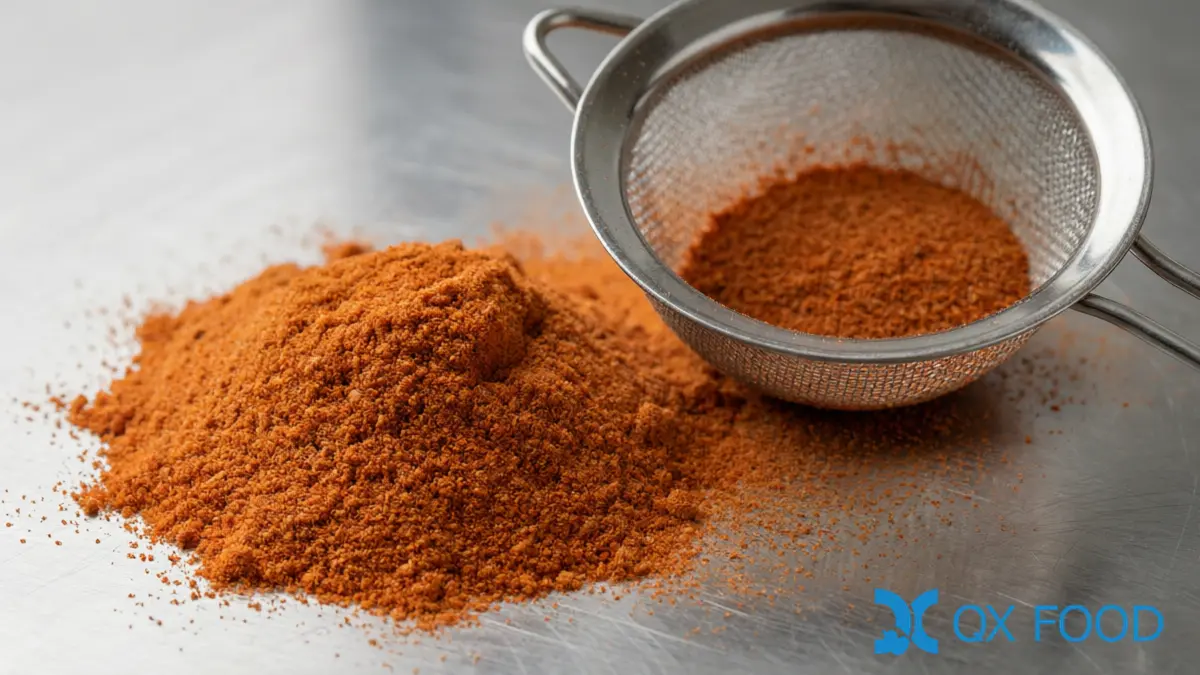
Electrostatic powder coating has been studied as a function of powder resistivity, coating voltage, relative humidity and coating density, and adhesion varies with all four. Cocoa powder with a high resistivity showed stronger electrostatic adhesion than starch powder with a medium resistivity in the same comparison, which is a reminder that the powder’s electrical behaviour is part of its identity rather than a lab curiosity (Huang and Barringer, 2012, Journal of Food Process Engineering).
Static is not only an application tool. In any dry powder handling system, friction and separation generate charge during conveying and mixing, and again during packaging, and uncontrolled charge produces the familiar set of problems: powder clinging to chutes, screens and film, erratic weighing, and inconsistent flow. Powder handling literature treats static as a process parameter to be engineered through grounding, bonding, material choice and environmental limits, not as housekeeping.
Plant humidity acts on the same variables from the other side. Humidity can change powder flowability, but the response is formulation-specific. In a comparative conditioning study of three commercial seasonings at 80 percent relative humidity, one powder changed by only a few percent in flow energy while another increased by about 30 percent (Centre for Industrial Rheology, 2025). No single humidity threshold is safe for every blend, and a seasoning’s moisture response belongs in its own specification discussion. Extraction and cooling airflow complete the picture, because air that carries powder into the applicator can also carry powder off a piece that has already been coated. Static control and humidity are therefore part of seasoning adhesion control, and both sit outside the mixing room.
What Handling and Packaging Do After the Drum
A bond survives until a force larger than it is applied. Everything between the drum and the sealed bag applies force: transfers between conveyors, drop heights into hoppers, vibration on a seasoning conveyor, the weigher, the filler, the drop into the bag, case packing and palletising, then road transport. Each event is a small removal test, and their effect compounds along the line.
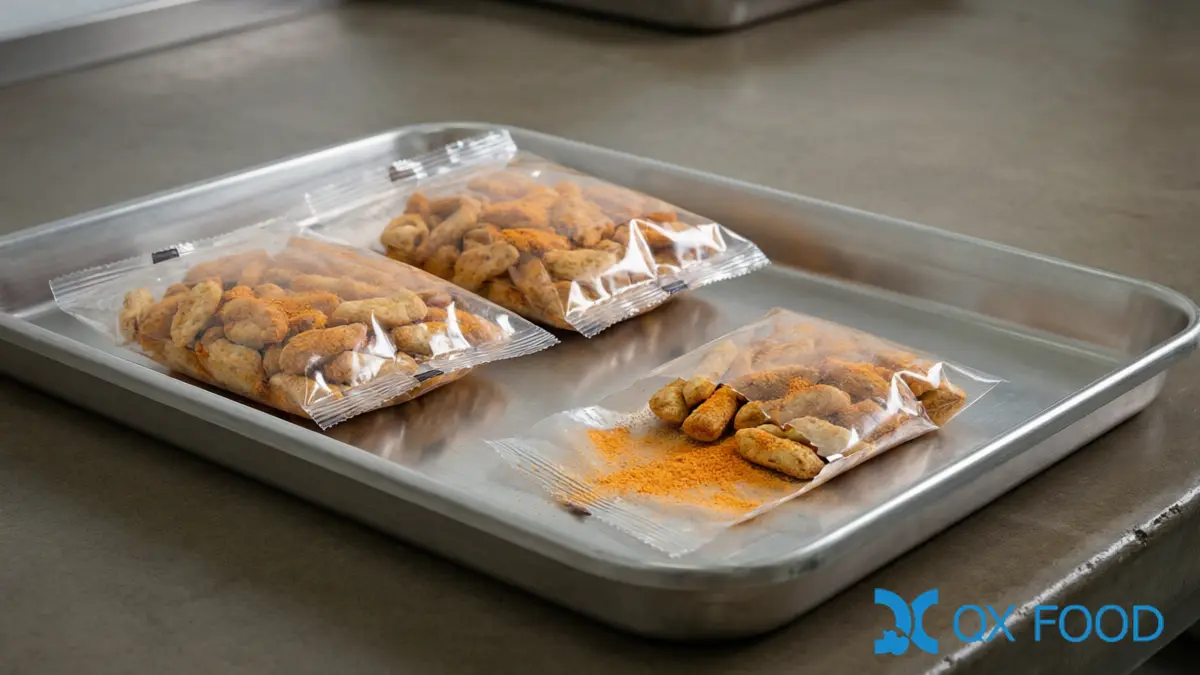
Packaging adds its own mechanisms. Charged film and charged fines attract each other, so a packaging zone with poor static control can collect airborne or already-detached fines on the film, in the headspace, and around the seal. Whether static is also driving powder off the product surface at that point should be settled by sampling before and after the packaging step rather than assumed. Equipment suppliers that sell anti-static and dust suppression systems describe material loss and seal contamination as the visible consequences, an assertion that belongs to the vendor rather than to independent testing. The powder is still inside the finished pack, but it is no longer on the snack, and it no longer delivers flavour where the consumer tastes it.
Storage continues the process. A coated snack is not a static system: published work on coated snacks shows moisture migrating from the centre into the coating during storage, changing the coating’s texture, and surface oil redistributes as well. Both movements change the interface that seasoning adhesion depends on, which is why a product that measures well on the day of packing can still be judged harshly weeks later, and why a storage check belongs in the trial protocol alongside the line check.
Map every removal event
The practical exercise is to walk the line from the applicator to the sealed case and write down every point where product changes direction, falls, or is vibrated, in order, with the drop height or the amplitude if it is known. That list is your fallout model, and it is usually shorter than people expect and more unevenly distributed than people assume. Once it exists, the retention measurement described in our guide to how to measure what actually stays on the piece can be run at the two points that matter most: at the drum, and after the last event before sealing.
Diagnose Before You Change the Blend
Most coating problems are solved by changing the right variable, not by changing the recipe. Work through the following sequence before touching a formula, and write down what you find at each step so that the next trial starts from evidence.
- Fix the measurement first. Agree the sampling points, the basis, the removal method and the handling step that retention is measured across. Without that, every later change is judged by opinion.
- Characterise the surface. Record water activity, surface oil or free fat, and piece temperature at the applicator for each base in the trial.
- Characterise the powder. Ask for the particle size distribution rather than a mesh range, and note moisture, bulk density and flow-related values.
- List the removal events. Walk the line and record every transfer and drop between the applicator and the sealed bag, and note where product is vibrated.
- Classify the failure. Decide from what comes off whether you are fighting an interfacial problem, a cohesion and fines problem, or mechanical removal.
- Change one variable at a time. Repeat the same protocol after each change, and keep the carrier comparison at an equivalent finished sensory target.
| What you see | Most likely mechanism | What to verify first |
|---|---|---|
| Fine, even dust in the bag, coverage looks complete | High fines fraction, targeting loss, static or airflow, or mechanical removal | Particle size distribution against the specification, and the list of removal events between the applicator and the sealer |
| Bare patches with clean edges on the piece | Adhesive failure at the interface | Carrier coverage and matching, surface oil or moisture, piece temperature and dwell time in the applicator |
| Powder on chutes and film, and inside the bag | Fines and static, or airflow and handling | Static control and grounding, plant humidity, and the fines content of the blend |
| Flavour drifts through a run, worse after a speed change | Application conditions rather than formulation | Feed rate against actual throughput over the same window, dwell time, and applicator settings |
| Same blend passes on one SKU and fails on another | Surface and geometry differences between bases | Water activity, surface oil and texture of each base, and whether one is applying from a different point |
How to Talk to a Seasoning Supplier About Adhesion
A supplier can control the powder side of seasoning adhesion and can support the trial, but no supplier can promise a pickup figure for a line they have never seen, because half of the system is the base and the process. Four questions keep a technical conversation honest. Does the specification include a particle size distribution or only a mesh range? Which carrier does the blend expect, and what happens if the line does not provide it? Under what surface conditions was the adhesion data generated? Can the sample be evaluated on our own base, at our own application point, with the retention step included?
Documentation should also be read for what it can and cannot establish. A specification defines the grade and its intended use. A batch certificate reports the results of that lot against the control plan. Method and application documentation supports the way the powder is used. A single batch certificate cannot demonstrate lot-to-lot consistency, and no document set replaces a line trial on your own product.
QXFOOD supplies seasoning powders and compound seasonings for snack coating, including chilli and pepper systems, tomato styles, savoury blends and HVP-based flavour components, alongside the spice ingredients that go into them. We can work on particle size targets, carrier direction and formulation adjustments against a described application, subject to technical feasibility, sample validation and agreed specifications. Whether a specific blend holds on your base is decided on your line, and we treat that trial as part of the project rather than a claim on a data sheet.
- Application and formulation context: snack seasoning for chips and extruded snacks and seasoning formulation by application
- Coating routes: seasoned nuts and bakery coating systems
- Powder form and flavour components: seasoning granules and powders and HVP in snack seasonings
- Supplier and specification discipline: seasoning powder supplier evaluation and spice procurement and supplier qualification
- Product routes: pepper salt seasoning powder, spicy chicken seasoning powder and tomato seasoning powder
Frequently Asked Questions
What causes seasoning to fall off snacks after coating?
Powder comes off for three broad reasons: the interface between powder and surface never formed well enough, the powder contains an excessive fines fraction that is easily lost as dust or is excessively cohesive and forms agglomerates or feeder-flow problems, or mechanical forces after the applicator break the bonds that did form. Carrier choice, surface oil and moisture, piece temperature, particle size distribution, static charge and handling each act on one of those three.
Is seasoning adhesion a property of the powder alone?
No. Adhesion is an interfacial property, so it belongs to the pair made up of the powder and the surface it meets. That is why the same blend can perform well on one base and poorly on another, and why a supplier cannot quote a pickup figure that transfers to a line they have not seen.
Does adding more oil always improve seasoning adhesion?
No. Carrier performance depends on compatibility with the powder and the surface rather than on quantity alone. In published work on cracker coating, solutions with a hydrophobicity similar to the powder gave the greatest adhesion, and increasing sucrose concentration reduced it. Excess oil can also create a film that the powder slides on rather than bonds to, and it adds fat to the finished product.
Does a smaller particle size always improve seasoning adhesion?
In several salt-coating studies, smaller particles showed better adhesion, but that trend is system-specific. Transfer efficiency can move differently depending on the applicator, and very fine fractions are more vulnerable to airflow and to segregation during coating. A blend also has to work as a mixture, so the practical target is a distribution that balances those effects for your applicator and your base.
Can static electricity pull seasoning off a snack?
Static can move powder in both directions. It is used deliberately in electrostatic coating to improve deposition and adhesion, and uncontrolled charge during conveying and packaging causes powder to cling to equipment, film and seals. In a packing zone, charged film can collect fines that are airborne or already detached and hold them in the headspace, which is one possible route to dust in the bag. Whether static also removes powder from the product surface at that point is better confirmed by sampling before and after the packaging step.
Why is there flavour dust at the bottom of the bag?
Usually because powder that was applied never bonded strongly enough and was released by handling, filling or transport, or because a fine fraction of the blend did not land on the product at all. It can also be amplified by static in the packing area. Either way, the dust is seasoning you have paid for that did not reach the product, and it also means the last servings in the bag taste differently from the first.
Can a seasoning supplier guarantee pickup for my line?
A supplier can guarantee the properties of the powder they ship and can support the trial, but pickup and retention depend on the base, the applicator and the handling that follows. Treat any adhesion figure offered without a description of the base, the carrier and the application conditions as a starting point for a trial rather than as a specification.
How do I tell adhesion failure from cohesion failure?
Look at what came off. Fine, uniform dust points first towards a high fines fraction, targeting loss, static or mechanical removal after the drum. Agglomerates, feeder bridging, or powder that will not disperse cleanly point towards excessive cohesion. Powder that leaves the surface as flakes, or as patches with clean edges on the piece, points towards the interface and the carrier. Each of those is a hypothesis to test, not a verdict. The distinction matters because the fixes are different, and changing the blend first is the expensive way to find out.
The Short Version
Seasoning adhesion is decided by the pair of powder and surface, the conditions at the moment they meet, and everything the product meets afterwards. Measure what stays on the piece rather than what is set on the feeder, record the surface and powder properties that make the result explainable, and walk the line to find where the loss actually happens. When a change is needed, change one variable, keep the comparison at an equivalent finished sensory target, and let the measurement decide.