
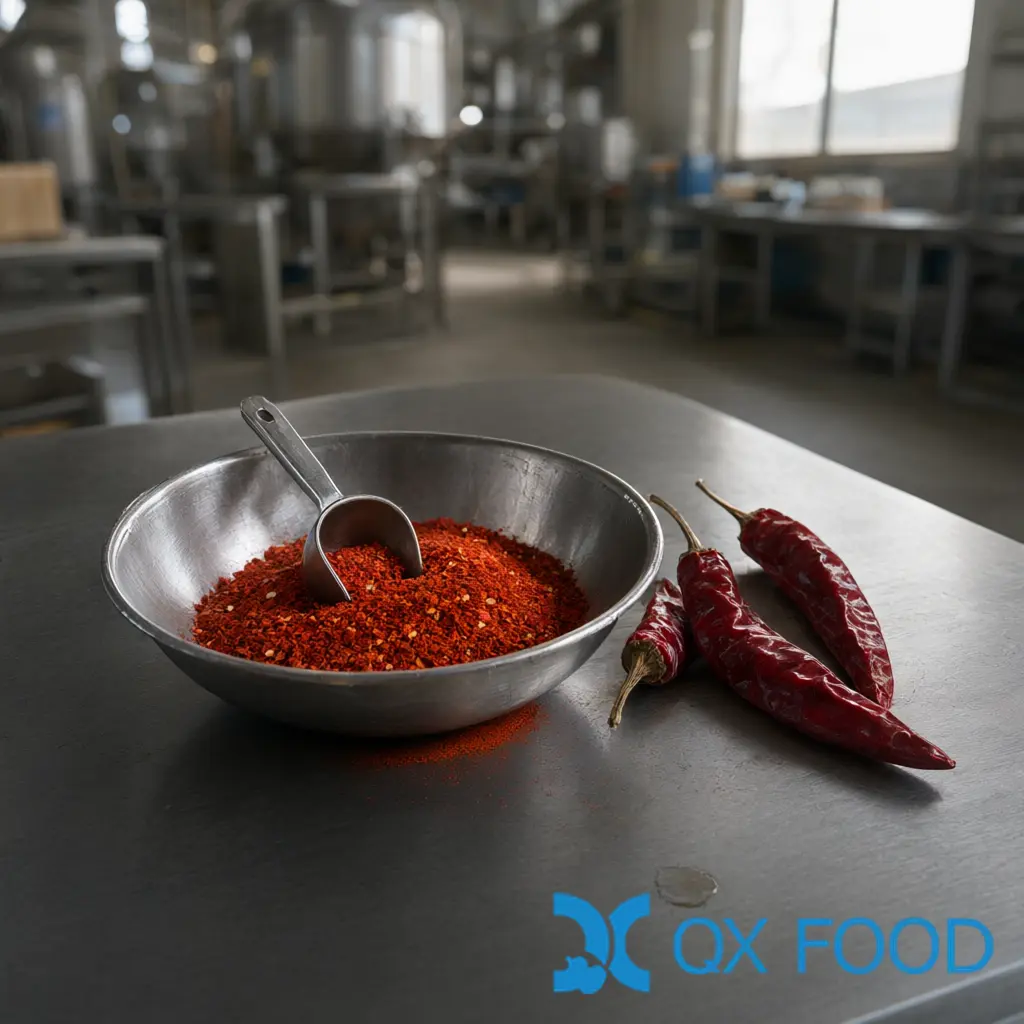
Quick answer. A gochugaru specification for the Korean market separates what the law requires from what the contract agrees: the Food Code sets identity and safety lines, KS H 2157 defines the pungency ladder if the contract adopts it, and the buyer writes the targets for heat, color, grind and documents. Define each line with its method, reporting basis and verification plan, and keep the layers apart.
Gochugaru is the Korean name for the dried, milled red pepper that sits behind kimchi and gochujang, plus a long line of sauces. The English trade often calls it Korean red pepper powder, and that looseness is exactly where trouble starts. In Korea it is not a style word. It is a product with a definition, a naming rule and an inspection routine, and a Korean importer will read your offer against that framework whether or not your offer sheet mentions it.
This article stays on the purchasing side of that framework. For the wider sequence around chili sourcing, the chili sourcing guide covers specifications and trade practice in general terms, and the processing guide covers the forms a chili line can produce. Here the question is narrower: what belongs in a gochugaru specification that a Korean customer can accept, and how each line is verified.
Four Layers, Four Kinds of Authority
A Korea-bound gochugaru specification should distinguish applicable legal requirements, any KS grade the contract adopts, and buyer-defined application targets. These layers may appear in one document set, but they do not have the same authority or verification requirements, and the rest of this guide sorts every line into one of them.
| Layer | Answers | Do not read it as |
|---|---|---|
| Korean food law (Food Code and import rules) | What must this product be and meet to be sold in Korea? | A requirement that every line is tested at one fixed frequency |
| KS H 2157 grade | How is declared pungency defined, if the contract adopts a grade? | A recommended grade for every application |
| Codex and ESA references | How do other frameworks describe quality for related products? | Automatically applicable Korean law |
| Your application spec | What heat, color, grind, treatment and documents does your line need? | A universal standard every factory must meet |
What Gochugaru Means on a Korean Specification
On a Korean label, gochugaru is a legal category before it is a flavor profile. The Food Code, published by the Ministry of Food and Drug Safety, defines it as the mature fruit of the pepper plant or its varieties, dried and then reduced to powder; the same section defines the thread-cut form sold as silgochu. Two production rules ride along with the definition: the fruit stalk has to be removed before processing, and diseased pods may only be used after the damaged parts are cut away. Neither rule is optional, and both show up later in how the buyer verifies a lot.
One name, one legal identity
The definition does more work than it looks. A product may carry the name gochugaru only if nothing besides the pepper went into it. Adding salt, sugars, bran, carbonates, starch or similar carriers is prohibited, and the Food Code backs that with a dedicated test for adulterant matter that must come back as not detected. Seeds are treated the same way: the seeds inside a gochugaru lot may only be the ones that came with the peppers, and putting extra seed back in to add weight is explicitly banned.
Compare that with the international habit. Codex defines ground chilli pepper as ground whole dried chilli that may keep or drop the placenta, seeds, calyx, and stalk, while ground paprika is defined as excluding them (CXS 353-2022). Gochugaru is closer to the ground chilli style, with one Korean addition: the stem has to be off, and the added-matter list is short and enforced. For the wider habits of the two families, the paprika against chili powder comparison is the place to start.
Where the salt question comes from
Some offers circulating for Korean-style chili powder quietly carry salt or a bulking carrier. In Korea that move changes the product’s legal identity. Once salt or another food ingredient is blended in, the lot is no longer gochugaru; it falls into the spice preparation class, which lives under a separate section of the Food Code with its own lines, including a tighter mold count and the same ban on tar colors. If the final product will be labeled gochugaru in Korea, a salted blend cannot get there, no matter how the offer sheet is titled. Buyers who want a seasoned blend should spec it as exactly that and negotiate the spice preparation lines instead.
Coarse for kimchi, fine for paste
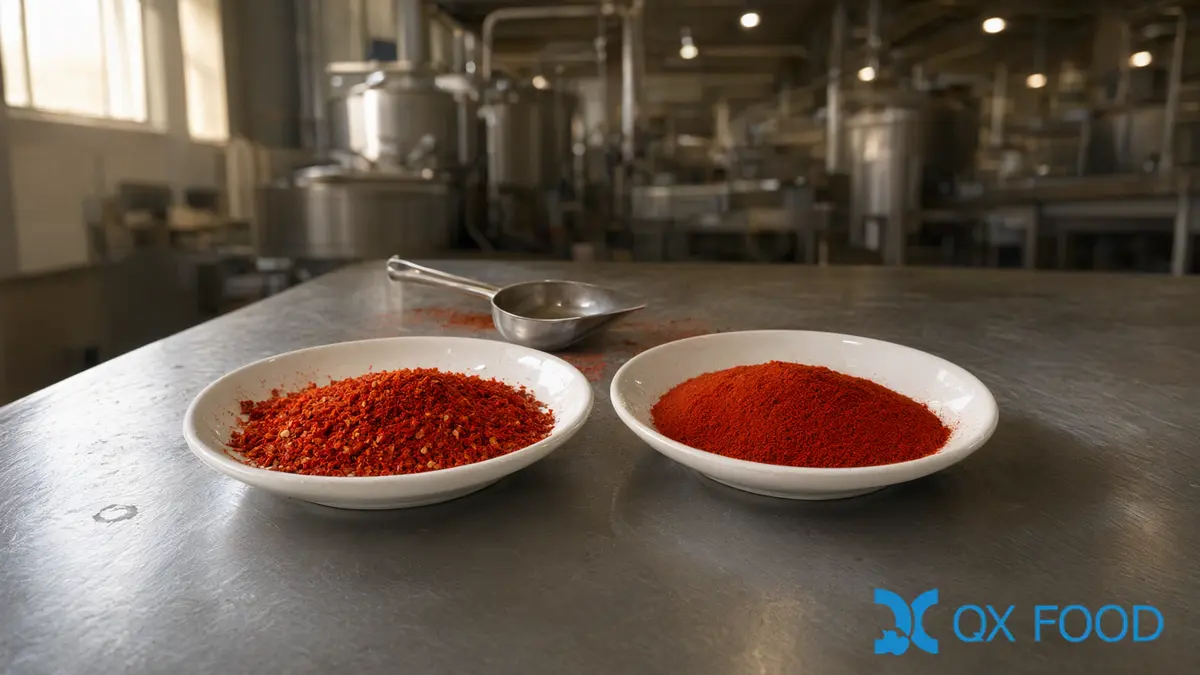
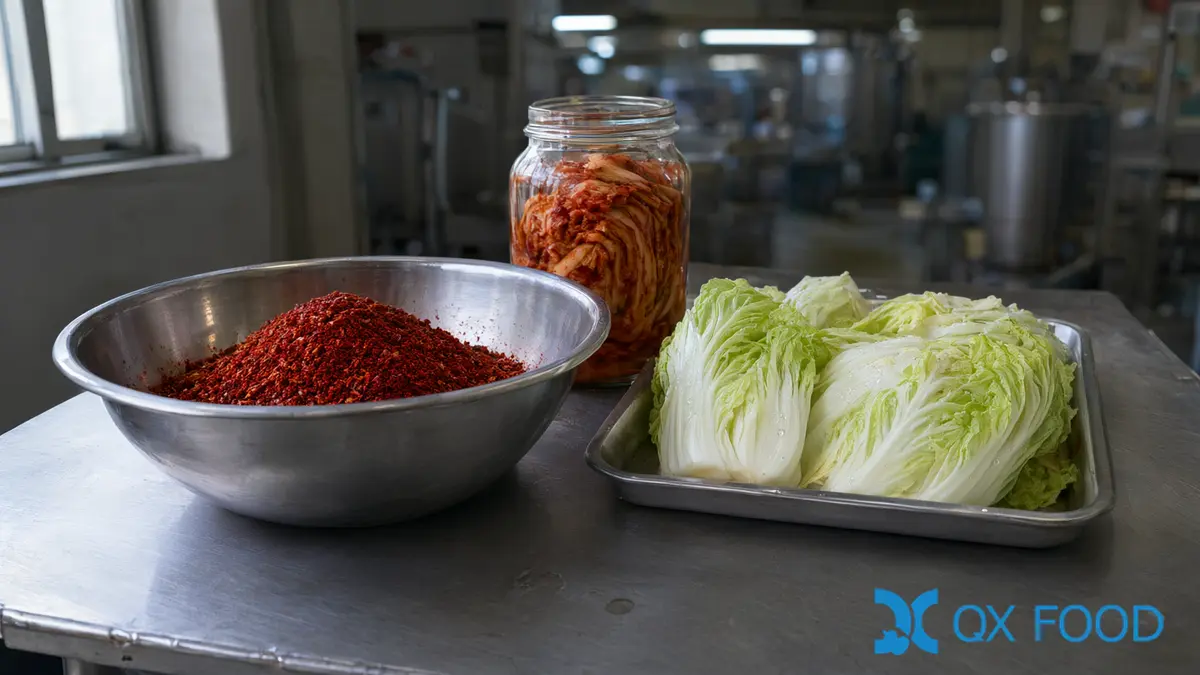
Kimchi manufacturers and paste makers buy from the same definition but not the same milling. The words you will hear, kimchi-grade and paste-grade, describe applications rather than legal grades, and the Food Code does not rank them. What differs is the particle distribution, and it is large enough to change how a lot measures, behaves on a line and holds moisture. That conversation belongs in the specification as numbers, not as adjectives, and it comes back in its own section below.
The Korean Legal Floor
These are the limits a lot must meet to be sold as gochugaru in Korea, whether it was produced there or imported. They are worth reading as a list of the failure modes Korean regulators decided were common enough to write down.
| Line | Food Code limit | What it guards against |
|---|---|---|
| Moisture | 15.0 percent max | Storage mold and caking on long voyages |
| Total ash | 7.0 percent max | Grit and plant tissue that ride along with the fruit |
| Acid-insoluble ash | 0.5 percent max | Sand and mineral grit that survives acid digestion |
| Adulterant matter | Not detected (starch, bran, carbonate or salt) | Fillers and carriers that change the product’s identity |
| Mold count | 20 percent of fields or less, by Howard mold counting (thread-cut form excluded) | Mold pressure the drying and storage stages left behind |
| Tar colors | Not detected | Synthetic dye, and specific natural colorants that are also barred from gochugaru |
| E. coli | n=5, c=2, m=0, M=10 | Hygiene failure in handling and drying |
| Total aflatoxin | 15 µg/kg max, with B1 at 10 µg/kg max | Mold toxins from a bad harvest or a wet store |
| Ochratoxin A | 7 µg/kg max | The second mold toxin Korean regulators added for this product |
Two of those lines need a sentence of translation. The mold figure is a Howard mold count, meaning the share of microscope fields in which mold filaments are visible, not the share of the product that is mold; Codex writes the same ceiling the same way and adds an explicit note so nobody reads it as a mass fraction. And the E. coli line is a sampling plan rather than a single number: five sample units are tested, up to two of them may sit between zero and the M value, and none may exceed it.
One more layer of rules sits on top of the numbers, and it is worth keeping the layers apart. Manufacturers registered in Korea self-test gochugaru on a fixed cycle, every three months, against a short list: foreign matter, mold count, tar colors and Clostridium perfringens. Import inspection and the buyer’s own incoming verification are separate requirements with their own rules, so that domestic interval should not be copied into an import or supplier-release programme without checking that it applies there.
Reading the Korean Lines Beside the International Ones
Line the Korean table next to the international one and two lines jump out: total ash capped at 7.0 percent against 10, and acid-insoluble ash at 0.5 against 1.6. Read those gaps with care. The two documents are not measuring identical material: the Korean product is defined with the stem removed and with seeds limited to what grew inside the peppers, while international ground chilli may legally include the placenta, the calyx and the stalk, and each framework reports on its own basis. A difference between published limits should be interpreted alongside those product definitions, analytical methods and reporting bases, and a lower number should not be attributed to a single botanical or processing difference unless the source itself establishes that link. The divergence runs the other way on moisture: Korea allows 15 percent where the international trade lines sit at 11, with some variety exceptions noted in Codex itself. Two tables, two different jobs. Copying numbers across them quietly changes what you are buying.
The colorant line deserves a note of its own, because two different checks sit behind it. Tar colors are assessed under the applicable analytical requirement, and the screen has to come back with none detected. Separately, Korea maintains a prohibited list under which several named colorants, including some natural ones, may not be used in gochugaru, silgochu, kimchi or gochujang at all (MFDS usage standards). A negative tar color screen proves nothing about the second list; review each line against the document that owns it. For a buyer, the pair is still a useful authenticity signal: color in this category is expected to come from the pepper, and a suspiciously deep lot invites a dye screen.
Color: The ASTA Number and Its Limits
Color is the attribute Korean buyers notice first and the one their documents govern least. The Food Code sets no color value for gochugaru, and KS H 2157 sets none either. The working tool in trade is the ASTA color value, measured by ASTA method 20.1: an acetone extract read at 460 nanometers in a 10 millimeter cell, with the prescribed sample preparation, extraction, instrument checks and calculation all defined in the method text (ASTA analytical methods). Cite the method and its edition in the contract; a lone coefficient without those conditions is not something a laboratory can work from. Commercial paprika-family material typically lands between 65 and 180 ASTA, and the same measuring logic is applied to gochugaru by suppliers who trade it on color.
Here is the catch: the 460 nanometer wavelength sits between the absorbance peak of the yellow-orange pigments and that of the red ones, which means two lots can carry the same ASTA value while looking visibly different on a bench, one deeper red, one more orange (instrument application note). ASTA measures how much color extracts, not the exact hue your product designer approved. A color clause therefore needs both an instrumental target and, where appearance is the point, a reference sample.
What does the Korean market actually deliver? A 2022 survey of 93 commercial retail gochugaru products measured values from 43.5 to 121.6 ASTA, with storage and shelf time pushing readings down from the mill gate (Korean Journal of Food Preservation, 2022). Codex gives a useful international anchor: its color classes attach to paprika, where ground material at 120 ASTA or higher is Extra class, 100 to 120 is Class I and 80 to 100 is Class II, while chilli pepper carries no color class at all. Gochugaru sits between those two families, and the practical implication is simple. Nobody upstream will hand you a mandatory color number. You write one, and you write it with the method, the sample basis and the consequence stated inside the gochugaru specification.
Writing a color line you can enforce
A usable clause names four things: the target or the minimum, the method including the wavelength and extraction step, the basis of the sample, and what happens when a lot misses. It also needs an answer for time. Pigments fade in storage and on the water, so contracts that will travel far often set a mill-gate minimum plus a stated allowance for the arrival reading, or they anchor acceptance to a sealed reference sample drawn at the same moment as the shipment sample. Any of those arrangements works if it is written down before the first lot sails. None of them works if the clause just says deep red.
Pungency: The KS Grades, and What SHU Does Not Do
Heat in Korea has a domestic ladder. KS H 2157, the national standard for gochugaru, grades products by total capsaicinoid content measured in milligrams per kilogram, and the five labels are the ones Korean packaging and product teams use in conversation (KS H 2157).
| KS label | Total capsaicinoids (mg/kg) |
|---|---|
| Mild | Below 150 |
| Slightly hot | 150 to 300 |
| Medium hot | 300 to 500 |
| Hot | 500 to 1,000 |
| Very hot | 1,000 and above |
The ladder entered the standard in a 2013 revision with a two year grace period, and the standard’s most recent confirmation dates to 2021. It is a labeling convention rather than a legal limit, but it is the one Korean retail buyers recognize, and a supplier who can hold a grade across lots is worth more than one who quotes the word loosely. The standard defines the bands; it does not assign a grade to any application, so which band a kimchi, paste or sauce line wants is a commercial choice to be validated against the finished product. Two definitions also belong in the contract before the table does. The measurement behind the grade is an HPLC determination whose reported total sums capsaicin and dihydrocapsaicin, the two compounds that carry most of the heat, so a result labeled total capsaicinoids should not be assumed comparable across methods without checking which compounds are included, under which method and edition, and on what reporting basis.
How firm is the label in practice? A 2022 study of 93 commercial retail products, bought in 2021, tested each against its printed grade and found only about half matching; among products labeled as hot, roughly a third landed where their label claimed, and several sat in mild territory when measured. What that supports is verification rather than a rule: a declared grade should be checked rather than trusted from the label alone, and the sampling and analytical frequency, including any per-lot HPLC reporting, belongs in the buyer’s qualification and control plan. This is also where a familiar trap sits. Scoville units can appear in a contract, but only with the measured compounds, the method, the conversion and the reporting basis all defined, because conversions between capsaicinoid content and SHU shift with the analytical family in use, which the capsaicin content specification guide covers in full. For a Korean-bound lot, the working line is the KS grade plus a milligrams-per-kilogram window with the HPLC basis named; a bare SHU number on its own belongs in marketing.
Particle Size: Getting Mesh Under Control
Grind is where two lots from the same field become different products. Korean research on milled red pepper found the paste-oriented samples clustered mainly between 300 and 425 micrometers, while kimchi-oriented powder carried a coarse fraction above 1,000 micrometers and a more irregular distribution overall (Journal of the Korean Society of Food Science and Nutrition, 2011). Those are observations about the samples studied, not a purchase range for every kimchi or paste line. The same work found finer particles reading higher in ASTA and capsaicinoids within a single sample; the study does not separate surface area from tissue composition, sieve segregation or extraction efficiency, so quote any value together with the grind it was measured on.
Supplier catalogs compress all of that into mesh numbers, and the compression is where orders go wrong. Mesh is not a unit by itself: the number means something only when the sieve series is named, because the same nominal mesh under different national sieve systems is not the same opening, and a passing claim without a retained fraction says nothing about the distribution. That is why the working clause in this guide asks for the series, the share inside the working band and the fractions above and below it instead of a single mesh figure. The 2022 survey also noted a moisture pattern worth remembering: coarse kimchi-oriented powders trended higher in moisture than the fine paste grades, which makes packaging and storage discipline more, not less, important on the grade that feels drier to the hand.
A grind clause that survives contact with a mill states the series, the target distribution and the extremes. Something like: material to pass a named sieve with at least a stated share in the working band, a cap on the fraction above the coarse screen, and a cap on dust below the fine screen if your filling line hates fines. If the application is kimchi, the wording should also fix the coarse fraction ceiling, since that fraction is what shows through the cabbage and what the customer sees first. The chili forms and cutting guide runs through the whole family of cuts this language is drawn from.
Seeds: The Quiet Variable
Korean practice removes part of the seed load before milling, mainly for color, and the residue in commercial powder has been reported in the range of ten percent or less of the product, with stricter mills going lower (Journal of Community Nutrition research, 2002). The Food Code allows only the seeds that came with the fruit, so a gochugaru specification cannot ask for seed to be added, but it can and should set a ceiling on how much remains. The reason is that ground seed carries little of the red pigment while still counting in the weight, and the international standards flag the visible cost as well: calyx, stalk or seed fragments show up as brown and white specks that pull the appearance down. What matters on the contract side is the measured outcome on the final powder, not a fixed role for the seed itself.
Testing seed content sounds academic until a supplier discovers it is cheaper to leave more in. Korean analysts have built compositional screens for exactly that problem, using mineral and fatty acid profiles to separate intrinsic seed from added seed (Journal of the Korean Society of Food Science and Nutrition, 2020). Those models are screening tools within their validated scope, though, not stand-alone proof of where a seed came from or why it is there. The practical version for a buyer keeps the evidence together: a seed fraction ceiling and a particle distribution in the specification, supplier process records and lot traceability, retained samples, and a discriminant screen where the numbers and the documents disagree.
The International Tables and Why They Do Not Travel
The two documents a Korean contract is most often compared against are Codex CXS 353-2022, adopted in 2022 and amended in 2025, and the European Spice Association’s quality minima. Both are useful references. Neither is a substitute for the Korean lines, and the comparison below is the honest way to use them: as a map of who owns which number.
| Line | Korea (Food Code) | Codex CXS 353-2022 | ESA quality minima |
|---|---|---|---|
| Moisture | 15.0 percent max | 11 percent max for chilli and ground paprika, with a note that some varieties reach 15 | 11 percent max for chillies and paprika powder |
| Total ash | 7.0 percent max | 10 percent max | 10 percent max |
| Acid-insoluble ash | 0.5 percent max | 1.6 percent max, rising to 3.0 or 3.6 with anticking agents in powder forms | 1.6 percent for chilli, 2.0 percent for paprika powder |
| Pungency | No legal limit; KS H 2157 grades by capsaicinoid range | Chilli at 900 SHU minimum; paprika and hot paprika at defined bands | Not specified |
| Color | Not specified | Paprika classes at 80, 100 or 120 ASTA; chilli carries no color class | Not specified |
| Mold | 20 percent Howard mold count max | 20 percent Howard mold count, with an explanatory note | Not specified |
Read the columns as frames rather than a ranking. Each pulls from a different document and a different reporting basis: the Korean Food Code lines as published for gochugaru, Codex CXS 353-2022 with its 2025 amendment for its own products, and the ESA quality minima document for the European trade. Versions move, so check the current edition of each before a contract leans on a number.
A few details from the Codex text are worth carrying into any negotiation, because they get quoted selectively. Ground chilli pepper under Codex may include placenta, seeds, calyx, and stalk, while ground paprika explicitly excludes them, so the same moisture number covers two different products. The anticking footnote matters for powder suppliers: up to two percent of an approved anticking agent raises the acid-insoluble ash allowance, which is why a supplier shipping powder with a carrier should be asked to declare it. Physical cleanliness limits live on the same page, with ground material allowing up to six rodent hairs per 25 grams and fifty insect fragments per 25 grams in the chilli column. Codex also requires the country of origin to be declared on the label and asks that the style, whole, crushed or ground, appear in the name. For non-retail containers it points to the dedicated Codex standard on packaging and transport.
The European minima add two habits the Korean documents do not. The ESA quality minima document sets a water activity target of 0.65 or below for the dried spice trade and treats ethylene oxide as banned in the European Union, including on material treated outside the bloc and re-imported. It also handles irradiation as a matter for explicit buyer and seller agreement, restricted to approved facilities, with a declaration trail. If a lot is destined for more than one market, those two lines belong in the specification alongside the Korean ones, because a treatment that clears Korea’s rules may still close the door to Europe.
One more entry belongs in this section, since it comes up in sample conversations: whole dried Capsicum covers several species and dozens of commercial varieties whose heat and color behave differently in the mill (chili pepper varieties and heat). A specification that names a grade without naming the variety line leaves the biggest variable on the table, and the Korean side of the trade names varieties freely: the same grade word can sit on very different peppers.
Treatments: Fumigation, Ethylene Oxide, Irradiation
Every microbial control decision on gochugaru eventually becomes a label and a test result, so treatments deserve explicit lines rather than a general promise of cleanliness. Korea does not permit ethylene oxide on food, and the residue method its regulators publish centers on the marker compound 2-chloroethanol, with provisional limits of 30 milligrams per kilogram for agricultural, livestock and fishery products and processed foods, and 10 milligrams per kilogram for foods intended for infants and young children and for capsules (MFDS testing method notice). Those are provisional 2-CE values attached to a testing method, not authorization to use ethylene oxide, and they are the figures as published in 2021; confirm the current requirement for the actual product category before a shipment moves. The European Union bans ethylene oxide outright. A supplier who runs one treatment house for all destinations is eventually going to write a declaration that one of the markets rejects.
Irradiation is a treatment Korea does allow, for defined product groups and conditions, with reporting and labeling duties attached (MFDS irradiation notice). Treat it as a verification frame rather than a slogan: confirm the currently permitted product category, the applicable treatment conditions, the processing records and the labeling requirements, and do not read a treatment declaration alone as proof that every regulatory condition around it was met. A buyer who requires an unirradiated supply should say so in the specification, because the treatment will surface on the label and in the import file either way. Fumigation with methyl bromide or similar agents follows the same logic, destination by destination. Whichever route is chosen, the clause that pays for itself is a declaration line: the specific treatment, or a statement that none was applied, per lot, signed with the rest of the certificate of analysis. The wider menu of microbial control options and where each one fits sits in the spice sterilization methods overview.
Import Mechanics in One Page
The import route is where the gochugaru specification meets the calendar. Overseas facilities that export food to Korea register with the regulator, either directly or through the importer, before a first shipment can move. Each consignment then enters through an import declaration, and the inspection system sorts it into document review, visual inspection, laboratory testing or random sampling depending on the product’s history; first-time imports of a product generally draw the detailed check. Only after clearance may the food be sold, and it must carry Korean-language labeling with the items the law requires, including product type and origin, plus the importer’s details. The USDA Foreign Agricultural Service annual report for Korea is the most current English-language summary of that machinery, and it is worth a skim before any first shipment.
Two numbers decide whether a shipment is commercially sane before it ever moves. The first is the tariff line. Ground and crushed Capsicum fruit enters under HS 0904.22, and Korean duty exposure there depends on the exact classification, quota eligibility and documentation, origin treatment and import date. The 2026 tariff quota plan for the pepper line lists a 50 percent in-quota rate against a 270 percent out-of-quota rate, and the customs schedule pairs the higher rate with an alternative 6,210 won per kilogram, whichever is greater. Whether a shipment can enter in-quota depends on the allocation route and the importer’s eligibility, so a published out-of-quota rate should not be treated as the rate for every shipment. The Korea-China free trade agreement treats gochugaru as a sensitive product outside its concessions. Confirm the applicable treatment with the Korean importer or a customs broker before building the landed-cost calculation, and treat any figure in an article, including this one, as a checkpoint rather than an authority.
The second is pesticide residue. When a substance has no Korean maximum residue level for the crop, the default level of 0.01 milligrams per kilogram applies, which turns an unlisted spray into a rejection risk rather than a negotiating point.
One expectation worth setting early: origin does not relax the framework. Gochugaru from China, like gochugaru from anywhere else, is measured against the same Food Code lines. There is no origin exemption to plan around.
Writing the Gochugaru Specification: Line by Line
Here is the whole guide compressed into a working sheet. Each row names the parameter, the form of words that survives a dispute, and how the line gets verified. Everything that comes from the Food Code stays in the contract whatever the application; the application targets around it are the ones you adjust or remove to fit the product brief, with the verification plan defined separately for each line. Keep the sheet in a form that can be argued in front of a lab result rather than in a meeting, and do not skip the last row; disposition language is what ends arguments months later.
| Parameter | Write it as | Verify by |
|---|---|---|
| Identity | Dried mature Capsicum fruit, stem removed, ground; no added matter, no added seed; to be labeled gochugaru in Korea | Product audit; adulterant matter test |
| Variety line and origin | Named variety or line where agreed; country of origin declared | Traceability documents per lot |
| Grind | Named sieve series, target distribution, coarse fraction ceiling, dust ceiling | Sieve analysis on the retained sample |
| Pungency | KS grade plus a capsaicinoid window, for example 300 to 500 mg/kg total capsaicinoids | HPLC for capsaicin and dihydrocapsaicin, frequency per applicable rules and the agreed control plan |
| Color | ASTA minimum or window at the mill gate, method 20.1, arrival allowance stated | Spectrophotometric reading at 460 nm against the retained sample |
| Moisture | Target below the legal ceiling, with method named | Drying oven or equivalent, frequency per applicable rules and the agreed control plan |
| Ash and acid-insoluble ash | 7.0 and 0.5 percent ceilings as the compliance floor | Gravimetric methods, frequency per applicable rules and the agreed control plan |
| Mold and visible defects | Howard mold count at or below 20 percent; defect description with reference photographs | Howard counting; visual screening against the reference |
| Microbiology | E. coli at n=5, c=2, m=0, M=10, plus any agreed additions such as Salmonella absence in 25 grams | Accredited laboratory, frequency per applicable rules and the agreed control plan |
| Mycotoxins | Total aflatoxin at or below 15 µg/kg with B1 at or below 10; ochratoxin A at or below 7 | LC-MS/MS or equivalent, frequency per applicable rules and the agreed control plan |
| Authenticity | Tar colors not detected; colorant list observed; seed fraction declared | Dye screening; discriminant testing where doubts persist |
| Treatments | Declared per lot: none, irradiation with label, or named fumigant; ethylene oxide excluded for Korea and the EU | Certificates and label check at clearing |
| Packaging | Moisture and light barrier suitable for the stated shelf life, in a form permitted by Korean rules | Packaging certificate; condition on arrival |
| Disposition | Who decides, on which sample, with what remedy for a failing lot | Contract appendix signed by both sides |
Two sentence templates, so the tone is clear; the blanks are yours to fill. Pungency: total capsaicinoids within [x] to [y] milligrams per kilogram on an [as-received or dry-matter] basis, measured by [method and edition], with sampling, reporting frequency, retained samples and the disposition of a nonconforming lot following [the agreed control plan]. Color: ASTA extractable color measured by [method and edition], with an acceptance limit of [x] at [defined sampling point and time]; any separate dispatch and arrival criteria must be supported by the agreed storage and transport conditions, measurement procedure and disposition rule. Notice what the templates do not do: they fix no supposed market convention, and they leave every number to be argued once, at the desk, instead of every shipment, at the port.
If your search for a Korean red pepper supplier is still open, the sections above are your interview script: ask for capsaicinoid data with its method, a Howard mold basis, treatment declarations and a retained sample, and the answers will sort real suppliers from catalog pages quickly. QXFOOD mills chili in several formats of its own, including a coarse powder, flakes, fine strips and slices, each documented on its product page for the applications it serves; those documents are built on the same verification logic this gochugaru specification guide describes. Nothing about those formats is a claim that one already carries a Korean-route approval, a KS grade or a standing test list; those are settled per contract, against the checklist above.
Frequently Asked Questions
Is gochugaru the same as chili flakes?
Not quite, and the difference is legal as much as visual. Chili flakes in international trade are a style description: dried chilli, crushed, with whatever share of seeds, placenta, calyx or stalk the supplier chooses. Gochugaru is a defined Korean product with the stem removed, no added matter and a specific test list behind it. A crushed chili product can look identical in the jar and still fail a Korean label review, because what the name promises differs. When comparing offers, put the definition first and the appearance second.
What ASTA color should gochugaru have?
There is no mandatory value. Neither the Korean Food Code nor KS H 2157 sets an ASTA figure, and retail products surveyed in Korea have measured from the mid-forties to above 120. International paprika classes reference 80, 100 or 120 ASTA for ground material, which is a useful yardstick for conversations but not a rule for gochugaru. The workable approach is to write your own target with the method, the sample basis and a time allowance, and to remember that the same ASTA reading can describe visibly different shades of red and orange.
What do the Korean pungency grades mean?
KS H 2157 sorts gochugaru into five labels by total capsaicinoids: mild below 150 milligrams per kilogram, slightly hot from 150 to 300, medium hot from 300 to 500, hot from 500 to 1,000, and very hot at 1,000 and above. The grades entered the standard in 2013 and are a labeling convention rather than a legal limit, and the standard assigns no grade to any application. Studies of commercial products have found that a substantial share do not match their printed grade, so a purchasing file should treat the label as intent and set its own verification plan, including when per-lot HPLC reporting is required, rather than relying on the printed grade alone.
Can gochugaru contain added salt or starch?
No. Korean rules prohibit adding salt, sugars, bran, carbonates, starch or similar materials, and a dedicated test must show no adulterant matter. Seed may not be added back either; only the seed that came with the fruit is allowed. Once salt or another ingredient is blended in, the product leaves the gochugaru category and becomes a spice preparation with different specifications, which also means it cannot be labeled gochugaru in Korea. If a blend is what you want, spec it openly as a blend.
Why is the mold limit written as a percentage?
Because it is a Howard mold count. A laboratory examines a set of microscope fields and records the share in which mold filaments appear; the limit of 20 percent describes fields, not product mass. Codex uses the same basis and adds a note to prevent the misreading, since a 20 percent figure sounds alarming when read as a mass fraction. A lot can meet the Howard limit and still fail on visible mold defects, which is why reference photographs belong beside the number in a gochugaru specification.
What aflatoxin and ochratoxin limits apply in Korea?
Total aflatoxin is capped at 15 micrograms per kilogram, with aflatoxin B1 at 10, and ochratoxin A at 7 micrograms per kilogram. Both lines exist because dried pepper is a known substrate for mold growth when harvest or storage goes wrong, and both are verified by laboratory methods such as LC-MS/MS. Contract language should name the toxins individually rather than a generic mold toxin screen, because a certificate that reports one and not the other leaves the second limit unverified.
What should a gochugaru specification include?
A working short list: moisture, total ash and acid-insoluble ash, adulterant matter, tar colors, Howard mold count, E. coli under the sampling plan, total aflatoxin with B1, ochratoxin A, capsaicinoids by HPLC with the method named, ASTA color when color is contracted, and the treatment declaration. Frequency should follow the applicable rules and the agreed control plan, and the first lots from a new supplier are the place to carry the full list. Retained samples per lot are what make a disagreement resolvable months later, so treat them as part of the specification rather than an extra.
Does Korea allow irradiated gochugaru?
Korea permits irradiation for defined product groups and conditions, with reporting and labeling duties attached, so the workable answer is a check rather than a yes: verify the currently permitted product category, the applicable treatment conditions, the processing records and the labeling requirements. A declaration shows the treatment was reported; it does not by itself show that every condition around it was met. A buyer who requires an unirradiated supply should write that requirement into the specification and verify it through the records, because the treatment will surface on the label and in the import file either way. Ethylene oxide, by contrast, is not permitted for food in Korea, and the European Union bans it as well.
Learn More
- Capsaicin content specification: how heat is measured and written into contracts
- Chili processing guide: from raw pods to the forms buyers order
- Chili sourcing guide: trade flows, quality checks and supplier questions
- Paprika or chili powder: reading the two labels correctly
- Spice sterilization methods: matching the treatment to the market
- Spice procurement guide: standards, supplier qualification and batch continuity
- Coarse chili powder CCP-C15 for blended and seasoned applications
- Economical chili flakes CFE-C17 for volume spice work
- Fine chili strips SCT-C18 for sauces and quick reconstitution
- Chili slices CF-C20, the visible-fleck grade for kimchi-style applications
- Discuss a gochugaru specification with QXFOOD